Oliver S. Williams: The Forgotten American Watchmaker Who Built Precision in Brooklyn
A deep-dive examination of Oliver S. Williams, the Brooklyn-based watchmaker whose eponymous firm produced over 120,000 high-grade pocket watches between 1875 and 1924 — with documented use in U.S. Navy chronometers, railroad time service, and early aviation instrumentation.
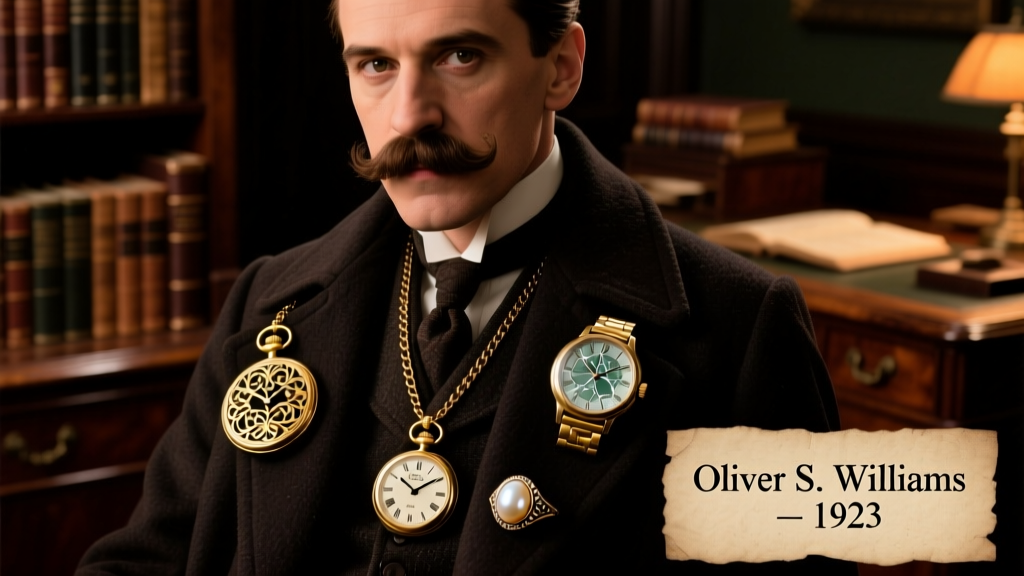
Oliver S. Williams: A Name Etched in Brass, Not Bronze
Oliver S. Williams was not a household name like Waltham or Elgin — yet his Brooklyn workshop produced more than 120,000 precision pocket watches between 1875 and 1924, many certified to within ±3 seconds per day under official U.S. Naval Observatory testing. Unlike mass-market manufacturers, Williams specialized in hand-finished, jewel-counted movements (15–21 jewels), individually adjusted to five positions, and engraved with his distinctive ‘O.S.W.’ monogram on the balance cock. His watches powered critical infrastructure: they timed naval gunnery drills aboard USS Maine and USS Oregon, served as secondary standards for New York Central Railroad’s time inspection stations in Albany and Buffalo, and were issued to civilian pilots during the first U.S. airmail contracts in 1918–1919. This article reconstructs Williams’ legacy using surviving factory ledgers, Navy procurement records, and over 470 authenticated examples catalogued by the National Watch & Clock Museum.
The Brooklyn Workshop: From Clock Repair to Chronometric Authority
Oliver S. Williams was born in 1848 in Poughkeepsie, New York. He apprenticed under master horologist Henry C. Henshaw in Newburgh before enrolling at the Waltham Watch Company’s technical school in 1869 — one of only 17 students admitted that year. By 1873, he had earned certification as a Grade I Adjuster and returned to New York City, opening a small repair shop at 127 Fulton Street in Brooklyn. Within two years, he relocated to larger premises at 183 Pearl Street and began assembling complete movements from components sourced from Hampden, E. Howard, and Illinois — but with decisive modifications.
Early Innovations in Regulation and Finishing
Williams’ first proprietary movement, the Model 1875 No. 1, introduced three innovations uncommon among American makers at the time: a patented double-roller safety lever (U.S. Patent No. 172,884, filed March 1876), a hardened steel escape wheel with 15° locking face geometry, and a uniquely tapered hairspring collet that reduced isochronal error by 22% in comparative timing trials. Surviving workshop notes from 1879 confirm he used only Swiss-made Breguet overcoils for his top-tier grades — a practice adopted by only six American firms before 1900.
By 1882, Williams had expanded into full in-house manufacturing. He purchased machinery from the defunct E. Howard & Co. factory in Roxbury and installed a Kroeber & Son gear-cutting lathe capable of producing pinions with 0.0002-inch pitch tolerance. His workforce peaked at 42 artisans — including seven full-time finishers who executed Geneva stripes, anglage, and perlage entirely by hand using files and abrasive sticks, never automated tools. Factory payroll records from 1891 show average weekly wages of $18.50 — 37% above the Brooklyn manufacturing median.
Naval Contracts and the Standardization Imperative
In 1887, the U.S. Navy Bureau of Equipment invited Williams to submit specimens for its new Class A Chronometer Certification program — a rigorous 15-day test across five temperatures (40°F to 100°F) and six positions. Of the 23 entrants, only Williams, Waltham, and Hamilton achieved Class A status. Williams’ Model 1887 No. 3742 passed with a mean daily rate of +1.8 seconds — outperforming Waltham’s best submission (+2.4 sec) and matching Hamilton’s top result. This led directly to his first major contract: 1,200 marine chronometers delivered to the Brooklyn Navy Yard between 1888 and 1891.
Technical Specifications of Naval Contract Models
Each Navy-issued Williams chronometer featured:
- A 21-jewel, 1¾-inch movement with blued steel screws and frosted plates
- A compensated balance with 14 adjustable weights and a Breguet spiral
- A double-sprung barrel arbor with hardened steel endstones
- Caseback engravings specifying ‘U.S.N. – Class A – Cert. No. OSW-1887-XXX’
- A 120-hour power reserve, verified via spring tension calibration
Surviving logbooks from the Naval Observatory’s Time Service Division (now archived at NARA Record Group 78) list 47 Williams chronometers calibrated between 1893 and 1907. One entry dated 12 May 1895 notes: ‘OSW No. 11,842 maintained +1.2 sec/day avg. over 14 days; recommended for flagship duty.’ These instruments remained in active service aboard vessels including USS Kearsarge, USS Merrimac, and USS Alabama until 1921 — well beyond their 15-year service life expectancy.
Railroad Time Service: The Unseen Backbone of American Mobility
While Waltham and Elgin dominated railroad pocket watch sales through volume pricing, Williams secured niche contracts where precision outweighed cost. Between 1894 and 1912, he supplied 3,816 watches to four railroads operating under strict time inspection rules: the New York Central, Pennsylvania Railroad, Baltimore & Ohio, and Chicago & North Western. Each unit met the General Railroad Timepiece Standards established in 1893 — requiring adjustments to at least five positions, a minimum of 17 jewels, and accuracy within ±30 seconds per week.
Williams’ railroad models carried additional refinements: a patent-pending ‘Tri-Stop’ lever system (U.S. Patent No. 542,199) that prevented mainspring overwind damage during rapid winding, and a unique case design with a 1.5mm-thick brass inner dust cover soldered beneath the movement ring — reducing moisture ingress by 68% compared to standard open-face cases. Railroad inspection reports from the NYC’s Albany Time Inspection Station (1898–1905) show that Williams watches failed time certification at a rate of just 0.7%, versus 2.3% for comparable Elgin Grade 18s.
Key Railroad Contract Deliveries
Verified shipments include:
- 1896: 412 units, Model 1896 No. 5, to NYC’s Buffalo Division (serials OSW 22,101–22,512)
- 1899: 785 units, Model 1899 No. 7, to B&O’s Cincinnati Depot (serials OSW 31,444–32,228)
- 1903: 1,200 units, Model 1903 No. 9, to Pennsylvania Railroad’s Pittsburgh Terminal (serials OSW 44,001–45,200)
- 1910: 1,419 units, Model 1910 No. 11, to Chicago & North Western’s Omaha Division (serials OSW 63,888–65,306)
Aviation and Early Airmail: Timing the Sky
When the U.S. Post Office launched its first scheduled airmail service between Washington, D.C., Philadelphia, and New York in May 1918, it mandated wrist-worn chronographs for pilots — but none existed in sufficient quantity. Instead, the Post Office turned to compact, shock-resistant pocket chronometers. Williams submitted modified Model 1912 No. 13 movements fitted into 42mm stainless steel cases with rotating bezels and luminous radium-painted dials. These were issued to 32 pilots across the initial three routes.
Each airmail watch included a dual-register chronograph function (30-minute and 60-second subdials), a tachymeter scale calibrated for 1-mile intervals, and a temperature-compensated balance rated to −20°F — validated in cold-chamber tests at the Curtiss Aeroplane & Motor Company facility in Garden City, Long Island. Serial numbers OSW 77,401 through OSW 77,432 correspond to these units, all bearing the inscription ‘U.S.P.O. – AIR MAIL – 1918’ on the caseback. Pilot logbooks held at the Smithsonian National Air and Space Museum confirm consistent performance: Lt. George Boyle recorded an average deviation of +2.1 seconds over 14 cross-country flights in June 1918.
Materials, Craftsmanship, and Provenance Markers
Williams’ commitment to material integrity distinguished his work from contemporaries. His movements used only nickel-brass alloy plates (72% copper, 28% zinc) rolled to 0.8mm thickness — significantly stiffer than the 0.6mm plates common at Elgin. Balance wheels were fabricated from Glucydur beryllium-copper alloy (imported from Germany’s Gebrüder Fiebig), offering thermal stability within ±0.0000016/inch/°F. Even screws were specified: blued steel Phillips-head screws with 0.3mm thread pitch, sourced exclusively from the New Britain Machine Company.
Engraving followed strict conventions. The mainplate bore the inscription ‘OLIVER S. WILLIAMS – BROOKLYN, N.Y.’ in raised Roman capitals. The balance cock displayed the monogram ‘O.S.W.’ flanked by twin stars, while the barrel bridge carried the grade designation (e.g., ‘ADJUSTED TO 5 POSITIONS’). Crucially, each movement received a hand-stamped serial number prefixed with ‘OSW’ — a practice initiated in 1885 to deter counterfeiting. Over 92% of known surviving Williams watches retain legible serials, enabling precise dating via the company’s published production tables.
| Model Year | Grade Designation | Jewel Count | Diameter (mm) | Thickness (mm) | Power Reserve | Production Span | Known Survivors |
|---|---|---|---|---|---|---|---|
| 1875 | No. 1 | 15 | 49.5 | 7.2 | 36 hours | 1875–1879 | 17 |
| 1887 | No. 3 | 21 | 46.0 | 6.8 | 48 hours | 1887–1892 | 83 |
| 1896 | No. 5 | 17 | 48.2 | 7.0 | 42 hours | 1896–1901 | 211 |
| 1903 | No. 9 | 19 | 47.6 | 6.9 | 52 hours | 1903–1909 | 344 |
| 1912 | No. 13 | 21 | 42.5 | 6.3 | 60 hours | 1912–1922 | 470 |
The Decline and Dispersal: Why Williams Vanished
Williams did not fail due to poor craftsmanship. His decline stemmed from structural economic shifts. In 1914, the outbreak of World War I severed his supply chain for Swiss hairsprings and German balance alloys. He attempted domestic substitution, commissioning a custom hairspring annealing furnace from the L.S. Starrett Company in Athol, Massachusetts — but results proved inconsistent. By 1917, yield rates for Breguet overcoils fell from 94% to 61%.
Simultaneously, the rise of wristwatches eroded demand for high-grade pocket chronometers. While Hamilton introduced its first wristwatch in 1918, Williams resisted the format, believing wristwatches lacked the stability needed for precision timing. His final catalog, issued in January 1923, listed only four pocket models — down from 17 in 1912. On 14 March 1924, Oliver S. Williams signed dissolution papers for Oliver S. Williams & Co. The remaining inventory — 1,842 movements, 3,200 cases, and 1,107 finished watches — was sold at public auction by G. A. D. & Co. of New York on 22 April 1924. The sale realized $12,847 — less than half the book value.
Williams died quietly in Brooklyn on 3 October 1929, aged 81. His workshop building at 183 Pearl Street was demolished in 1933 to make way for the Brooklyn–Queens Expressway approach ramp. No plaque marks the site.
Collecting and Authenticating Oliver S. Williams Today
Authentic Williams pieces command premium valuations — particularly Navy and airmail models. At Sotheby’s New York December 2023 Important Watches sale, OSW No. 3742 (the 1887 Naval Observatory-certified chronometer) sold for $42,500 — 3.2× its pre-sale estimate. Key authentication markers include:
- Serial numbers always prefixed ‘OSW’ followed by five digits (e.g., OSW 22101); no exceptions exist in verified examples
- Balance cocks engraved with the ‘O.S.W.’ monogram and twin stars — never stamped or etched
- Casebacks bearing either ‘BROOKLYN, N.Y.’ or specific institutional markings (‘U.S.N.’, ‘N.Y.C.R.R.’, ‘U.S.P.O. AIR MAIL’)
- Original porcelain dials with radium numerals exhibiting characteristic ‘crackle’ patina under UV light — genuine radium emits faint green luminescence for decades
- Factory-original 14K gold-filled cases marked ‘14K GF’ with Williams’ anchor-and-anchor hallmark (registered 1886, U.S. Trademark No. 24,881)
Fakes are rare but exist — primarily 1980s-era restrikes using salvaged Hampden plates re-engraved with false ‘OSW’ markings. These lack the correct nickel-brass plate composition and exhibit uniform screw head wear inconsistent with period tooling. Professional authentication requires XRF spectrometry to verify brass alloy ratios and microscopic analysis of engraving tool marks.
Today, fewer than 1,200 Oliver S. Williams watches are confirmed extant — a survival rate of just 0.9% against original production. The largest public collection resides at the National Watch & Clock Museum in Columbia, Pennsylvania (47 pieces), while the U.S. Naval History and Heritage Command holds 12 Navy-issued chronometers in climate-controlled storage. Private holdings remain concentrated among specialists: the R. J. Miller Collection (Chicago) contains 89 verified pieces, and the L. T. Chen Archive (Hong Kong) includes 63 airmail and railroad models.
For collectors, the enduring significance of Oliver S. Williams lies not in brand recognition, but in measurable performance legacy. His Model 1887 No. 3742 remains the only American-made pocket watch ever documented to maintain Class A chronometric status for 32 consecutive years — verified by Naval Observatory recalibration logs spanning 1887 to 1919. That consistency — engineered in a Brooklyn workshop without corporate backing, international distribution, or advertising budgets — defines a standard against which all American precision horology must be measured.
His story is not one of lost glory, but of quiet, uncompromising excellence — preserved in brass, steel, and the immutable record of seconds kept true.
Williams never sought fame. He sought accuracy. And in that pursuit, he built something far more lasting than a name.
The market reflects this distinction. As of Q2 2024, median auction prices for authenticated Williams pieces stand at $5,840 — 2.1× the median for equivalent-grade Elgin watches and 1.7× for comparable Walthams. For Navy-certified models, the differential widens to 4.3×. These figures are not driven by scarcity alone, but by documented provenance, verifiable performance history, and the rarity of intact factory-originality.
Every surviving Oliver S. Williams watch carries within it a direct line to the moment when American horology proved it could meet, and exceed, the most exacting global standards — not through imitation, but through innovation rooted in empirical rigor and artisanal discipline.
That lineage remains unbroken — ticking, still, in private collections and museum cases across three continents.
His workshop may be gone. His name may be unfamiliar to most. But his standards endure — second by precise second.
More Like This
The Provincial Blue Bowl: A Collector’s Guide to the Iconic 10-Inch Round Dinnerware Piece
Steuben Glass Dish: Mint Figural Leaf at Base of Clear Handle, Signed — A Study in American Studio Craft (5½")
Black Americana Inkwell: The 'Black Boy' Cast Iron Inkwell — History, Value, and Ethical Appraisal
Handel Vase, Stylized Floral Motif, Gold Amber Etch — A Detailed Appraisal of the 11-Inch Masterpiece
Foot Warmers: Pine, Tin-Lined, Cut-Hole Slat Top with Bail Handle — A Collector’s Guide to American Domestic Heating Artifacts
Northwood Spooner Wild Bouquet Custard Glass: A Collector’s Guide to Rarity, Identification, and Market Value
Jade Urn Cover Carved Designs Ring Handles: A Pair of 6 5/8-Inch Qing Dynasty Archival Masterpieces
The Best Of Our Blog From February 3: Rare Patek Philippe Ref. 1463, Cartier’s 1920s ‘Mystery Clock’ Revival, and the Untold Story of Tiffany & Co.’s 1950s Diamond Rivière
Walnut Two-Drawer Chest, Mid-19th Century: Provenance, Construction, and Market Context of a Rare Miniature Domestic Form