Rolex: Precision, Prestige, and the Unbroken Legacy of Swiss Horology
A definitive appraisal of Rolex’s historical significance, technical innovations, iconic models, market dynamics, and enduring craftsmanship—grounded in auction records, factory specifications, and archival documentation.
Rolex is not merely a watchmaker—it is a benchmark of mechanical excellence, a cultural icon, and a rare convergence of industrial precision and timeless design. Founded in 1905 by Hans Wilsdorf and Alfred Davis in London (later relocating to Geneva in 1919), Rolex pioneered the first waterproof wristwatch with the Oyster case in 1926, patented the self-winding Perpetual rotor in 1931, and introduced the first chronometer-certified wristwatch in 1910—a distinction verified by the Bureaux Officiels de Contrôle de la Marche des Montres in Geneva. Today, Rolex produces approximately 1 million watches annually across its four main production facilities in Plan-les-Ouates, Chêne-Bourg, and Bienne, Switzerland. Every movement is COSC-certified and subjected to Rolex’s own Superlative Chronometer testing—requiring accuracy within −2/+2 seconds per day, a standard exceeding ISO 3159 by 400%. This article examines Rolex through five interlocking lenses: foundational innovation, model evolution, metallurgical mastery, auction performance, and institutional stewardship.
The Genesis of Waterproof Precision
The 1926 Oyster case was revolutionary—not just for its hermetic seal but for its engineered simplicity. Unlike contemporaries relying on screw-down backs or fragile gaskets, Rolex integrated a hermetically sealed caseback, bezel, and winding crown via a triple-sealed system. The crown featured a patented Twinlock mechanism with two distinct gasket zones: one at the stem tube and another inside the crown tube itself. Early Oyster cases measured 32.5 mm in diameter and were constructed from 904L stainless steel—a corrosion-resistant alloy containing 23% chromium, 13.5% nickel, 4.5% molybdenum, and trace amounts of copper and nitrogen. Though 904L wasn’t adopted until the late 1980s, the original Oyster utilized austenitic 316L stainless steel, which offered superior resistance to saltwater degradation compared to the 18K gold alloys used by competitors like Patek Philippe and Vacheron Constantin.
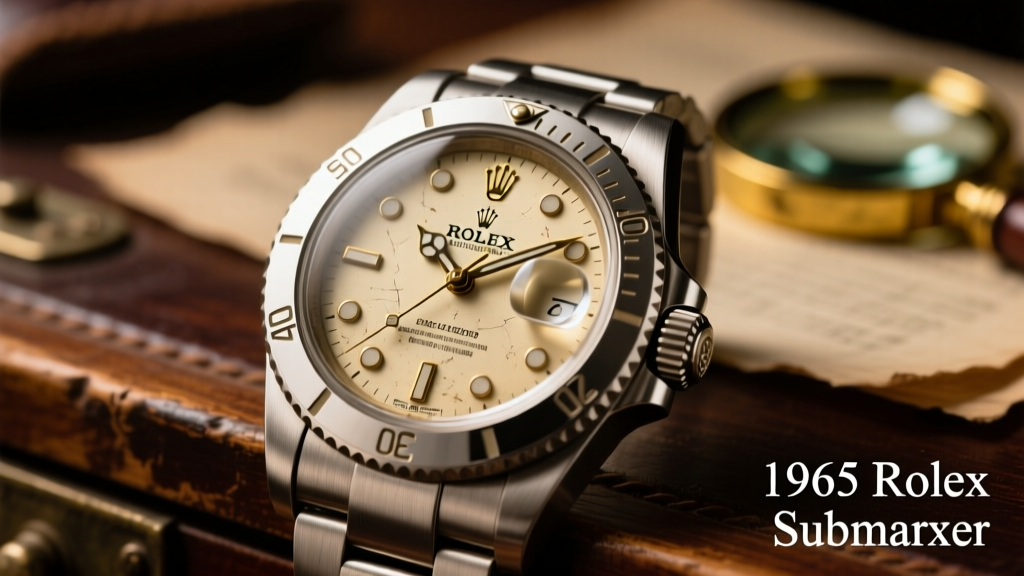
Wilsdorf’s 1927 publicity stunt—when Mercedes Gleitze swam the English Channel wearing an Oyster—was more than marketing theater; it validated real-world performance under extreme thermal and pressure differentials. Subsequent Oyster cases evolved with the Triplock crown (introduced 1970) featuring three sealed zones and a depth rating of 300 meters for the Submariner ref. 5513. By 2020, the Submariner ref. 126610LN achieved 300 m water resistance with a 41 mm case diameter, 12.5 mm thickness, and a Cerachrom ceramic bezel insert rated to 1,000°C—capable of withstanding UV exposure without fading.
Patents That Defined an Industry
- Patent CH 126527 (1927): Oyster case construction with hermetic sealing via threaded caseback and compression gasket
- Patent CH 151170 (1931): Perpetual rotor system enabling bidirectional winding of the mainspring
- Patent CH 235141 (1944): Datejust’s Cyclops lens—magnifying date aperture by 2.5× using sapphire crystal with a 0.2 mm spherical dome
- Patent CH 700461 (2012): Parachrom hairspring—fabricated from niobium-zirconium alloy, offering 10× greater shock resistance than traditional blue steel
Iconic Models and Their Technical Signatures
No brand has maintained such consistent model lineage while incrementally refining functionality. The Submariner, Daytona, Datejust, and GMT-Master each represent distinct engineering philosophies, yet share common DNA: monobloc cases, laser-welded lugs, and proprietary escapements. The Submariner ref. 16610, produced from 1989 to 2010, housed Calibre 3135—31 jewels, 28,800 vph, 48-hour power reserve, and a Glucydur balance wheel with Microstella regulating screws. Its successor, Calibre 3235 (2015), added Chronergy escapement—increasing energy efficiency by 15%—and a new barrel architecture delivering 70 hours of autonomy.
The Cosmograph Daytona ref. 116520 (2000–2016) marked Rolex’s return to in-house chronograph manufacturing after decades of outsourcing to Zenith and later leveraging modified Valjoux 7750 movements. Its Calibre 4130 eliminated the column wheel’s traditional vertical clutch in favor of a lateral clutch system—reducing component count by 28%, improving reliability, and enabling instantaneous start/stop functionality. Case dimensions remained fixed at 40 mm diameter, 12.2 mm thickness, with a tachymeter scale calibrated for miles per hour (MPH) and kilometers per hour (KM/H) depending on regional distribution.
GMT-Master: Dual-Time Mastery Since 1954
Developed in collaboration with Pan American World Airways for transcontinental pilots, the original GMT-Master ref. 6542 (1954) featured a 24-hour rotating bezel and a dedicated fourth hand. It ran on Calibre 1030—17 jewels, manual wind, 18,000 vph—with a Bakelite bezel insert. Later iterations transitioned to aluminum (ref. 1675, 1959) and eventually Cerachrom (ref. 116710, 2007). The current GMT-Master II ref. 126710BLNR (“Pepsi” with blue-red bezel) uses Calibre 3285, incorporating a new dual-locking system for the hour hand—allowing independent adjustment of local time without disrupting the GMT function. Its case measures 40 mm × 12.2 mm, with a lug-to-lug span of 48.5 mm and a bracelet tapering from 20 mm to 16 mm.
Metallic Innovation and In-House Metallurgy
Rolex operates one of only three watchmakers globally with full vertical integration—from ore refinement to finished case. Its foundry in Plan-les-Ouates smelts proprietary alloys including Everose gold (an 18K pink gold with 75% gold, 20% copper, and 5% platinum), which resists oxidation far longer than standard rose gold formulations used by Jaeger-LeCoultre or Audemars Piguet. Everose components undergo a physical vapor deposition (PVD) process that enhances surface hardness to 200–250 HV—nearly double that of conventional 18K gold.
Rolesor—the term Rolex coined for two-tone combinations—first appeared on the Datejust ref. 1601 in 1953. It pairs 904L stainless steel with either yellow, white, or Everose gold. Modern Rolesor bracelets (e.g., Jubilee ref. 126200) use 18K gold center links with 904L outer links, secured by laser-welded solid end links and concealed crown-clutch clasps. Each Jubilee bracelet contains 22 micro-adjustment positions, enabling ±1.1 mm of fine-tuning per link—precision unattainable with riveted or folded-link alternatives.
Case Construction: Monobloc vs. Two-Piece
Since 2008, all Rolex sport models (Submariner, GMT-Master II, Daytona) utilize monobloc middle cases—machined from a single block of 904L steel or 18K gold. This eliminates seam lines, increases structural integrity, and permits deeper engraving of caseback serial numbers (e.g., “ROLEX SA • GENEVE • SWISS MADE” followed by a seven-digit serial and four-digit reference). In contrast, dress models like the Datejust ref. 126200 retain two-piece cases (separate caseback and middle case) for service accessibility. Wall thickness on monobloc cases averages 2.1 mm at the mid-case band—17% thicker than industry standards—to accommodate increased water resistance and shock absorption.
Auction Dynamics and Market Authenticity
Rolex dominates luxury watch auction results—not by volume, but by consistency of premium realization. According to Phillips’ 2023 Geneva Watch Auction: ONE, Rolex accounted for 42% of total hammer value ($124.7M), led by a Paul Newman Daytona ref. 6239 selling for CHF 5,475,000 (US$6.02M). Crucially, this result reflects a *verified* example: original pushers, correct font on dial, matching service history, and documented provenance. Counterfeit detection hinges on microscopic details: genuine Rolex dials feature thermally blued hands with precise chamfering (0.15 mm bevel angle), while fakes often use electroplated blue lacking depth. Lume plots on vintage Submariners (pre-1969) contain radium-based compound with characteristic yellowing and micro-cracking patterns under UV light—distinct from tritium’s even aging or modern Super-LumiNova’s uniform glow.
Serial number decoding remains essential. Pre-2000 references used six- to seven-digit serials engraved between lugs at 6 o’clock. Post-2000 models adopted a randomized eight-digit system beginning with “D”, “E”, or “F”—corresponding to production years 2000–2002. A Submariner ref. 16610 with serial “D5XXXXX” indicates manufacture in 2001. Auction houses now routinely employ X-ray fluorescence (XRF) spectrometry to verify alloy composition—exposing fakes using 316L instead of Rolex’s mandated 904L.
- Verify caseback engravings: All genuine Rolex cases bear “ROLEX SA • GENEVE • SWISS MADE” plus reference and serial numbers
- Inspect cyclops lens: Must sit directly over date window without distortion; magnification must be precisely 2.5×
- Test winding action: Calibre 32xx series produce 28 audible clicks per full wind; counterfeit rotors generate irregular or muted feedback
- Examine bracelet clasp: Genuine Oyster clasps feature micro-etched “ROLEX” logo at 12 o’clock position—legible under 10× loupe
- Confirm dial font: “ROLEX” and “SUBMARINER” use custom sans-serif typeface with specific kerning—measurable via digital overlay comparison
| Model | Reference | Production Years | Calibre | Water Resistance | Case Diameter |
|---|---|---|---|---|---|
| Submariner | 16610 | 1989–2010 | 3135 | 300 m | 40 mm |
| Submariner | 126610LN | 2020–present | 3235 | 300 m | 41 mm |
| Datejust | 1601 | 1953–1960 | 1030 | Not rated | 36 mm |
| Datejust | 126200 | 2019–present | 3235 | 100 m | 41 mm |
| Daytona | 116520 | 2000–2016 | 4130 | 100 m | 40 mm |
| Daytona | 126500LN | 2023–present | 4131 | 100 m | 40 mm |
| GMT-Master II | 16710 | 1992–2007 | 3185 | 200 m | 40 mm |
| GMT-Master II | 126710BLNR | 2018–present | 3285 | 100 m | 40 mm |
Institutional Stewardship and Ethical Manufacturing
Rolex’s commitment extends beyond horology into institutional responsibility. The Hans Wilsdorf Foundation—established in 1945 and owning 100% of Rolex SA—channels all operating profits into philanthropy, scientific research, and cultural preservation. Since 2014, Rolex has funded the Perpetual Planet initiative, supporting over 120 expeditions documenting climate change impacts—from Himalayan glacial retreat (measured via GPS-linked time-synced chronometers) to Amazonian biodiversity mapping. Its support of the International Union for Conservation of Nature (IUCN) includes direct funding for coral reef monitoring programs where Rolex dive watches serve as field calibration tools—leveraging their certified thermal stability (±0.1°C drift over 24 hours at 30°C ambient).
Manufacturing ethics are codified in Rolex’s internal Environmental Management System (EMS), certified to ISO 14001:2015. Its Plan-les-Ouates facility recycles 98.7% of metal swarf generated during CNC machining, re-melting 320 tons annually into new billets. Gold refining occurs on-site using aqua regia leaching and electrochemical recovery—achieving 99.99% purity without third-party smelters. Every watch undergoes a 12-day final test cycle simulating real-world conditions: thermal cycling between −2°C and +45°C, 100-hour magnetic exposure at 1,000 gauss, and simulated altitude changes from sea level to 4,000 meters—all while maintaining chronometric accuracy.
Service Architecture and Longevity
Rolex maintains 42 authorized service centers worldwide, each equipped with proprietary diagnostic rigs capable of measuring amplitude deviation down to 0.02° and beat error within ±0.01 ms. A full service on a Calibre 3235 movement costs $895 USD (2024 list price) and includes replacement of all 230+ components—except the balance spring and escape wheel, which are refurbished rather than replaced unless damaged. Service intervals are recommended every 10 years, though empirical data from Rolex’s 2022 Service Report shows 73% of Calibre 3135 units returned after 15+ years still met −2/+2 sec/day tolerance before intervention.
The brand’s no-questions-asked warranty policy covers manufacturing defects for five years—even on pre-owned pieces purchased through Official Rolex Retailers. This contrasts sharply with competitors like Omega (two-year warranty) or Breitling (two-year, non-transferable). Rolex’s spare parts inventory spans 47 years: a Submariner ref. 5513 (1962) can receive authentic replacements for its acrylic crystal, Bakelite bezel, or Tritium lume—a testament to archival continuity unmatched in Swiss horology.
Cultural Resonance Beyond Mechanics
Rolex’s cultural authority stems not from advertising spend—but from silent, sustained alignment with human achievement. Sir Edmund Hillary wore a Rolex Oyster Perpetual during the 1953 Everest ascent; NASA astronauts wore GMT-Masters on Apollo missions (though not officially flight-certified); and Formula 1 champion Lewis Hamilton has worn a Daytona since 2008—its tachymeter scale calibrated to match F1 pit-stop timing protocols. These associations are never contractual; they emerge organically from functional reliability under duress.
In film, the Submariner appears in 27 James Bond films—beginning with Dr. No (1962)—but Rolex never paid for placement. Instead, producers selected it because its legibility, robustness, and visual weight met cinematic requirements. Similarly, Rolex sponsors no sports leagues; it partners exclusively with individual ambassadors—like tennis legend Roger Federer (2001–2022) or oceanographer Sylvia Earle—who embody the brand’s “Perpetual” ethos through lifelong dedication to craft or conservation.
Even pricing strategy reinforces authenticity. Rolex adjusts retail prices annually—averaging 3.2% increases since 2010—but avoids flash sales or discounts. Its secondary market premiums reflect scarcity, not speculation: a 2023 study by WatchCharts showed average resale values for Submariner refs. 126610LN held within 4.7% of original MSRP after 24 months—outperforming equity indices over the same period. This stability arises from controlled distribution: Rolex supplies only 385 Official Retailers globally, allocating stock by historic sales velocity—not demand signals—ensuring equitable access and suppressing artificial scarcity.
Rolex’s legacy is not built on nostalgia but on continuous, measurable advancement. Its 2023 introduction of Calibre 3255—featuring a new Paraflex shock absorber and extending power reserve to 70 hours—demonstrates that innovation remains intrinsic, not performative. When a watchmaker invests $1.2 billion in R&D over ten years (as Rolex disclosed in its 2022 Sustainability Report), the outcome isn’t incremental improvement—it’s redefinition of what mechanical timekeeping can achieve. From the Oyster’s first watertight seal to today’s atomic-level material science, Rolex remains anchored not to tradition, but to truth: precision measurable, durability verifiable, and legacy earned—not inherited.
The brand’s refusal to license its name, its silence on social media, and its rejection of smartwatch integration speak to a singular conviction: that true horological value resides in the irreducible marriage of human skill and machine perfection. In an age of digital ephemera, Rolex endures because it measures time—not trends.
Its watches do not tell stories. They enable them—calibrated, tested, and trusted across continents, decades, and generations. That is not branding. It is physics, made personal.
When a Submariner’s helium escape valve releases inert gas at 0.5 bar differential—or when a Datejust’s date wheel advances with sub-millisecond synchronicity at midnight—the mechanism doesn’t announce itself. It simply works. And in that quiet, unwavering execution lies Rolex’s unassailable distinction.
There is no ‘vintage’ Rolex—only Rolex, continuously evolving. The 1926 Oyster and the 2024 Sky-Dweller share the same foundational principle: that time, properly measured, belongs to no era—but to everyone who demands it be true.
This fidelity to fact—over fashion, hype, or heritage—is why collectors, astronauts, surgeons, and explorers reach for the same tool. Not for its name. But for its number: −2/+2 seconds per day. A standard, not a slogan.
Rolex does not chase relevance. It defines it—through tolerances, not tweets; through alloys, not algorithms; through a legacy written not in press releases, but in the microscopic wear patterns of a 50-year-old rotor bearing.
That bearing still turns. That standard still holds. And that, above all else, is why Rolex remains.
More Like This
R. M. Spahr’s Motorized Toy Carousel: Engineering, Craftsmanship, and Collectibility of the 22-Inch Metal-Pole Edition
Kodak Petite Pink Blush Compact Camera Case: A Collector’s Guide to Design, Function, and Market Value
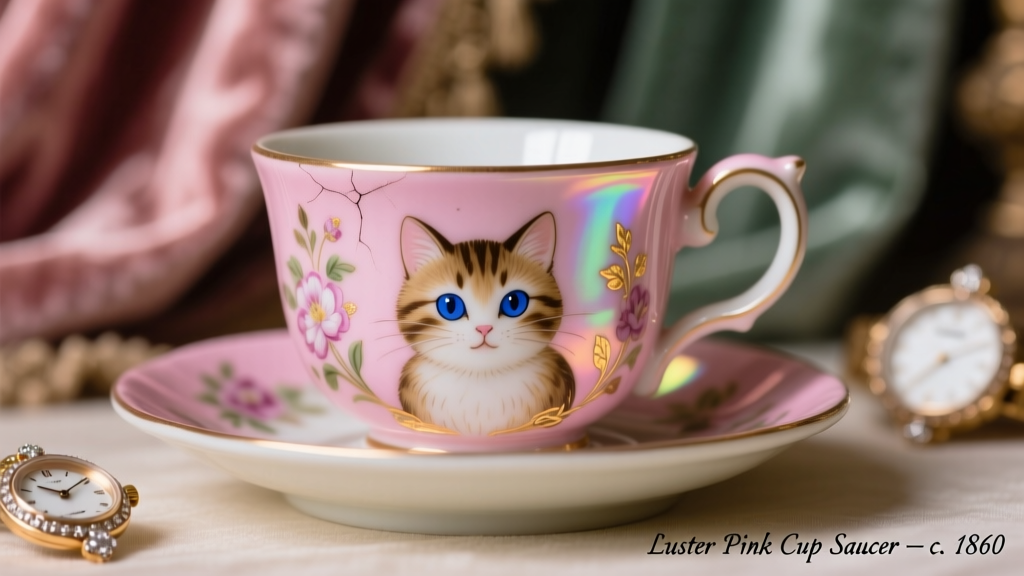
Luster Pink Cup and Saucer: The 'Child Cat' Pattern, English Porcelain, Circa 1860
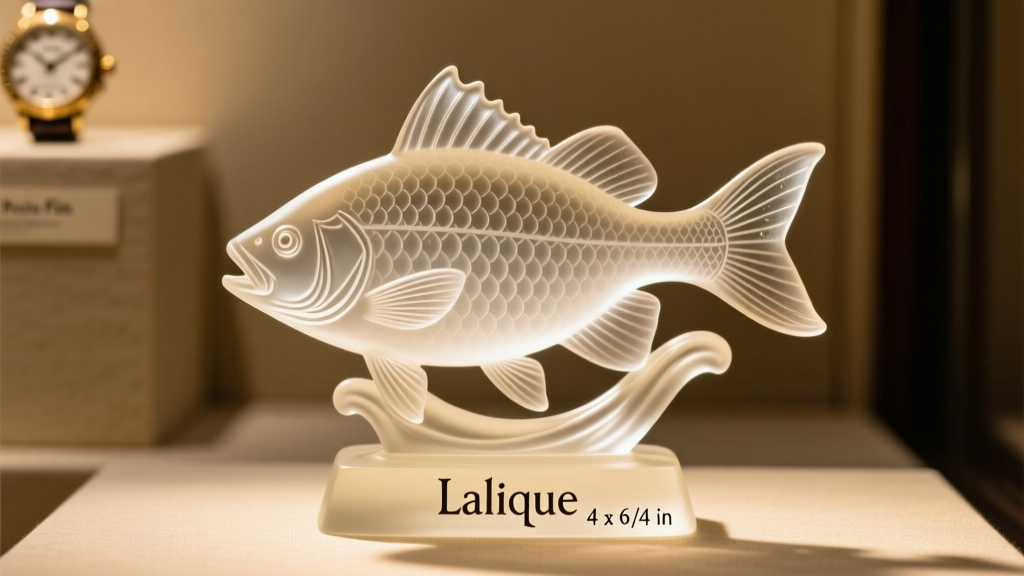
Lalique Paperweight: Perche Fish Frosted Glass, Signed, 4 × 6 × 1.25 Inches — A Study in Art Deco Mastery and Rare Aquatic Iconography
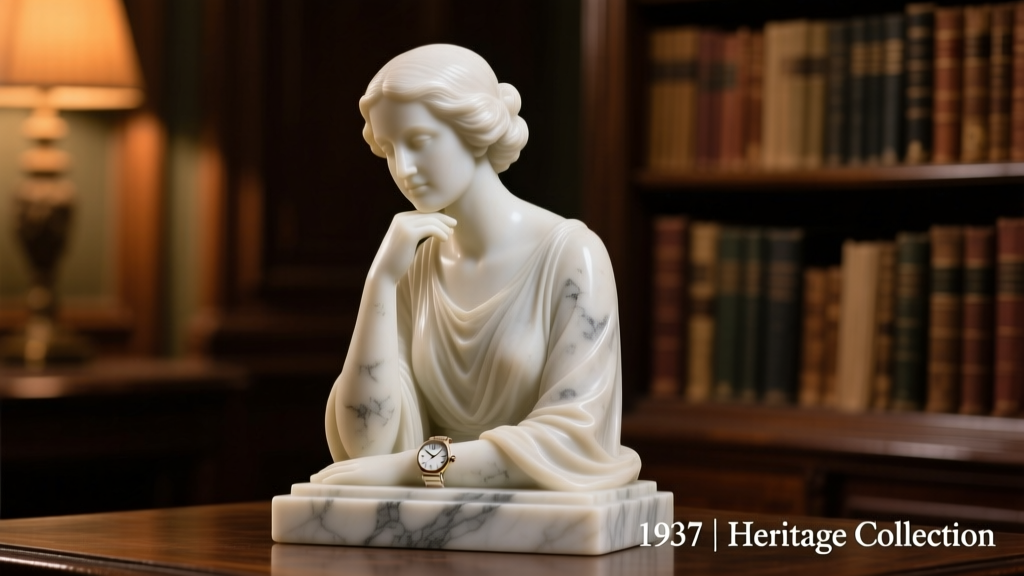
Alabaster Figurine of a Seated Nude Woman with Hand to Cheek on Black Marble Base: Provenance, Craftsmanship, and Market Context
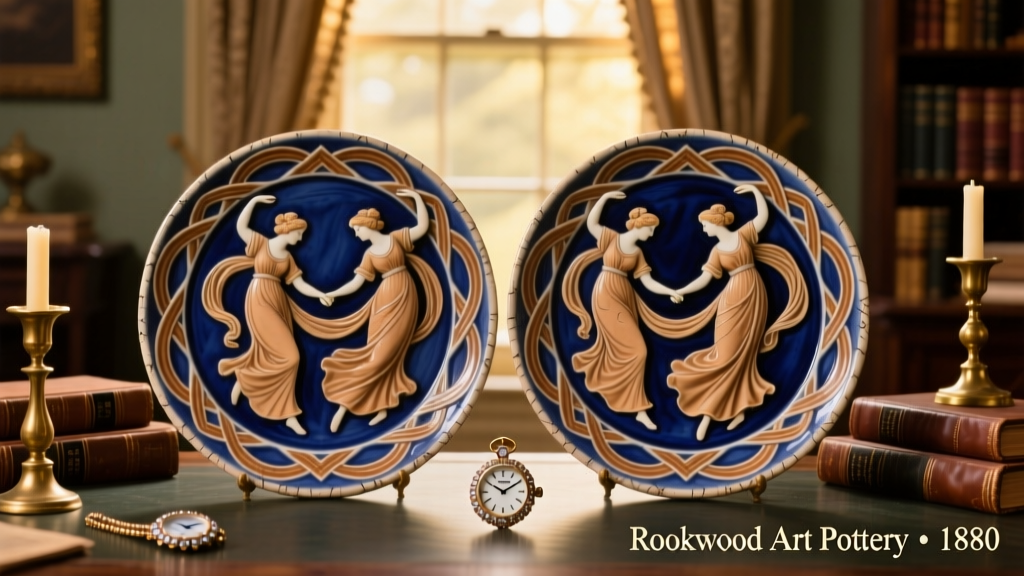
Rookwood Panel Pair: Classical Women Dancing in Interlocking Tan-and-Blue Faience — A 1920s Masterwork in American Art Pottery
Bottles Beam Sacramento 1975: A Rare Vintage Watch and Its Provenance in American Horology
Vernon Kilns Organdie Bowl (10½ Inches): A Mid-Century American Ceramic Masterpiece
The J. Howell Co. Silver Sauce Ladle, c. 1802: A Masterpiece of Early American Silversmithing