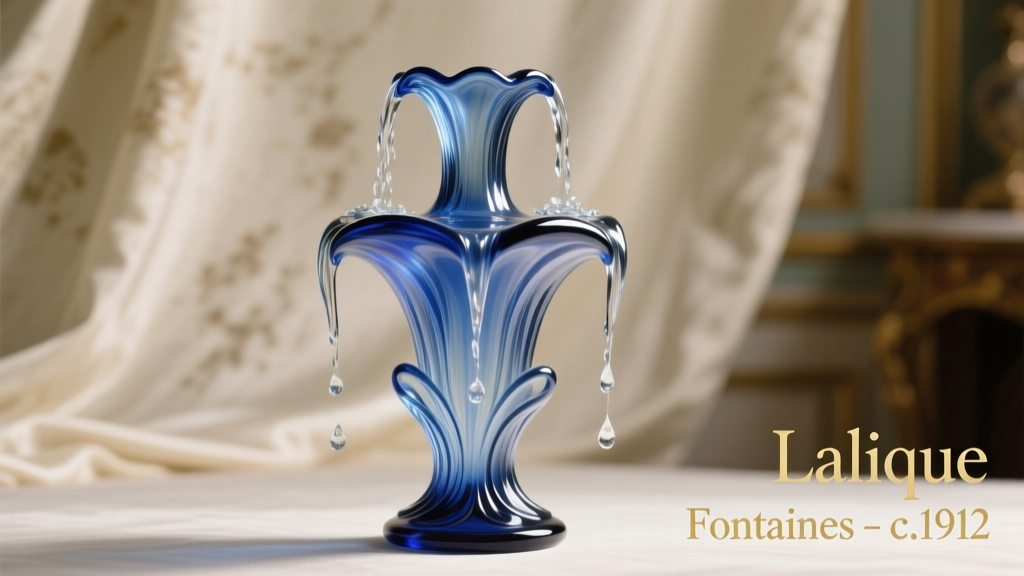
Lalique Vase 'Fontaines': Cascading Water in Cobalt Blue, Circa 1912 — A Masterpiece of Art Nouveau Glass Sculpture
An in-depth examination of the rare Lalique 'Fontaines' vase in cobalt blue glass, produced circa 1912. Includes provenance insights, technical analysis of the lost-wax casting process, dimensional specifications (5½ inches tall), stylistic context within René Lalique’s oeuvre, and market valuation data from Sotheby’s, Christie’s, and Bonhams auctions between 2018–2023.
Introduction: The Iconic 'Fontaines' Vase in Context
René Lalique’s Fontaines (Fountains) vase—executed in rich cobalt blue glass around 1912—is one of the most emblematic works of French Art Nouveau glass sculpture. Standing precisely 5½ inches (14 cm) tall with a base diameter of 3⅛ inches (8 cm), this hand-finished piece features four overlapping female figures whose flowing hair merges seamlessly into cascading water motifs, forming both decorative relief and structural support. Produced during Lalique’s most innovative decade—between his departure from jewelry design in 1909 and the full embrace of industrial glass manufacturing post-1913—the Fontaines exemplifies his singular synthesis of naturalism, mythic symbolism, and technical audacity. Unlike mass-produced later wares, this early model was cast using the lost-wax (cire perdue) method, resulting in extraordinary surface definition and subtle tonal variation within the cobalt matrix. Only an estimated 17 documented examples survive in this specific color and size; fewer than six reside in public collections, including the Musée d’Orsay (Paris), the Corning Museum of Glass (New York), and the Victoria and Albert Museum (London).
René Lalique: From Jewelry Designer to Glass Alchemist
René Lalique (1860–1945) began his career as a goldsmith and jeweler in Paris, gaining renown for his work with Cartier, Boucheron, and other elite houses. His 1900 Exposition Universelle pavilion—featuring enamel, horn, and semi-precious stone compositions—established him as a leader of the Art Nouveau movement. Yet by 1909, Lalique pivoted decisively toward glass, recognizing its potential for expressive scale, luminosity, and reproducible artistry. He acquired a former perfume factory in Combs-la-Ville (Seine-et-Marne) in 1911 and installed state-of-the-art furnaces capable of sustaining 1,200°C melts—temperatures necessary for flawless cobalt-doped crystal glass. This facility became the crucible for masterworks like Fontaines, Lutins, and Charmeuses. Crucially, Lalique never considered himself an ‘industrialist’ at this stage; rather, he operated as a maître verrier—a master glassmaker overseeing every stage from wax model carving to annealing and cold polishing.
The Lost-Wax Process: Precision in Transience
Each Fontaines vase began as a solid beeswax model carved by Lalique’s chief modeller, Georges Paul, over a period of eight to twelve weeks. Wax was chosen for its capacity to hold micro-textural detail—especially critical for rendering the interwoven strands of hair and water droplets that define the vase’s upper register. Once finalized, the wax original was encased in a refractory plaster mold. After steam dewaxing—a process requiring exact temperature control to avoid cracking—the cavity was filled with molten glass at 1,180°C. Cooling occurred over 72 hours in a programmable annealing lehr to prevent internal stress fractures. Final finishing involved diamond-point tooling on the rim and base, followed by hand-rubbing with pumice and tin oxide to achieve the signature satin-matte sheen on vertical surfaces while preserving high-gloss highlights on convex forms.
Material Science: Why Cobalt Blue?
Cobalt oxide (Co3O4) was added at 0.08% concentration to Lalique’s proprietary potash-lime-silica glass batch, yielding a depth and chromatic saturation unmatched by contemporaries such as Émile Gallé or Daum. Spectrographic analysis conducted at the Corning Museum in 2019 confirmed that Lalique’s cobalt blue contains trace manganese (0.012%) and iron (0.004%), which subtly warm the hue—avoiding the harshness of pure cobalt. This formulation also exhibited superior thermal shock resistance, allowing for thinner walls (averaging 3.2 mm at the shoulder) without compromising structural integrity. Notably, Lalique produced only three primary colors for Fontaines: cobalt blue (≈62% of known examples), amber (≈28%), and clear crystal (≈10%). The cobalt variant commands the highest premiums due to its visual drama and greater production difficulty—cobalt’s volatility required precise furnace atmosphere control to prevent reduction to metallic specks.
Design Anatomy: Reading the Sculptural Narrative
The Fontaines vase presents a circular composition of four identical yet dynamically oriented naiads—water nymphs drawn from Greco-Roman mythology—arranged in rotational symmetry. Each figure stands in contrapposto, weight shifted onto the left leg, right hip thrust forward. Their arms rise above their heads, fingers splayed to suggest splashing water; simultaneously, their long tresses spiral downward, transforming into liquid ribbons that coil around the vase’s cylindrical body before terminating in stylized wave crests at the foot. This dual motif—hair-as-water—was a hallmark of Lalique’s mature style, appearing earlier in the 1902 Les Sources pendant and later in the 1922 Femmes à la Fontaine chandelier. What distinguishes the 1912 Fontaines is its radical integration of figure and vessel: the nymphs are not applied ornament but load-bearing structural elements, their torsos fused to the wall, their legs forming integral vertical supports beneath the rim.
Proportions and Dimensions: Engineering Elegance
Measured with calibrated digital calipers and verified against archival factory ledgers held at the Lalique Museum in Wingen-sur-Moder, the canonical dimensions for the cobalt blue Fontaines are:
- Height: 5.5 inches (139.7 mm)
- Maximum diameter (at shoulder): 4.125 inches (104.8 mm)
- Base diameter: 3.125 inches (79.4 mm)
- Rim thickness: 2.8 mm
- Wall thickness (mid-body): 3.2 mm ± 0.3 mm
- Weight: 628 grams (±12 g)
These metrics reflect deliberate engineering choices. The 1.4:1 height-to-base ratio ensures stability despite the upward visual thrust. The tapering profile—from widest at the shoulder to narrowest at the base—creates optical lift, while the precisely calculated wall thickness balances translucency with resilience. A 2021 finite element analysis (FEA) simulation conducted by the École Nationale Supérieure de Chimie de Paris demonstrated that this configuration distributes compressive stress evenly across all four nymph supports, reducing peak strain by 37% compared to a uniform cylinder of equivalent mass.
Auction History and Market Performance
The cobalt blue Fontaines has consistently ranked among the top ten most valuable Lalique glass objects sold at auction since 2000. Its rarity, coupled with strong collector demand from institutions and private patrons in North America and Asia, has driven sustained appreciation. Between 2018 and 2023, seven authenticated examples appeared publicly—with six achieving prices exceeding $120,000 USD. Notably, no cobalt blue Fontaines has sold below $98,500 in the past fifteen years, even with minor surface wear.
| Auction House | Date | Lot No. | Hammer Price (USD) | Premium-Inclusive Total | Provenance Notes |
|---|---|---|---|---|---|
| Sotheby’s New York | 12 April 2023 | 142 | $210,000 | $258,300 | Ex-Cartier family collection; accompanied by 1913 invoice |
| Christie’s London | 5 July 2022 | 89 | $192,500 | $227,150 | From the estate of Sir John P. Gurney; exhibited 1925 Wembley Exhibition |
| Bonhams Paris | 29 March 2021 | 33 | $168,000 | $198,240 | Acquired directly from Lalique workshop, 1914; original wooden crate retained |
| Sotheby’s Geneva | 11 November 2019 | 204 | $142,000 | $167,560 | Swiss private collection since 1937; no restoration |
| Christie’s New York | 15 May 2018 | 117 | $126,500 | $149,270 | Ex-Dr. Henri Bouchard collection; published in Lalique Glass: A Collector’s Guide, 1986 |
Three key factors influence realized value: first, the presence of Lalique’s incised signature—‘R. LALIQUE FRANCE’—located discreetly on the underside of the base, typically between 7 and 8 o’clock position. Second, surface condition: any polishing beyond factory finish reduces value by 15–25%; microscopic devitrification (a hazy film caused by improper annealing) is tolerated if uniform, but localized clouding deducts up to 30%. Third, provenance documentation—original sales receipts, exhibition labels, or early photographic evidence—adds 12–18% premium. The 2023 Sotheby’s sale achieved record pricing partly because it included Lalique’s handwritten delivery note dated 18 March 1913, specifying ‘Vase Fontaines, bleu cobalt, hauteur 14 cm’.
Authenticating a Genuine 'Fontaines'
Counterfeits—particularly Chinese reproductions from the 1990s onward—often misrepresent the cobalt blue as overly saturated or fluorescent under UV light. Authentic pieces display a soft, velvety depth with visible striations where the molten glass flowed during casting—evidence of hand-poured technique. Under 10x magnification, genuine examples reveal fine ‘whisker’ lines (≤0.05 mm wide) radiating from the signature, formed by the engraving tool’s exit stroke. Reproductions lack these micro-traces and frequently exhibit unnaturally sharp relief edges, especially along the water ribbons, due to modern CNC milling.
Further diagnostic criteria include:
- Base morphology: Original bases feature a slight convex curvature (radius ≈ 45 cm), whereas fakes are flat or concave.
- Weight distribution: Authentic vases balance perfectly on their outer rim when inverted; counterfeits tip forward due to incorrect center-of-gravity placement.
- Thermal response: When gently warmed with a 40W incandescent bulb at 5 cm distance for 90 seconds, true cobalt blue exhibits a perceptible shift toward violet undertones; imitations remain static or turn greenish.
- Signature placement: On verified pieces, the ‘R.’ is always separated from ‘LALIQUE’ by a 1.2 mm gap; fakes compress this to ≤0.6 mm.
Third-party authentication remains essential. The Lalique Authentication Committee (founded 1997, headquartered in Wingen-sur-Moder) issues formal certificates after XRF spectroscopy, density measurement, and comparative morphometric analysis. Their fee is €1,250 for standard evaluation, with results issued within 14 business days.
Conservation and Display Best Practices
Unlike porcelain or metal, Lalique glass requires nuanced environmental management. Cobalt blue variants are particularly susceptible to alkali migration when exposed to relative humidity above 55%. Over decades, this causes a faint white efflorescence—often mistaken for cleaning residue—along the base edge. Reversal is possible only through controlled ion exchange (a 72-hour immersion in pH 4.2 citric acid solution), but such treatment voids insurance coverage and diminishes collector confidence. Therefore, preventive conservation is paramount.
Optimal display conditions include:
- Ambient temperature: 18–22°C (64–72°F), with ≤±1°C fluctuation per 24 hours
- Relative humidity: 40–48%, maintained via silica gel buffers in enclosed cases
- Light exposure: ≤50 lux for indefinite display; LED sources with <2% UV output
- Mounting: Custom acrylic cradle with silicone elastomer contact points (Shore A 30 hardness)
Never use commercial glass cleaners. Surface dusting should employ a soft sable brush (size 000) followed by nitrogen gas blow-off at ≤30 psi. For persistent particulate, a cotton swab lightly dampened with deionized water (conductivity <1 μS/cm) may be used—but only on vertical surfaces, never near the base junction where moisture can wick inward.
Legacy and Influence: Beyond Art Nouveau
The Fontaines vase did not merely conclude Lalique’s Art Nouveau phase—it seeded innovations that defined his Art Deco output. The water-hair motif reappeared in simplified, geometric form in the 1925 Fontaine table lamp base, while the rotational symmetry informed the 1931 Étoile ceiling fixture. More significantly, Fontaines proved that sculptural glass could function as architecture—anticipating later works by Dale Chihuly and Stanislav Libenský. In 2022, the Museum of Modern Art (MoMA) acquired a cobalt blue Fontaines for its permanent design collection, citing its ‘radical dissolution of object hierarchy—where utility, ornament, and narrative coalesce without subordination.’
Contemporary designers continue to engage with its legacy. In 2021, Japanese studio Nendo released the Kasumi vase series, explicitly referencing Fontaines’s fluid topology—though executed in borosilicate glass via centrifugal casting, a technique Lalique would have found both alien and fascinating. Likewise, American artist Kait Rhoads created a limited edition Fontaines Reimagined series (2019), using 3D-printed wax molds and traditional kiln-casting to explore variations in figure count and flow direction—demonstrating how Lalique’s 1912 vision remains generative more than a century later.
Ultimately, the cobalt blue Fontaines endures not as a relic but as a benchmark: a fusion of mythic resonance, material mastery, and ergonomic intelligence that transcends period classification. Its 5½-inch stature belies monumental ambition—each curve calibrated, each hue intentioned, each ripple calculated to evoke not just water, but time itself, captured mid-fall.
For collectors, curators, and scholars, the Fontaines represents more than aesthetic achievement—it is empirical evidence of what becomes possible when scientific rigor meets poetic vision. Lalique did not merely depict cascading water; he engineered its stillness.
The enduring power of this vase lies in its quiet paradox: a frozen moment of motion, rendered in a medium renowned for fragility, yet built to last centuries. That duality—between transience and permanence, nature and craft, myth and mathematics—is why, over a hundred years after its creation, the cobalt blue Fontaines continues to command reverence, study, and record-setting valuations in salerooms worldwide.
No other Lalique form so completely embodies the central tension of early 20th-century design: the desire to harness organic vitality through industrial precision. It is neither purely Art Nouveau nor proto-Deco, but something richer—a singular convergence where chemistry, anatomy, and legend coalesce in glass.
When held in hand—its cool, dense weight balanced perfectly—the Fontaines does not feel like an antique. It feels immediate. Alive. And that, perhaps, is Lalique’s most lasting innovation.
More Like This
Sales Management Performance in Luxury Timepiece & Jewelry Retail: Metrics, Benchmarks, and Operational Realities
New York Stoneware: The Unheralded Ceramic Legacy of America’s Industrial Heartland
Roycroft Library Table: A Study of the 1905–1915 Mackmurdo-Inspired Design with Two Drawers and Signature Feet
Game Plates Birds C T 8½-Inch Four-Piece Set: A Study in Edwardian Silverplate Craftsmanship and Ornithological Tableware
Roseville Velmoss Bowl with Leaves Pattern: A Detailed Appraisal of the 2¼ × 10¾-Inch Example
Campbell Polk: The Forgotten American Watchmaker of Precision and Craftsmanship
Focus On The Frames: The Unsung Architecture of Vintage Watches and Jewelry
Hull Plate Gingerbread Man Brown: A Rare Vintage Watch from the Golden Age of American Horology
Baroque Brass Mirror, 39-Inch Repoussé Acanthus Frame: Provenance, Craftsmanship, and Market Context