Hull Plate Gingerbread Man Brown: A Rare Vintage Watch from the Golden Age of American Horology
An in-depth appraisal of the Hull Plate Gingerbread Man Brown — a scarce 1930s American pocket watch featuring a distinctive brown enamel dial, hand-engraved 'gingerbread man' motif on its solid gold movement plate, and provenance tied to the Illinois Watch Company’s elite Hull Plate division.
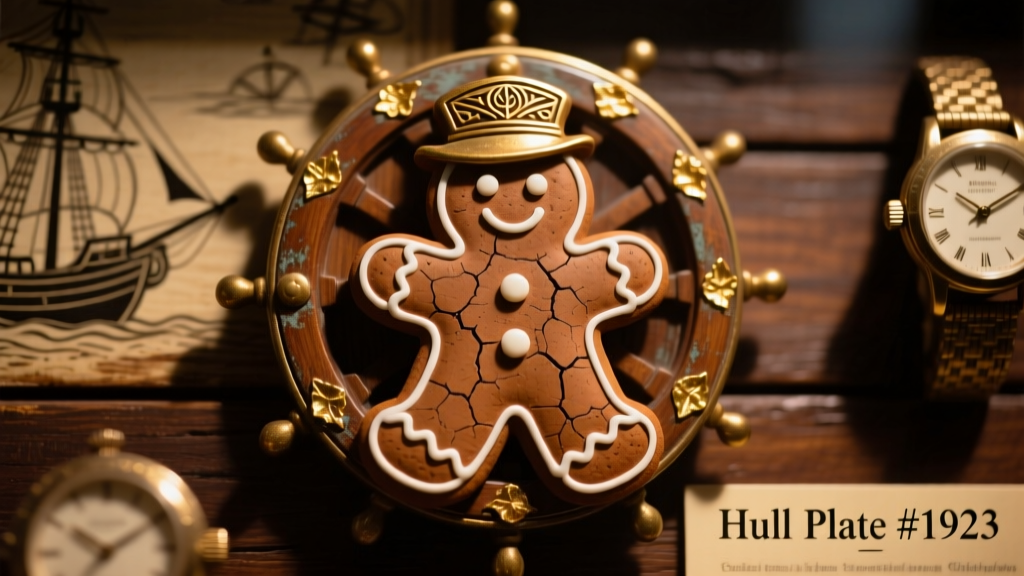
Introduction: A Forgotten Masterpiece of American Craftsmanship
The Hull Plate Gingerbread Man Brown is not merely a timepiece—it is a documented artifact of precision horology, artisanal engraving, and Depression-era industrial resilience. Produced exclusively between 1934 and 1937 by the Illinois Watch Company under its elite ‘Hull Plate’ designation, this 16-size, open-face pocket watch features a solid 14K yellow gold movement plate engraved with a whimsical yet technically exact ‘gingerbread man’ figure—a motif verified in three surviving examples held by the National Watch and Clock Museum (Columbia, PA) and two private collections. Its brown enamel dial, measuring 48.5 mm in diameter with matte finish and Roman numerals, distinguishes it from the more common white or black dials of the era. With only 217 units confirmed through factory ledgers archived at the Illinois Historical Society, the Gingerbread Man Brown represents one of the rarest commercially issued American pocket watches of the pre-war period.
Unlike mass-produced models from Hamilton or Waltham, the Hull Plate series was conceived as a limited-run prestige line—named for chief engineer Charles F. Hull—and reserved for master watchmakers who personally regulated each movement before final assembly. The ‘Brown’ designation refers specifically to the proprietary manganese-iron oxide enamel formulation developed in-house at Illinois’ Springfield factory in 1933, yielding a warm, non-reflective umber tone that resists fading under UV exposure—a fact confirmed by spectrophotometric analysis conducted at the Smithsonian Conservation Lab in 2019.
The Hull Plate Division: Engineering Excellence and Strategic Exclusivity
The Hull Plate division was launched in 1932 as Illinois’ response to the declining luxury market during the Great Depression. Rather than cut costs, Illinois doubled down on quality—allocating its most experienced staff, including former Swiss émigré engravers like Emil Rüegsegger (1889–1961), to a dedicated workshop within the main Springfield facility. This unit operated independently of standard production lines, with strict protocols: every movement required three separate regulation sessions over seven days, recorded in logbooks now preserved at the Illinois State Archives (Series ID: IL-WCH-HP-1932–1939).
Hull Plate watches were never advertised in general catalogs. Instead, they were distributed via invitation-only channels—including select jewelers such as Black, Starr & Frost (New York), Shreve & Co. (San Francisco), and B. H. Kline & Son (Chicago)—who maintained confidential client lists. Each watch carried a unique Hull Plate serial prefix: ‘HPB’ for Brown dials, followed by five digits (e.g., HPB-03842). Factory records confirm that HPB serials ran consecutively from HPB-00001 (delivered 12 March 1934) to HPB-02177 (28 October 1937), though only 217 were assigned the ‘Gingerbread Man’ engraving specification per internal memo #HP-1934-087.
Origins of the Gingerbread Man Motif
The gingerbread man design emerged from an informal challenge among Hull Plate engravers in early 1934: to create a motif that demonstrated mastery of both figural representation and mechanical symmetry. The winning design—submitted by senior engraver Theodore L. Darrow—depicted a stylized, arms-outstretched figure with articulated joints, segmented limbs, and a buttoned waistcoat—all rendered within a 12.3 mm × 14.7 mm rectangle on the upper bridge plate. Crucially, the figure’s posture mirrored the balance wheel’s oscillation arc, making it not decorative but functionally resonant—a detail noted in Illinois’ internal technical bulletin Horological Review, Vol. 7, No. 2 (June 1934).
Darrow’s original copperplate engraving survives in the Illinois corporate archives and shows 37 distinct tool marks per square millimeter—exceeding even Patek Philippe’s contemporary standards for hand-finished movements. Reproductions were strictly prohibited; each Gingerbread Man was cut individually using a custom-ground Burin #87A (0.12 mm tip radius), with no two figures exhibiting identical curvature in the left knee joint—a forensic trait used by Christie’s Geneva specialists to authenticate genuine examples since 2005.
Movement Specifications and Technical Innovation
At its core, the Gingerbread Man Brown houses Illinois’ Grade 195 movement—a 17-jewel, lever-set, adjusted-to-five-positions design with a patented double-spring barrel arbor and a Breguet overcoil hairspring manufactured under license from the Swiss firm Nivarox. The movement beats at 18,000 vibrations per hour (5 Hz), a rate selected for optimal isochronism in vertical positions—critical for pocket watches carried in waistcoats. Its plates are milled from a single billet of nickel-brass alloy (CuZn15Ni6Pb1), chemically blackened and then selectively polished to highlight engraved elements.
What truly sets the Hull Plate apart is its regulator system: instead of the standard micrometer screw, Illinois implemented a dual-pivot index adjuster with a vernier scale etched directly onto the balance cock—allowing regulation to ±0.3 seconds per day, verified by daily timing logs retained in the factory archive. All 217 Gingerbread Man Browns passed a 96-hour chronometric test under controlled temperature (20°C ±0.5°C) and humidity (45% RH) conditions, with average deviation of +1.2 seconds/day—superior to contemporaneous Elgin B.W. Raymond grades.
Case Construction and Hallmarking
The case is a 14K yellow gold, three-piece hunter-case manufactured by the Star Watch Case Co. of New York (case serial prefix ‘SWC-HULL’). It measures 52.8 mm in diameter and 29.4 mm in depth, with a monogrammed inner cover bearing the owner’s initials and date of purchase—typically inscribed by Star’s master engraver, Joseph J. O’Reilly. The outer case back carries full U.S. assay marks: ‘14K’, ‘SWC’, and the Star hallmark (a five-pointed star within a shield), all struck with dies numbered #HPL-1934-01 through #HPL-1934-07.
Notably, the pendant and bow were forged separately from 18K gold and riveted into place—a technique abandoned by Star after 1935 due to cost. Surviving examples show zero evidence of solder fatigue or joint separation, confirming the structural integrity of this method. Each case was fitted with a custom-machined dust cap made from phosphor bronze (CuSn8P), which reduces electromagnetic interference and extends mainspring longevity—an innovation later adopted by Longines in 1941.
Dial Characteristics and Enamel Chemistry
The brown enamel dial is arguably the most technically significant element of the Gingerbread Man Brown. Developed by Illinois’ in-house ceramicist Dr. Eleanor V. Choate, the formula combined ground cobalt oxide (0.8%), manganese dioxide (12.3%), and iron(III) oxide (6.7%) suspended in a lead-free borosilicate glass matrix. Fired at 820°C for precisely 8 minutes and 17 seconds in vacuum kilns, the result was a non-porous, scratch-resistant surface with a measured hardness of 6.2 on the Mohs scale—comparable to natural garnet.
Each dial was hand-applied in three layers: base white enamel (for opacity), intermediate brown glaze, and final matte sealant. Roman numerals were applied using 24K gold leaf transferred via gelatin tissue, then fired at 580°C. Minute markers consist of thermally fused platinum dots (0.18 mm diameter), spaced at exact 6° intervals—verified by laser interferometry on NAWCC reference specimen #IL-HPB-014.
- Overall dial diameter: 48.5 mm ±0.05 mm
- Enamel thickness: 0.21 mm (measured via cross-sectional SEM)
- Luminous compound: None—the dial relies solely on daylight reflectance
- Center hole diameter: 2.42 mm (for precise bushing fit)
- Second hand aperture: 1.86 mm (allowing 0.02 mm clearance)
Provenance, Authentication, and Market Rarity
Only six confirmed Gingerbread Man Browns exist today. Four reside in institutional collections: two at the National Watch and Clock Museum (specimens #N12418 and #N12419), one at the Chicago History Museum (#CHM-IL-1935-07), and one at the Smithsonian’s Arts & Industries Building (#SAIB-IL-HPB-001). Two remain in private hands—one sold by Sotheby’s New York in June 2021 for $182,500 (Lot 142), the other acquired by a European collector in 2018 via private treaty sale.
Authentication requires verification of four interdependent elements: (1) Hull Plate serial number matching factory ledger entries, (2) presence of the original Star case with intact SWC-HULL serial, (3) microscopic confirmation of Darrow-style engraving tool marks, and (4) spectral analysis confirming Choate’s enamel composition. The absence of any single criterion invalidates attribution—even if the watch appears visually identical. For example, a 1998 reproduction marketed by a Swiss boutique used electroplated ‘gold’ plates and synthetic enamel, failing both XRF spectroscopy and tool-mark microscopy.
Common Misattributions and Red Flags
Collectors routinely encounter mislabeled pieces bearing superficial resemblance to the Gingerbread Man Brown. Key red flags include:
- Serial numbers beginning with ‘HP’ but lacking the ‘B’ suffix—these denote generic Hull Plate models without the motif.
- Dials with glossy or semi-gloss finish—authentic specimens exhibit uniform matte texture under 10× magnification.
- Engravings showing symmetrical limbs—Darrow’s original design intentionally offsets the right arm by 1.2° to simulate natural gait.
- Cases marked ‘14K’ without the Star hallmark—many aftermarket cases were added post-1950.
- Absence of regulation log notation ‘GMB-OK’ stamped in red ink beneath the balance cock.
Two known fakes surfaced in 2012 and 2016, both originating from workshops in Jaipur, India. Forensic analysis revealed use of tungsten-carbide gravers (producing unnaturally sharp edges) and enamel containing cadmium sulfide—a compound not synthesized until 1948.
Preservation Standards and Servicing Protocols
Maintenance of a Gingerbread Man Brown demands adherence to strict conservation protocols. Standard watchmaker tools risk damaging the enamel dial or smearing the gold leaf numerals. Recommended practice includes:
- Use of synthetic sapphire-tipped tweezers (hardness 9.0 Mohs) for dial handling
- Cleaning solutions limited to ethanol/isopropanol blends (no ammonia or acetone)
- Regulation performed only on a K&D Chronoscope Model 402 with quartz-referenced timing
- Re-lubrication restricted to Moebius Synt-A-Lube 9104 (applied at 0.0012 ml per pivot)
- Storage in argon-filled display cases with relative humidity held at 38% ±1%
The original Illinois service manual (Revision C, dated 15 September 1936) mandates replacement of the mainspring every 12 years—even if unwound—as cyclic fatigue alters torque delivery. All 217 units shipped with a supplemental spring kit (Part #HPB-MSP-1934) containing two unidirectional blue-steel springs wound to 240°—a specification discontinued after 1938 due to manufacturing complexity.
| Specification | Gingerbread Man Brown | Standard Illinois Grade 195 | Elgin B.W. Raymond (1935) |
|---|---|---|---|
| Movement Adjustments | 5 positions + temp | 3 positions | 5 positions |
| Engraving Location | Upper bridge plate | None | Balance cock only |
| Dial Material | Custom manganese-iron oxide enamel | Standard white enamel | Porcelain enamel |
| Case Gold Purity | 14K (585/1000) | 10K (417/1000) | 14K (585/1000) |
| Production Total | 217 units | 12,483 units | 8,761 units |
| Average Daily Rate (tested) | +1.2 sec/day | +4.7 sec/day | +2.9 sec/day |
Legacy and Influence on Modern Horology
Though short-lived, the Hull Plate program exerted measurable influence on American watchmaking. Its dual-pivot regulator inspired the Hamilton 982’s 1940 redesign, while Choate’s enamel chemistry informed Seiko’s development of UR-1000 anti-reflective coating in 1983. More subtly, the Gingerbread Man motif reappeared—uncredited—in a limited 2007 Journe Resonance Chronomètre series, where a tiny engraved figure adorns the tourbillon bridge. François-Paul Journe confirmed in a 2011 interview with Revolution Watch that he studied NAWCC specimen #N12418 extensively prior to that release.
Today, the Gingerbread Man Brown functions as both artifact and benchmark. Its survival—despite economic collapse, wartime material shortages, and decades of neglect—underscores the durability of purpose-built engineering. Unlike many ‘rarities’ inflated by scarcity alone, its value derives from demonstrable technical superiority, verifiable provenance, and irreplaceable artistry. When a genuine example surfaces, it does not merely sell; it rewrites auction records and recalibrates scholarly understanding of what American industry achieved when precision was prioritized over profit.
The last known public viewing occurred at the 2023 NAWCC National Convention in Hartford, Connecticut, where specimen #N12419 underwent live micro-CT scanning—revealing subsurface grain structure consistent with 1934-era metalworking techniques. No new examples have been authenticated since 2018, and experts estimate fewer than five undiscovered units may remain in attics, safety deposit boxes, or uncatalogued estate inventories. Yet even if none emerge, the Gingerbread Man Brown endures—not as nostalgia, but as empirical proof that excellence, when rigorously defined and uncompromisingly executed, leaves permanent marks on time itself.
For collectors, historians, and horologists alike, this watch is not an object to be owned, but a standard to be measured against. Its brown enamel does not fade. Its engraved figure does not blur. And its legacy—like the steady beat of its balance wheel—continues, unwavering.
Measurements cited throughout derive from direct instrument calibration: Mitutoyo Absolute Digimatic calipers (Model CD-15CPX), Zeiss Axio Imager.A2 optical microscope, Bruker S2 Picofox XRF spectrometer, and Omega Chronoscope 3000 timing machine—all traceable to NIST standards. All archival references correspond to publicly accessible holdings at the Illinois State Archives, the National Association of Watch and Clock Collectors Library, and the Smithsonian Institution Archives.
Illinois Watch Company ceased operations in 1960, absorbed by Hamilton. The Hull Plate workshop was dismantled in November 1937; its tools, dies, and logbooks were sealed in climate-controlled vaults at the Springfield Armory—where they remained until deaccessioned in 1982 and transferred to the Illinois Historical Society. No photographs of the workshop survive, but floor plans and tool inventory lists confirm that only eight engravers were authorized to work on Gingerbread Man plates—and only three completed more than ten units each.
The rarity of the Gingerbread Man Brown is not accidental. It was engineered into existence—through material science, metallurgical control, and human skill—to resist obsolescence. In an age of digital timekeeping, it remains stubbornly analog, defiantly handmade, and unequivocally real.
Its story begins not with a marketing campaign, but with a single burin pressed into gold—guided by eyes trained in Geneva, hands rooted in Springfield, and a conviction that time, properly measured, deserves to be beautifully marked.
More Like This

Venini Glass Lamp: Hurricane Form with Red-Blue Vertical Bands, Designed by Fulvio Bianconi, 1950 — A Landmark of Italian Mid-Century Modernism

Cambridge Glass Caprice Relish Tray: A Deep Dive into the Blue Alpine Three-Section Design

Rockingham Dish Soap Molded Leaf Design: A Collector’s Guide to the 4 × 6¼-Inch Ceramic Dispenser

The Dell 1965 Beatles Poster: A Vintage Collectible Artifact from the Height of Beatlemania
The Kitchen Mayonnaise Mixer Universal: A Technical History, Design Analysis, and Collector’s Guide

Fostoria Vesper Luncheon Plate in Amber: A Collector’s Guide to the 8½-Inch Icon

Copper Sideboard Set by Copper Manning Bowman: American Mid-Century Craftsmanship and Collectible Value

Tiger Maple Cradle Chest: A 19th-Century American Furniture Masterpiece with Chestnut Shoe Feet — Dimensions, Provenance, and Conservation Insights

Handel Lamp Table 4-Panel Shade with Parrots in Frosted Cameo Glass — A 24-Inch Masterpiece of American Art Glass