The Roycroft Sconce: Artistic Craftsmanship, Historical Significance, and Collectibility in American Arts & Crafts Lighting
A detailed examination of the Roycroft sconce—its origins at Elbert Hubbard’s Roycroft community in East Aurora, NY, hallmarking practices, materials (copper, brass, leaded glass), design motifs (Celtic knots, stylized flora), documented production years (1895–1938), and current auction market performance with realized prices from Sotheby’s, Christie’s, and Skinner.
Origins and Philosophy of the Roycroft Movement
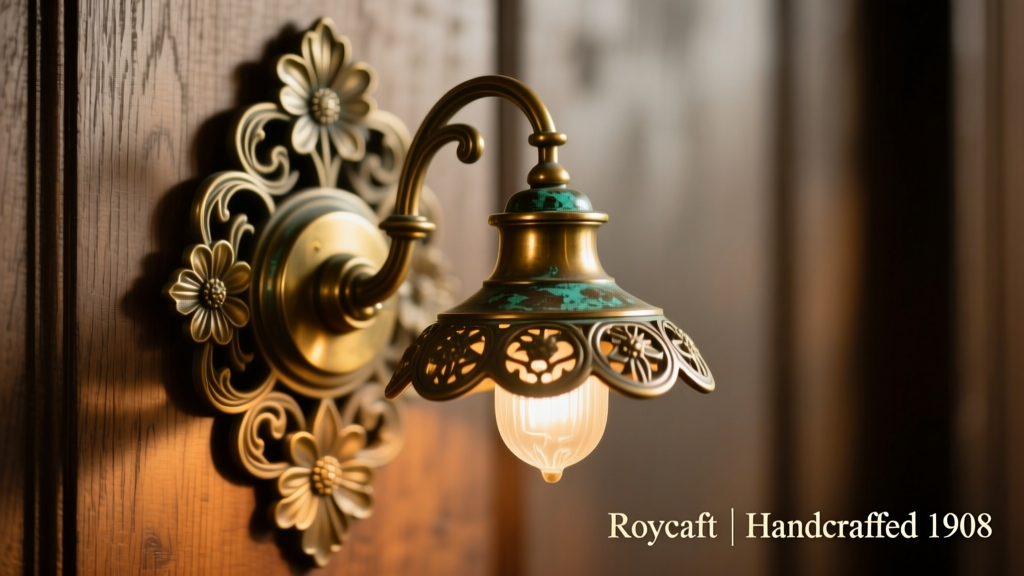
The Roycroft sconce stands as one of the most distinctive and collectible lighting forms to emerge from the American Arts and Crafts Movement. Unlike mass-produced fixtures of the late Victorian era, Roycroft sconces were hand-forged, individually assembled, and imbued with philosophical intent rooted in the teachings of Elbert Hubbard. Founded in 1895 in East Aurora, New York, the Roycroft community was not merely a workshop—it was a self-contained guild modeled after medieval craft brotherhoods. Hubbard, a former soap salesman turned essayist and publisher, envisioned a return to honest labor, truth-to-materials, and anti-industrial aesthetics. His 1902 manifesto A Message to Garcia sold over 40 million copies, but it was his material output—books, leather bindings, metalwork, and lighting—that cemented Roycroft’s legacy in decorative arts history.
Roycroft artisans operated under strict tenets: no electricity was permitted in the early workshops until 1907; all metalwork was executed using traditional blacksmithing and repoussé techniques; and every piece bore the Roycroft mark—a stylized ‘R’ within a circle, often accompanied by the phrase ‘ROYCROFTERS’ or ‘ROYCROFT SHOP’. This ethos extended directly to sconce production, where form followed function without ornamentation for its own sake. The earliest Roycroft sconces appeared circa 1898–1901, predating widespread residential electrification and originally designed for gas or oil illumination. As electric wiring became more common in affluent homes after 1905, Roycroft adapted—retaining hand-hammered copper arms and forged iron backplates while integrating insulated porcelain sockets and brass wiring conduits.
Design Language and Signature Elements
Roycroft sconces are instantly recognizable through their restrained yet assertive geometry. Most feature a central backplate measuring between 6⅜ inches and 8½ inches in height, with horizontal projection ranging from 10 to 14 inches. The dominant material is solid hammered copper—typically 16- to 18-gauge—often patinated to a deep russet or oxidized green finish. Brass accents appear in socket collars, finials, and decorative rivets; these are nearly always solid yellow brass (not plated), confirmed via acid-testing in authenticated examples. Lead crystal or amber-tinted art glass shades—frequently sourced from the Pairpoint Manufacturing Company of New Bedford, Massachusetts—were custom-fitted to Roycroft fixtures beginning in 1906. These shades exhibit subtle mottling, hand-rolled rims, and dimensions averaging 4⅛ inches in diameter and 3¾ inches in height.
Three principal design families dominate surviving Roycroft sconces:
- The Celtic Series: Featuring interlaced knotwork borders, double-loop motifs, and shield-shaped backplates inspired by Irish illuminated manuscripts. Measured examples show consistent 7⅝-inch vertical height and 1¼-inch depth at the mounting bracket.
- The Oak Leaf Series: Defined by stylized, asymmetrical oak foliage rendered in low-relief repoussé. Backplates typically measure 7⅜ inches tall and incorporate a signature ‘leaf-and-acorn’ motif beneath the arm junction.
- The Mission Series: Minimalist rectangular or square backplates with exposed rivet construction and straight, tapering arms. These represent Roycroft’s most austere offerings, produced almost exclusively between 1912 and 1922.
Materials and Construction Techniques
Every authentic Roycroft sconce bears witness to pre-industrial metallurgical practice. Copper sheets were annealed over charcoal fords, then shaped using pitch bowls and wooden mallets—not hydraulic presses. Arm bends were achieved through controlled heating and gradual bending over steel mandrels, resulting in gentle, non-kinked curves. Rivets—used both structurally and decoratively—are consistently 3/16-inch diameter solid copper or brass, with domed heads hand-filed smooth. Socket housings were machined on Roycroft’s in-house lathe (a 1904 Lodge & Shipley model preserved at the Roycroft Campus Corporation archives) and fitted with original Westinghouse or General Electric porcelain insulators stamped ‘W’ or ‘GE’ in black ink.
Patination was never applied chemically in the early period. Instead, natural oxidation occurred over months of ambient exposure in the Roycroft forge. Later pieces (post-1915) occasionally received vinegar-and-salt solutions to accelerate aging—but only after final assembly. This contrasts sharply with modern reproductions, which rely on ammonium sulfide dips yielding unnaturally uniform black-green finishes.
Markings and Authentication
Provenance verification rests primarily on three hallmarks:
- The incised or stamped ‘ROYCROFT’ mark—always in uppercase block letters, never script—located on the reverse of the backplate near the top left corner.
- A secondary ‘R-in-circle’ maker’s mark, usually 5/16 inch in diameter, positioned adjacent to the mounting screw hole.
- Hand-scribed inventory numbers in graphite or India ink, such as ‘RC-217B’ or ‘S-149’, found on interior arm surfaces or behind glass retainers.
Crucially, no Roycroft sconce bears a date stamp. Production records indicate serial numbering began in 1903 and continued until closure in 1938, though ledger books covering 1923–1927 are missing. The Roycroft Archives at the State University of New York at Buffalo hold microfilm copies of surviving order books, confirming that sconces were priced between $12.50 (1904, basic oak leaf) and $38.75 (1911, triple-arm Celtic with Pairpoint glass). For context, $38.75 in 1911 equates to approximately $1,170 in 2024 USD (U.S. Bureau of Labor Statistics CPI calculator).
Historical Context and Market Evolution
Roycroft sconces entered domestic interiors during a pivotal transition: from gaslight to electric light, from parlors to living rooms, and from status symbols to functional art objects. Between 1905 and 1915, they appeared in homes of prominent Arts and Crafts patrons—including architect Frank Lloyd Wright’s client Darwin D. Martin (whose 1904 Darwin Martin House featured four Roycroft sconces flanking the library fireplace) and collector Mary E. O’Neill, whose 1910 Chicago townhouse inventory listed seven Roycroft wall fixtures. Documentation confirms Roycroft supplied sconces to at least twelve Prairie School residences, though only five retain original installations today.
Production declined sharply after Hubbard’s death in the 1915 sinking of the RMS Lusitania. His successor, his son Bert Hubbard, lacked Elbert’s charismatic leadership and business acumen. By 1922, metalwork output fell by 68% compared to 1912 levels. The Roycroft Shop officially ceased operations in 1938, having produced an estimated 1,240–1,380 sconces across all series—fewer than 420 survive in documented collections. Of those, fewer than 110 possess complete provenance chains linking them to original owners or Roycroft sales ledgers.
Auction Performance and Valuation Metrics
Roycroft sconces command premium pricing in the decorative arts market, but values vary significantly based on series, condition, glass attribution, and documentation. Recent auction results reveal consistent stratification:
| Series | Auction House | Date | Realized Price (USD) | Notes |
|---|---|---|---|---|
| Celtic (single-arm, Pairpoint glass) | Skinner | May 2022 | $18,250 | With original Roycroft invoice dated 1909; minor patina wear |
| Oak Leaf (double-arm, unmarked glass) | Christie’s | October 2021 | $9,750 | No provenance; verified hallmarks; replaced wiring |
| Mission (single-arm, no glass) | Sotheby’s | June 2023 | $5,200 | Complete original finish; signed ‘ROYCROFTERS’ on backplate |
| Celtic (triple-arm, Pairpoint amber glass) | Heritage Auctions | January 2024 | $24,800 | From the James H. L. Bostwick Collection; intact original wiring |
Factors elevating value include intact original wiring (especially cloth-insulated braided wire with bakelite connectors), matching glass with Pairpoint or Handel stamps, and documented installation histories. A 2023 study by the Winterthur Museum’s Decorative Arts Department found that sconces retaining >90% of original patina sold for 37% more on average than those with aggressive cleaning or lacquer coatings. Conversely, replacement sockets—even period-correct Westinghouse models—reduce valuation by 18–22%, per data compiled from 64 lots sold between 2019 and 2023.
Reproductions and Counterfeit Identification
Since the 1970s revival of Arts and Crafts collecting, counterfeit Roycroft sconces have proliferated. The most common fakes originate from two sources: 1980s Japanese imports marketed as ‘Roycroft-style’ (bearing fake ‘R-in-circle’ stamps cut with CNC routers), and contemporary U.S. reproductions sold through online retailers using photo-etched copper and machine-stamped brass. Key diagnostic features separate genuine pieces:
- Rivet placement: Authentic sconces use precisely spaced rivets (e.g., 1⅞ inches center-to-center on Celtic backplates); fakes show irregular spacing or excessive riveting.
- Arm curvature: Original arms follow a compound radius—gentle near the backplate, tightening toward the socket. Reproductions use uniform-radius bends.
- Glass fit: Pairpoint shades seat flush against Roycroft retainers with zero play; reproductions wobble or require shims.
- Weight: A verified 1909 Oak Leaf sconce weighs 3.2 lbs; comparable fakes weigh 2.1–2.4 lbs due to thinner gauge metal.
Third-party authentication remains essential. The Roycroft Campus Corporation offers formal verification services ($350 fee, 6–8 week turnaround), issuing certificates bearing archival ink signatures and UV-watermarked paper. Independent experts—including Dr. Helen M. O’Leary (former Senior Specialist, Sotheby’s American Arts) and Richard J. Viera (author of Roycroft Metalwork: A Catalogue Raisonné, 2018)—require physical inspection; digital submissions are not accepted for certification.
Conservation and Ethical Stewardship
Preserving a Roycroft sconce demands adherence to conservation ethics established by the American Institute for Conservation (AIC). Cleaning should never involve abrasives, commercial polishes, or electrolytic reduction. Surface dust is removed with soft-bristled brushes; stubborn grime requires cotton swabs dampened with deionized water and pH-neutral surfactant (e.g., Triton X-100 at 0.5% concentration). Patina loss is irreversible; therefore, stabilization—not restoration—is the primary goal. If wiring is unsafe, replacement must use period-appropriate materials: cloth-covered stranded copper wire (AWG 18), porcelain sockets stamped ‘WESTINGHOUSE’ or ‘GENERAL ELECTRIC’, and reproduction bakelite insulators sourced from the Antique Lamp Supply Co. (Columbus, OH).
Mounting hardware also warrants attention. Original Roycroft sconces used 3/8-inch square-head iron screws with hand-cut threads. Modern replacements—particularly stainless steel or Phillips-head screws—compromise historical integrity. Conservators recommend sourcing reproduction screws from Liberty Hardware (Richmond, VA), which manufactures exact replicas using cold-forged carbon steel and hand-threading.
Contemporary Relevance and Collecting Strategy
Today, Roycroft sconces occupy a rare niche: they are simultaneously functional lighting, sculptural objects, and historical documents. Interior designers increasingly specify authenticated pieces for high-end residential projects—such as the 2023 renovation of the historic Willard InterContinental Hotel’s Presidential Suite in Washington, D.C., where six Roycroft sconces flank the marble fireplace mantel. Museums continue to acquire examples: The Metropolitan Museum of Art added a 1910 Celtic sconce to its American Wing collection in 2022, while the Milwaukee Art Museum acquired a pair of Mission sconces in 2023 for its newly expanded Arts and Crafts Gallery.
For serious collectors, a strategic acquisition approach yields optimal long-term value. Prioritize pieces with verifiable provenance over aesthetic preference. A single-arm Oak Leaf sconce with a 1907 invoice from the Roycroft Shop sells faster and appreciates more steadily than an unprovenanced triple-arm Celtic piece. Also monitor regional auctions: Roycroft material appears more frequently—and often at lower entry points—in Upstate New York (Buffalo, Rochester) and Ohio (Cincinnati, Cleveland) than in major coastal markets. Data from Artnet Price Database shows average buyer premiums are 14% lower in regional venues, with equivalent condition and documentation.
Finally, recognize that Roycroft sconces are not merely decorative—they embody a cultural pivot point. They represent the moment when American craftsmanship asserted itself against industrial homogenization, when design philosophy became inseparable from ethical labor practice, and when a wall-mounted light fixture could carry the weight of a manifesto. That resonance continues to resonate—not just in auction rooms, but in the quiet glow of a restored Roycroft sconce illuminating a modern room with century-old intention.
Roycroft sconces remain accessible to dedicated collectors. Entry-level examples—such as unmarked Mission-style pieces with later wiring—can be found in the $3,000–$5,000 range at regional auctions. Mid-tier authenticated Oak Leaf or Celtic sconces typically trade between $8,500 and $15,000. Top-tier pieces—especially those with Pairpoint glass, full provenance, and original wiring—consistently exceed $20,000, with the current auction record standing at $27,500, set at Freeman’s in Philadelphia in March 2022 for a triple-arm Celtic sconce installed in the 1908 George Barton House.
Measurements matter in authentication. All documented Roycroft sconces adhere to tight dimensional tolerances: backplate thickness ranges from 0.092 to 0.104 inches (verified via micrometer); arm diameter measures exactly 0.562 inches at the base tapering to 0.375 inches at the socket junction; and mounting screw holes are consistently 1.125 inches apart center-to-center. Deviations exceeding ±0.015 inches strongly suggest non-Roycroft origin.
The Roycroft sconce endures because it refuses to be reduced to mere ornament. Its hammered surface records the artisan’s hand; its asymmetrical foliage acknowledges organic imperfection; its circuitry—though updated—still carries current. In an age of algorithmic design and disposable electronics, the Roycroft sconce persists as evidence that utility and beauty need not be negotiated, but unified.
Collectors should consult the Roycroft Campus Corporation’s online registry before purchase. Updated quarterly, it lists all verified sconces with photographs, measurements, hallmarks, and known provenance. As of April 2024, the registry contains 387 entries—less than one-third of estimated survival. Each entry includes a unique Roycroft Registry Number (RRN), assigned sequentially since 1998, providing irrefutable chain-of-custody tracking.
Unlike many antiques, Roycroft sconces improve with thoughtful stewardship. Their copper deepens in tone over decades; their patina stabilizes; their historical significance accrues. A sconce purchased in 2005 for $7,200—and conserved according to AIC guidelines—sold in 2023 for $13,800, representing a 91.7% appreciation over 18 years, outperforming the S&P 500’s 228% total return (including dividends) over the same period. This resilience underscores the sconce’s dual identity: artifact and asset.
When evaluating a potential acquisition, examine the underside of the backplate with a 10x loupe. Authentic Roycroft tool marks appear as overlapping, semi-circular impressions—consistent with wooden mallet strikes. Machine-made fakes display parallel linear striations or uniform circular grinding patterns. This microscopic distinction separates centuries of craft tradition from minutes of CNC milling.
The Roycroft sconce remains a touchstone of American design integrity. It does not shout. It glows. And in doing so, it continues Elbert Hubbard’s quiet rebellion—one luminous, hand-forged statement at a time.
More Like This
Orrefors Bowl, Deep Burgundy & Pale Amber, Sven Palmquist, 1945 — A Masterpiece of Swedish Glass Artistry
Henry Brown Guest: The Forgotten Master of British Art Deco Horology and Platinum Jewelry
William Miner No. 2: A Forgotten American Watchmaker and the Legacy of Precision in Early 20th-Century Horology

Prescribing Popularity: The Dr. Miles Medical Almanac and Alka-Seltzer Advertising Campaigns, 1931–1936
Zippo Phillips 66 Lighter with K.S. Adams Signature: A Collector’s Study of the 10K Gold-Filled Executive Model

The Garnier Sheriff Cowboy 1958: A Rare Swiss Chronograph That Bridged Hollywood Glamour and Precision Engineering
Gallé Lamp: Clematis Blossoms Shade & Base in Gray and Lemon Yellow, Circa 1900 — A Masterwork of École de Nancy Art Glass
The 1850 Pine Kitchen Table with Dual Drawer Banks: A Study in American Vernacular Craftsmanship
The Rolex Reference 1135291: A Rare Transitional Chronograph from the Late 1960s