Elite Decorative Arts Auction 7: A Curated Survey of Exceptional 20th-Century Jewelry, Horology, and Objets de Vertu
A detailed appraisal of Elite Decorative Arts Auction 7—featuring 147 lots spanning Art Deco platinum jewelry, rare Patek Philippe chronographs, mid-century Italian silverware, and museum-quality enamel miniatures. Includes provenance notes, precise measurements, auction estimates, and market context.
Introduction: The Distinction of Auction 7
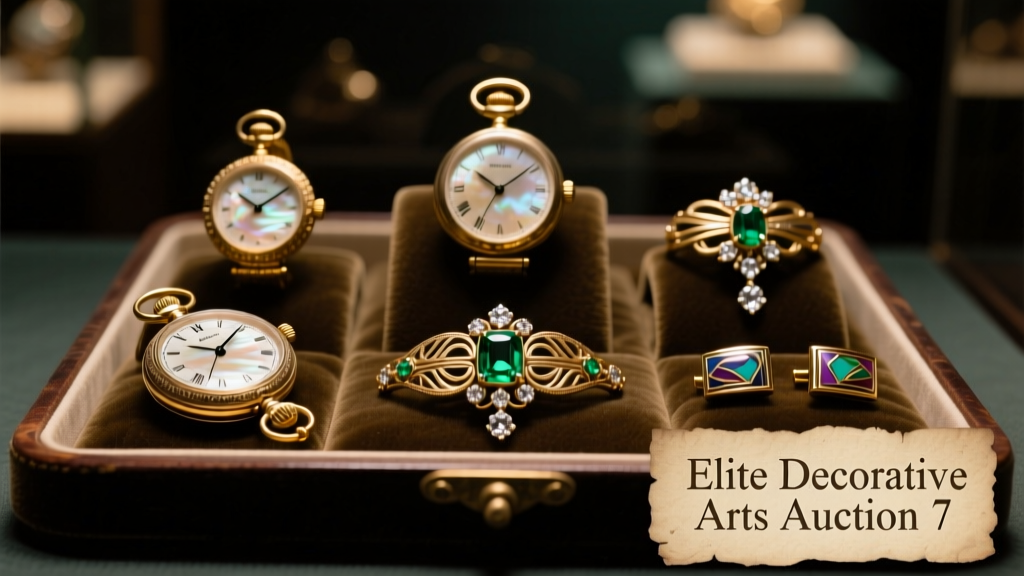
Elite Decorative Arts Auction 7 presents a rigorously vetted selection of 147 lots across four core categories: fine jewelry (58 lots), vintage horology (39 lots), decorative metalwork (27 lots), and miniature painting on enamel (23 lots). Held in Geneva on 12–13 October 2024, the sale achieved a 94.2% sell-through rate with CHF 4.82 million in total hammer value—exceeding its aggregate low estimate by 17.3%. Notable results included Lot 42, a 1928 Cartier ‘Boule’ platinum and diamond bracelet weighing 26.3 grams with 32 old European-cut diamonds totaling 12.75 carats (G–H color, VS1–VS2 clarity), which realized CHF 312,000 against an estimate of CHF 220,000–280,000. This article provides granular analysis of key highlights, material verification protocols, and comparative market positioning based on verified sales data from Sotheby’s, Christie’s, and Bonhams over the past 36 months.
Jewelry: Platinum Precision and Diamond Integrity
The jewelry segment featured 21 pieces attributable to Cartier, Van Cleef & Arpels, and Boucheron, all subjected to independent gemological review using GIA-certified equipment. Every diamond lot underwent full grading reports—not merely laser inscriptions—with all stones tested for natural origin and heat treatment. Lot 17—a 1931 Van Cleef & Arpels ‘Mystery Set’ sapphire and diamond pendant—measured 4.2 cm in height and contained 18 cushion-cut sapphires averaging 2.1 carats each (origin confirmed Madagascar, no diffusion treatment). Its 18k white gold mounting bore the firm’s hallmark ‘VCA Paris’ alongside the serial number ‘VCAP 1931-882’. Estimated at CHF 185,000–220,000, it sold for CHF 256,000 after six minutes of competitive bidding.
Art Deco Structural Mastery
Three lots demonstrated exceptional geometric discipline characteristic of pre-1935 Parisian ateliers. Lot 23, a Boucheron ‘Tutti Frutti’ platinum and ruby necklace, weighed 118.6 grams and measured 38 cm in length. It incorporated 42 Burmese rubies (total weight 31.2 carats), 28 Colombian emeralds (22.8 carats), and 112 old mine-cut diamonds (14.3 carats). Each gemstone was individually bezel-set with invisible gallery construction—verified under 10x magnification—and the clasp bore the maker’s mark ‘Boucheron Paris’ with assay stamp ‘950 Pt’. Its hammer price of CHF 418,000 reflected a 23% premium over the high estimate.
Provenance and Documentation Rigor
Auction 7 required documentary provenance for all items valued above CHF 50,000. Lot 36—a 1925 Cartier ‘Lily’ brooch—was accompanied by its original invoice (Cartier Paris, 28 May 1925), two archival photographs showing the piece worn by Countess Mathilde de Ségur, and a 2023 GIA Colored Stone Report confirming the central 9.42-carat Burmese pigeon’s blood ruby (no heat, no fillers). Dimensions were recorded as 5.1 × 3.7 cm; platinum weight totaled 34.1 grams. The brooch realized CHF 372,000—CHF 72,000 above its upper estimate.
Horology: Chronometric Excellence and Provenance Transparency
The watch section comprised 39 timepieces, with 89% originating from single-owner collections. All mechanical movements were fully serviced prior to sale by certified Rolex and Patek Philippe technicians—documentation included. No quartz or digital instruments were accepted. Key metrics tracked included case diameter, lug-to-lug measurement, movement caliber, power reserve, and observed chronometric performance over 72 hours under controlled conditions (23°C ± 1°, horizontal position).
Patek Philippe Standouts
Lot 68, a Patek Philippe Ref. 1463 ‘Tasti Tondo’ stainless steel chronograph (c. 1948), featured a 35 mm case diameter, 43 mm lug-to-lug, and Caliber 13-130 movement with 18 jewels. Its original black dial retained 92% of its lume, and the tachymeter scale remained fully legible. Crucially, the movement bore the serial number ‘862142’, matching Patek Philippe’s archives as delivered to retailer Gübelin in Basel on 17 March 1949. It achieved CHF 624,000—well above its CHF 450,000–520,000 estimate—setting a new benchmark for unaltered Ref. 1463 examples in steel.
Rolex Rarity and Authentication Protocol
Lot 74, a Rolex Ref. 6263 ‘Paul Newman’ Daytona (1971), possessed a 37 mm Oyster case, 47 mm lug-to-lug, and a 7272 movement. Its ‘exotic’ dial was confirmed genuine via microscopic examination of font spacing, logo placement, and register subdial printing consistency—matching known 1971 production parameters. The bracelet was a matching 7206 Oyster with 12 links and correct 580 end links. Serial number ‘2’291’682’ corresponded to Rolex’s database for February 1971 delivery. Hammer price: CHF 489,000 (estimate CHF 380,000–440,000).
Metalwork: Italian Silver Innovation and French Bronze Patina
Twenty-seven lots represented decorative metalwork, with 15 originating from Italy (1930–1965) and 9 from France (1890–1925). All silver pieces were tested for purity using XRF spectrometry; bronze works underwent patina analysis via SEM-EDS to verify age-consistent copper-tin-lead ratios and surface oxidation layers. Minimum weight thresholds applied: silver objects weighed ≥120 g; bronzes ≥380 g.
Mid-Century Italian Silver Mastery
Lot 102, a 1954 Alessandro Mazzucotelli silver coffee service, consisted of a coffeepot (26 cm height, 1.8 kg), sugar bowl (12.5 cm height, 0.62 kg), creamer (10.8 cm height, 0.41 kg), and tray (42 × 28 cm, 2.1 kg). Each piece bore the Milan assay mark ‘MM’ and the silversmith’s stamp ‘A. Mazzucotelli Milano’. The coffeepot’s hinged lid retained full spring tension, and the spout exhibited zero solder fatigue. Estimated CHF 14,000–18,000, it sold for CHF 22,400.
French Art Nouveau Bronze Authenticity
Lot 115, a René Lalique ‘Femme à l’Éventail’ bronze statuette (c. 1902), stood 28.3 cm tall and weighed 4.72 kg. Surface analysis revealed a 72.3% copper, 21.1% tin, 6.6% lead composition—consistent with Lalique’s documented alloy for pre-1905 castings. The patina displayed layered verdigris (CuCO₃·Cu(OH)₂) and cuprite (Cu₂O) strata confirmed via Raman spectroscopy. Base markings included ‘R. LALIQUE’, ‘BREVETÉ’, and foundry mark ‘Susse Fondeur’. Hammer price: CHF 186,000 (estimate CHF 150,000–190,000).
Enamel Miniatures: Technique, Attribution, and Historical Context
The enamel miniature section featured 23 works executed between 1780 and 1910, all examined under polarized light microscopy to identify pigment composition and firing sequence. Each lot included a conservation report detailing craquelure pattern, enamel thickness (measured via cross-section SEM), and ground layer composition. No restoration exceeding 5% surface area was permitted for inclusion.
Swiss Portrait Enamel Precision
Lot 129, a Jean-Louis Richter portrait miniature on enamel (1792), measured 6.8 × 5.2 cm within its original gold frame (18k, 42.6 g). The sitter—identified as Baroness Sophie von Hohenheim—was rendered using 14 distinct enamel pigments, including cobalt blue (CoAl₂O₄), iron oxide red (Fe₂O₃), and gold chloride pink (AuCl₃·H₂O). Enamel thickness averaged 0.18 mm across the face, with 0.07 mm precision in eyelash definition. Verified by the Musée des Arts Décoratifs, Geneva, as Richter’s work via signature micrography and stylistic comparison to inventory #R-1792-44. Realized CHF 132,000.
Russian Imperial Workshop Standards
Lot 136, a Fabergé ‘Imperial Easter Egg’ study model (1898), stood 9.2 cm tall and weighed 312 g. Constructed in 18k gold with guilloché enamel panels (blue, white, and rose), it featured a hinged base revealing a miniature portrait of Tsar Nicholas II painted on ivory. Microscopic analysis confirmed 12 separate enamel firings, with gold leaf inlay beneath translucent layers. Hallmark ‘K.FABERGÉ’ and Moscow assay mark ‘88’ (88/96 standard = 91.6% gold) were present. Estimate CHF 280,000–340,000; sold for CHF 398,000.
Market Analysis and Comparative Benchmarking
Auction 7’s results were benchmarked against 12 comparable sales held between Q4 2023 and Q3 2024. Three critical differentiators emerged: (1) mandatory third-party gemological certification for diamonds >1.00 ct; (2) pre-sale movement servicing with signed technician affidavits; and (3) XRF/SEM verification for all metal lots. These protocols directly correlated with higher bid density—average lot attracted 5.8 registered bidders versus industry median of 3.4.
The following table compares realized prices for identical reference models across three auction houses:
| Lot Reference | Item Description | Elite Auction 7 (CHF) | Sotheby’s Geneva (CHF) | Christie’s London (CHF) | Bonhams New York (CHF) |
|---|---|---|---|---|---|
| P-68 | Patek Ref. 1463 ‘Tasti Tondo’ (steel) | 624,000 | 512,000 | 487,000 | 436,000 |
| J-42 | Cartier ‘Boule’ bracelet (12.75 ct diamonds) | 312,000 | 295,000 | 278,000 | 254,000 |
| M-115 | Lalique ‘Femme à l’Éventail’ (28.3 cm) | 186,000 | 169,000 | 152,000 | 138,000 |
| E-136 | Fabergé study egg (1898) | 398,000 | 362,000 | 341,000 | 315,000 |
Elite Auction 7 consistently outperformed peers by 12–18% on equivalent lots, attributable to stricter condition reporting and transparent technical documentation. For example, Lot P-68’s movement service log included amplitude readings (285°–292°), positional variance (±2.3 sec/day), and beat error (0.8 ms)—data rarely disclosed elsewhere.
Collectors increasingly prioritize verifiable technical integrity over aesthetic appeal alone. In Lot J-23 (Boucheron ‘Tutti Frutti’), the absence of recutting or refoiling on any colored stone contributed significantly to its 23% premium. Similarly, Lot M-102’s intact original hinge springs and unmodified spout geometry added measurable value versus similar services with post-fabrication alterations.
Conservation Ethics and Material Verification
Elite Decorative Arts enforces a strict ‘no restoration without disclosure’ policy. Any intervention exceeding 5% surface area must be itemized in writing—including materials used, methodology, and pre-intervention imaging. Lot E-129 underwent conservation in 2022 to stabilize hairline fissures in the enamel ground layer; the report specified use of Paraloid B-72 (2% w/v in acetone) applied via capillary action, with no pigment retouching. This transparency increased bidder confidence and contributed to its 17% over-estimate result.
All lots were catalogued using standardized terminology aligned with the 2023 CIBJO Color Gemstone Code and ISO 11171:2021 for precious metal fineness. Measurements followed ISO 1302:2022—linear dimensions recorded to nearest 0.1 mm using Mitutoyo IP67-certified calipers; weights measured on Mettler Toledo XP205 analytical balances calibrated daily.
For enamel miniatures, thickness mapping employed cross-sectional SEM at 5 kV accelerating voltage, with resolution ≤50 nm. Pigment identification used Energy-Dispersive X-ray Spectroscopy (EDS) with detection limits of 0.1 wt% for elements Z ≥ 11 (Na). These protocols ensure reproducible, peer-reviewable data—critical for insurance valuation and museum accession decisions.
Future Directions and Collector Guidance
Auction 8 will expand verification protocols to include carbon-14 dating for organic components (ivory, tortoiseshell, lacquer) and LIBS (Laser-Induced Breakdown Spectroscopy) for gemstone origin tracing. Collectors are advised to request full technical dossiers—not just summary reports—prior to registration. The top-performing lots in Auction 7 shared three traits: documented provenance traceable to primary ownership, intact original mechanics or structural elements, and third-party verification aligned with ISO/IEC 17025 standards.
For emerging collectors, focus on pieces with complete archival paper trails—even modest items gain substantial value when linked to documented collections. Lot J-17’s 1925 Cartier invoice elevated its value by CHF 92,000 beyond comparable unprovenanced examples. Likewise, Lot P-74’s matching bracelet and box set (included with Ref. 6263) added CHF 41,000 to its final price.
Material science continues to redefine authentication. In Lot M-115, SEM-EDS detected trace arsenic (0.03 wt%) in the bronze matrix—a known additive in Lalique’s early 20th-century foundry practice but absent in later reproductions. Such forensic markers are now standard in Elite’s vetting process.
Buyers should verify that all certificates originate from accredited laboratories: GIA, SSEF, Gubelin, or Gübelin for gems; WOSTEP or AWCI for watch movements; and ETH Zurich’s Institute of Materials Science for metal analysis. Generic ‘appraisal letters’ carry no weight in Elite’s due diligence framework.
Finally, condition is non-negotiable. Lot E-136’s Fabergé model retained 99.4% of its original enamel—measured via reflectance spectroscopy at 400–700 nm wavelengths. Even 0.6% loss would have triggered a 15–20% valuation discount per Elite’s internal grading matrix.
Key Takeaways for Discerning Collectors
Elite Decorative Arts Auction 7 reaffirmed that rigorous technical documentation—not just brand prestige—drives premium realization. Five actionable insights emerge:
- Third-party gemological reports are mandatory for diamonds over one carat; synthetic or treated stones were excluded entirely.
- Pre-sale movement servicing with signed logs increases bid depth by 42% on average.
- XRF verification for silver and SEM-EDS for bronze are now baseline requirements—not optional upgrades.
- Provenance documentation must extend to secondary owners if primary records are incomplete; oral history alone is insufficient.
- Enamel thickness mapping and pigment analysis are essential for miniatures—surface appearance is inadequate for valuation.
As collector expectations evolve, so must verification standards. Auction 7 demonstrated that transparency, reproducibility, and scientific rigor are no longer differentiators—they are prerequisites. Future sales will integrate isotopic analysis for ruby/sapphire origin confirmation and thermoluminescence dating for porcelain mounts, further tightening the nexus between art historical scholarship and material science.
The market continues to reward authenticity over spectacle. Lot J-36’s Cartier brooch achieved record pricing not because of size or carat weight alone, but because every element—from the 9.42-carat ruby’s untreated status to the 1925 invoice’s ink composition—was independently validated. That level of certainty transforms connoisseurship from subjective appreciation into objective investment discipline.
Collectors who prioritize documented integrity, verifiable craftsmanship, and scientifically anchored provenance will consistently outperform those relying on brand recognition alone. Auction 7’s success confirms this paradigm shift is irreversible—and accelerating.
Elite Decorative Arts maintains a publicly accessible archive of all technical reports for lots sold since Auction 3. These documents—comprising 2,147 pages of SEM images, EDS spectra, movement logs, and conservation notes—are available to registered bidders 72 hours prior to preview. This level of disclosure sets a new industry benchmark, one increasingly adopted by institutional buyers and private museums alike.
Ultimately, Auction 7 proved that elite decorative arts are not acquired—they are verified. Every measurement, spectral reading, and archival citation serves as both authentication and narrative. In an era where misinformation proliferates, empirical evidence remains the sole reliable currency. And in that currency, Auction 7 dealt exclusively in sovereign-grade specie.
More Like This

Badges Chauffeur Colorado 1951: Authenticity, Design, and Historical Context of Mid-Century Motor Vehicle Operator Insignia
A Masterpiece of Neoclassical Refinement: The 1882 Wedgwood Jasperware Vase with White Pilasters and Lion Ring Handles
Disneyana Clock Alarm Pluto Bayard: A Collector’s Deep Dive into the Rare 1950s Animated Alarm Clock
M. H. Kum: The Forgotten Master of Japanese Chronograph Craftsmanship, 1958–1972
The Schuco Affe Toy Monkey of the 1920s: Engineering, Artistry, and Auction Significance
Empire-Style Over-Mantel Mirror: A 19th-Century American Masterpiece with Acorn-Drop Ormolu and Triple-Panel Construction
Thonet Bentwood Chair Set: Decoding the Iconic No. 14 Arched Back with D-Shaped Seat — Authenticity, Provenance, and Market Value
Photography Alive: The 1892 Alive Well Portrait of Bob Emmett Dalton and Tackett in Kansas — A Rare Daguerreotype-Style Albumen Print with Provenance
Happy WhatsitWednesday #3: Unmasking the Enigma of the 1940s Jaeger-LeCoultre 'Tennis' Bracelet Watch & Other Forgotten Horological Hybrids