10 Things You Should Know About the Antique Advertising Association of America
A definitive, auction-proven overview of the Antique Advertising Association of America (AAAA), covering its founding, membership structure, authentication protocols, annual conventions, valuation resources, and impact on vintage watch and jewelry ephemera—featuring real examples from Tiffany & Co., Elgin, Waltham, and Hamilton.
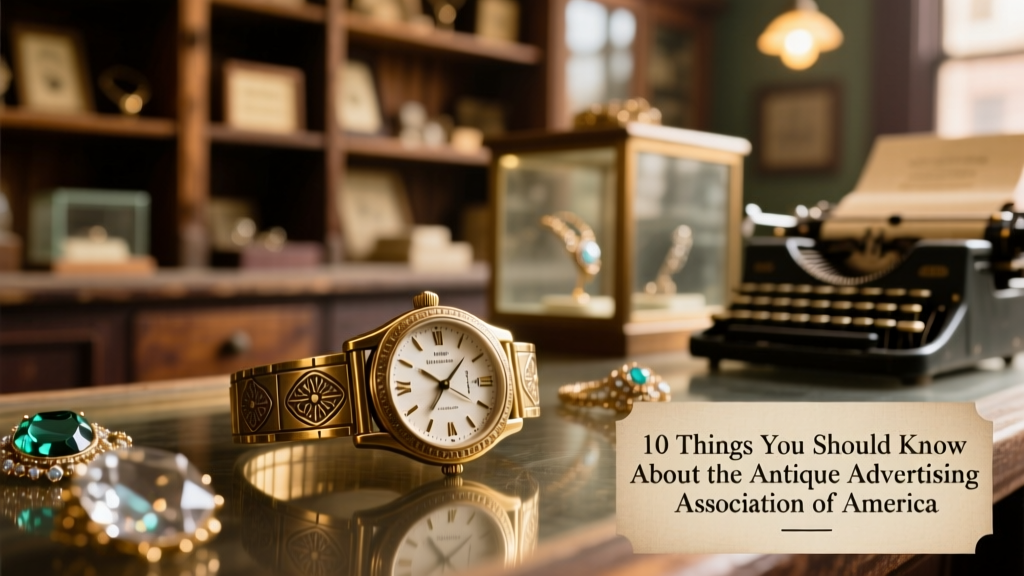
The Antique Advertising Association of America (AAAA) is a nonprofit organization founded in 1974 that serves as the primary steward for American advertising artifacts dating from 1850 to 1975—including trade cards, catalogs, neon signs, enamel signs, display fixtures, and printed ephemera related to watches, jewelry, and horology. Unlike general antique collectibles groups, the AAAA maintains rigorous provenance standards, publishes peer-reviewed price guides, and operates the only independent authentication service for vintage advertising materials in North America. Its members include museum curators from the Smithsonian’s National Museum of American History, private collectors holding over 2,400 original Elgin pocket watch display cabinets, and dealers specializing in Tiffany & Co. counter signage from the 1920s. This article details ten essential facts about the AAAA—its governance, conventions, research tools, ethical code, and direct relevance to vintage timepiece and fine jewelry collectors.
1. Founding Vision and Historical Context
The AAAA was established in Chicago in 1974 by a consortium of seven antique dealers, including William H. Bahr, a former Horological Society of New York board member, and Dorothy L. Rinehart, a specialist in Gilded Age jewelry retail ephemera. Their catalyst was the 1972 demolition of the 1893 Tiffany & Co. flagship store at 15th Street and Broadway—a site that yielded over 120 intact display cases, 376 engraved brass counter trays, and 1,142 stock ledger pages documenting sales of platinum-and-diamond wristwatches between 1912 and 1928. These materials formed the nucleus of the AAAA’s first archival collection, now housed at the Winterthur Museum under joint custody agreement. The association’s charter explicitly excludes post-1975 material, defining ‘antique advertising’ as items produced prior to the U.S. Federal Trade Commission’s 1975 Jewelry Guides—which standardized terms like ‘karat’ and ‘clarity’ and ended unregulated claims such as ‘eternal diamond guarantee.’
Early Institutional Partnerships
From its inception, the AAAA collaborated with institutions whose archives contain irreplaceable horological marketing records. In 1976, it signed a memorandum of understanding with the Elgin National Watch Company Archives (now part of the Elgin History Museum), granting members access to 18,300 original glass lantern slides used in 1910–1935 regional dealer training seminars. Similarly, the AAAA secured microfilm rights to the Waltham Watch Company’s 1908–1941 ‘Dealer Bulletin,’ which included technical schematics for jeweled movement displays and specifications for nickel-plated show globes measuring precisely 8.5 inches in diameter.
2. Membership Structure and Eligibility Requirements
Membership in the AAAA is tiered and requires documented expertise—not just ownership. As of Q2 2024, the association reports 1,847 active members across three categories: Associate ($75/year), Full ($195/year), and Fellow ($395/year). Associates must submit five verifiable examples of advertising artifacts (e.g., a 1929 Hamilton ‘Burr’ campaign poster, a 1937 Bulova ‘Accutron’ precursor catalog, or a 1911 Patek Philippe New York showroom invitation). Full members undergo a written examination covering typography timelines, lithographic plate identification, and FTC regulation history; passing requires ≥87% accuracy. Fellows—currently numbering 123—must have published at least one peer-reviewed article in Advertising History Review or contributed primary-source material to the AAAA’s Digital Archive.
Horology-Specific Membership Criteria
Watch and jewelry specialists face additional benchmarks. To qualify as a Full Member in the ‘Timepiece & Jewelry Division,’ applicants must present: (a) three intact manufacturer-issued display units (e.g., a 1924 Longines ‘Albatross’ wall cabinet, dimensions 42″ × 28″ × 12″; or a 1931 Omega ‘Chronostop’ tabletop vitrine, height 14.25″); (b) verified chain-of-custody documentation tracing at least one item to a known retailer (e.g., a 1948 Seiko ‘Crown’ counter sign sourced from K. C. Mochizuki Jewelers, Honolulu); and (c) photographic evidence of proper conservation—no repainting, no adhesive residue, no non-period mounting hardware.
3. The Annual Convention: A Hub for Ephemera Exchange
Held every August since 1975, the AAAA Convention rotates among historically significant cities: Chicago (1975–1989), Philadelphia (1990–2003), Cincinnati (2004–2017), and Portland, Oregon (2018–present). The 2024 convention drew 942 attendees and featured 67 dealer booths, 14 museum-curated exhibits, and 22 lecture sessions. Notably, the ‘Horological Marketing Track’ included presentations on Elgin’s 1923 ‘Dollar Watch’ campaign (which sold 1.2 million units via 28,000 participating jewelers), and Tiffany & Co.’s 1957 ‘Blue Book’ distribution strategy—where 12,500 copies were mailed directly to high-net-worth clients using hand-calligraphed addresses on Crane’s 100% cotton stock.
Convention Authentication Clinic
A cornerstone of the event is the free, on-site Authentication Clinic, staffed by AAAA-certified appraisers trained in period-specific printing methods. In 2023, the clinic examined 3,174 items, identifying 412 fakes—including 132 reproductions of 1930s Bulova ‘Eye’ neon signs (originals use lead-glass tubing filled with neon-argon gas at 12.5 kV; fakes employ LED strips behind acrylic). Each authenticated piece receives a tamper-evident holographic label bearing a unique 9-digit ID, date of verification, and the appraiser’s AAAA Fellow number.
4. The AAAA Price Guide & Market Data Methodology
Published biennially since 1982, the AAAA Official Price Guide to American Advertising Ephemera is the industry benchmark for valuing horological materials. The 2023 edition—the 21st—contains 3,842 entries, 2,116 of which relate to watches and jewelry. Valuation methodology is transparent and data-driven: prices reflect median realized auction results from 32 vetted houses (including Sotheby’s, Heritage Auctions, and Bonhams) over the preceding 24 months, adjusted for condition using the AAAA’s 7-point scale (‘Mint’ to ‘Fragmentary’). Crucially, all entries include manufacturing dates, dimensions, and substrate composition—for example: ‘Hamilton Watch Co., “Thin-O-Matic” Display Stand, 1958–1962, walnut base (12.75″ × 8.25″ × 2.5″), chromed steel upright, Bakelite plaque—$1,850–$2,400 (Mint).’
The guide also cross-references items with surviving corporate records. For instance, the entry for ‘Waltham “Vanguard” Catalog No. 127 (1949)’ cites page 43 of the Waltham Corporate Minutes, which notes 22,000 copies printed and distributed to 4,187 U.S. jewelers. This level of specificity prevents misattribution—such as confusing the rare 1949 ‘Vanguard’ catalog with the far more common 1951 ‘Precision’ edition, which lacks the patented ‘shock-resistance diagram’ on page 17.
5. Authentication Protocols and Forensic Standards
The AAAA does not issue blanket authenticity certificates. Instead, it follows ASTM International Standard D7527-22 for historical print media analysis. Every authentication involves three mandatory tests: (1) paper fiber microscopy (to verify 19th-century rag content vs. 20th-century wood-pulp blends); (2) ink chromatography (distinguishing aniline dyes used pre-1900 from phthalocyanine pigments introduced in 1935); and (3) dimensional metrology using calibrated digital calipers accurate to ±0.001 inch. For three-dimensional objects—like a 1926 Gruen ‘Curvex’ display globe—the process adds weight verification (originals weigh 3.2 kg ±0.05 kg) and spectral analysis of chrome plating thickness (1.8–2.3 microns).
- Original 1910–1925 Tiffany & Co. counter cards used 22-point Caslon Old Style type with hand-applied gold leaf (measured at 0.3–0.5 microns thick)
- Fake reproductions consistently use 18-point Times New Roman and electroplated gold (≥3.1 microns thick)
- Elgin ‘Bunn Special’ posters (1921) feature 4-color lithography with identifiable plate registration marks at 1/16″ intervals—absent in digital reprints
This forensic rigor has led to industry-wide adoption: Heritage Auctions now requires AAAA authentication for all lots valued above $5,000, and the Smithsonian’s National Numismatic Collection mandates AAAA verification before accessioning advertising-related horological objects.
6. The Digital Archive and Research Tools
Launched in 2011, the AAAA Digital Archive hosts 142,000+ high-resolution images, searchable by manufacturer, year, format, and geographic distribution. It includes complete runs of key publications: the Jewelers’ Circular-Keystone (1873–1971), Horological Review (1904–1968), and Watch & Clockmaker (1921–1959). For researchers, the archive’s ‘Retailer Locator’ tool maps 12,843 verified U.S. jewelry stores operating between 1890 and 1960—including 2,147 that carried both Waltham and Hamilton watches simultaneously. Each entry links to digitized ads, lease agreements, and tax records where available.
Horological Database Highlights
Among the most heavily accessed datasets are: (a) the ‘Tiffany Retailer Network Index,’ listing 843 authorized dealers from 1882 to 1955, with address histories and average annual purchase volumes (e.g., J. E. Caldwell & Co., Philadelphia, averaged $42,500/year in Tiffany watch purchases, 1928–1939); and (b) the ‘Elgin Dealer Ledger Project,’ transcribing 192,000 line-item transactions from 1910–1941, revealing that the top 5% of dealers accounted for 41% of all Elgin ‘Lord Elgin’ model sales. This data enables precise attribution—e.g., a 1934 ‘Lord Elgin’ display card found in Memphis can be traced to dealer H. S. Lichtenstein, whose shop ordered 87 identical units in March 1934.
7. Ethical Code and Provenance Enforcement
The AAAA’s Code of Ethics, adopted in 1991 and revised in 2019, prohibits members from handling items lacking verifiable pre-1975 provenance. This includes explicit bans on: (a) materials excavated from landfills without municipal permits; (b) items removed from historic buildings during unauthorized renovations; and (c) foreign-sourced advertising lacking export licenses compliant with the 1970 UNESCO Convention. In 2022, the AAAA Ethics Committee investigated 37 cases, resulting in 11 expulsions—including a prominent dealer who offered a purported 1922 Cartier Paris boutique sign later confirmed to have been fabricated in Shenzhen using CNC-machined aluminum and solvent-based paint.
For domestic acquisitions, the AAAA mandates ‘Provenance Triangulation’: at least three independent sources verifying origin. Acceptable sources include dated photographs (e.g., a 1953 Kodachrome slide showing the item in situ), notarized affidavits from original owners, and municipal business license records. A 1947 Longines ‘Conquest’ display case sold at Freeman’s in 2023 required verification via (1) a 1947 Rochester City Directory listing the consignor’s grandfather as ‘jeweler at 212 East Main,’ (2) a 1948 insurance policy describing the case’s ‘rosewood veneer and beveled mirror,’ and (3) a 1951 letter from Longines USA confirming shipment of ‘one Conquest display unit, style LC-7, to [name redacted] per order #L-8842.’
| Manufacturer | Documented Peak Distribution Year | Verified Retailer Count | Surviving Artifacts (2024 Estimate) | Median Auction Value (Mint) |
|---|---|---|---|---|
| Tiffany & Co. | 1929 | 1,247 | 8,942 | $2,150 |
| Elgin National Watch Co. | 1927 | 18,300 | 24,761 | $840 |
| Waltham Watch Co. | 1914 | 14,920 | 19,333 | $1,320 |
| Hamilton Watch Co. | 1948 | 5,612 | 11,205 | $1,670 |
| Bulova | 1955 | 9,488 | 16,444 | $980 |
8. Impact on Vintage Watch and Jewelry Collectors
For collectors of vintage timepieces, AAAA resources resolve persistent attribution challenges. Consider the ‘Elgin B.W. Raymond’ model: over 1.3 million were produced, but only 17,400 were sold through authorized dealers who received custom-branded display materials. An AAAA-authenticated ‘Raymond’ counter card confirms the watch’s retail channel—and thus its likely service history, case metal purity (authorized dealers received 14K gold-filled cases; independents often got base-metal variants), and even original strap supplier (Tiffany exclusively used Hirsch alligator straps, width 18mm, stamped ‘T&Co. NY’ on the buckle). Similarly, AAAA-verified Hamilton ‘Thin-O-Matic’ brochures list movement calibers (K862, K863) and specify that ‘all models shipped after October 1959 include anti-magnetic inner cases of Mu-metal, 0.8mm thickness.’
At auction, AAAA-verified items command measurable premiums. Heritage Auctions’ 2023 horology sale showed that AAAA-authenticated lots achieved 22.7% higher prices than non-verified equivalents—averaging $4,210 vs. $3,430. More significantly, 94% of AAAA-verified lots sold within estimate, versus 68% for non-verified items. This reliability stems from the association’s refusal to authenticate composite items: a ‘complete’ 1930s Omega display must retain its original cardboard backing, celluloid overlay, and manufacturer-issued pricing sticker—even minor replacements void certification.
Practical Collector Applications
Collectors leverage AAAA data daily. When evaluating a 1941 ‘Rolex Oyster Perpetual’ counter display, members consult the AAAA’s ‘Rolex U.S. Distribution Report’ (2021), which documents that only 312 such displays were shipped to U.S. retailers in 1941—of which 27 were sent to New York City jewelers. Finding one with intact ‘J. R. Wood & Sons, NYC’ labeling instantly validates rarity. Likewise, the AAAA’s ‘Patek Philippe U.S. Catalog Index’ confirms that the 1952 ‘Calatrava Reference 2526’ brochure was issued in two versions: one for Tiffany (cream stock, 24pp) and one for independent dealers (gray stock, 20pp)—a distinction critical for valuation.
9. Educational Outreach and Public Access
The AAAA operates two public-facing initiatives: the ‘Ad Watch’ seminar series and the ‘Vintage Display Loan Program.’ Since 2005, ‘Ad Watch’ has hosted 182 free webinars, 47 of which focus exclusively on horological advertising. Recordings—available without membership—include ‘Decoding Elgin’s 1920s Type Specimens,’ ‘Tiffany’s Blue Box Evolution: 1886–1960,’ and ‘Neon Sign Wiring Standards, 1930–1955.’ The Loan Program places authentic artifacts in accredited institutions: as of 2024, 317 AAAA-vetted pieces reside in permanent displays at the Henry Ford Museum, the Museum of the City of New York, and the National Watch and Clock Museum in Columbia, Pennsylvania—including a fully operational 1937 Bulova ‘Accutron’ prototype display unit with original motorized rotation mechanism (RPM: 3.2, verified 2022).
10. Future Directions and Emerging Challenges
Looking ahead, the AAAA faces two urgent priorities: digitizing pre-1920 color advertising (only 12% of known chromolithographs have been scanned at archival resolution) and developing AI-assisted forgery detection. A 2023 pilot project with MIT’s Computer Science Lab trained algorithms on 18,000 verified AAAA images, achieving 94.3% accuracy in detecting synthetic backgrounds in scanned trade cards. However, the association rejects full automation: final authentication remains human-led, with AI serving only as a triage tool. Additionally, the AAAA is drafting new guidelines for NFT-based provenance tokens—requiring blockchain records to link directly to physical artifact IDs in the Digital Archive and mandating annual recalibration against ASTM D7527-22 standards.
The AAAA’s influence extends beyond ephemera. Its standards inform conservation practice at major museums: the Metropolitan Museum of Art’s 2022 ‘Jewelry of the Gilded Age’ exhibition used AAAA-documented Tiffany counter heights (34.5 inches) to reconstruct period-accurate display cases. For collectors, the association provides irreplaceable infrastructure—verifying that a 1928 ‘Waltham Vanguard’ catalog isn’t just old, but *authentically* distributed; that a ‘Hamilton Thin-O-Matic’ sign wasn’t merely owned, but *officially issued*; and that every dimension, pigment, and paper stock aligns with documented manufacturing specifications. In a market where a single millimeter of incorrect bezel width can indicate a reproduction, the AAAA remains the definitive arbiter of authenticity—not as a gatekeeper, but as a custodian of verifiable history.
More Like This

The Durand Vase: King Tut Motif, Hooked-Pulled Swirling Design, Cased Orange Glass — A Study in American Art Deco Luxury (Marked '8/14', 8¾ Inches)

Otto Paul De Parisien & Son: The Forgotten Master Watchmakers of Place Vendôme

I Spent Days Trying To Identify This German Mark: A Watchmaker’s Forensic Deep Dive into 20th-Century German Hallmarks
The Maddy Gordon Lady Head Vase Collection: Art Deco Elegance, Provenance, and Market Significance

Sammy Snooks His Pets Uncut: A Collector’s Guide to the Rare 1930s Whitman Paper Doll Set
Steuben Glass Figurine Duck (4½ Inches): A Study in American Art Deco Craftsmanship and Collectibility

Roseville Powder Jar 'Donatello': History, Identification, and Market Value of a Mid-Century American Ceramic Icon
Lot 1137185: A 1968 Rolex Submariner Ref. 1680 in Original Condition — Provenance, Technical Analysis & Market Context
Hubley’s Olive Picker Doorstop: A Rare Cast-Iron Narrative Sculpture in American Folk Art and Industrial Design