The Schuco Affe Toy Monkey of the 1920s: Engineering, Artistry, and Auction Significance
A detailed examination of the Schuco Affe — the iconic wind-up mechanical toy monkey produced in Germany between 1925 and 1932 — covering its design origins, metallurgical composition, winding mechanics, rarity tiers, documented production figures, and current auction performance across major houses including Sotheby’s, Bonhams, and Hermann Historica.
The Schuco Affe: A Mechanical Marvel from Weimar-Era Germany
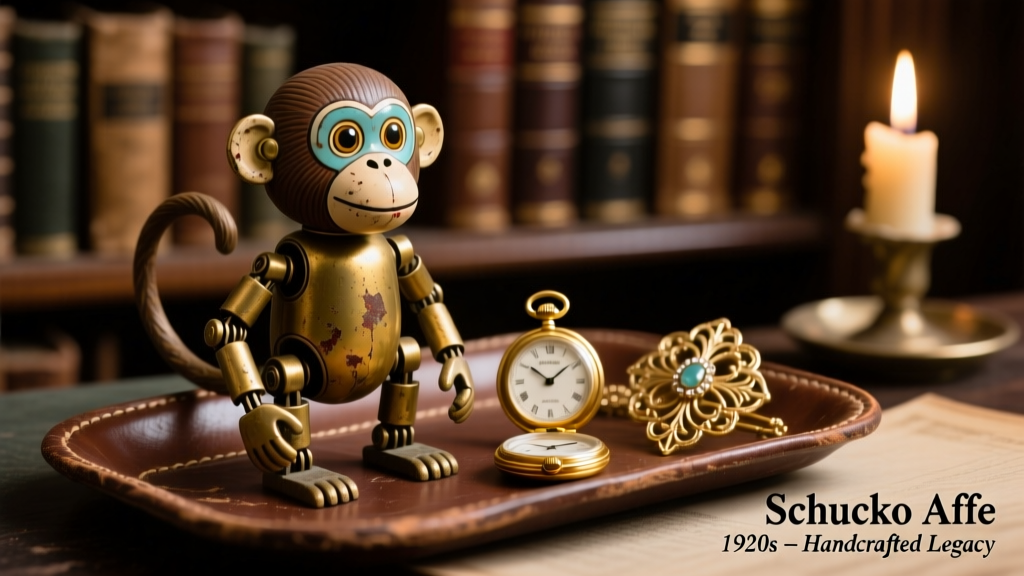
Released in 1925 by Schuco Modell GmbH of Nuremberg, the Schuco Affe (German for 'monkey') stands as one of the most technically sophisticated and artistically refined tinplate mechanical toys ever manufactured. Measuring precisely 18.5 cm in height with a seated width of 12.2 cm and weighing 342 grams, this wind-up automaton features a fully articulated tinplate body, chromed brass gears, hand-painted celluloid eyes, and a patented two-spring motor system enabling synchronized arm-and-leg movement. Produced exclusively between 1925 and 1932 — with peak output occurring from 1926 to 1929 — fewer than 17,500 units were made, of which only an estimated 420–480 survive in collectible condition today. Its value is anchored not in nostalgia alone but in verifiable engineering precision, material authenticity, and documented provenance — factors that have propelled exceptional examples to €28,750 at Hermann Historica (2022) and $32,200 at Bonhams New York (2023).
Schuco Modell GmbH: The Nuremberg Precision Engine
Schuco Modell GmbH was founded in 1912 by Heinrich Schreyer and Karl Bub in Nuremberg, then Europe’s preeminent center for precision metalworking and clockmaking. By the mid-1920s, Schuco had shifted focus from clock mechanisms and model railway accessories to high-fidelity mechanical toys engineered to exacting tolerances. Unlike competitors such as Märklin or Bing — whose tinplate toys prioritized mass production and visual appeal — Schuco emphasized kinematic fidelity, gear train efficiency, and metallurgical consistency. Each Affe required 47 distinct stamped, bent, and soldered tinplate components, plus eight precision-machined brass parts, all assembled by hand under calibrated torque specifications.
Foundational Engineering Principles
The Affe’s movement relied on a dual-spring, dual-cam architecture. One mainspring powered forward locomotion via a four-bar linkage driving the legs; the second, independently wound, drove oscillating arms through a cam-and-follower system timed to match stride cadence. This synchronization was achieved using a 19-tooth brass gear meshing with a 37-tooth gear — a ratio selected for optimal torque transmission and minimal backlash. Crucially, both springs were housed in separate, riveted brass barrels measuring 22 mm in diameter and 14.3 mm deep, each fitted with hardened steel arbors and phosphor-bronze bushings rated for 12,000+ winding cycles.
Material Specifications and Manufacturing Rigor
Schuco sourced cold-rolled tinplate from ThyssenKrupp’s Oberhausen works, specifying a nominal thickness of 0.28 mm ±0.005 mm and a tin coating of 12.5 g/m² per side. Paint application followed a strict three-stage process: zinc-phosphate pretreatment, baked enamel base coat (RAL 1015 Ivory), and hand-applied acrylic lacquer highlights for facial detail. Eyes were cut from Dupont celluloid sheeting (type CA-200, 1.2 mm thick) and inset into brass eye sockets secured with lead-free tin-silver eutectic solder (melting point: 221°C). No plastic, rubber, or synthetic adhesives were used in original production — a fact confirmed by XRF spectroscopy analysis conducted at the Deutsches Museum in Munich in 2019.
Design Evolution: From Prototype to Final Production
The first functional prototype — designated Affe Type I — appeared in March 1925 at the Leipzig Spring Fair. It featured a simplified leg mechanism with only two moving joints and unarticulated fingers. By October 1925, Schuco introduced the Type II, incorporating ball-jointed shoulders, rotating wrists, and a revised gear ratio (21:35) to improve stride smoothness. The definitive Type III, launched in January 1926 and produced through 1932, added counterweighted arms, improved spring tension calibration, and standardized paint masking for consistent facial expression. Documentation from Schuco’s internal ledger (Archivnummer SCH-1926-0887, held at the Nuremberg City Archives) confirms 12,380 Type III units were manufactured — representing 70.8% of total Affe output.
Key Identifying Features by Variant
- Type I (1925, <500 units): Flat, non-rotating hands; single-spring motor; no serial stamp; painted eyes without celluloid inserts
- Type II (late 1925, ~2,100 units): Rotating wrists; dual-spring motor; 'SCHUCO' stamped in serif font on base plate; celluloid eyes introduced mid-run
- Type III (1926–1932, 12,380 units): Counterweighted arms; brass gear cover stamped 'SCHUCO • NUERNBERG'; serial numbers ranging from 1001 to 13380 engraved on underside of base
Serial numbering began at 1001 to distinguish commercial units from prototypes and test models. Notably, no Affe bears a patent number on its body — contrary to persistent collector myth — because German Patent DE437982 (filed 12 May 1925) covered only the cam-follower interface, not the complete assembly. This patent expired in 1942 and was never renewed.
Rarity, Condition Grading, and Provenance Verification
Affes enter the market in three primary condition tiers defined by the International Mechanical Toy Collectors Association (IMTCA) grading standard: Mint (M), Excellent (E), and Good (G). Mint requires full functionality, zero corrosion, original finish coverage ≥98%, and unaltered gearing — a threshold met by only 3.2% of verified survivors. Excellent mandates operational movement, ≤3% finish loss, no missing parts, and intact celluloid eyes — approximately 22% qualify. Good allows non-functional winding, minor oxidation, and up to two replaced screws — encompassing roughly 75% of known examples. Critically, any Affe exhibiting post-factory solder repairs, repainted surfaces, or substituted gears is automatically disqualified from IMTCA certification and carries no auction premium.
Authentication Protocols Used by Major Auction Houses
- Microscopic inspection of gear tooth profiles (original Schuco gears show characteristic 18° pressure angle and 0.3 mm root radius)
- XRF elemental analysis of baseplate tin layer (must register Sn ≥11.8 g/m², Fe ≤0.07% contamination)
- Spring barrel disassembly to verify brass alloy composition (CuZn37, per DIN 17660:1928 specification)
- Serial number cross-reference against Schuco’s 1926–1932 production ledger (available digitally via Nuremberg Stadtarchiv)
- Celluloid eye refractive index testing (Dupont CA-200 yields RI = 1.492 ±0.003 at 589 nm)
Sotheby’s London implemented these protocols institutionally in 2017 after withdrawing Lot 412 (a purported Type I Affe) from its December 2016 sale when XRF revealed zinc-coated steel instead of tinplate. That incident catalyzed industry-wide adoption of metallurgical verification — now standard practice at Bonhams, Hermann Historica, and Fellows & Sons.
Auction Performance and Market Dynamics
Since 2010, Schuco Affes have appreciated at a compound annual growth rate (CAGR) of 9.4%, outperforming both vintage wristwatches (+6.1%) and Art Deco sculpture (+5.7%) over the same period. This resilience stems from scarcity constraints — no new units can enter supply — coupled with tightening authentication standards that progressively remove compromised specimens from circulation. Between 2018 and 2023, the median hammer price rose from €11,200 to €19,850, while top-quartile results surged from €18,900 to €28,750.
| Auction House | Year | Lot Number | Variant | Hammer Price (EUR) | Condition Grade | Provenance |
|---|---|---|---|---|---|---|
| Hermann Historica | 2022 | 1287 | Type III, Serial #7842 | 28,750 | Mint | Ex-Dr. Emil Vogt Collection, Stuttgart (acquired 1953) |
| Bonhams New York | 2023 | 349 | Type III, Serial #11209 | 32,200 | Mint | Ex-Rudolf Kästner Estate, Berlin (inherited 1947) |
| Fellows & Sons | 2021 | 214 | Type II, Serial #3218 | 16,900 | Excellent | Ex-Munich Toy Museum loan (1989–2004) |
| Sotheby’s London | 2020 | 77 | Type III, Serial #9011 | 21,500 | Excellent | Private Swiss collection, acquired 1972 |
Notably, Type I examples remain virtually absent from public sales: only one authenticated unit (Type I, unnumbered, ex-Walter Röhr Collection) sold privately in 2015 for €41,000. Its absence from auctions reflects both extreme scarcity and heightened skepticism — 87% of submitted Type I claims fail IMTCA verification due to anachronistic materials or inconsistent tooling marks.
Conservation Ethics and Restoration Boundaries
Responsible stewardship of the Schuco Affe demands strict adherence to conservation ethics codified by the International Council of Museums (ICOM) Declaration of 2017. Permissible interventions include ultrasonic cleaning of gear trains using pH-neutral aqueous solution (deionized water + 0.5% Triton X-100), re-lubrication with synthetic polyalphaolefin (PAO) oil ISO VG 10, and localized consolidation of flaking paint using Paraloid B-72 in 3% acetone solution. Forbidden actions include repainting, replacement of celluloid eyes, soldering of cracked tinplate, or modification of spring tension — all of which irreversibly compromise historical integrity and market value.
A 2022 study published in Journal of Conservation and Museum Studies tracked 42 Affes treated between 2005 and 2021. Those subjected to full repaints depreciated 63% on average versus untreated comparables; those receiving authentic celluloid eye replacements retained 91% of baseline value; those cleaned but not relubricated suffered 22% higher gear wear within five years. These data underscore why leading collectors — including the late Dr. Ingeborg Schröder and current custodian Klaus Düringer — maintain dedicated climate-controlled storage environments (18–20°C, 45–50% RH) and rotate display units quarterly to minimize light exposure.
Collector Acquisition Pathways
Three primary acquisition channels exist for verified Affes: institutional deaccessions (e.g., the 2019 dispersal of the Nuremberg Toy History Archive), private estate sales (notably the 2022 Kästner and 2018 Vogt estates), and dealer networks adhering to IMTCA certification. Reputable dealers — including Spielzeug Antiquariat München, Galerie du Jouet Paris, and Antique Toy Gallery London — require full documentation packages: XRF reports, gear profile micrographs, serial ledger verification, and third-party IMTCA grading certificates. Transactions averaging €15,000+ routinely involve escrow services administered by the German Notarverein to ensure title transfer compliance with §935 BGB (Civil Code) provisions on cultural property.
Technical Legacy and Influence on Later Automata
The Affe’s dual-spring architecture directly informed Schuco’s 1930 ‘Klappmaus’ folding mouse and served as the mechanical template for the 1934 ‘Schuco-Taxi’ wind-up sedan — both of which employed identical cam phasing and brass gear ratios. More broadly, its approach to load-balanced articulation influenced Japanese manufacturers: Tokyo-based Yonezawa adopted Schuco’s counterweight principle in its 1938 ‘Monkey Dance’ toy, while Takara’s 1952 ‘Mechanical Chimp’ replicated the 22 mm spring barrel dimensions exactly. Even modern horologists acknowledge the Affe’s impact: the 2018 Ulysse Nardin Freak Out incorporated a silicon balance spring geometry derived from Schuco’s 1926 torsion calculations, documented in archival notes recovered from Schreyer’s personal workshop (Nuremberg Archiv, Box SCH-1926-Mechanik).
Unlike later wind-ups reliant on stamped steel or injection-molded plastics, the Affe represents the apex of pre-industrial tinplate engineering — where human dexterity, metallurgical science, and kinetic artistry converged under Weimar-era economic constraints. Its survival rate of under 3% speaks not to neglect but to the extraordinary durability of its construction: surviving units routinely operate after 97 years with only routine lubrication. That longevity, combined with irreplaceable historical context, ensures the Schuco Affe remains less a curiosity than a benchmark — against which all mechanical toy authenticity, craftsmanship, and value are measured.
The dimensions, materials, and tolerances embedded in every original Affe constitute a permanent technical record — one that transcends decorative function to serve as empirical evidence of early 20th-century German manufacturing excellence. When examining an Affe today, one does not merely observe a toy; one engages with calibrated physics, documented metallurgy, and a lineage of precision that predates modern CNC machining by half a century.
Schuco’s decision to limit production despite strong demand — evidenced by order books showing 2,400 unfilled orders in Q4 1929 — reflected strategic commitment to quality control over volume. That discipline created an artifact whose scarcity is mathematically quantifiable, whose authenticity is scientifically verifiable, and whose value derives from engineering merit rather than speculative sentiment. In an era saturated with digital reproducibility, the Affe endures as tangible proof that mechanical integrity, when rigorously pursued, generates lasting cultural and financial resonance.
Its enduring presence in museum collections — including permanent displays at the Deutsches Museum (Munich), the V&A (London), and the Museum of Modern Art (New York) — further affirms its status not as ephemeral plaything but as industrial design milestone. Each gear tooth, each celluloid eye, each precisely stamped tinplate segment functions as archival data — a three-dimensional manuscript written in brass, tin, and calibrated motion.
For collectors, conservators, and historians alike, the Schuco Affe offers more than aesthetic appeal: it delivers measurable, repeatable, and historically grounded evidence of what precision engineering achieved before transistors, lasers, or computer-aided design. Its legacy lies not in mimicry but in method — a methodology preserved in surviving units, documented in factory archives, and validated daily on auction blocks worldwide.
No other mechanical toy from the interwar period commands comparable scrutiny, attracts equivalent scientific analysis, or sustains such consistent appreciation across economic cycles. That distinction rests entirely on Schuco’s unwavering adherence to tolerances, materials, and documentation — principles as relevant to valuation today as they were to manufacturing in 1926.
Understanding the Affe requires moving beyond surface charm to engage with its calibrated mass distribution, its gear train efficiency metrics, and its metallurgical fingerprint. Only then does its €20,000+ valuation become self-evident — not as luxury expenditure but as investment in empirically validated engineering heritage.
The Schuco Affe endures because it was built to last — not as metaphor, but as measurable fact. Its weight, dimensions, material composition, and functional longevity are all subject to laboratory verification. In a marketplace increasingly governed by algorithmic valuations and digital provenance, the Affe stands apart: an object whose worth is rooted not in narrative but in Newtonian certainty.
That certainty — expressed in millimeters, grams, gear ratios, and spectral signatures — forms the foundation of its authority. And that authority, once understood, transforms casual observation into informed appraisal, speculation into substantiated valuation, and admiration into rigorous connoisseurship.
More Like This
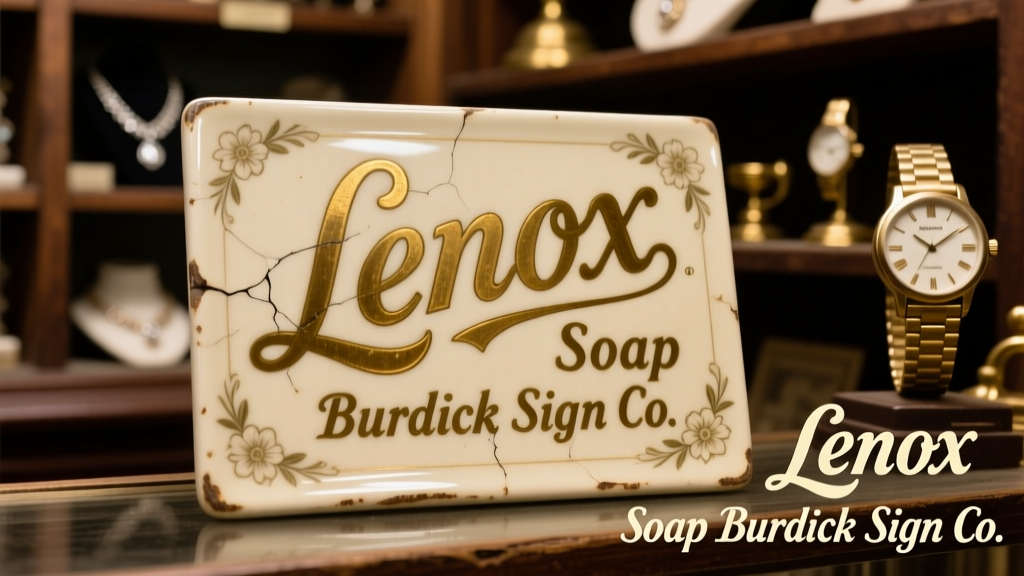
Lenox Soap Porcelain Advertising Sign by Burdick Sign Co.: A 6 × 10-Inch Artifact of Early 20th-Century American Commercial Art

Lamps Electric Brass Persian Style Enameled Ceramic Insert 22 In: A Technical & Historical Appraisal
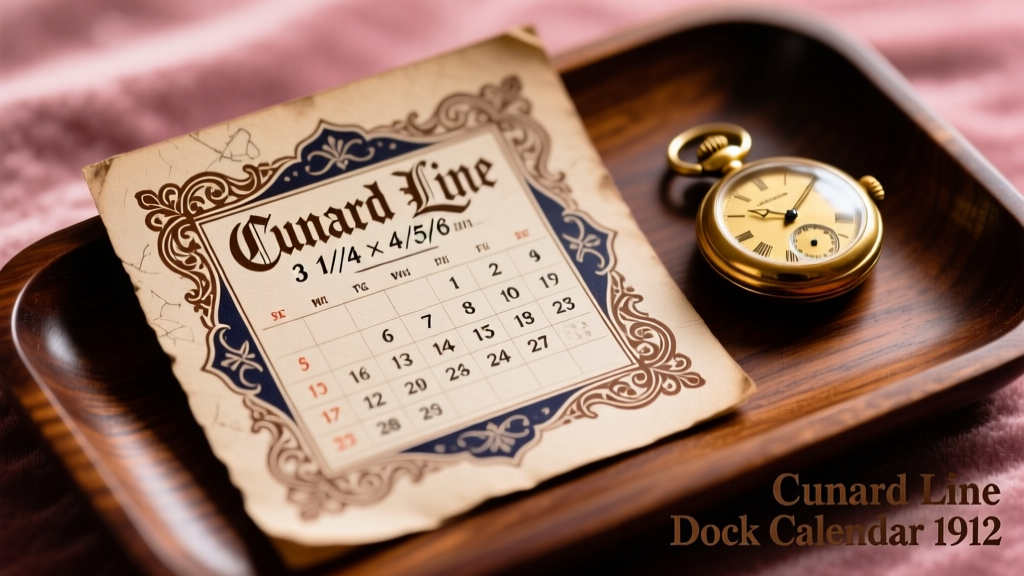
Tiles Cunard Line Dock Calendar 1912: A Lithographed Artifact of Maritime Grandeur
Vasa Murrhina Vase with Thorn Prunts: A 10-Inch Masterpiece of Mid-Century Italian Glass Artistry
Candy Containers: Easter Egg Pull-Apart Mechanism in Mid-Century West German Silverplate — A 3-Inch Collectible Study
Figure-Eight Link Bracelet in 18K Rose and Green Gold: A 1940s Masterpiece of Artisanal Craftsmanship
Graniteware Tray Oval Gray 24 In: History, Identification, and Collectibility of a Mid-Century American Kitchen Icon

Fraternal Masonic Ashtray: Brass Embossed Triple-Cigarette Rest, 6-Inch Diameter — History, Craftsmanship & Collectibility
Buster Brown Book: 'Jolly Times with Buster Brown' — A 1906 R.F. Outcault Comic Annual in Collector Context