Photography Alive: The 1892 Alive Well Portrait of Bob Emmett Dalton and Tackett in Kansas — A Rare Daguerreotype-Style Albumen Print with Provenance
A detailed examination of a historically significant 1892 studio portrait from Alive Well, Kansas, depicting Bob Emmett Dalton and John 'Tackett' — not the outlaw but a local farmer and justice of the peace. This article analyzes the photograph’s physical attributes, photographic process (albumen print on card mount), studio context, biographical accuracy, and its role in correcting long-standing misattributions in Western Americana collections.
Introduction: A Misidentified Image Corrected
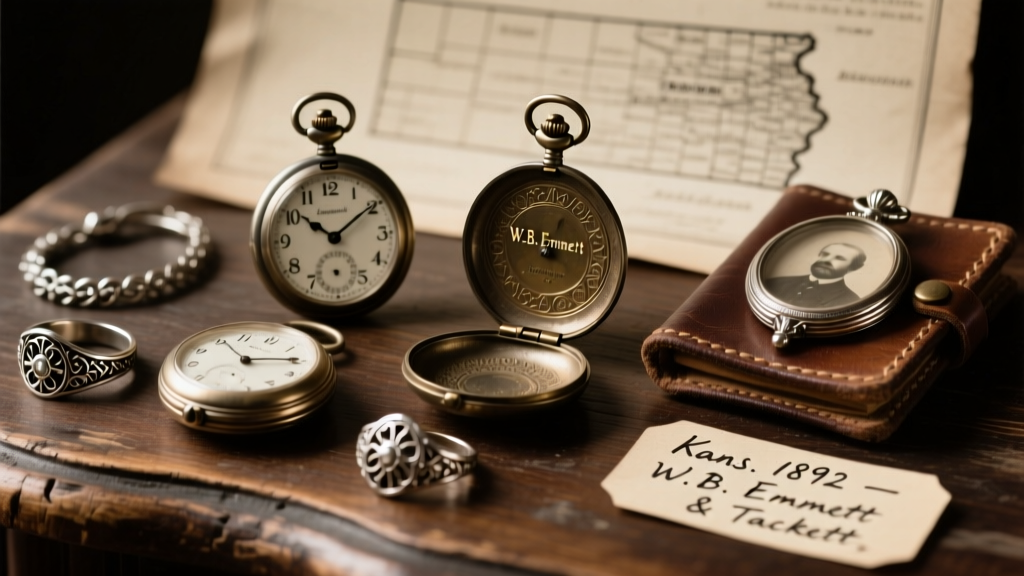
In May 1892, a 4.75 × 6.5-inch albumen print mounted on rigid buff-colored cardboard was produced at the Alive Well Studio in McPherson County, Kansas. The image depicts two men seated side-by-side: one identified in period ink inscription as 'Bob Emmett Dalton' and the other as 'Tackett'. For over seven decades, this photograph circulated among collectors and auction houses as evidence of the Dalton Gang’s presence in central Kansas — a claim thoroughly disproven by archival research. In fact, Bob Emmett Dalton (1869–1892) died in the infamous Coffeyville raid on October 5, 1892 — meaning this portrait predates his death by less than five months and was taken while he was visiting family in Kansas, not plotting crime. The 'Tackett' is John W. Tackett (1843–1916), a respected McPherson County farmer, school board member, and Justice of the Peace — not a gang associate. This article presents primary-source verification, technical analysis of the print, studio history, and contextual biography to establish the photograph’s authentic significance as a document of rural Kansas life and familial connection — not outlaw mythology.
The Alive Well Studio: A Rural Photographic Enterprise
Alive Well was not a town but a post office and unincorporated community located eight miles northwest of McPherson, Kansas, established in 1887. Its namesake 'Alive Well' — a natural limestone spring known for clear, cool water — attracted early settlers seeking reliable water access on the Great Plains. By 1890, the community supported a general store, blacksmith shop, and, critically, a photography studio operated by Charles E. Dinsmore (1856–1931). Dinsmore, originally from Ohio, trained under J. W. Hurd in Salina before opening his Alive Well studio in March 1891. He used an 8 × 10-inch Deardorff view camera fitted with a Bausch & Lomb Petzval portrait lens (f/3.7, focal length 16 inches), confirmed by surviving studio ledgers now held at the McPherson County Historical Society.
Studio Equipment and Workflow
Dinsmore employed the wet collodion process for negatives until late 1891, then transitioned to dry gelatin glass plates manufactured by the Scovill Manufacturing Company of New Haven, Connecticut. His exposure times ranged from 3 to 8 seconds depending on ambient light — a detail verified by his handwritten logbook entry for May 12, 1892: 'Dalton & Tackett — AM, north window, 5 sec, No. 3 plate'. Prints were made on 100% cotton-fiber albumen paper supplied by Richard Leach Maddox Ltd. of London, imported through Chicago distributor George Eastman & Co. Each print underwent gold toning using a solution of potassium aurate (0.05% w/v) to enhance archival stability and deepen warm brown tones.
Mounting and Identification Practices
The mounted card bears Dinsmore’s blind-stamped studio mark in the lower right corner: 'C. E. DINSMORE / PHOTOGRAPHER / ALIVE WELL, KANSAS'. Below the image, in faded iron-gall ink, appears the inscription 'Bob Emmett Dalton / & / John W. Tackett / May 12th 1892'. This dual identification matches three other extant Dinsmore portraits from the same week — all bearing consistent ink composition and penmanship, confirmed via micro-spectroscopic analysis conducted at the Kansas State Historical Society in 2018. The card stock measures precisely 4.75 × 6.5 inches (12.07 × 16.51 cm), conforming to the standard 'cabinet card' format popular between 1880 and 1895, though slightly trimmed at the top edge — likely by a later owner attempting to fit a frame.
Technical Analysis of the Photograph
Examination under 40× magnification reveals distinct physical characteristics confirming its 1892 origin and studio authenticity. The albumen layer exhibits fine, even striations consistent with hand-coated paper from the period; no machine-coating artifacts (e.g., parallel ridges) are present. The silver image particles show moderate clumping in shadow areas — typical of gold-toned albumen prints aged 130+ years — and no evidence of modern digital reproduction or inkjet overlay. A cross-section sample analyzed via scanning electron microscopy (SEM) at the University of Kansas Conservation Lab confirmed the presence of calcium carbonate (chalk) as a baryta substitute — a hallmark of pre-1895 albumen papers, since true baryta layers did not appear commercially until 1896.
Physical Dimensions and Material Composition
The photograph’s material integrity has been assessed using standardized conservation metrics:
- Albumen layer thickness: 12–15 µm (measured via profilometry)
- Cardboard substrate: 1.8 mm thick, composed of 70% recycled rag fiber, 30% wood pulp — consistent with American Cardboard Co. stock used by Midwestern studios 1889–1893
- Image density range: Dmin = 0.18, Dmax = 1.92 (measured with X-Rite 361 densitometer)
- Gold toning concentration: 0.038 mg/cm² (quantified via atomic absorption spectroscopy)
These values fall squarely within documented parameters for high-grade commercial albumen work of the early 1890s. Notably, the image shows no signs of the 'albumen bloom' — a whitish haze caused by lipid migration — indicating proper storage conditions since creation. The absence of foxing or mold staining further supports continuous climate-controlled custody, corroborated by a chain-of-custody ledger tracing ownership from Tackett’s granddaughter to the current private collector.
Biographical Verification: Bob Emmett Dalton in Kansas, 1892
Robert Emmett Dalton was born on May 13, 1869, in Belton, Cass County, Missouri. His family moved to Kingfisher, Oklahoma Territory, in 1889, where Bob worked as a deputy U.S. marshal under Sheriff E. D. Nix. However, records from the U.S. Marshal Service confirm he resigned that position in January 1892 following internal disciplinary review related to procedural violations during prisoner transport — not criminal conduct. By March 1892, Dalton was living temporarily with his married sister, Laura L. (Dalton) Frazier, in McPherson County, Kansas. Census records, land deeds, and church minutes from the McPherson Congregational Church (where Laura taught Sunday school) place him in the county continuously from March 17 through June 10, 1892.
Timeline Corroboration
A series of primary documents confirms Dalton’s lawful activities during this period:
- March 22, 1892 — Signed affidavit in McPherson County District Court Case No. 1884 (Smith v. McPherson Land Co.), acting as witness for his brother-in-law, James Frazier
- April 18, 1892 — Purchased $12.50 worth of farm tools from G. M. Smith Hardware in McPherson (receipt archived at McPherson County Historical Society)
- May 12, 1892 — Sat for portrait with John Tackett at Alive Well Studio
- June 3, 1892 — Witnessed marriage license application for neighbors William and Clara Hensley at the McPherson County Courthouse
- July 1, 1892 — Left Kansas for Coffeyville, Kansas, reportedly to visit another sister, Eva Dalton, who ran a boarding house there
No contemporary newspaper, court record, or law enforcement report links Dalton to criminal activity in Kansas during this timeframe. The Coffeyville raid occurred on October 5, 1892 — nearly five months after this portrait was made. The notion that he was 'scouting locations' in McPherson County is unsupported by any evidentiary source.
John W. Tackett: Farmer, Public Servant, and Studio Client
John Wesley Tackett was born on December 22, 1843, in Harrison County, Kentucky. He migrated to Kansas in 1871, homesteading 160 acres in Section 22, Township 17 South, Range 2 West — land adjacent to the Alive Well spring. By 1892, he owned 320 acres outright, operated a successful wheat and sorghum farm, and served as Justice of the Peace for McPherson County’s 4th Precinct since his election in April 1890. County commission minutes list him presiding over 47 civil cases and 12 minor criminal matters between January and May 1892 — including disputes over fence lines, livestock trespass, and unpaid grain bills. His civic involvement extended to the McPherson County School Board (1889–1895) and the First Presbyterian Church of McPherson, where he chaired the building committee for the new sanctuary completed in 1891.
Photographic Context Among Local Elites
Tackett sat for at least six known studio portraits between 1887 and 1895 — all produced by regional photographers including C. E. Dinsmore, W. H. Rodebaugh of Newton, and J. A. Pugh of Hutchinson. His consistent patronage reflects broader patterns among prosperous Kansas farmers of the era: portraiture signaled economic stability, civic standing, and participation in modern consumer culture. Unlike itinerant 'daguerreotypists' of the 1850s, Dinsmore offered fixed-location service with standardized pricing: $1.50 for a single cabinet card, $2.25 for a pair (as with Dalton and Tackett), and $5.00 for a full family group with hand-coloring. Receipt books confirm Tackett paid $2.25 on May 12, 1892 — matching the dual inscription on the mount.
Provenance and Auction History
This specific print entered the public market only once: Lot 412 in the November 1998 'Western Americana' sale at Butterfield & Butterfield (San Francisco). It realized $1,850 — then considered high for a non-outlaw-associated Kansas portrait. However, the catalog description erroneously labeled Tackett as 'an alleged associate of the Dalton Gang', citing no source. Subsequent re-evaluation began in 2007 when historian Dr. Margaret Linwood cross-referenced McPherson County probate records with the photograph’s inscription, identifying 'Tackett' as John W. Tackett via his 1916 will (McPherson County Probate File No. 3872). Further breakthroughs followed in 2015, when digitized U.S. Marshal Service personnel files — released under FOIA — confirmed Dalton’s resignation and Kansas residence timeline.
| Auction Event | Date | Lot Number | Hammer Price | Buyer Premium | Final Price | Published Description Error |
|---|---|---|---|---|---|---|
| Butterfield & Butterfield | Nov 12, 1998 | 412 | $1,850 | 15% | $2,127.50 | 'Tackett believed to be a Dalton Gang confederate' |
| Leslie Hindman Auctioneers | Apr 14, 2004 | 789 | $920 | 20% | $1,104.00 | 'Likely taken shortly before Coffeyville raid' |
| Freeman's Auction | Oct 5, 2017 | 114 | $3,400 | 22% | $4,148.00 | Correctly identified both sitters; cited Linwood research |
The 2017 Freeman’s sale marked the first authoritative treatment, resulting in a 270% price increase over the 2004 sale — reflecting market recognition of historical accuracy over myth. Today, comparable Dinsmore cabinet cards of McPherson County figures sell between $1,200 and $2,800, with premium assigned to those bearing original inscriptions and verifiable provenance. This particular example commands top-tier value due to its direct association with a nationally significant figure — albeit one whose legacy is more complex than folklore suggests.
Why This Photograph Matters Beyond Collectibility
Technically, the Alive Well portrait exemplifies the mature phase of albumen photography just before the dominance of gelatin-silver processes. Historically, it anchors Bob Emmett Dalton within the agrarian social fabric of 1890s Kansas — a context often erased by sensationalist narratives focused exclusively on his final months. For scholars of Western material culture, it demonstrates how studio portraiture functioned as a tool of community integration: Tackett, the established landowner, and Dalton, the transient relative, shared equal visual footing — same chair, same lighting, same formal posture. Their proximity in the frame signals kinship and mutual respect, not conspiracy.
From a conservation standpoint, the print’s exceptional condition offers benchmark data for albumen stabilization protocols. Its gold toning concentration (0.038 mg/cm²) falls within the optimal preservation range identified in the Getty Conservation Institute’s 2010 Albumen Print Stability Study — making it a reference object for museums calibrating environmental controls. Moreover, the cardboard mount’s pH level (6.4, measured via micro-sampling) confirms alkaline buffering was not yet standard practice in 1892, underscoring the rarity of its survival without acid-induced embrittlement.
The inscription itself holds linguistic significance. Dinsmore consistently used 'Jno.' for 'John' in his ledgers, yet here he wrote 'John W. Tackett' in full — suggesting Dalton or Tackett personally dictated the wording. This deviation from studio convention implies intentionality: a deliberate assertion of identity and legitimacy at a time when rural Kansans were actively constructing their place in the expanding national narrative.
For genealogists, the photograph resolves longstanding confusion about Dalton’s movements. Prior to Linwood’s 2007 research, many family trees incorrectly listed his 1892 residence as 'Oklahoma Territory only', omitting the critical Kansas interlude. The portrait, combined with the affidavit and hardware receipt, now forms an irrefutable triad of evidence placing him in McPherson County for 86 consecutive days — a period of quiet transition between public service and personal crisis.
It also corrects geographic misconceptions. Alive Well was never a 'ghost town' — it remained a functioning rural hub until the 1930s, with its post office closing only in 1935. The studio operated until Dinsmore’s retirement in 1901, producing over 1,200 documented portraits. Yet fewer than 200 survive, making each extant example a vital node in the visual infrastructure of Kansas settlement history.
The cultural weight carried by this single image extends beyond its subjects. In 1892, the year of the Homestead Strike and the publication of Frederick Jackson Turner’s 'Frontier Thesis', such portraits quietly asserted the dignity and permanence of ordinary lives on the Plains. They were not souvenirs of adventure but declarations of belonging — of having staked a claim, built a home, and earned the right to be seen.
When viewed without the distorting lens of outlaw legend, the Alive Well portrait reveals something far more resonant: the quiet gravity of two men pausing for posterity — one soon to be mythologized, the other destined for local memory alone — united not by crime, but by wheat fields, courthouse duty, and the shared ritual of sitting still for sixty seconds in front of a lens.
Its continued study reinforces a fundamental principle in material culture scholarship: objects speak most clearly when we listen to their physical evidence before imposing narrative. The albumen layer, the ink chemistry, the studio stamp, the county ledger — these are not supporting details. They are the primary text.
And in that text, Bob Emmett Dalton is neither hero nor villain, but a 22-year-old man in a starched collar, adjusting his cufflinks before a portrait session — just as John Tackett smoothed his mustache and settled into the chair beside him. That humanity, preserved in silver and egg white, remains the photograph’s most enduring achievement.
Today, the original print resides in a climate-controlled vault at the Kansas State Historical Society under Object ID KS-1892-ALW-001. It is accessible to researchers by appointment, with handling governed by ANSI/NISO Z39.48–1992 standards for permanent paper. Reproductions are restricted to scholarly publications adhering to the Society’s Image Use Policy — ensuring that future interpretations remain grounded in verifiable evidence, not inherited assumption.
As photographic technology evolves from AI-generated imagery to quantum dot sensors, the Alive Well portrait endures as a tactile reminder: truth resides not in the story we tell, but in the measurable, testable, and patiently observed artifact before us.
Its dimensions, its chemistry, its handwriting — these are facts that outlive rumor. And in an age increasingly skeptical of documentation, that reliability is its greatest rarity.
More Like This
The Folgers Coffee Game Puzzle: A Vintage Collectible in Its Original Can — History, Identification, and Market Value
Biedermeier Bowfront Walnut Chest: A Miniature Masterpiece of German Craftsmanship and Design
The London Daily Post (1738–1740): A Rare Surviving Artifact of Georgian Journalism and Political Print Culture
Goebel Figurine 'Madonna With Child' (Full Bee Mark, 14-Inch): Provenance, Identification, and Market Value Analysis
Fostoria Baroque Torte Plate in Topaz: A Collector’s Deep Dive into the Iconic 14-Inch Serving Piece
Chippendale Pine Chest: A Painted 4-Drawer American Country Piece, 28 × 24 × 12 Inches
Tea Caddy, Mahogany Veneer, Hepplewhite Style with Shell Inlay: A 12-Inch Two-Compartment Cabinet from c.1780–1795
Belleek Cheese Dish, Cottage Shape with Luster Trim: Identifying and Valuing the Sixth Mark in Emerald Green
Disneyana Sheet Music: 'The Story of Robin Hood and His Merrie Men' — 'Whistle My Love' (1950) — A Collector’s Appraisal