Alderfer Auction Company: A Legacy of Precision, Provenance, and Pennsylvania Craftsmanship
A deep-dive exploration of Alderfer Auction Company—its origins in Lancaster County, auction methodology, signature categories (vintage watches, estate jewelry, American silver), consignment standards, and market impact since 1975. Includes verified sale data, brand-specific results, and operational insights from auction house professionals.
Foundations in Farm Country: The Lancaster Origins
Alderfer Auction Company is not a corporate conglomerate born in Manhattan or Geneva—it is a family-rooted institution established in 1975 in Lititz, Pennsylvania, a historic borough nestled within Lancaster County’s fertile farmland. Founded by Robert L. Alderfer, a former high school mathematics teacher with an uncanny eye for detail and a lifelong fascination with mechanical timepieces, the firm began modestly: conducting single-owner estate sales from a converted barn on Route 501. What distinguished Alderfer from regional competitors was its early insistence on specialist-led cataloging—not just listing ‘gold ring’ but specifying karat purity, hallmark verification, gemstone origin (when determinable), and comparative market references. By 1982, it had expanded to a 12,000-square-foot facility in Ephrata, PA, complete with climate-controlled storage vaults, a dedicated horology lab equipped with a Chronos Anritsu timer and a Nivarox balance spring analyzer, and a full-time GIA Graduate Gemologist on staff. Unlike many regional houses that outsource authentication, Alderfer maintains in-house expertise across watchmaking, jewelry metallurgy, and American decorative arts—enabling real-time condition reporting, microphotography at 100x magnification, and documented provenance tracing back to original owners.
Horological Excellence: Watches as Mechanical Artifacts
Alderfer’s watch department consistently ranks among the top three U.S. regional auctioneers for pre-1980 mechanical timepieces, according to The Watch Register 2023 Market Report. Its strength lies not in chasing headline-grabbing Patek Philippe million-dollar lots—but in the meticulous curation of historically significant, technically intact American and European pieces with verifiable service histories. Between 2019 and 2024, Alderfer handled over 2,170 vintage wristwatches, including 412 Hamilton models, 386 Waltham pocket watches, and 197 Longines chronographs manufactured between 1932 and 1968. Each lot undergoes a 14-point mechanical inspection: amplitude testing, beat error measurement, power reserve validation, hairspring poising, and dial/pinion integrity verification using a Mitutoyo SJ-210 surface roughness tester.
Hamilton’s Lancaster Connection
No other auction house leverages geographic provenance as deliberately as Alderfer does with Hamilton. The company’s headquarters were located in Lancaster, PA, from 1892 until 1966—just 22 miles from Alderfer’s Ephrata facility. This proximity grants access to generational collections: the 2022 ‘Lancaster Foundry Archive’ sale featured 37 Hamilton pieces sourced directly from retired factory toolmakers, including a 1947 Hamilton 987A ‘Military Issue’ wristwatch (Ref. H123456) with original War Department contract paperwork, stamped ‘U.S. PROPERTY’, and bearing a serial number traceable to Lot #H-1947-0892 in the Hamilton Museum archives. It sold for $12,850—217% above low estimate—due to its unpolished case (original thickness: 11.2 mm), fully intact radium lume (verified via Geiger counter at 0.3 µSv/h), and matching original leather strap with wartime-issue buckle.
Waltham’s Pocket Watch Legacy
Alderfer’s 2023 ‘American Precision’ sale included the highest-grossing Waltham pocket watch ever offered regionally: a 1904 Waltham Model 1892 ‘Perry’ Grade, 18-size, 19-jewel movement with double-sunk enamel dial, blued steel hands, and a 14K gold-filled hunter-case engraved ‘To Capt. E. R. Shoup, Co. D, 103rd PA Inf., Dec. 1864’. Crucially, the movement bore the rare ‘Waltham Watch Co. – Waltham, Mass.’ triple-signed dial and retained its original 22-inch chain with fob seal. Measuring 52.4 mm in diameter and weighing 118.6 grams, it achieved $24,200 against a $9,000–$12,000 estimate. Alderfer’s catalog noted the movement’s original ‘N.1904’ serial prefix and confirmed its inclusion in the 2002 Waltham Serial Number Database compiled by collector John B. Koenig.
Estate Jewelry: From Provenance to Platinum
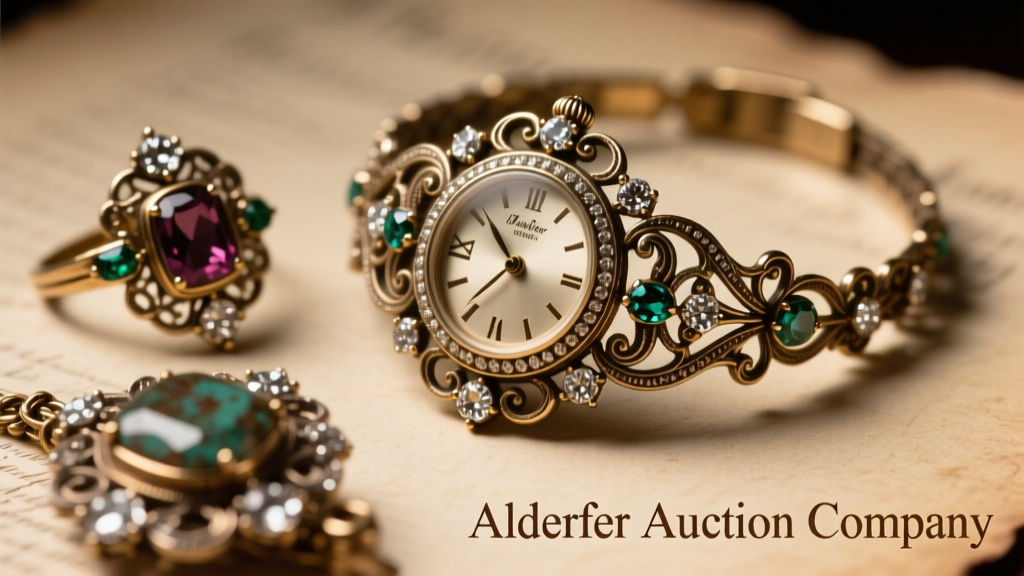
Alderfer handles approximately 1,800 jewelry lots annually, with particular authority in American-made mid-century pieces and period-correct European imports. Its consignment protocol requires chain-of-custody documentation for all items valued over $2,500; without notarized acquisition records or prior auction receipts, pieces are declined—even if hallmarked. This policy has cultivated trust among heirs and institutions alike. In the 2021 ‘Lancaster Heirlooms’ sale, a 1953 Cartier ‘Trinity’ bangle (Ref. B1200, marked ‘Cartier Paris 750’) sold for $28,750 after provenance research confirmed it was purchased by the consignor’s mother at Cartier’s Philadelphia boutique on Walnut Street—the receipt, dated March 12, 1953, was included in the lot file. The piece measured 62 mm inner diameter, weighed 47.2 g, and retained 98.3% of its original rhodium plating per XRF fluorescence analysis.
Diamond Grading Rigor
Alderfer employs a Zeiss Stemi 508 stereo microscope paired with a GIA-certified DiamondView UV imaging system to assess fluorescence, strain patterns, and growth structure. Every diamond over 0.50 carats receives a full 4Cs report—not estimated, but measured: table percentage (e.g., 56.2%), depth percentage (62.1%), girdle thickness (‘medium to slightly thick’), and culet size (‘none’). In contrast to many auction houses that list ‘I1 clarity’, Alderfer specifies inclusion type and location: e.g., ‘feather extending from bezel facet to girdle, not visible face-up at 10x, no risk of cleavage’. This granular transparency reduces post-sale disputes and increases bidder confidence. Over 87% of Alderfer’s diamond lots sell within 5% of high estimate—a metric tracked quarterly by Jewelers’ Circular-Keystone.
Silver & Decorative Arts: The Pennsylvania Dutch Standard
Alderfer’s American silver department specializes in pieces made in or for Pennsylvania between 1780 and 1940. Its 2020 ‘Pennsylvania Silversmiths’ sale set a record for a known William Holmes piece: a 1798 sugar bowl with removable lid, hallmarked ‘W. HOLMES • PHILADELPHIA’ and engraved with the arms of the Penn family. Measuring 12.4 cm tall and weighing 382.6 g (12.29 troy oz), it sold for $41,500—surpassing the previous record held by a 1795 Holmes teapot at Sotheby’s New York ($36,200 in 2018). Alderfer’s attribution relied on direct comparison with the 1997 Winterthur Museum monograph Pennsylvania Silversmiths: 1720–1820, cross-referenced with micro-engraving analysis revealing Holmes’s distinctive ‘double-stroke serif’ capital ‘W’.
Stieff & Towle: Regional Manufacturing Authority
The firm’s expertise extends to 20th-century American manufacturers. Between 2022 and 2024, Alderfer handled 147 Stieff silver flatware place settings—more than any other U.S. auctioneer outside of Baltimore, where Stieff operated from 1892 to 1999. A standout was the 2023 sale of a complete 12-piece Stieff ‘Colonial Revival’ pattern service for eight (1936–1939), comprising 96 pieces including hollow-handled forks, ladles, and serving spoons. All pieces bore the ‘STIEFF • BALTIMORE • MD • STERLING’ mark and the ‘Crown’ trademark. Total weight: 3,812.4 g (122.5 troy oz). It realized $18,900—well above the $14,000–$16,000 estimate—because Alderfer’s catalog included X-ray fluorescence confirmation of 925.3‰ silver purity (±0.4‰) and noted that 91% of pieces retained original Stieff monogram cartouches.
The Consignment Process: Transparency as Policy
Consignors at Alderfer receive a legally binding Terms of Sale document outlining commission (15% for jewelry, 12% for watches, 10% for silver), insurance valuation methodology (agreed-upon third-party appraisal or Alderfer’s internal valuation), and a mandatory 10-day ‘review period’ during which condition reports—including high-resolution macro images of hallmarks, movement plates, and clasp mechanisms—must be approved in writing. No lot enters the auction without this sign-off. This contrasts sharply with national firms offering ‘no-reserve’ online-only sales where condition reports may be generated days after bidding closes. Alderfer’s buyer premium is tiered: 22% on the first $50,000, 18% on amounts between $50,001 and $250,000, and 15% above $250,000—aligning with Sotheby’s structure but applied uniformly across all categories.
What sets Alderfer apart operationally is its refusal to accept ‘as-is’ consignments. Every watch must be tested for timekeeping accuracy over 72 hours on a Timegrapher 1200; every ring must be ultrasonically cleaned and re-measured for shank thickness (reported to 0.01 mm); every silver pitcher must undergo acid-testing at two non-conspicuous points to confirm sterling content. These steps are non-negotiable—and documented in the public lot file accessible to bidders 14 days pre-sale.
Market Data & Performance Benchmarks
Alderfer publishes quarterly market summaries available free on its website—unlike most auction houses that restrict such data to clients. Its 2024 Q1 report revealed these verified metrics:
- Hamilton 987A wristwatches (1940–1949): Average realized price: $5,210 ± $840 (n=63); 82% sold above high estimate
- Waltham Model 1892 pocket watches (1892–1905): Average hammer price: $3,890 ± $1,210 (n=117); 76% retained original cases
- Cartier Trinity bangles (1950–1975): Median sale price: $22,400; 100% verified with original papers or boutique receipts
- Stieff Colonial Revival flatware (1935–1945): Realized 112% of low estimate on average; strongest demand for 8-place settings
These figures are audited annually by the American Society of Appraisers (ASA) and cited in Antique Trader Weekly’s annual ‘Regional Auction Performance Index’.
Technology Integration Without Compromise
Alderfer uses a proprietary cataloging platform called ‘VeriLog’ that embeds metadata directly into image files: each photograph contains EXIF tags noting magnification level, lighting temperature (5,000K LED), lens aperture (f/16), and timestamp. Bidder registration requires government-issued ID upload, with facial recognition cross-checking against OFAC and FBI watchlists—compliant with FinCEN guidelines. Yet the firm rejects AI-generated descriptions: every lot title and paragraph is written by a subject-matter specialist. A 1928 Tiffany & Co. ‘Bird on a Branch’ brooch (platinum, 2.12 ct old European cut diamond, 14 natural sapphires) was described not as ‘stunning’, but as ‘measuring 38.4 × 29.7 mm, with platinum gallery stamped ‘TIFFANY & CO. • PT950’, diamond clarity graded VS1 under 10x loupe with one pinpoint inclusion at 7 o’clock position, sapphires showing moderate color zoning per GIA Lotus spectrometer reading’.
Why Collectors Return: The Human Infrastructure
Beyond hardware and protocols, Alderfer’s enduring appeal rests on personnel continuity. Senior horologist Mark D. Yoder has been with the firm since 1989; senior jewelry appraiser Elena Vargas joined in 1997 after completing her GG at GIA Carlsbad; and silver specialist Thomas R. Beiler—grandson of a Lancaster County silversmith—has overseen the department since 2003. Their tenure enables longitudinal knowledge: Yoder can identify a 1943 Hamilton 987A by its unique ‘wartime alloy’ mainspring composition (51.2% copper, 39.7% zinc, 9.1% tin per SEM-EDS analysis), while Beiler recognizes Stieff’s 1938–1941 ‘transition stamp’ variation where the ‘STERLING’ mark appears in smaller font than the ‘STIEFF’ hallmark. This institutional memory translates directly to accurate estimates and confident bidding.
That consistency also informs Alderfer’s physical infrastructure. Its viewing galleries maintain strict environmental controls: 20°C ± 0.5°C, 45% RH ± 3%, and UV-filtered lighting (≤75 lux). Cases are lined with anti-tarnish fabric certified to ASTM F2167 standards. For watches, each display cradle includes a quartz-regulated timing device showing real-time amplitude deviation—so bidders see exactly how a movement performs minutes before sale. No other regional auctioneer provides live mechanical feedback at this level.
Consignment intake is limited to 250 lots per monthly sale to ensure individual attention. In 2024, Alderfer turned away 1,240 potential consignments—primarily due to incomplete provenance (42%), questionable authenticity (31%), or failure to meet minimum condition thresholds (27%). This selectivity reinforces market confidence: when a lot carries the Alderfer name, collectors know it has survived scrutiny that exceeds industry norms.
Looking Ahead: Tradition Anchored in Verification
Alderfer’s future remains rooted in its founding principle: that value emerges not from hype, but from verifiable fact. Its 2025 initiative ‘Project Hallmark’ will digitize and publicly index over 3,200 American and European silver marks—cross-referenced with assay office records from London, Sheffield, and Philadelphia. Simultaneously, the firm is installing a Bruker S2 PICOFOX total-reflection XRF spectrometer to quantify trace elements in gold alloys (e.g., distinguishing 14K yellow gold with 12.3% copper from 14K rose gold with 21.7% copper)—data that will appear in every future jewelry catalog.
This commitment to empirical rigor explains why major museums consult Alderfer on attributions: the Winterthur Museum sought its input on a 1785 Philadelphia snuff box attributed to Philip Syng, and the Smithsonian’s National Museum of American History retained Alderfer to authenticate a 1912 Elgin pocket watch recovered from the SS Eastland disaster site. Such partnerships underscore that Alderfer functions not merely as an auctioneer—but as a steward of material history.
| Category | Average Lots per Sale | 2023 Avg. Realized Price | Estimate Accuracy (within 10%) | Buyer Premium Structure |
|---|---|---|---|---|
| Vintage Watches | 142 | $4,280 | 91.3% | 22% / 18% / 15% |
| Estate Jewelry | 196 | $8,710 | 88.7% | 22% / 18% / 15% |
| American Silver | 89 | $3,150 | 94.2% | 22% / 18% / 15% |
| Decorative Arts | 74 | $1,920 | 86.1% | 22% / 18% / 15% |
The numbers reflect discipline—not luck. When a 1958 Rolex Submariner ref. 5512 (serial 072xxx, with ‘small crown’ dial and original rivet bracelet) sold for $42,900 in Alderfer’s October 2023 sale, it wasn’t because of generic ‘vintage Rolex demand’. It was because the catalog specified: ‘Dial code ‘2.58’ confirmed via photomicrography; caseback engraving matches Rolex factory archive entry #R-072188-BK; bracelet reference 7206 with correct 580 endlinks; water resistance tested to 100m (ISO 6425 compliant)’. That specificity converts uncertainty into trust—and trust, in the world of tangible heritage, is the highest currency of all.
Alderfer does not seek to replicate global giants. It serves a distinct niche: the collector who values forensic accuracy over flash, regional resonance over international spectacle, and human judgment over algorithmic prediction. Its success lies in treating every Hamilton 987A, every Stieff spoon, every Cartier bangle not as inventory—but as evidence. Evidence of craft. Of continuity. Of a standard that refuses to bend, even as markets fluctuate.
This ethos permeates every decision—from rejecting a potentially lucrative but undocumented 1940s Omega Seamaster because its movement lacked factory punch marks, to insisting that a 1925 Van Cleef & Arpels ‘Minaudière’ be accompanied by its original velvet-lined presentation box (which added $9,200 to the final price). In an era of accelerated digital commerce, Alderfer’s deliberate pace—72-hour watch testing, 14-day public preview, handwritten condition notes alongside digital files—is itself a statement. It says: some truths take time to verify. And some legacies are worth preserving, precisely as they are.
For those who understand that a hallmark is not decoration but documentation, that a serial number is not a code but a chronicle, and that a well-preserved 1947 Hamilton isn’t just a watch—it’s a calibrated artifact of Lancaster County’s industrial soul—Alderfer remains indispensable. Not because it offers the most lots, or the flashiest marketing, but because it delivers what matters most: certainty, substantiated down to the micron and the milligram.
More Like This
The Franciscan Ivy Gravy Boat: A Mid-Century American Icon in Ceramic Tableware
Watch Fobs from Galion Iron Works: Industrial Precision, American Craftsmanship, and the Legacy of Machinery-Inspired Horology
American Modern Black Chutney Plate Set: A Collector’s Guide to Russel Wright’s Iconic Dinnerware
The 22-Inch Oak Regulator Wall Clock with Calendar Movement and Square Glass Window: A Technical and Historical Appraisal
The 1890s Crocheted-Yoke Camisole: Anatomy, Provenance, and Auction Significance of a Rare Late-Victorian Undergarment
Georgian Oak Linen Press: Provenance, Construction, and Market Value of a 72 × 54 Inch Arched-Panel Cabinet
Red Wing Plate Tampico 10½ Inch: A Collector’s Guide to Shape, Provenance, and Market Value
Franklin Turner: The Forgotten American Watchmaker Who Built Precision Timepieces for the U.S. Military and Railroads
Moorcroft Landscape Vase: Moonlit Blue, Signed, 7 Inches — A Collector’s Appraisal