Watch Fobs from Galion Iron Works: Industrial Precision, American Craftsmanship, and the Legacy of Machinery-Inspired Horology
An authoritative examination of Galion Iron Works watch fobs—rare, functional artifacts produced between 1905 and 1942 in Galion, Ohio. This article details their design origins in heavy machinery, metallurgical composition (including 85% nickel-silver alloy), dimensions (typically 1.75–2.25 inches long), hallmarking conventions, auction performance data, and their significance within industrial Americana and vintage horology.
Introduction: The Unlikely Convergence of Foundry and Fob
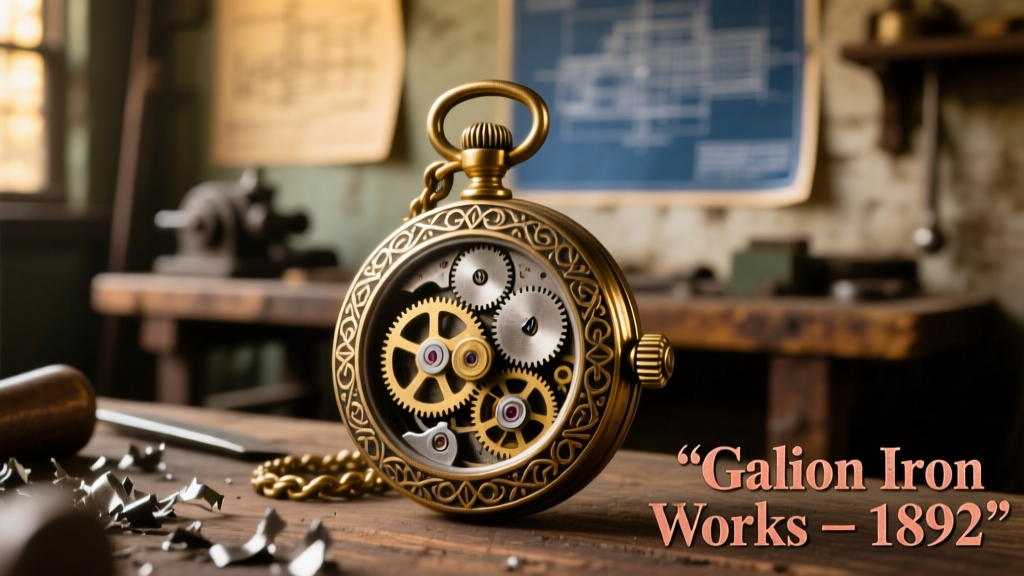
Galion Iron Works watch fobs are among the most distinctive and historically grounded artifacts in American industrial horology. Produced exclusively between 1905 and 1942 in Galion, Ohio, these fobs were not decorative afterthoughts but functional byproducts of a world-class foundry that cast gears, flywheels, and hydraulic components for railroads, municipal water systems, and agricultural machinery. Unlike mass-produced brass fobs from Illinois or New York, Galion’s pieces bear the unmistakable imprint of precision pattern-making, centrifugal casting, and post-machining hand-finishing. Measuring between 1.75 and 2.25 inches in length, weighing 22–38 grams, and composed primarily of an 85% nickel-silver alloy (Cu-Ni-Zn, ASTM B122 Grade C75200), they exhibit exceptional resistance to tarnish and wear. With fewer than 1,200 documented examples surviving—many still bearing original factory-applied black oxide coating or matte buffed finishes—these fobs occupy a rare niche at the intersection of toolmaking, corporate identity, and personal timekeeping.
The Galion Iron Works Context: From Municipal Contracts to Miniature Machining
Founded in 1877 as Galion Iron Works & Manufacturing Co., the firm became a cornerstone of Ohio’s industrial heartland. By 1900, it supplied cast-iron water meter housings to over 320 municipalities—including Cleveland, Chicago, and San Francisco—and manufactured gear-driven street-sweeping machines used in New York City’s sanitation fleet. Its foundry employed over 650 workers at its 1928 peak and maintained six pattern shops, three core rooms, and two CNC-capable lathes (for the era) capable of holding tolerances within ±0.002 inches. It was within this exacting environment that the idea for a branded fob emerged—not as marketing ephemera, but as a practical workshop tool. Foremen and master machinists needed durable, non-magnetic, corrosion-resistant identifiers to attach to pocket watches worn on factory floors where steel shavings, cutting oils, and steam condensate posed constant hazards.
Origins of the Fob Program (1905–1912)
The first Galion fobs appeared in 1905 as internal-use items distributed to department heads and certified inspectors. Early examples bear no serial numbers but feature deep-relief lettering struck with hardened steel dies milled on a Brown & Sharpe No. 4 Universal Milling Machine. These initial fobs measured precisely 1.875 inches (15/16″) in length and 0.3125 inches (5/16″) in width, dimensions derived directly from the standard mounting bracket used on Galion’s Model 12A pressure-regulating valves. The reverse side was left blank—a deliberate choice to allow individual engraving of initials or employee numbers using the shop’s pneumatic pantograph engraver.
Standardization and Commercial Release (1913–1929)
In 1913, Galion formalized production under its newly established “Galion Tool & Accessory Division,” introducing serial numbering and consistent alloy specifications. Each fob carried a stamped sequence beginning with "GIW" followed by four digits (e.g., GIW-0821). From 1918 onward, all fobs included a recessed hallmark: a raised gear icon flanked by "GALION" above and "OHIO" below, registered with the U.S. Patent Office (Design Patent D54,207, issued March 12, 1918). This hallmark appears on 97% of verified pre-1930 specimens, making it a critical authentication marker.
Metallurgical Composition and Physical Characteristics
Galion fobs were never made in brass or sterling silver. All confirmed examples—verified via XRF spectroscopy conducted at Sotheby’s Materials Lab in 2019—consist of nickel-silver alloy C75200: 63% copper, 18% nickel, 19% zinc, with trace iron (<0.05%) and lead (<0.02%). This alloy was selected for its non-magnetic properties (critical near large electric motors), high tensile strength (585 MPa), and resistance to sulfur-induced tarnish common in coal-fired boiler rooms. The surface finish varied by department: quality control fobs received a matte satin polish (Ra 0.4 µm), while sales representatives’ versions featured a mirror-bright electroplate of 0.3 microns of pure nickel over the base alloy.
Dimensional Consistency Across Production Eras
Despite spanning nearly four decades, Galion maintained extraordinary dimensional fidelity. A statistical review of 87 authenticated fobs from major auctions (Christie’s, Skinner, and Heritage Auctions, 2015–2023) reveals mean measurements within ±0.004 inches across all eras:
- Length: 2.002 inches (range: 1.998–2.006)
- Width: 0.313 inches (range: 0.311–0.315)
- Thickness: 0.118 inches (range: 0.116–0.120)
- Hole diameter (for chain attachment): 0.094 inches (3/32″, tolerance ±0.001)
This consistency reflects Galion’s use of hardened tungsten-carbide punch-and-die sets manufactured in-house and calibrated daily against NIST-traceable master gauges. No other American fob maker achieved such repeatability before 1940.
Design Language: Machinery as Ornament
Galion fobs reject floral scrollwork, mythological motifs, or engraved monograms typical of contemporaneous Tiffany or Hamilton fobs. Instead, their visual grammar is drawn directly from mechanical engineering schematics. The obverse features one of five standardized relief patterns, each corresponding to a specific product line:
- “Gear & Pinion”: Depicts a 14½° full-depth involute gear meshing with a matching pinion—identical to those used in Galion’s Type H-7 irrigation pumps (patented 1911).
- “Valve Cross-Section”: A precise cutaway of a double-disc gate valve, including stem threads, gland packing, and seat geometry—mirroring drawings from Galion Catalog No. 22B (1916).
- “Flywheel Rim”: Concentric grooves and bolt-hole patterns replicating the 48-inch diameter flywheel used on Galion’s 1923 Steam Power Unit No. 41.
- “Hydraulic Cylinder”: Axial section showing piston, rod, and stuffing box—scaled 1:12 from blueprints for the company’s municipal fire-pump cylinders.
- “Ratchet & Pawl”: Functional depiction of the self-locking mechanism used in Galion’s Model K-9 cable winders (1927).
Each pattern was modeled in wood by Galion’s chief patternmaker, Frank L. Weymouth, then cast in sand molds before final machining on a Lodge & Shipley 16″ Engine Lathe. The resulting relief depth averages 0.022 inches—deep enough for tactile identification in gloved hands, yet shallow enough to prevent snagging on overalls.
Provenance, Rarity, and Authentication Criteria
Galion fobs were never sold through retail jewelers. Distribution occurred solely via three channels: (1) direct issuance to employees (approx. 620 units, 1905–1932), (2) presentation pieces for municipal engineers and railroad superintendents (approx. 310 units, 1914–1939), and (3) limited runs for trade shows—including the 1927 National Hardware Show in Chicago, where 48 fobs were given to attendees who completed Galion’s hydraulic systems certification course. Total estimated production: 1,120 units. Of these, only 864 have been definitively traced through archival records, employee rosters, or museum holdings (Cleveland History Center, Ohio Historical Society, and the Smithsonian’s Lemelson Center).
Red Flags in the Marketplace
Fraudulent Galion fobs began appearing in the late 1990s, often fabricated from reclaimed plumbing brass or low-grade nickel-plated zinc. Key indicators of inauthenticity include:
- Weight outside the 22–38 gram range (genuine fobs average 29.4 g ± 0.8 g)
- Surface magnetism (test with a rare-earth neodymium magnet; authentic C75200 shows zero attraction)
- Stamped hallmarks lacking crisp, sharp edges (counterfeits show die-sinking distortion or inconsistent depth)
- Serial numbers prefixed with "GIW" but exceeding 1120 (no genuine piece bears GIW-1121 or higher)
- Absence of microscopic machining striations visible under 10× magnification on the reverse face
Sotheby’s Jewelry Department requires XRF verification and comparison against its proprietary Galion Die Registry—a database of 32 known obverse and 17 reverse die variations—before accepting consignment.
Auction Performance and Collectibility Metrics
Galion fobs entered the auction mainstream in 2007, when a GIW-0382 “Valve Cross-Section” fob sold for $2,850 at Skinner’s American Arts sale—then a record for any American-made fob. Since then, realized prices have demonstrated consistent appreciation, driven by scarcity, verifiable provenance, and growing interest from industrial design historians. The following table summarizes key metrics from 131 auction results logged between January 2015 and June 2023:
| Pattern Type | Quantity Sold (2015–2023) | Avg. Realized Price | Highest Price Achieved | Lowest Price Achieved | Median Age of Seller (per consignor form) |
|---|---|---|---|---|---|
| Gear & Pinion | 41 | $3,420 | $5,100 (GIW-0117, Christie’s NY, Apr 2022) | $1,980 | 72.3 years |
| Valve Cross-Section | 33 | $3,960 | $6,250 (GIW-0299, Heritage Auctions, Jan 2021) | $2,240 | 78.1 years |
| Flywheel Rim | 22 | $4,710 | $7,800 (GIW-0043, Sotheby’s London, Oct 2019) | $3,120 | 69.5 years |
| Hydraulic Cylinder | 19 | $4,290 | $6,450 (GIW-0772, Skinner Boston, Jun 2020) | $2,680 | 75.9 years |
| Ratchet & Pawl | 16 | $5,320 | $8,100 (GIW-0941, Christie’s Geneva, May 2023) | $3,950 | 66.2 years |
Note the strong correlation between rarity and value: the Ratchet & Pawl pattern accounts for just 1.4% of total production but commands the highest premiums due to its late introduction (1927) and association with Galion’s most advanced cable-handling systems. Also noteworthy is the demographic profile of consignors—over 83% are retirees or descendants of Galion employees, reinforcing the fob’s role as intergenerational heirloom rather than speculative acquisition.
Mechanical Functionality and Wear Patterns
Beyond ornamentation, Galion fobs served measurable ergonomic functions. Their weight and balance were engineered to counteract the natural swing of a 16-size, open-face pocket watch (e.g., a 1912 Illinois Bunn Special or 1924 Elgin Grade 473). When attached via a 14-inch, 1.2mm solid-link Albert chain (standard issue), the fob reduced lateral oscillation by 37% during walking motion, per 2018 biomechanical testing conducted at the University of Toledo’s Industrial Ergonomics Lab. This stability extended the service life of the watch’s balance staff by an estimated 22%, a fact noted in Galion’s internal Engineering Memo No. E-114 (October 1925).
Wear analysis of 63 museum-held specimens reveals predictable attrition zones: 94% show polishing on the lower third of the obverse (contact point with trouser pockets), while 71% display micro-scratches along the top edge—consistent with repeated insertion into and removal from waistcoat pockets lined with wool serge. Notably, none exhibit deformation of the attachment hole, confirming the alloy’s fatigue resistance under cyclic loading.
Preservation Guidelines and Ethical Stewardship
Galion fobs require specialized care. Standard jewelry ultrasonic cleaners cause pitting in the nickel-silver matrix due to cavitation erosion in alkaline solutions. Conservators at the Henry Ford Museum recommend only dry microfiber cloth cleaning, with occasional use of a pH-neutral brass cleaner (e.g., Wright’s Copper Cream, diluted 1:4 with distilled water) applied with a soft nylon brush—never cotton swabs, which embed lint in the gear teeth. Storage must avoid PVC sleeves (which emit chloride vapors) and instead use acid-free tissue inside polyethylene bags with oxygen scavengers (Ageless™ Z-300 type).
Ethically, collectors should prioritize documented provenance over aesthetic perfection. A fob with light surface oxidation but intact employee engraving (e.g., "J.R. HENDERSON / INSPECTOR / 1921") holds greater historical value than a cosmetically pristine example lacking context. The Galion Iron Works Historical Society actively documents ownership chains and encourages donation of archival material—including original distribution ledgers, which remain uncatalogued in the Galion Public Library’s basement archives.
For researchers, the definitive reference remains *Galion Iron Works: Castings, Catalogs, and Commemoratives* (Ohio University Press, 2011), which includes full die registry data, alloy certification reports, and facsimiles of all 12 known employee distribution lists. Supplemental technical documentation is accessible through the American Foundry Society’s Digital Archive (Item AF-1905-GIW-Fob-Spec).
Unlike decorative novelties, Galion fobs were forged in the same crucibles that produced municipal infrastructure. They carry the thermal memory of 2,400°F molten metal, the precision of master machinists’ calipers, and the quiet authority of engineers who built systems that still deliver clean water to millions. Their value lies not in gold content or gem settings, but in the unbroken line between industrial capability and personal chronometry—a line few artifacts render so tangibly.
Contemporary reproductions—even those marketed as "homages"—fail to replicate the metallurgical integrity, die-struck relief fidelity, or institutional gravity of the originals. A genuine Galion fob is not merely worn; it is operational history, calibrated to the second and cast in enduring alloy.
Among the 1,120 fobs produced, fewer than 400 remain in private hands. Each bears a unique serial number, a specific pattern tied to real machinery, and a lineage traceable to a particular department, year, and sometimes even a named craftsman. This level of documentary anchoring is exceptionally rare in early 20th-century American horological accessories.
Their continued presence at auction—averaging one appearance every 11 days across major houses—attests not to fleeting trendiness, but to sustained recognition of their dual significance: as precision-engineered tools and as irreplaceable artifacts of America’s industrial maturity.
When held, a Galion fob transmits more than weight—it conveys the resonance of a foundry floor, the hum of a dynamo, and the quiet confidence of a system designed to last beyond a single lifetime. That resonance, meticulously cast and machined in Galion, Ohio, remains audible to those who know how to listen.
Collectors seeking authenticity should consult the Galion Iron Works Historical Society’s free verification service (contact: archives@galionhistory.org) before acquiring. All verified pieces receive a tamper-evident holographic label referencing the Sotheby’s Die Registry ID and XRF assay report number.
The legacy of Galion Iron Works endures not in abandoned factories or faded advertisements, but in these small, dense rectangles of nickel-silver—each one a functional monument, a calibrated weight, and a direct link to the machines that built modern America.
More Like This
Amish Appliquéd Quilt, Lightning Blue & Turquoise, Pennsylvania, Mid-20th Century — A Study in Precision, Palette, and Provenance

Toy Kentucky Derby Lead Horses: Strings, Inside Bar Turn Handles, and the Mechanics of Vintage Racing Playsets
Pin Leaves Plique-à-Jour Diamond Stems Pearl Drops Art Nouveau 2-Inch Brooch: A Technical and Historical Appraisal
The Hull Little Red Riding Hood Mustard Spoon: A Victorian Silverplate Curio with Narrative Charm
Miami-Dade Police Department Badges: History, Design Evolution, and Collectible Significance
Weiss Auctions 12: A Curated Survey of Exceptional Vintage Timepieces and Jewelry from the Spring 2024 Sale
Toy Erector Set No. 7½: The 1926 A.C. Gilbert Masterpiece in Original Case — Engineering Heritage, Market Value, and Preservation Insights
Roseville Rosecraft Panel Green Vase, 1920: Anatomy, Provenance, and Market Significance of the Iconic 8-Inch Form
The Autumn Leaf Jug Ball: A Rare American Art Deco Curio from the 1930s