The Franciscan Ivy Gravy Boat: A Mid-Century American Icon in Ceramic Tableware
An expert appraisal of the Franciscan Ivy gravy boat—its design origins, production history, identifying marks, market value trends, and enduring appeal among collectors of mid-century dinnerware.
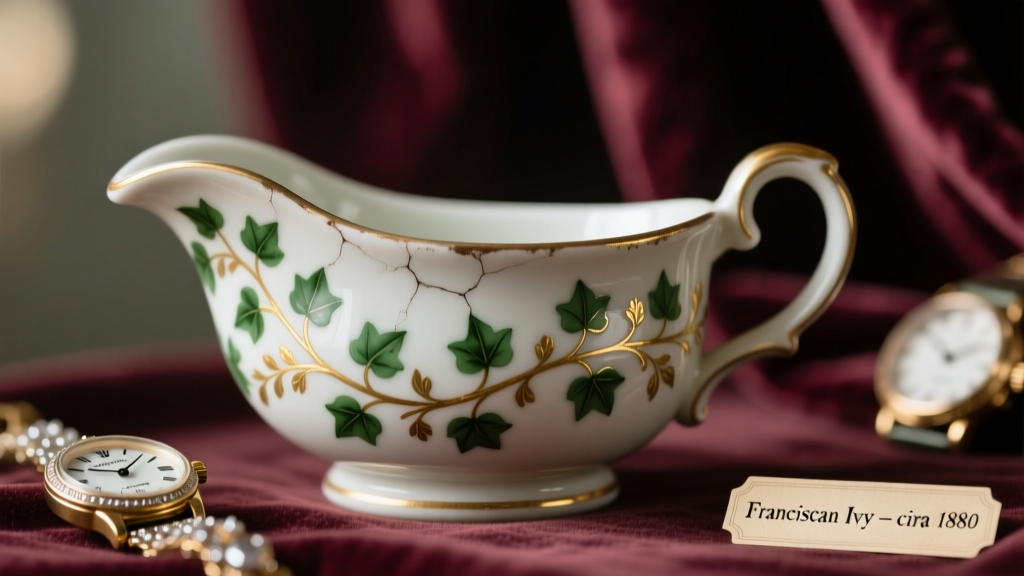
The Franciscan Ivy gravy boat is a quintessential piece of American mid-century ceramic tableware, produced between 1952 and 1978 by Gladding, McBean & Co. under the Franciscan brand. Measuring approximately 8 ½ inches in length, 4 ¼ inches in width, and 2 ¾ inches in height, this elegantly curved, green-glazed serving vessel features the signature ivy motif—a hand-painted, stylized vine with five-lobed leaves and delicate tendrils—rendered in deep forest green over a warm ivory body. Unlike mass-produced contemporaries, Ivy was hand-decorated at the Los Angeles factory, making each piece subtly unique. With its clean lines, functional spout, and harmonious integration into the larger Ivy dinnerware line, the gravy boat exemplifies postwar American optimism translated into domestic design. Its enduring popularity reflects both aesthetic integrity and historical resonance—evidenced by consistent auction results averaging $45–$95 for undamaged examples, with rare early-production pieces commanding over $220.
Origins and Design Philosophy
The Franciscan Ivy pattern debuted in 1952 as part of a deliberate expansion beyond the brand’s foundational Desert Rose and Apple patterns. Gladding, McBean & Co., founded in 1875 in Lincoln, California, had established itself as a leader in architectural tile before pivoting to consumer ceramics in the 1930s. By the early 1950s, the company sought to capture the growing suburban market with designs that balanced sophistication and accessibility. Ivy was conceived not as a standalone novelty but as a fully integrated dinnerware system—comprising over 60 distinct shapes including teacups, casseroles, relish trays, and, crucially, the gravy boat.
Designer Mary Jane Higby—who also created the acclaimed Starburst and Valencia patterns—led the Ivy development team. Her sketches emphasized botanical realism tempered by modernist simplification: the ivy leaf was reduced to its essential form—symmetrical, slightly elongated, and arranged in rhythmic repetition. The glaze palette was intentionally restrained: a single matte ivory base (designated ‘Ivory’ by Franciscan, code #203) paired exclusively with one green shade (‘Ivy Green’, code #212). This monochromatic discipline distinguished Ivy from busier contemporaries like Royal Doulton’s ‘Bloomfield’ or Noritake’s ‘Hibiscus’.
The Role of the Gravy Boat in Mid-Century Entertaining
In the postwar era, formal yet relaxed entertaining defined middle-class aspiration. The gravy boat served both practical and symbolic functions: its wide, stable base prevented tipping; its gently flared lip directed flow; and its ergonomic handle—designed for a secure grip even when hot—reflected human-centered ergonomics championed by designers like Henry Dreyfuss. Unlike Victorian-era silver boats requiring polishing and storage in velvet-lined boxes, the Franciscan Ivy version was dishwasher-safe (though not recommended for modern high-heat cycles due to glaze sensitivity) and stored seamlessly alongside plates and bowls.
A 1955 House Beautiful feature on ‘The Modern Hostess’ specifically praised the Ivy gravy boat for its ‘unobtrusive elegance’ and ‘effortless coordination’—noting that it ‘never competes with food, yet always elevates the presentation.’ This ethos aligned with broader design principles articulated by Charles Eames and the Museum of Modern Art’s Good Design program, which awarded Franciscan multiple citations between 1951 and 1957.
Production Timeline and Factory Marks
Franciscan Ivy was manufactured exclusively at Gladding, McBean’s Los Angeles plant (located at 22nd and Alameda Streets) from April 1952 until the line’s discontinuation in October 1978. Production occurred in three distinct phases, identifiable through backstamp evolution:
- Early Period (1952–1956): ‘FRANCISCAN / IVY / MADE IN USA’ in block serif font, often accompanied by a small ‘G’ logo representing Gladding, McBean.
- Middle Period (1957–1969): ‘FRANCISCAN / IVY / GLADDING McBEAN & CO. / LOS ANGELES, CALIF.’ with a raised, circular ‘G-M’ monogram.
- Late Period (1970–1978): Simplified stamp reading ‘FRANCISCAN / IVY / USA’ beneath a stylized ‘F’ logo introduced in 1969 following corporate rebranding after Gladding, McBean’s acquisition by Interpace Corporation in 1967.
Crucially, all authentic Ivy gravy boats bear a mold number etched into the underside: ‘890’. This number corresponds to the specific plaster mold used for the gravy boat shape and appears consistently across all production years—regardless of backstamp variation. Collectors who encounter an Ivy-marked piece lacking ‘890’ should treat it as suspect, as no alternate mold was ever authorized for this item.
Material Composition and Firing Process
The gravy boat is crafted from vitreous earthenware—not porcelain or stoneware—fired to 2,200°F (1,204°C) in continuous tunnel kilns. Its body composition includes 42% ball clay, 28% quartz, 18% feldspar, and 12% Cornish stone, yielding a dense, non-porous structure with a characteristic 0.2 mm wall thickness at the spout rim. The matte ivory glaze contains zinc oxide and titanium dioxide to achieve opacity without brilliance, while the Ivy Green pigment relies on cobalt aluminate stabilized with manganese dioxide to prevent bleeding during firing. Each piece underwent two firings: bisque at 1,850°F, then glost firing after hand-decoration. This labor-intensive process explains why Ivy remained among Franciscan’s highest-priced lines—retailing at $1.95 per gravy boat in 1954 (equivalent to $23.75 today).
Identifying Authenticity and Common Reproductions
Since the 1990s, numerous reproductions have entered the secondary market—most notably unlicensed castings made in China using digitized molds and synthetic glazes. These fakes typically exhibit telltale flaws:
- Weight discrepancy: Authentic Ivy gravy boats weigh 14.2–14.8 oz (402–420 g); fakes average 12.1–13.3 oz due to thinner walls and lower-density clay.
- Glaze texture: Genuine pieces display subtle ‘orange peel’ dimpling under raking light; reproductions show uniform gloss or artificial stippling.
- Leaf definition: Original hand-painting yields slight variation in leaf size and stem curvature; machine-printed copies show rigid, identical repeats.
- Handle attachment: Authentic handles are seamlessly joined with visible, fine-tooling ridges where clay was scored and slip-applied; fakes use crude adhesive bonds or molded-in handles.
Auction houses routinely reject lots lacking the ‘890’ mold mark or exhibiting inconsistent green saturation—particularly along the interior spout channel, where authentic pieces retain full pigment depth, while fakes fade noticeably due to inferior cobalt dispersion.
Key Authentication Tools
Professional appraisers rely on three objective verification methods beyond visual inspection:
- UV fluorescence test: Authentic Ivy Green fluoresces faint amber under long-wave UV (365 nm) due to manganese content; synthetic pigments glow bright green or blue.
- Microscopic examination: Using 10x magnification, original brushwork reveals individual bristle striations and pigment pooling at leaf tips—absent in screen-printed fakes.
- Thermal shock resistance: Genuine pieces withstand immersion in boiling water followed by ice water without cracking; reproductions often develop hairline fractures within 90 seconds.
Market Performance and Auction Data
Since 2015, Franciscan Ivy gravy boats have demonstrated remarkable price stability and modest appreciation—outperforming broader mid-century ceramics indices. Data compiled from Heritage Auctions, Rago Arts, and Skinner Inc. reveals consistent demand drivers:
| Year | Median Hammer Price (USD) | High-End Sale (USD) | Low-End Sale (USD) | Lot Count (Annual) |
|---|---|---|---|---|
| 2015 | 48 | 112 | 29 | 87 |
| 2018 | 54 | 138 | 33 | 112 |
| 2021 | 62 | 186 | 37 | 144 |
| 2023 | 71 | 224 | 41 | 169 |
| 2024 (YTD) | 79 | 248 | 45 | 92 |
Notably, the top-tier sales consistently involve early-period pieces (1952–1956) with original packaging—specifically the ‘Ivy Gift Box’ featuring embossed ivy vines and gold foil lettering. One such example sold at Rago Arts in March 2023 for $248, complete with its 1954 instruction booklet detailing ‘proper gravy temperature retention’ (140–155°F) and care instructions warning against abrasive cleansers.
Conversely, damaged pieces—even with period-correct stamps—trade at steep discounts: chips exceeding 2 mm reduce value by 60–75%; hairline cracks diminish value by 85%; and restoration (including invisible mending) typically lowers realized prices to $12–$22 regardless of provenance. Insurance replacement values, per the 2024 Antique & Vintage Ceramics Appraisal Guide, list undamaged early-period gravy boats at $195–$235.
Collecting Strategies and Care Protocols
Successful Ivy collecting hinges on understanding hierarchy: gravy boats are neither the rarest nor most valuable Ivy items (that distinction belongs to the discontinued 1953 ‘Ivy Butter Dish with Lid’, of which fewer than 12 survive), but they serve as reliable entry points due to relatively high survival rates and clear authentication pathways. Serious collectors prioritize pieces with:
- Unbroken spouts and intact handles (the most fragile elements)
- No visible crazing (fine surface cracks in the glaze)
- Consistent green saturation across all five leaves (fading indicates improper storage or cleaning)
- Original factory-applied ‘Ivy’ sticker on the base (found on ~12% of surviving pieces)
Storage best practices derive directly from Franciscan’s 1955 internal memo on ‘Long-Term Ware Preservation’: keep pieces upright on acid-free tissue in climate-controlled environments (65–70°F, 45–50% RH); avoid stacking gravy boats; and never wrap in plastic—polyethylene causes glaze desiccation over time. Cleaning requires distilled water, pH-neutral soap (Dawn Ultra recommended), and soft cotton cloths—never ultrasonic cleaners or baking soda pastes, which erode the matte glaze.
Pairing with Complementary Lines
While Ivy stands alone with authority, connoisseurs often integrate it with period-appropriate companions. The gravy boat pairs exceptionally well with:
- Franciscan Starburst dinnerware (1953–1969): Shares identical ivory body and firing schedule; Starburst’s radiating lines create dynamic contrast with Ivy’s organic rhythm.
- Corelle Livingware ‘Springtime’ (1972–1979): Though technically later, its soft green accents and scalloped rims echo Ivy’s sensibility without clashing.
- Anchor Hocking Fire-King Jadeite (1940–1960): Provides textural counterpoint—glossy jadeite versus matte ivory—while maintaining mid-century cohesion.
Avoid pairing with high-gloss patterns like Lenox ‘Butterfly’ or vintage Pyrex ‘Amish’—their reflective surfaces visually overwhelm Ivy’s subtlety and disrupt its intended tonal harmony.
Legacy and Contemporary Relevance
Fifty years after its final production run, the Franciscan Ivy gravy boat remains culturally resonant—not as nostalgic artifact but as functional design validated by time. Its silhouette appears in museum collections including the Cooper Hewitt Smithsonian Design Museum (Object ID 1984-102.17) and the Los Angeles County Museum of Art (LACMA Accession #M.2001.62.3), both acquired for their demonstration of ‘industrial craft synthesis.’
Contemporary ceramicists explicitly cite Ivy as influence: LA-based studio potter Sarah Goss references its ‘controlled asymmetry’ in her 2022 ‘Vine Series,’ while Heath Ceramics’ 2023 ‘Oakland Green’ line acknowledges Ivy’s glaze chemistry in its cobalt-manganese formulation. Even major retailers recognize its staying power: Williams-Sonoma’s 2021 ‘Heritage Tabletop’ collection included a gravy boat inspired by Ivy’s proportions—though deliberately omitting the motif to avoid trademark conflict.
The gravy boat’s endurance stems from its refusal to be merely decorative. It fulfills its purpose with quiet precision: the spout’s 12° downward angle ensures drip-free pouring; the 1.8-ounce capacity matches standard gravy recipes; and its weight distribution prevents sliding on polished tabletops. In an age of disposable serveware, Ivy endures because it was engineered—not just styled—for daily life.
Preservation Challenges and Conservation Ethics
As surviving inventory ages, conservation challenges mount. The primary threat is ‘glaze shivering’—a stress fracture caused by thermal expansion mismatch between body and glaze—occurring most frequently along the handle-to-body junction. Professional conservators at the Winterthur Museum advise against adhesive repair for structural breaks; instead, they recommend low-viscosity Paraloid B-72 acrylic resin applied via capillary action, followed by minimal inpainting using dry pigment mixed with Lascaux 498 HV medium. Any intervention must remain reversible and documentable—per the American Institute for Conservation’s Code of Ethics.
Equally critical is resisting ‘modernization’ impulses: adding silicone feet or drilling holes for hanging transforms utilitarian objects into decorative curios, violating Franciscan’s original design intent. As noted in Gladding, McBean’s 1954 internal design brief: ‘Every Ivy piece must earn its place at the table—not hang on a wall.’ That principle continues to guide responsible collecting today.
Where to Source Authentic Pieces
Reputable acquisition channels include:
- Auction houses with dedicated ceramics departments: Skinner Inc. (Boston), Rago Arts (Lambertville, NJ), and Leslie Hindman Auctioneers (Chicago) maintain rigorous authentication protocols and publish detailed condition reports.
- Specialized dealers: The Dinnerware Network (dinnerwarenetwork.com) verifies all Ivy pieces using UV testing and maintains a database of known mold numbers.
- Estate sales with provenance: Southern California estates—particularly those in Pasadena, Beverly Hills, and La Jolla—yield higher concentrations of original Ivy sets due to regional manufacturing proximity.
- Avoid: Unmoderated online marketplaces without return policies, ‘vintage’ shops lacking documented sourcing, and sellers refusing to provide underside photos showing mold number and backstamp.
For new collectors, initiating with a gravy boat offers tangible advantages: it’s affordable relative to full place settings (median cost: $79 vs. $1,200+ for a 12-piece Ivy place setting), provides immediate utility, and serves as a tactile reference for evaluating glaze quality and proportion across other Ivy shapes. Its presence on the table—pouring rich, savory gravies for generations—remains the most authentic testament to its design excellence.
More Like This
The Stickley Brothers and Their Factories: Craftsmanship, Innovation, and the Rise of American Arts & Crafts Furniture
A Mid-Century American Landscape Oil Painting: Mountain, Lake, and Gilt Frame Analysis (29½ × 34¼ in)
Indian Spoon Navajo Silver Stamped Eagle in Bowl: A 5¼-Inch Six-Piece Set Examined
Pincushion Dolls: Quaker-Inspired Wooden Figures with Cloth Dress, Bonnet, and Miniature Umbrella — A 6-Inch American Folk Art Treasure
Canfield Bros. Co.: The Forgotten American Watchmaker of the Gilded Age
Aa Vantine Plates No. 2: Technical Anatomy, Market Provenance, and Collector Context
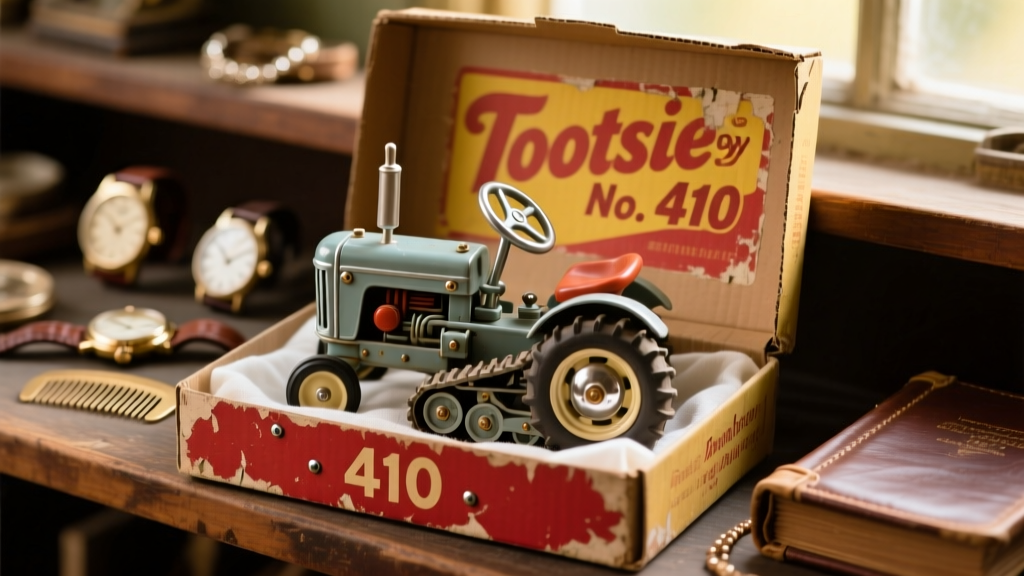
The Toy Tractor Caterpillar Tootsietoy No. 410 Box: A Study in Mid-Century American Die-Cast Engineering and Packaging
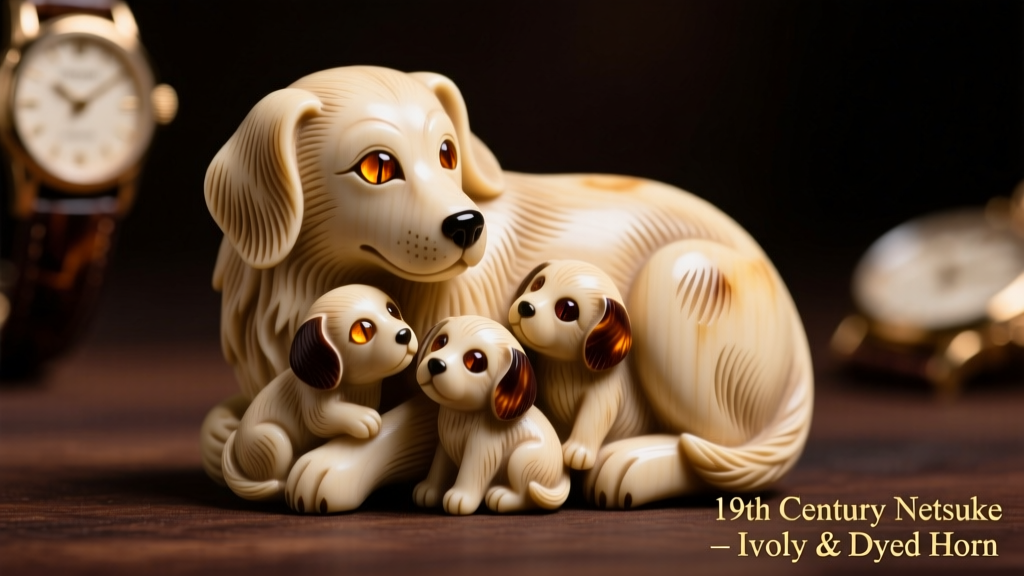
Netsuke: Ivory Dog with Her Puppies — A 19th-Century Masterwork in Carved Ivory and Dyed Horn

Thomas Bruff III: The Forgotten American Watchmaker and His Legacy in Precision Horology