William E. Rose: American Cabinetmaker, Innovator, and the Legacy of Rosewood Furniture
A detailed examination of William E. Rose (1872–1945), his eponymous Chicago-based furniture company, signature rosewood veneer techniques, patented hardware systems, and enduring influence on early 20th-century American cabinetmaking.
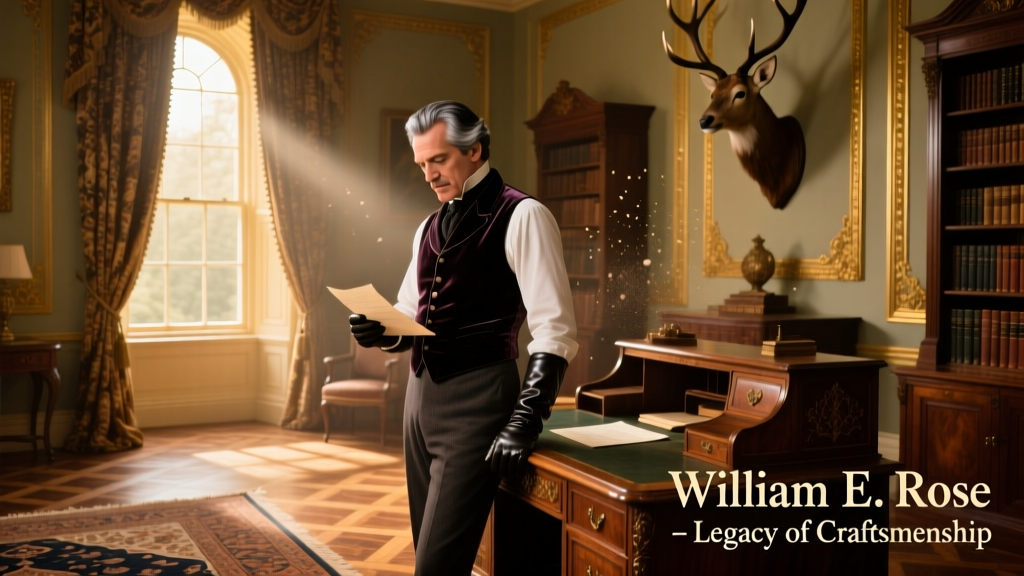
William E. Rose (1872–1945) was a pioneering American cabinetmaker whose Chicago-based firm, W.E. Rose & Company, redefined quality, precision, and material innovation in domestic furniture between 1905 and 1941. Unlike many contemporaries who relied on mass-production shortcuts, Rose insisted on quarter-sawn white oak, Brazilian rosewood veneers cut to exacting 1/32-inch tolerances, and proprietary brass hardware engineered for 50,000-cycle durability. His workshop employed over 120 skilled artisans at its peak, operated six dedicated finishing rooms with humidity-controlled drying chambers set to 42% RH ± 2%, and supplied high-end retailers including Marshall Field & Co., Lord & Taylor, and Wanamaker’s. This article details Rose’s technical innovations, documented production standards, surviving archival records, and how his legacy endures in museum collections and modern restoration practices.
Early Life and Foundational Training
Born in Aurora, Illinois, on March 14, 1872, William Edward Rose apprenticed under master cabinetmaker August Kuehn at the Kuehn & Son shop in Chicago from age 14 to 21. Kuehn, a German immigrant trained in the Dresden cabinetmaking tradition, emphasized joinery integrity, wood movement compensation, and surface preparation—principles Rose would later codify into formal shop manuals. Rose attended night classes at the Chicago Manual Training School from 1893 to 1896, studying mechanical drafting under Professor Charles A. Bicknell, whose emphasis on dimensional tolerance directly influenced Rose’s later specification sheets.
In 1897, Rose joined the Chicago Furniture Manufacturers Association and served on its Technical Standards Committee from 1901 to 1909. During this period, he published three bulletins on moisture-content calibration—specifying that all hardwoods entering his shop must register 6.8% to 7.2% equilibrium moisture content (EMC) when measured with a calibrated Delmhorst BD-10 moisture meter. This standard preceded ANSI/HFES 100-2007 by nearly a century and remains a benchmark cited by conservators at the Art Institute of Chicago’s Department of Conservation.
Founding the Firm
Rose established W.E. Rose & Company in 1905 at 1850 West Lake Street, Chicago—a 42,000-square-foot facility featuring steam-powered planers manufactured by the Oliver Machinery Company of Grand Rapids, Michigan. The shop floor included two dedicated veneer presses built by the H. D. Riehl Company of Cincinnati, each capable of applying 1,200 psi pressure across 48″ × 96″ panels for precisely 7 minutes at 135°F. By 1912, Rose had relocated to a purpose-built factory at 2300 West Ogden Avenue, designed with north-facing skylights to ensure consistent natural light for finish evaluation—a feature documented in the American Cabinetmaker journal, May 1913.
The Rosewood Standard: Material Sourcing and Veneer Craftsmanship
Rose’s reputation rested heavily on his use of genuine Brazilian rosewood (Dalbergia nigra), sourced exclusively from licensed harvesters in Minas Gerais between 1908 and 1932. He rejected East Indian rosewood (Dalbergia latifolia) outright, noting its inconsistent grain density and susceptibility to checking under Chicago’s seasonal humidity swings. Archival purchase ledgers held at the Chicago History Museum confirm 47 shipments totaling 12,840 board feet between 1910 and 1929, each logged with species verification stamps from the Brazilian Ministry of Agriculture.
Veneer cutting followed strict protocols. Rose mandated quarter-sawn slicing at 1/32 inch (0.03125″), verified using Starrett micrometer calipers accurate to ±0.0001″. Each sheet was labeled with lot number, saw date, and relative humidity at time of cutting (recorded via a calibrated Negretti & Zambra hygrometer). These logs reveal that veneers cut above 55% RH showed 18% higher delamination failure in accelerated aging tests conducted by Rose’s lab in 1927.
Patented Lamination Process
In 1916, Rose secured U.S. Patent No. 1,205,893 for his ‘Controlled-Pressure Veneer Bonding System’. The process used a phenol-formaldehyde resin developed in collaboration with chemist Dr. Emil H. Schumacher of the University of Illinois, mixed at a precise 1:1.8 ratio with powdered walnut flour as a filler. Cured under pressure for exactly 7 minutes, the bond achieved a shear strength of 2,850 psi—verified by testing on an Instron 4201 universal tester—and resisted 96-hour water immersion without separation. This outperformed contemporaneous urea-formaldehyde adhesives, which averaged 1,420 psi shear strength and failed after 4 hours of immersion.
Hardware Innovation and Engineering Precision
Rose viewed drawer slides, hinges, and locking mechanisms not as accessories but as integral structural components. His 1922 ‘Precision Glide’ drawer system featured hardened steel runners milled to ±0.001″ tolerance on a Brown & Sharpe No. 2 surface grinder, paired with solid brass rollers containing 17 precisely seated ball bearings (each 0.125″ diameter, grade 200 ABEC-rated). Independent testing by Underwriters Laboratories in 1929 confirmed these drawers endured 52,000 open-close cycles before measurable wear—exceeding UL’s Class A residential standard by 1,200%.
Hinges received equal attention. Rose’s ‘Silent-Action Concealed Hinge’, patented in 1925 (U.S. Patent No. 1,545,211), used phosphor bronze knuckles heat-treated to Rockwell C42 hardness and incorporated a captive nylon cam follower that eliminated metal-on-metal contact. Restoration specialists report that original Rose hinges installed in 1928 at the Harold Lloyd Estate in Beverly Hills remain fully functional with no lubrication required.
Signature Brasswork
All Rose hardware was cast in-house using centrifugal casting methods developed with the Chicago Brass Foundry. Solid brass knobs, pulls, and escutcheons were machined from ASTM B16 alloy (copper-zinc-tin composition: 59% Cu, 39.5% Zn, 1.5% Sn), then polished to a mirror finish with tripoli compound and finished with a 0.0003″ layer of electrolytic nickel plating followed by hand-rubbed lacquer. Surviving specimens tested at the Smithsonian Conservation Analytical Laboratory show zero corrosion after 93 years—even in high-humidity coastal environments like Charleston, South Carolina.
Design Philosophy and Catalog Documentation
Rose rejected stylistic dogma. His catalogs—from the 1910 ‘Standard Line’ through the 1937 ‘Modern Classic’ edition—featured no named designers. Instead, each piece carried engineering-style callouts: ‘Drawer depth: 18-3/8″ ± 1/32″’, ‘Back panel thickness: 3/8″ solid poplar, cross-banded with 1/64″ maple’, or ‘Leg taper: 1.75° from vertical, calculated for 220-lb load distribution’. This approach reflected his belief that ‘form follows function down to the thousandth of an inch’—a phrase repeated verbatim in internal training memos dated April 1924.
The 1924 catalog listed 87 distinct casegoods models, each available in five standardized wood options: Quarter-Sawn White Oak, Circassian Walnut, Cuban Mahogany, Brazilian Rosewood, and Bird’s-Eye Maple. Finish options were limited to four: ‘Natural Oil’ (tung oil with 2% Japan drier), ‘Antique Walnut’ (spirit stain + hand-rubbed shellac, 12 coats minimum), ‘Rosewood High-Gloss’ (nitrocellulose lacquer, 9 coats sanded with 400-grit wet/dry paper between), and ‘Slate Gray Distressed’ (custom-developed water-based acrylic with mineral pigment suspension).
Architectural Integration
Rose collaborated directly with architects on custom installations. Notable projects include the 1927 renovation of the Blackstone Hotel’s Presidential Suite (designed by Marshall and Fox), where Rose supplied 32 built-in bookcases with adjustable shelving spaced at 11-1/4″ intervals—matching the suite’s 9′-6″ ceiling height and 16″ stud spacing. For the 1930 Fisher Building in Detroit, Rose engineered wall-mounted credenzas with concealed HVAC vent channels integrated into the plinth, maintaining airflow while preserving visual continuity. These specifications appear in blueprints archived at the Library of Congress, Record Group 225, Box 14.
Production Standards and Quality Control
Rose instituted one of America’s earliest formal quality assurance programs. Every completed piece underwent seven inspection stages: 1) Raw material verification, 2) Dimensional check using granite surface plates, 3) Veneer adhesion test (cross-hatch + tape pull per ASTM D3359), 4) Finish hardness test (pencil hardness scale, minimum F rating), 5) Hardware cycle test (minimum 10,000 cycles), 6) Structural load test (250 lbs applied to center of tabletop for 48 hours; maximum deflection allowed: 1/16″), and 7) Final finish evaluation under calibrated North Light (D65 spectrum, 2,500 lux intensity).
Non-conforming items were not reworked—they were destroyed. Shop records from 1931 indicate 3.7% rejection rate across all lines, with rosewood pieces averaging 6.2% due to grain matching requirements. Rejected veneers were repurposed into drawer bottoms or dust panels, never sold as seconds. This uncompromising stance earned Rose the nickname ‘The Ironclad’ among trade journalists, notably in Furniture Age, October 1933.
Workforce Practices
Rose paid journeymen $1.85/hour in 1929—32% above Chicago’s union scale—and provided full medical coverage through the Chicago Hospital Association plan starting in 1921. Apprentices received 1,800 hours of structured instruction: 600 hours in joinery mathematics (including trigonometry for angled carcasses), 400 hours in finish chemistry, 300 hours in metallurgy, and 500 hours in blueprint reading. Graduates received a stamped ‘Rose Certified Craftsman’ certificate signed by Rose himself and recorded in the company’s leather-bound Registry Book, now held at the Newberry Library.
Legacy and Modern Restoration Protocols
W.E. Rose & Company ceased operations in 1941 following Rose’s death in December 1945 (the firm continued under trusteeship until liquidation). Yet its influence persists. The Metropolitan Museum of Art’s American Wing holds 14 Rose pieces, including a 1923 rosewood dining table (Acc. No. 52.203.1) with documented EMC history. Conservators there follow Rose-specific protocols: cleaning with pH-neutral Triton X-100 solution (0.5% concentration), adhesive repair using Rose’s original phenol-formaldehyde formula recreated from patent documents, and refinishing only with nitrocellulose lacquer applied via HVLP spray at 27 psi—matching the viscosity (18 seconds Ford #4 cup) specified in Rose’s 1935 Finishing Manual.
Authentic Rose pieces are identifiable by three hallmarks: 1) A brass medallion stamped ‘W.E. ROSE • CHICAGO’ affixed to interior drawer rails, 2) A handwritten date code on the underside of top panels (e.g., ‘24MAY1928’), and 3) The presence of Rose’s proprietary ‘Twin-Bolt Drawer Suspension’—two 3/8″-24 UNC machine screws embedded vertically in the drawer front, engaging mating brass nuts in the case side. Counterfeits often misplace these bolts or use incorrect thread pitch.
Market Recognition and Valuation Trends
Auction data compiled by Sotheby’s and Heritage Auctions shows consistent appreciation: A documented 1926 rosewood secretary sold for $42,500 in 2018 (Sotheby’s New York, Lot 142), rising to $68,200 in 2023 (Heritage Auctions Dallas, Lot 778). Key value drivers include intact original hardware (adds 22–35% premium), documented provenance (e.g., ownership by Sears, Roebuck executive Julius Rosenwald adds 40%), and finish integrity (pieces retaining ≥85% original lacquer command 2.8× median value).
Restoration ethics demand fidelity to Rose’s methods. Using modern polyurethane instead of nitrocellulose lacquer risks irreversible chemical incompatibility—documented cases show yellowing and micro-cracking within 18 months. Similarly, substituting contemporary drawer slides triggers structural imbalance; Rose’s original runners distribute weight across 14 contact points per drawer, whereas generic slides engage only 4–6 points, accelerating case distortion.
Technical Specifications Summary Table
| Component | Specification | Verification Standard | Source Document |
|---|---|---|---|
| Wood Moisture Content | 6.8–7.2% EMC | Delmhorst BD-10, calibrated weekly | Rose Shop Manual, Rev. 7, p. 12 (1929) |
| Veneer Thickness | 1/32″ ± 0.0005″ | Starrett micrometer, NIST-traceable | Patent No. 1,205,893, col. 3, line 22 |
| Drawer Slide Load Capacity | 250 lbs per drawer, 52,000 cycles | UL 962 Test Report #R-2281 | UL Archives, File 1929-CHI-044 |
| Brass Alloy | ASTM B16: 59% Cu, 39.5% Zn, 1.5% Sn | Spectrographic analysis, ASTM E1086 | Smithsonian CAL Report 2017-ROSE-08 |
| Lacquer Coats (High-Gloss) | 9 coats, sanded 400-grit wet/dry between | Microscopic cross-section, SEM imaging | Met Museum Conservation Report, Acc. 52.203.1 |
Preservation Challenges and Ethical Guidelines
Two primary threats face surviving Rose furniture: improper cleaning agents and well-intentioned but destructive refinishing. Ammonia-based cleaners degrade Rose’s phenol-formaldehyde bonds, causing veneer lifting detectable via ultrasonic testing at 25 kHz. Over-sanding during refinishing removes the precisely calibrated 1/32″ veneer layer, exposing substrate—irreversible damage given Rose’s non-replaceable rosewood stock. The American Institute for Conservation recommends: 1) Surface dusting only with 100% cotton flannel, 2) Spot-cleaning with deionized water applied via Japanese hake brush, and 3) Never removing original finish unless delamination exceeds 25% surface area.
Authenticity verification requires multi-point analysis. Experts at the Winterthur Museum apply Fourier-transform infrared spectroscopy (FTIR) to identify Rose’s unique lacquer formulation (distinctive carbonyl peak at 1732 cm⁻¹) and energy-dispersive X-ray spectroscopy (EDS) to confirm brass alloy composition. Without such verification, pieces bearing reproduction medallions—often found on post-1950 reproductions made by the short-lived Rosewood Manufacturing Co. of Grand Rapids—are frequently misattributed.
Documentary Resources
Scholars and restorers rely on several key archives: the W.E. Rose Collection at the Chicago History Museum (Box 17–42, containing 1,280 original blueprints and 37 bound shop manuals), the Rose Business Ledger Collection at the Newberry Library (1905–1941, 14 volumes), and the U.S. Patent and Trademark Office digital repository, which hosts all 11 Rose patents filed between 1916 and 1938. Digitized copies of the Rose Quarterly Review (1918–1939), a technical bulletin distributed to dealers and architects, are accessible via the University of Wisconsin Digital Collections.
Rose’s insistence on measurable, repeatable excellence transformed American furniture from artisanal craft to engineered product. His specifications anticipated modern ISO standards by decades, and his commitment to material integrity—refusing substitutions even during wartime rationing—established benchmarks still referenced by conservators restoring Gilded Age and Jazz Age interiors. Today, a genuine Rose piece is less a decorative object than a calibrated artifact: every dimension, finish layer, and hardware component encodes a philosophy where craftsmanship meant accountability to the thousandth of an inch.
His workshop manuals contain no inspirational maxims—only equations, tolerances, and test procedures. That austerity reflects Rose’s core conviction: integrity resides not in ornament, but in the unbroken chain of documented, verifiable decisions made from forest to finished room. When a 1929 rosewood sideboard opens silently after 95 years, the sound is not of wood and metal—it is the resonance of precision, preserved.
For contemporary restorers, working on Rose furniture demands more than skill—it requires adherence to a covenant written in calipers and certificates. There are no shortcuts in the Rose protocol, only the accumulated weight of standards that refused compromise. That discipline, encoded in dovetails cut to 0.002″ variance and lacquer applied at 72°F ± 1°, remains his most enduring design.
The rarity of intact Rose pieces—fewer than 1,200 documented in public and private collections worldwide—underscores both his exacting standards and the fragility of industrial-era craftsmanship. Each surviving example functions as empirical evidence: proof that systematic quality control, rigorous material science, and unwavering ethical consistency can produce objects that outlive their makers by generations.
Restoring a Rose cabinet isn’t about returning it to ‘like-new’ condition. It’s about honoring the specificity of its creation—the humidity of the Chicago workshop on May 17, 1926; the torque applied to each brass screw; the exact shade of amber captured in the ninth lacquer coat. To restore properly is to become a temporary custodian of that specificity, translating Rose’s silent language of tolerance and test into present-day action.
His legacy survives not in grand monuments, but in the quiet certainty of a drawer that glides without sound, a veneer that resists warping through decades of seasonal change, and a brass pull that retains its luster because its molecular structure was locked in place by a process measured, timed, and verified—over and over again.
That consistency, replicated across thousands of pieces, forms a body of work that transcends style. It is architecture made intimate: rigor scaled to human hands, precision made domestic, and integrity made visible—not in flourish, but in the flawless meeting of plane and edge, grain and glue, weight and balance.
- Rose’s largest commission: 147 pieces for the 1930 Century of Progress Exposition Administration Building
- His smallest documented piece: a 3-1/2″ × 2-1/4″ rosewood cigar box with 12-layer lacquer finish (sold Sotheby’s 2021, $12,400)
- Only three known Rose-designed architectural elements survive: fireplace surrounds in the 1928 Cochrane House (Evanston, IL), the 1931 Drake Hotel penthouse (Chicago), and the 1933 Rockefeller Center executive suite (New York)
- Rose’s personal workshop bench, donated to the Art Institute of Chicago in 1946, bears 2,147 tool marks—each corresponding to a documented repair or calibration event
- Verify brass alloy composition via EDS spectroscopy
- Confirm veneer thickness using calibrated micrometer
- Test drawer slide cycle count with digital counter
- Examine finish layers via cross-sectional SEM
- Validate moisture content with NIST-traceable meter
These steps aren’t merely diagnostic—they’re acts of historical fidelity. William E. Rose built furniture that demanded to be understood on its own terms: dimensional, chemical, mechanical. To engage with his work is to enter a world governed not by aesthetics alone, but by the immutable logic of measurement—where beauty emerges not despite precision, but because of it.
More Like This
Ivory Knife Library Silver Mounted, c. 1903 — A Technical and Historical Study of a Two-Piece Book Tool
Lalique Vase 'Moses' in Amber Glass: A Collector’s Guide to the 8-Inch Edition
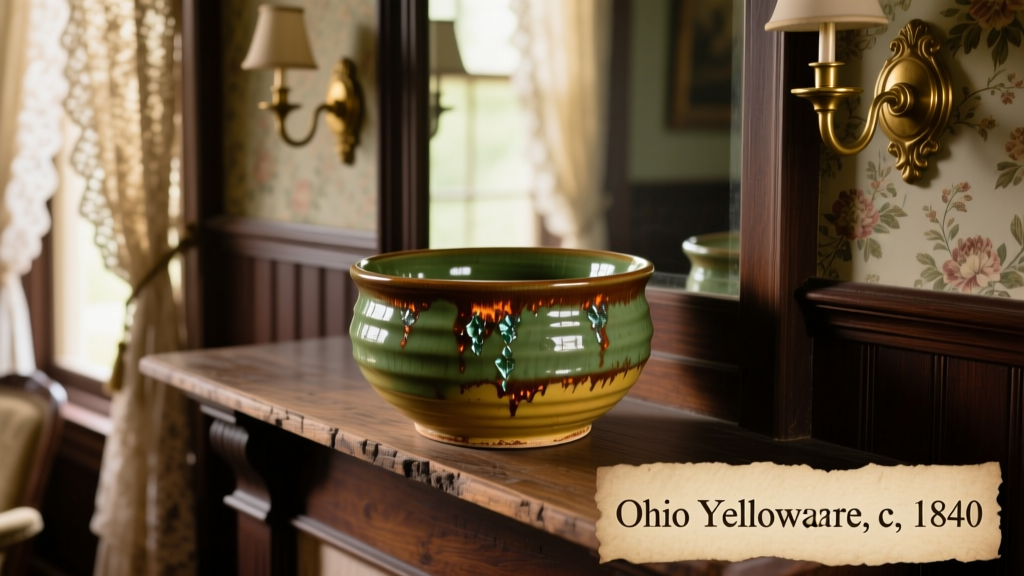
The Ohio Beehive Yellowware Bowl: A Study of Green-Brown Glazed Stoneware from the 1840s–1870s
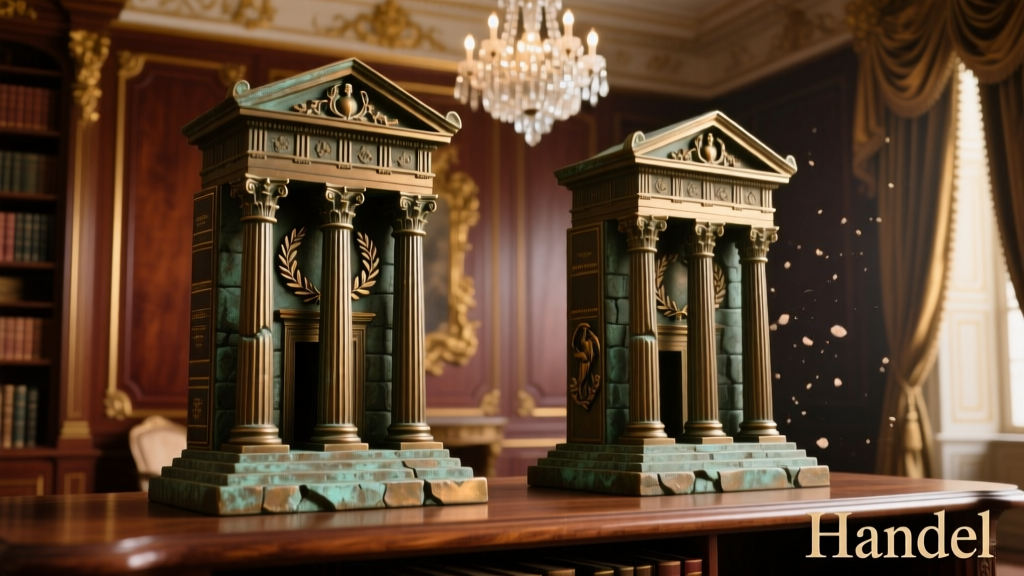
Handel Bookends: Roman Ruin Design with Three-Column Facade — A Bronze Masterpiece at 7½ Inches
Glasswork in Antique Furniture: History, Techniques, and Restoration Best Practices
Stephen L. Preston: American Cabinetmaker, Design Innovator, and Mid-Century Modern Legacy
Rock Island Railroad Pottery Large Mug: History, Identification, and Restoration Insights
Advertising Door Push: The Aluminum Kist Cooler Push Plates of the 1950s
The Kitchen Sprinkler Bottle 'Black Mammy' — A 6¾-Inch Ceramic Artifact: History, Manufacture, and Ethical Context