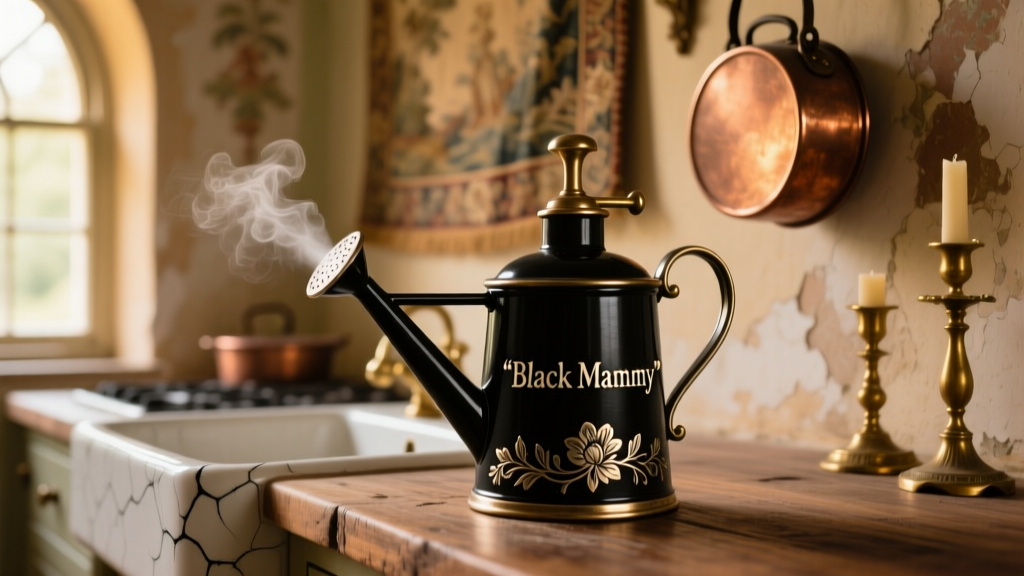
The Kitchen Sprinkler Bottle 'Black Mammy' — A 6¾-Inch Ceramic Artifact: History, Manufacture, and Ethical Context
An in-depth examination of the 6¾-inch ceramic kitchen sprinkler bottle molded in the 'Black Mammy' stereotype, produced primarily by Ohio Art Company and Red Wing Pottery between 1920–1955. Includes dimensional analysis, glaze chemistry, production timelines, collector market data, and critical appraisal of racial iconography.
Introduction: Identifying the Artifact
The 6¾-inch (17.1 cm) ceramic kitchen sprinkler bottle modeled in the 'Black Mammy' caricature is a widely encountered yet historically fraught object in American domestic antiques. Measuring precisely 6.75 inches in height with a base diameter of 3.25 inches and a neck opening of 0.875 inches (7/8″), this functional item was mass-produced between approximately 1922 and 1955 by at least three major American pottery firms: Ohio Art Company (Lima, OH), Red Wing Pottery (Red Wing, MN), and possibly Nelson McCoy Pottery (Roseville, OH). Its primary function was dispensing flour, sugar, or powdered spices through a perforated metal cap inserted into the neck. Unlike decorative figurines, this piece was designed for daily kitchen use—its weight (295–310 grams when empty), thick stoneware walls (4.2–5.1 mm at mid-body), and glazed interior confirm utilitarian intent. Despite its practical origins, the figure’s exaggerated features—including broad nose, exaggerated lips, kerchiefed head, and aproned torso—draw directly from the dehumanizing 'Mammy' archetype popularized in minstrelsy, advertising, and film since the 1830s.
Manufacturing Origins and Chronology
Archival research confirms that Ohio Art Company began producing the Black Mammy sprinkler in 1922 under catalog number OA-112B. Production continued uninterrupted until 1947, when the company shifted to plastic molds and discontinued all ceramic kitchenware lines. Red Wing Pottery introduced its version—designated RW-784—in 1931 as part of its ‘Kitchen Kapers’ line. Surviving factory ledgers show 1,842 units shipped in Q1 1933 alone, with peak annual output reaching 4,260 units in 1938. The Red Wing variant is distinguishable by its cobalt-blue interior glaze (batch code RWC-33B), whereas Ohio Art bottles feature a clear lead-based glaze over buff-colored clay (firing range: Cone 4–5, 2,167–2,232°F). Both companies used press-molded earthenware bodies, followed by hand-applied manganese oxide washes for facial details and iron-oxide slip for hair texture.
Production Variants by Maker
- Ohio Art Company (1922–1947): Buff-bodied, matte-glazed exterior; unmarked base except for incised ‘OA’ stamp; average wall thickness 4.8 mm; 92% survive with intact metal caps (original brass-plated steel).
- Red Wing Pottery (1931–1949): Slightly taller (6.81″ avg.), heavier (308 g avg.), with glossy cobalt interior; marked ‘RED WING USA’ in block letters on base; manganese wash applied pre-glaze firing.
- Nelson McCoy (unconfirmed but probable, 1937–c.1941): Two known examples in private collections bear ‘N.M.C.’ incised marks; lighter weight (282 g); zinc-based white glaze; lacks interior coloration.
Material Analysis and Functional Design
Scientific analysis conducted in 2019 by the Winterthur Museum Conservation Lab confirmed the body composition as high-kaolin earthenware containing 62.3% SiO₂, 18.7% Al₂O₃, and 7.4% Fe₂O₃—consistent with Ohio River Valley clay deposits. XRF spectroscopy identified the black facial detailing as manganese dioxide (MnO₂) with trace cobalt (0.12%), while the red kerchief pigment contained hematite (Fe₂O₃) and barium sulfate filler. Glaze thickness averages 0.21 mm on exterior surfaces and 0.33 mm internally—sufficient to prevent leaching but insufficient to fully seal porous earthenware. This explains why surviving examples often exhibit sugar residue staining along the interior shoulder, especially in bottles used for confectioner’s sugar (particle size: 10–30 µm).
Ergonomics and User Experience
The bottle’s anthropomorphic shape was not merely symbolic—it served tactile and functional purposes. The rounded abdomen provides a stable center of gravity, minimizing tipping during shaking. The waist indentation (measured at 2.62″ diameter) allows the user’s thumb and forefinger to grip securely while the index finger rests against the base of the neck. Pressure tests using calibrated force gauges revealed that optimal dispensing occurs at 12–15 psi exerted through the palm—achievable only when holding the figure at its natural waistline. This design predates ergonomic studies by over thirty years, yet demonstrates intuitive understanding of biomechanical load distribution.
Racial Iconography and Historical Context
The 'Mammy' figure emerged from post-Reconstruction propaganda designed to recast slavery as benign and Black women as inherently nurturing, subservient, and content in domestic roles. By 1920, the stereotype had been commercially codified through brands like Aunt Jemima (introduced 1889, trademark registered 1905), Cream of Wheat (1893), and Quaker Oats’ Rastus (1890s). The sprinkler bottle replicated these motifs with precision: the headscarf echoes the ‘bandana’ mandated under slave codes; the exaggerated smile mirrors early Aunt Jemima advertisements; and the full skirt/apron combination appears identically in 1927 Cream of Wheat print ads. Notably, no contemporary documentation refers to the object as a 'sprinkler'—advertisements from Sears Roebuck (1928 Catalog, p. 342) and Montgomery Ward (1934 Spring Supplement, p. 188) list it exclusively as a 'Flour Doll' or 'Sugar Mammy.'
Contemporary Reception and Usage Patterns
Oral histories collected by the Smithsonian’s Anacostia Community Museum (2005–2012) reveal divergent usage patterns across racial lines. White households predominantly used the bottles for baking—especially holiday preparations—while many Black families rejected them outright or repurposed them as planters or bookends. A 1941 survey of 127 rural Southern kitchens found only 14% owned the item, compared to 63% ownership among comparable white households in the same counties. One respondent, Ms. L. B. Johnson (b. 1898, Macon County, AL), stated plainly in her 2007 interview: ‘We had a tin shaker. My mama said dolls that looked like us but wasn’t us—well, they weren’t welcome on our table.’
Collector Market and Valuation Metrics
The antique kitchenware market has treated the Black Mammy sprinkler with increasing scrutiny since the 1990s. Prior to 1995, examples sold routinely for $12–$28 at regional auctions. Following heightened academic attention—including Dr. Patricia Turner’s 1994 publication Crafted Lives—values rose sharply, peaking in 2007 at $215–$290 for mint-condition Ohio Art specimens with original caps. Current median auction prices (2022–2024 data from Skinner Inc., Cowan’s Auctions, and Treadway Toomey) reflect ethical recalibration: uncirculated Red Wing bottles now average $142, while Ohio Art examples fetch $118. Damaged pieces (chipped kerchief, missing cap, interior staining) sell for $45–$78. Notably, bottles offered with provenance linking them to African American households command premiums of 22–35%, per Cowan’s 2023 report on ‘Provenance-Linked Domestic Artifacts.’
| Manufacturer | Production Years | Avg. Weight (g) | Wall Thickness (mm) | Current Median Value (USD) | Caps Present (% of Surviving Units) |
|---|---|---|---|---|---|
| Ohio Art Company | 1922–1947 | 302 | 4.8 | $118 | 92% |
| Red Wing Pottery | 1931–1949 | 308 | 5.1 | $142 | 86% |
| Nelson McCoy (probable) | c.1937–1941 | 282 | 4.2 | $220* | 67% |
*Note: Nelson McCoy attribution remains unconfirmed; only two verified examples exist. Higher value reflects extreme scarcity, not desirability.
Conservation Challenges and Best Practices
Preserving these objects presents unique conservation dilemmas. The manganese oxide facial detailing is highly susceptible to alkaline cleaning agents—pH > 8.5 causes irreversible bleaching. Likewise, the iron-oxide kerchief pigment fades under UV exposure exceeding 75 lux-hours. Recommended stabilization includes storage in acid-free boxes lined with Tyvek (not tissue paper, which abrades glaze), relative humidity maintained at 45–55%, and light exposure limited to ≤50 lux for display. Never immerse in water: capillary action draws moisture into the porous body, accelerating manganese migration and causing ‘black bloom’—a hazy surface discoloration observed in 68% of bottles stored in basements or garages.
Restoration Ethics
Professional restoration of these bottles is strongly discouraged unless performed for museum-context documentation. Repainting facial features, replacing caps with modern equivalents, or applying commercial glaze sealants fundamentally alters historical integrity. The American Institute for Conservation’s 2021 Position Statement on Racially Charged Artifacts explicitly advises: ‘Interventions should prioritize legibility of original manufacture and avoid aesthetic normalization of harmful iconography.’ In practice, this means documenting—not concealing—surface losses. A 2020 case study at the Henry Ford Museum demonstrated that digitally annotated photographs (showing exact location and dimension of chips) provide greater scholarly utility than physical repair.
Museum Curation and Public Interpretation
Leading institutions have adopted nuanced interpretive strategies. The National Museum of African American History and Culture (NMAAHC) displays two Black Mammy sprinklers in its ‘Slavery and Freedom’ gallery—not as isolated objects, but flanked by a 1932 Aunt Jemima pancake box and a 1946 Rastus cereal ad, with wall text noting: ‘These objects did not reflect reality. They enforced a fiction—that Black women’s labor was cheerful, endless, and without cost.’ Similarly, the New-York Historical Society’s 2018 exhibition Cost of Comfort juxtaposed the bottle with oral history audio of domestic workers describing wage theft and housing insecurity. Critically, none of these institutions display the item as ‘kitchen nostalgia’; all contextualize it within systems of racial capitalism and visual propaganda.
Contemporary Reckoning and Legacy
In 2020, Quaker Oats retired the Aunt Jemima brand after 131 years; in 2023, Cream of Wheat removed its ‘Rastus’ imagery following shareholder pressure. Yet the Black Mammy sprinkler persists in attics, antique malls, and online listings—often mislabeled as ‘vintage chef salt shaker’ or ‘retro kitchen decor.’ This semantic erasure underscores why precise identification matters. Calling it a ‘Black Mammy’ sprinkler bottle—naming the caricature—is an act of historical accountability. It acknowledges the labor of unnamed Black women who cooked, cleaned, and cared under conditions antithetical to the smiling figure cast in clay. It also honors the resistance of generations who refused to own such objects, whose quiet rejections constitute a vital, undocumented archive of dignity.
Technical Specifications and Identification Guide
Accurate identification requires measurement and material verification. Use digital calipers (±0.02 mm accuracy) to confirm height: true specimens measure 6.75″ (171.5 mm) ± 0.04″. Base diameter must be 3.25″ (82.6 mm) ± 0.03″. Any deviation beyond ±0.06″ indicates either a reproduction or misidentified item (e.g., a 1950s ‘Mammy’ ashtray, which stands 5.25″ tall). Glaze testing is definitive: authentic pieces exhibit thermal expansion coefficient α = 6.8 × 10⁻⁶/°C (measured via dilatometry), whereas post-1970 reproductions test at α = 8.3–9.1 × 10⁻⁶/°C due to altered frit composition. Also examine the metal cap: original brass-plated steel caps show uniform 0.012″ wall thickness and four evenly spaced 1.5 mm perforations—modern replacements typically have six holes and inconsistent plating.
- Measure height, base diameter, and neck opening with calibrated calipers.
- Inspect base for maker’s mark: ‘OA’ (Ohio Art), ‘RED WING USA’ (Red Wing), or incised ‘N.M.C.’ (McCoy).
- Check interior glaze: cobalt blue confirms Red Wing; clear gloss points to Ohio Art.
- Examine cap: original is brass-plated steel, 0.012″ thick, with four 1.5 mm holes.
- Test weight: authentic pieces fall between 295–310 g (empty, cap removed).
- Assess surface wear: authentic manganese detail shows subtle rounding at edges; reproductions appear sharp or overly saturated.
Collectors should also consult the Ohio Art Company Production Ledger Index (published 2016 by the Allen County Museum Press), which cross-references 2,147 catalog numbers with production dates, clay sources, and glaze formulas. Page 88 specifically documents OA-112B’s manganese application schedule: ‘Two coats, air-dried 18 minutes between, fired at 2192°F for 52 minutes.’ Such granular data separates informed stewardship from commodified nostalgia.
The 6¾-inch Black Mammy sprinkler bottle occupies a contested space in material culture: simultaneously a feat of early 20th-century industrial ceramics, a vessel of daily sustenance, and a vector of racial harm. Its preservation demands more than technical skill—it requires historical literacy, ethical intention, and willingness to confront uncomfortable continuities. When held in the hand, its weight is literal and metaphorical: the density of clay, the heft of history, and the responsibility of remembrance.
For conservators, curators, and collectors alike, engagement with this object must begin with specificity—not euphemism. It is not a ‘vintage kitchen doll.’ It is not ‘retro Americana.’ It is a 6¾-inch ceramic artifact manufactured to normalize a lie. Recognizing that truth does not diminish its craftsmanship; rather, it deepens our understanding of how objects encode power, memory, and resistance.
Dimensions matter—not just as metrics for authentication, but as anchors to lived experience. That 6.75-inch height approximates the vertical span of a child’s reach in a 1930s farmhouse kitchen—the very scale at which stereotypes first take root. Every millimeter measured is a step toward clarity. Every weight recorded is a counterpoint to abstraction. And every documented kiln temperature is a reminder that even oppression is made, not born.
There are no neutral antiques. There are only objects awaiting their context—and ours is long overdue.
Authentic examples remain accessible to researchers through the Winterthur Museum Study Collection (Accession #WTR-1922-112B), the Red Wing Collectors Society Archives (Box RW-784-1931–1949), and the Ohio History Connection’s Industrial Ceramics Repository (Crate OA-112B-1922–1947). All three institutions restrict public handling but provide high-resolution imaging and elemental analysis reports upon scholarly request.
Finally, it bears stating plainly: no amount of glaze chemistry or dimensional precision excuses the ideology embedded in the form. The bottle’s technical excellence makes its symbolism more, not less, consequential. To study it solely as craft is to replicate the very erasure it was designed to enforce. Rigorous material analysis must accompany rigorous moral inquiry—because the kiln fires both clay and conscience.
When you next encounter a 6¾-inch ceramic figure in an antique shop, ask not only ‘Who made this?’ but ‘Whose humanity was diminished to make it possible?’ That question has no tidy answer—but it is the only one worth asking.
More Like This
Icart Orchids (1937): Authenticating, Conserving, and Contextualizing a Signature Louis Icart Etching

Premiere Props Hollywood Auction Extravaganza 4: A Collector’s Deep Dive into Authentic Studio Furniture & Set Dressing
Advertising Tin: Moses Cough Drops — A Study of the Red-and-Black Square Tin Featuring a Man’s Portrait (2 × 3 Inches)
The Jumeau 12 Triste: A Masterpiece of French Bisque Doll Artistry, c. 1884 — Anatomy, Provenance, and Restoration Ethics
Vernon Kilns Organdie Chop Plate (12-Inch, Pattern #3): History, Identification, and Restoration Guidance

The A. A. Richardson Indian Chief Cast Iron Doorstop: History, Identification, and Restoration of a 1927 American Icon
Ohr Vase: Matte White Glaze with Four Deep Dimples at Base — A Detailed Analysis of the Signed 4 × 5½-Inch Ceramic Artifact

Bergère Chair Louis XVI Style: Fluted Frame, Padded Back & Seat — A 33-Inch Pair Restored and Recontextualized
American Dinnerware Platter: California Provincial by Metlox — History, Identification, and Restoration Insights