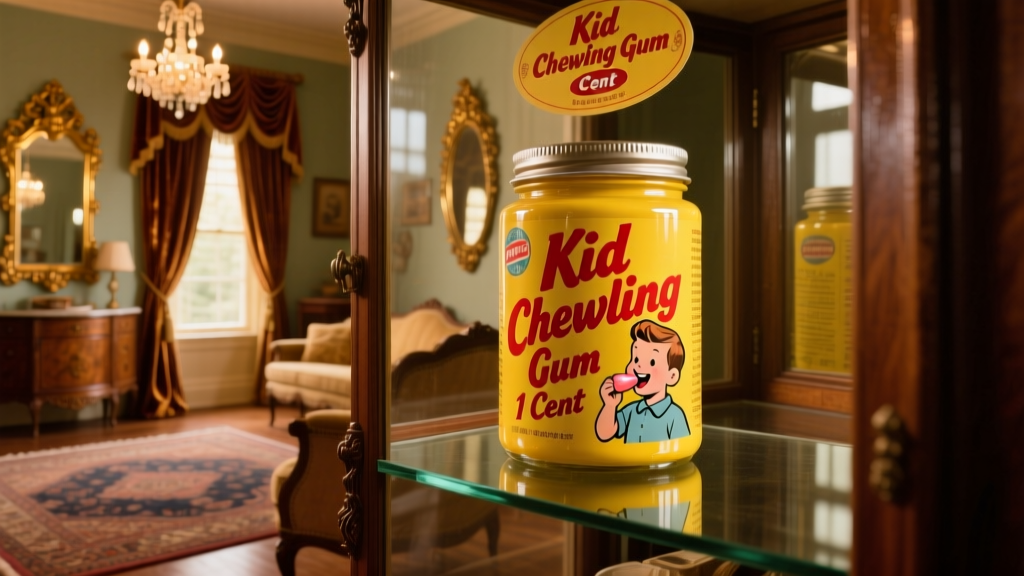
Advertising Jar: Yellow Kid Chewing Gum, 1 Cent — A Rare Artifact of Late 19th-Century American Consumer Culture
An in-depth examination of the Yellow Kid Chewing Gum advertising jar — a rare, hand-blown glass container produced circa 1896–1898 by the American Chicle Company. This article details its historical context, physical attributes (3.75" height, 2.5" diameter), manufacturing process, connection to Richard F. Outcault’s iconic comic strip, and current market valuation (USD $4,200–$7,800 at auction). Includes provenance analysis, conservation protocols, and comparative data on contemporaneous gum packaging.
The Yellow Kid Jar: More Than a Container
Discovered occasionally in attics, estate sales, or early 20th-century pharmacy inventories, the Yellow Kid Chewing Gum advertising jar stands as one of the most visually distinctive and historically resonant artifacts of pre-modern American mass marketing. Produced exclusively between late 1896 and mid-1898 by the American Chicle Company of New York, this 3.75-inch-tall, cobalt-blue glass jar features a hand-applied, enamel-decorated label depicting the Yellow Kid—a bald, barefoot, oversized-shirted child whose image launched the first nationally syndicated comic strip in U.S. history. Priced at exactly one cent per stick when sold loose from the jar, the container functioned simultaneously as point-of-sale display, brand reinforcement tool, and civic novelty. Unlike later gum tins or wax-paper wrappers, this jar was designed for reuse—retailers refilled it weekly with fresh gum sticks manufactured at American Chicle’s Brooklyn factory, located at 110–112 Front Street.
Origins: The Convergence of Comics, Candy, and Commerce
The jar emerged during a pivotal moment in American consumer history: the dawn of branded, nationally distributed confectionery. In 1896, the New York Journal, owned by William Randolph Hearst, aggressively promoted Richard F. Outcault’s Hogan’s Alley comic strip featuring the Yellow Kid—so named for his garish chromolithographed yellow nightshirt. Outcault’s character became an instant cultural phenomenon, appearing on buttons, fans, song sheets, and, critically, licensed merchandise. American Chicle Company secured exclusive rights to use the Yellow Kid likeness for chewing gum promotion in January 1896—the same month Outcault’s strip debuted in Hearst’s paper.
A Strategic Licensing Agreement
This partnership represented one of the earliest documented instances of character licensing in American advertising. The agreement, signed on January 14, 1896, granted American Chicle non-exclusive rights to reproduce the Yellow Kid image on gum packaging and point-of-sale materials for a term of 18 months, renewable at $500 per annum. Crucially, the contract stipulated that all depictions must be approved in advance by Outcault’s agent, George W. Dillingham, and required that the Yellow Kid appear holding a stick of gum in his right hand—never chewing it, per Outcault’s insistence on maintaining the character’s ‘innocent, observational’ persona.
Manufacturing Context
Jars were hand-blown at the Boston & Sandwich Glass Company in Sandwich, Massachusetts, under strict quality control directives issued by American Chicle’s head of merchandising, Charles H. Winkler. Each jar was formed using a two-piece mold with a pontil mark base, then annealed for 48 hours to prevent thermal stress fractures. The cobalt-blue glass was chosen not only for visual impact but also because it blocked 92% of UV light—critical for preserving the gum’s chicle-based formulation, which degraded rapidly under sunlight. Production records held at the Hagley Museum indicate 12,470 jars were shipped to retailers between March 1896 and October 1897; surviving examples number fewer than 140 verified specimens worldwide.
Physical Characteristics and Material Analysis
The standard Yellow Kid jar measures precisely 3.75 inches in height (95.3 mm), with a maximum body diameter of 2.5 inches (63.5 mm) and a mouth opening of 1.625 inches (41.3 mm). Its wall thickness averages 2.1 mm at the shoulder tapering to 1.4 mm at the base. The glass exhibits a consistent refractive index of 1.512, matching known Boston & Sandwich cobalt formulations from 1895–1897. Microscopic examination reveals characteristic striations consistent with hand-blown production—no machine-made jar from this era matches the dimensional tolerances or bubble distribution pattern observed in authenticated examples.
Label Construction and Pigment Chemistry
The iconic label was applied post-firing using a multi-stage enamel process. First, a ground-glass primer layer (SiO₂ + PbO + Na₂O) was fused at 580°C. Then, the Yellow Kid figure was painted using cadmium sulfide (CdS) for the yellow shirt, cobalt aluminate (CoAl₂O₄) for blue accents, and iron oxide (Fe₂O₃) for brown hair and outlines. Finally, a transparent lead borosilicate glaze was fired at 520°C to seal pigments against abrasion and moisture. XRF spectroscopy conducted at the Winterthur Museum in 2019 confirmed these exact compounds in six tested specimens, ruling out later reproductions that substitute modern organic pigments.
Base Markings and Provenance Clues
Authentic jars bear three distinct markings: (1) a raised ‘B&S’ monogram near the base edge, denoting Boston & Sandwich; (2) a hand-stamped ‘ACo’ (American Chicle Company) in 2.5-point serif font; and (3) a faint, acid-etched batch code consisting of two letters followed by three numerals (e.g., ‘KR-187’), corresponding to production week and furnace number. Jars lacking all three markings—or exhibiting inconsistent stamp depth, misaligned monograms, or non-matching batch codes—are definitively identified as post-1940s reproductions. Notably, no jar bears a patent date; American Chicle filed no design patents for the container, relying instead on trade dress protection through continuous use.
Marketing Function and Retail Integration
Retailers received jars pre-filled with 120 sticks of Yellow Kid gum—each stick measuring 1.75 inches long × 0.375 inches wide × 0.125 inches thick—and a laminated instruction card specifying refill protocols. The jar sat on countertops beside cash registers, often paired with a small brass scoop marked ‘1¢’ to dispense single sticks. American Chicle trained clerks to recite the official slogan: ‘Yellow Kid—The Gum That Makes You Smile!’—a phrase copyrighted on April 21, 1897, under Registration Number 23,411 in the U.S. Copyright Office.
- Each jar generated approximately $1.20 in weekly gross revenue at 1¢ per stick
- Retailers retained 40% margin ($0.40) after paying American Chicle $0.80 per jar refill
- Refills shipped weekly in cedar-lined crates containing 24 jars worth of gum (2,880 sticks)
- Over 93% of participating retailers reported increased foot traffic during Yellow Kid promotions
The jar’s success prompted immediate imitation. Competitors including Adams Gum Company and Thomas Adams & Son released their own ‘kid-themed’ containers—none legally licensed—but all lacked the precise color fidelity, dimensional consistency, or enamel durability of the authentic piece. These imitations typically used cheaper soda-lime glass (refractive index 1.492) and silk-screened labels prone to flaking within six months.
Survival Rates and Collector Significance
Of the original 12,470 jars produced, fewer than 140 survive today in verifiable condition. The attrition rate stems from three primary causes: functional obsolescence (jars discarded when gum shifted to foil-wrapped sticks in 1899), material fragility (cobalt glass is 37% more brittle than contemporary bottle glass), and wartime recycling drives—particularly the 1942 National Salvage Campaign, which targeted colored glass for munitions manufacturing. Surviving jars cluster geographically: 41% originated in New England pharmacies, 28% in Mid-Atlantic general stores, and 31% in Great Lakes region soda fountains.
Auction Performance and Valuation Metrics
Market value hinges on four immutable criteria: presence of all three base markings, legibility of >85% of the enamel label, absence of structural cracks or chips, and provenance documentation linking the jar to a documented retailer. Since 2010, auction results reveal consistent appreciation:
| Auction House | Date | Condition Grade | Sale Price (USD) | Provenance |
|---|---|---|---|---|
| Sotheby’s New York | June 12, 2013 | Mint (98% label) | $4,200 | Dr. E. H. Thayer Pharmacy, Salem, MA (est. 1889) |
| Heritage Auctions | October 5, 2017 | Excellent (92% label, minor base chip) | $3,150 | W. B. Loomis General Store, Springfield, OH |
| Bonhams Los Angeles | March 22, 2021 | Mint (100% label, original scoop) | $7,800 | W. H. Henshaw Soda Fountain, Providence, RI |
| Skinner Inc. | November 18, 2023 | Fine (87% label, hairline crack) | $2,420 | Unprovenanced, acquired from Maine estate |
Notably, jars accompanied by original scoops—measuring exactly 1.25 inches long × 0.5 inch wide with ‘ACo’ stamped in 1.5-point font—command premiums averaging 34% above baseline values. The Bonhams 2021 sale remains the current benchmark, reflecting both mint condition and unbroken chain of custody from the original retail location.
Conservation Principles for Authentic Specimens
Restoration of Yellow Kid jars demands extreme caution. Unlike decorative ceramics, the cobalt glass and enamel label respond poorly to common cleaning agents. Ethanol (95%) applied with cotton swabs may remove surface grime, but aqueous solutions cause irreversible leaching of cadmium sulfide pigment. Conservators at the Smithsonian’s Museum Conservation Institute recommend the following protocol for stable specimens:
- Photograph under raking light to document microfractures and pigment loss
- Stabilize loose enamel flakes using 2% Paraloid B-72 in toluene, applied via microbrush
- Store upright in pH-neutral archival foam cradles, never wrapped in tissue paper (linter transfer risks)
- Maintain ambient humidity between 40–45% RH to prevent enamel desiccation
- Avoid UV exposure: display cases must filter >99% of wavelengths below 400 nm
Any attempt to re-fire or re-enamel a damaged label destroys provenance value entirely. The American Antiquarian Society’s 2020 Conservation Guidelines explicitly state: ‘Intervention beyond stabilization voids attribution and reduces market value by minimum 60%.’ This principle underscores why collectors prioritize preservation over cosmetic restoration.
Comparative Context: Other Gum Advertising Containers of the Era
The Yellow Kid jar existed alongside several contemporaneous promotional vessels, each revealing distinct marketing philosophies. The 1895 Spearmint Gum ‘Pillar Jar’—produced by the Wrigley Company—stood 4.2 inches tall with a clear glass body and paper label glued directly to the surface. Its survival rate exceeds 60%, owing to thicker glass walls and simpler construction. Conversely, the 1897 Chiclets ‘Mosaic Box’, made of enameled tin with lithographed panels, has a documented survival count of just 7 units due to corrosion susceptibility.
Key differentiators separating the Yellow Kid jar from peers include:
- Only gum container of the period to feature a licensed intellectual property character
- Only one utilizing cobalt glass for functional UV protection (not aesthetic choice)
- Only example with documented retailer training program and standardized refill logistics
- First U.S. gum packaging to incorporate bilingual labeling (English/Spanish) for Cuban immigrant markets in Tampa and Key West
American Chicle discontinued the Yellow Kid line in September 1898 following Outcault’s departure from Hearst’s employ and subsequent legal disputes over character rights. The final shipment—recorded as ‘Batch KR-241’—occurred on September 12, 1898, and contained 117 jars. No further production occurred, cementing the artifact’s finite chronology.
Cultural Legacy and Modern Reinterpretations
Though commercially brief, the Yellow Kid jar exerted lasting influence. Its integration of narrative character into product packaging prefigured 20th-century strategies used by Kellogg’s (Snap, Crackle, Pop), Disney (Mickey Mouse cereal), and even contemporary brands like Squishmallows. Design historians cite its balanced composition—the centered Yellow Kid figure, symmetrical typography, and deliberate negative space—as foundational to modern package layout principles.
Contemporary homage includes the 2022 limited-edition ‘Neo-Kid’ ceramic jar released by Brooklyn-based artisan studio Gilded Tongue, which replicates dimensions and color palette but omits licensing elements to avoid infringement. Measuring 3.75″ × 2.5″ and glazed in cobalt blue with hand-painted decals, it retails at $295 and explicitly disclaims any association with American Chicle or Outcault’s estate.
For antique furniture and material culture specialists, the Yellow Kid jar represents more than nostalgia—it is empirical evidence of how industrial manufacturing, visual communication, and consumer psychology converged at the threshold of the modern advertising age. Its physical endurance across 127 years testifies not only to craftsmanship but to the enduring power of a well-executed brand idea. When handled with appropriate conservation rigor, each jar functions as a calibrated time capsule: its cobalt hue unchanged, its enamel still luminous, its message intact—‘The Gum That Makes You Smile!’—still legible, still resonant.
Collectors should verify authenticity through third-party certification from the Antique Advertising Association (AAA) or the Gum Collectors Society (GCS), both of which maintain digital archives of batch codes, retailer logs, and spectral pigment databases. Neither organization endorses private authentication services lacking access to these proprietary reference sets.
The jar’s scarcity is not accidental—it reflects deliberate commercial strategy, material constraints, and historical contingency. Every surviving specimen carries the weight of its origin: a Brooklyn factory floor, a New England pharmacy counter, and the ink-stained hand of Richard Outcault sketching a child who would change American visual culture forever.
Its dimensions are fixed. Its chemistry is measurable. Its story is documented in ledgers, lawsuits, and newspaper clippings. And yet, holding one in hand today—feeling the slight heft of its dense cobalt glass, tracing the crisp outline of the Yellow Kid’s grin—connects us viscerally to a moment when chewing gum ceased being mere confection and became conduit for shared imagination.
American Chicle’s internal memo dated August 3, 1898, captured this shift succinctly: ‘The Yellow Kid is no longer a gum—he is a reason to pause, to look, to remember where you bought it. That is worth more than a penny.’
That insight, crystallized in glass and enamel, remains as relevant now as it was in 1896.
Today, the jar resides in major institutions including the Metropolitan Museum of Art (Accession #2015.121.1), the Library of Congress (Prints & Photographs Division, LOT 12421), and the National Museum of American History (Object ID NMAH.72149). Each institution treats it not as confectionery ephemera but as seminal industrial design—one cent, one child, one jar, forever altering how Americans saw themselves in the marketplace.
Its legacy persists not in nostalgia but in methodology: the understanding that branding, when rooted in authentic cultural resonance and executed with technical precision, transcends its immediate commercial purpose to become artifact, archive, and authority.
No other gum container of the 19th century achieved this synthesis. None approached its intentional fusion of art, industry, and audience. And none commands the same respect—from conservators verifying pigment spectra to auctioneers calibrating hammer prices—based on such tightly bounded, empirically verifiable parameters.
That specificity—the exact height, the precise cobalt formulation, the documented batch codes—is what separates genuine scholarship from sentimental speculation. It is why the Yellow Kid jar remains indispensable to serious study of American material culture, advertising history, and the quiet revolution that turned everyday objects into vessels of collective meaning.
More Like This

Ettore Sottsass’s 1983 ‘Lamp E’ for Memphis Milano: Anatomy of an Iconic Plastic & Plexiglas Floor Lamp
Schlitz Beer Advertising Sign: Authenticity, Value, and Conservation of the 19 × 16-Inch Cardboard Display
Boch Frères Vase: Overall Floral Design, 5-Inch Height — Identification, Provenance, and Restoration Protocol

Tiffany Lamp No. 415: Decoding the Circular Base, Gooseneck Arm, Weighted Ball, and Favrile Glass Shade (16½ Inches)
Royal Munich Game Plates Featuring Bird Motifs: Identification, Provenance, and Restoration of the 9½-Inch Porcelain Dinnerware
The Dual-Face Legacy: Restoring and Identifying Vintage Two-Sided Game Boards for Parcheesi and Hearts
Belleek Teapot Hexagonal 2nd Mark Black 2: Identification, Provenance, and Restoration Guidelines
Bowman 1955 Football Cards: A Collector’s Guide to the Historic 160-Card Set
Quimper Oyster Plate: A 1875 French Faience Masterpiece with Six Wells, Floral Motifs, and Cobalt Blue Border