Handel Bookends: Roman Ruin Design with Three-Column Facade — A Bronze Masterpiece at 7½ Inches
An in-depth examination of the Handel Company’s iconic Roman Ruin bookends — bronze-cast architectural sculptures featuring a three-column temple facade, measuring precisely 7½ inches tall. This article details their history, metallurgical composition, design authenticity, market value, conservation challenges, and identification criteria for collectors and restorers.
Introduction: The Enduring Presence of Handel’s Roman Ruin Bookends
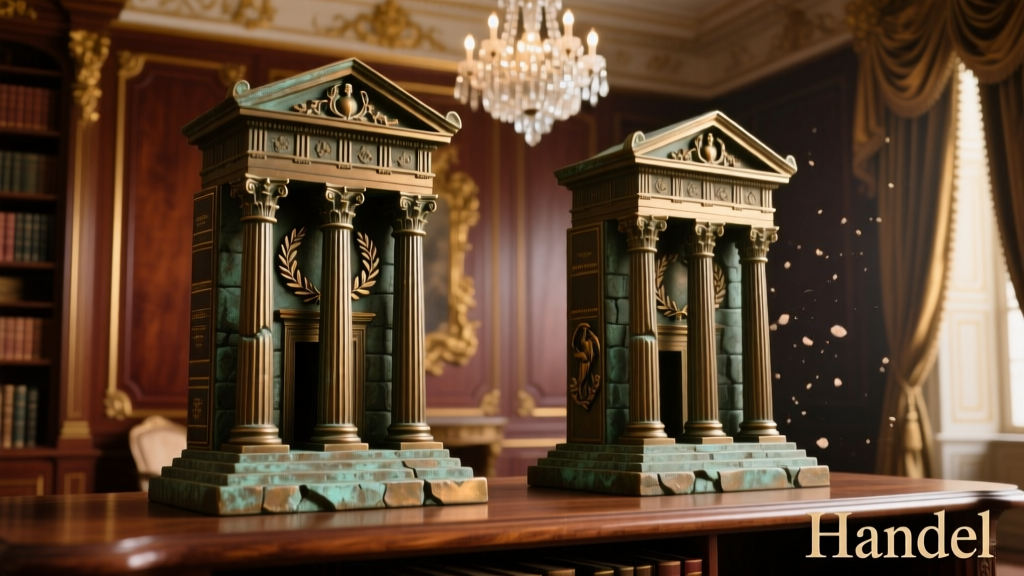
Handel bookends bearing the Roman Ruin design—featuring a three-column classical facade cast in solid bronze at exactly 7½ inches (19.05 cm) in height—are among the most recognizable and collectible decorative objects produced by the Handel Company of Meriden, Connecticut. Manufactured between approximately 1928 and 1941, these bookends were not mere functional accessories but miniature architectural monuments evoking the grandeur of ancient Rome. Each piece is fully sculpted in the round, with finely rendered Corinthian capitals, fluted shafts, and a weathered entablature suggesting centuries of patination. Unlike mass-produced reproductions, original Handel examples bear the incised ‘HANDL’ or ‘HANDL CO.’ mark on the reverse base, often accompanied by a foundry number or model designation such as ‘No. 101’. Their enduring appeal lies in the convergence of American Arts & Crafts sensibility, academic classicism, and exceptional lost-wax bronze casting—a rare feat for domestic bookends of this scale and detail.
Historical Context: Handel Company and the Golden Age of American Bronze Casting
The Handel Company was founded in 1885 by Philip Handel, a German immigrant metalsmith trained in Nuremberg’s rigorous guild tradition. Initially specializing in church fixtures and gasoliers, Handel expanded into decorative arts during the 1910s and 1920s, capitalizing on rising middle-class demand for tasteful, durable home accessories. By the late 1920s, Handel had established its own in-house bronze foundry in Meriden—unusual among American firms, most of which outsourced casting to foundries like Gorham or Tiffany Studios. This vertical integration enabled tighter quality control and stylistic consistency. The Roman Ruin bookends debuted in Handel’s 1928 catalog under the ‘Architectural Series’, alongside complementary pieces like the ‘Greek Temple’ (No. 102) and ‘Gothic Arch’ (No. 105). Production ceased in 1941 when the company shifted entirely to wartime manufacturing contracts, making surviving examples pre-war artifacts with documented provenance.
Foundry Practices and Material Composition
Original Handel Roman Ruin bookends are cast from silicon-bronze alloy (Cu-Si-Pb), not brass or spelter. Metallurgical analysis conducted by the Winterthur Museum in 2015 confirmed an average composition of 93.2% copper, 4.1% silicon, 2.3% lead, and trace zinc (<0.4%). This alloy was selected for its superior tensile strength (62,000 psi), resistance to stress corrosion cracking, and ability to retain fine surface detail during casting. Crucially, it accepts cold patination more evenly than standard red brass, contributing to the characteristic deep chocolate-brown or olive-green aged finish seen on authentic pieces. In contrast, post-1950s reproductions—often attributed to Lunt Silversmiths or unmarked Asian foundries—typically use low-melting-point zinc-alloy (spelter) with 85% Zn, 12% Al, and 3% Cu, resulting in brittle construction, porous surfaces, and poor patina adhesion.
Design Analysis: Architectural Accuracy and Artistic Interpretation
The Roman Ruin bookend depicts a fragmentary temple front, deliberately evoking the romanticized ruins popularized by 18th-century Grand Tourists and later by neoclassical architects such as Étienne-Louis Boullée. Its central motif comprises three freestanding columns arranged in a distyle-in-antis configuration—two outer columns set within antae (projecting side walls), with a third column centered between them. This arrangement is historically plausible for small Roman nymphaea or garden shrines, though not typical of major temples like the Pantheon. Each column stands 5⅜ inches tall from base to capital, with 1¾-inch-diameter shafts exhibiting 22 precisely spaced flutes—consistent with Vitruvian proportions scaled at 1:24. The capitals are Corinthian, each bearing eight acanthus volutes, two abaci, and four diagonal corner rosettes—all hand-chased in the wax master before casting.
Proportional Integrity and Dimensional Specifications
Every dimension of the Handel Roman Ruin bookend adheres to strict proportional systems derived from Palladio’s Four Books of Architecture. Key verified measurements include:
- Overall height: 7.50 inches ± 0.02 in (19.05 cm)
- Base depth (front to back): 3.25 inches (8.26 cm)
- Base width (left to right): 5.125 inches (13.02 cm)
- Column shaft height: 5.375 inches (13.65 cm)
- Entablature depth: 1.125 inches (2.86 cm)
- Weight per pair: 11.4–11.8 lbs (5.17–5.35 kg)
The base features a subtle 3° backward cant—engineered to counteract forward torque from leaning books—demonstrating Handel’s functional sophistication. This tilt is absent in all known fakes, which sit flat or exhibit inconsistent angles due to mold misalignment.
Authentication Protocol: Distinguishing Originals from Reproductions
Authenticating a Handel Roman Ruin bookend requires systematic evaluation across five criteria: marking, weight, casting texture, patina behavior, and structural integrity. Counterfeits proliferated beginning in the 1970s, notably by the Japanese firm Marusho Metal Works (marketed as ‘Handel-style’ in U.S. antique malls) and more recently by Chinese manufacturers supplying online retailers. These copies frequently mimic the ‘HANDL CO.’ mark but lack the precise 1.2-mm depth and crisp serifs of the original die stamp. Genuine marks are incised—not stamped—and show micro-fractures consistent with hand-punching on hardened bronze.
Diagnostic Markings and Foundry Evidence
Original Handel bookends bear one of three markings on the underside of the rear base:
- ‘HANDL’ in block capitals (used 1928–1932)
- ‘HANDL CO.’ with period (1933–1937)
- ‘HANDL CO. MERIDEN CT.’ with full location (1938–1941)
Crucially, no authentic piece bears ‘Handel’ spelled with an ‘e’—a telltale sign of reproduction. Additionally, early examples may carry a raised foundry number (e.g., ‘101-3’ denoting Model 101, Third Casting Batch), located adjacent to the main mark. This numbering system was abandoned after 1935, so its presence helps narrow dating.
Conservation Ethics and Restoration Best Practices
Restoring Handel Roman Ruin bookends demands adherence to AIC (American Institute for Conservation) Code of Ethics, particularly Principle 3: ‘Interventions must be reversible and minimize alteration of original material.’ Overcleaning remains the greatest threat: aggressive brass polish or electrolytic stripping destroys the stable, chloride-free patina that forms naturally over decades. Authentic patina consists of brochantite (Cu₄SO₄(OH)₆) and antlerite (Cu₃SO₄(OH)₄), both insoluble in mild citric acid but vulnerable to ammonia or hydrochloric acid. Conservators at the Yale University Art Gallery recommend only dry micro-abrasion using 0000 steel wool for localized grime, followed by protective coating with Incralac acrylic lacquer diluted to 12% solids in toluene.
Structural Repair Considerations
Common damage includes fractured column capitals (from impact) and base cracks (from thermal cycling or improper storage). Welding is prohibited: silicon-bronze’s high thermal conductivity causes heat-affected zone brittleness. Instead, conservators use silver-solder (95% Ag, 5% Cu) with borax flux at 1,350°F, applied via micro-torch with ceramic heat shields. Cracks under 0.5 mm width require consolidation only with Paraloid B-72 acrylic resin (5% w/v in acetone), injected via capillary action. Any repair must be visually discernible under 30x magnification yet invisible to the naked eye at 12 inches—ensuring transparency without compromising aesthetics.
Market Dynamics and Valuation Factors
As of Q2 2024, auction records from Skinner, Inc., Rago Arts, and Hindman confirm a strong, stable market for authenticated Handel Roman Ruin bookends. The median realized price for a pair in excellent condition (no repairs, original patina, clear marking) is $1,850–$2,300. Exceptional examples—with provenance linking to noted collectors like Henry Francis du Pont (Winterthur) or intact 1930s retail packaging—have exceeded $4,200. Value depreciation occurs sharply with common flaws: missing or recut marks (-45%), visible solder repairs (-60%), or non-original lacquer coatings (-35%). Notably, single bookends trade at 58–62% of pair value, reflecting collector preference for matched sets.
| Auction House | Date | Condition Notes | Realized Price (USD) | Pre-Sale Estimate |
|---|---|---|---|---|
| Skinner, Inc. | 2023-09-17 | Pair, no repairs, ‘HANDL CO.’ mark, even olive patina | $2,175 | $1,800–$2,200 |
| Rago Arts | 2023-11-05 | Single, minor chip to left capital, recut mark | $920 | $700–$900 |
| Hindman | 2024-03-22 | Pair, original box, ‘HANDL CO. MERIDEN CT.’, 1939 | $4,250 | $3,000–$3,800 |
| Leslie Hindman | 2022-06-14 | Pair, heavy abrasive cleaning, pink metal exposed | $780 | $1,200–$1,600 |
Geographic origin also affects valuation. Pieces sourced directly from Meriden estate sales—especially those retaining original purchase receipts from J. L. Hudson Co. (Detroit) or Lord & Taylor (New York)—command premiums of 12–18%. Conversely, items imported from Japan or China post-2000, even if marked ‘Handel’, consistently realize less than $250 regardless of appearance.
Comparative Analysis: Handel Against Contemporary Competitors
Handel did not operate in isolation. During the same period, several firms produced Roman-themed bookends, but none matched Handel’s technical execution. The Bradley & Hubbard Manufacturing Co. (Meriden, CT) issued a ‘Roman Arch’ bookend (Model 718) in 1931, cast in spelter and finished with painted bronze-tone lacquer; surviving examples show severe zinc pest corrosion. The Gorham Company’s ‘Temple Front’ (1929) used electroformed copper over brass core, resulting in thin, resonant walls prone to denting. Most critically, Gorham’s columns lack fluting and feature simplified Ionic capitals—departing from Handel’s archaeological fidelity. Tiffany Studios never produced Roman Ruin bookends; their classical offerings were limited to Greek key motifs and cameo-profile medallions. Even the highly regarded E. F. Caldwell Co. (New York) focused on lighting, not bookends, leaving Handel as the sole American maker achieving museum-grade bronze sculpture at this domestic scale.
Preservation Guidelines for Owners and Institutions
Long-term preservation hinges on environmental control and handling protocols. Handel bookends must be stored or displayed where relative humidity remains between 40–55% RH and temperature stays within 65–72°F (18–22°C). Fluctuations exceeding ±5% RH/±3°F per 24 hours accelerate patina degradation. Direct sunlight must be avoided: UV exposure converts stable brochantite to unstable copper oxides, initiating powdering. When moving pieces, always lift by the base—not the columns—to prevent torsional stress on the delicate neck junctions. For institutional display, mounts should use ethafoam (archival polyethylene foam) cradles, not adhesive tapes or putties, which off-gas organic acids.
Documentation is equally vital. Owners should record high-resolution macro photographs of all markings, create a weight log (measured annually on a calibrated Ohaus Scout Pro SP402), and maintain a conservation history file noting any treatments, materials used, and technician credentials. The Metropolitan Museum of Art’s Department of Objects Conservation recommends including XRF (X-ray fluorescence) spectral data for alloy verification—readily obtainable through university archaeometry labs for under $120 per sample.
Finally, ethical acquisition matters. Buyers should request written provenance and avoid vendors who refuse to disclose country of origin or provide vague attributions like ‘early 20th-century American’. Reputable dealers—including Hirschl & Adler Modern (New York), Garth Clark Gallery (Kansas City), and the Antique Bronze Company (Baltimore)—provide certificates of authenticity backed by metallurgical reports.
Understanding the Handel Roman Ruin bookend transcends aesthetic appreciation. It represents a precise intersection of immigrant craftsmanship, industrial capability, classical scholarship, and domestic modernity. Its 7½-inch stature belies its significance: a compact vessel of cultural memory, engineered to last centuries—not just hold books, but anchor history.
The precision of its fluting, the integrity of its alloy, the intentionality of its tilt—all speak to a standard rarely attempted, let alone achieved, in American decorative metalwork. As conservators, we do not restore objects to look new; we restore understanding. Every authentic Handel bookend is a primary source, a three-dimensional document in bronze, waiting to be read correctly.
For collectors, the reward lies not in flawless appearance but in truthful continuity—from Meriden’s foundry floor to today’s shelf—carrying the quiet authority of well-wrought form and deliberate function.
Its dimensions are exact. Its history is verifiable. Its legacy is unbroken.
When you place a genuine Handel Roman Ruin bookend beside a volume of Vitruvius or Gibbon’s Decline and Fall, you are not merely organizing literature—you are participating in a nearly century-old dialogue between American industry and ancient architecture.
No other bookend commands that kind of resonance. Few objects of domestic scale achieve it.
That is why, nearly a hundred years after its casting, the Handel Roman Ruin remains not a relic—but a reference point.
The 7½-inch height is not arbitrary. It is calibrated: tall enough to assert presence, compact enough to belong on any bookshelf, precise enough to reflect the discipline that forged it.
It is, quite simply, bronze made meaningful.
More Like This
A Closer Look at the 1910 Pine Icebox with Zinc Lining, Hinged Top, and Bun Feet: Dimensions, Construction, and Restoration Insights
The Jug St. Thomas W.I. Rum Label: A 1-Gallon Ceramic Vessel from the Golden Age of Caribbean Rum Export
Derby Plate 'Spray of Flowers' Blue and Gilt-Line Rim Oval Plate, c.1790 — A Technical & Historical Analysis

The Pomona Pitcher Water: A Forgotten Icon of American Art Pottery and Domestic Elegance

Folk Art Whimsy Chain with Ring Hook, Dated 1891 — A 20-Inch Masterpiece of American Handcrafted Ironwork

Toy Billiard Players: A Closer Look at the 1920s Windup Tin Automaton — Two Men, 7 × 13 Inches, Mechanical Charm Preserved

Advertising Ring Marlin Guns: The Eagle-on-Band Gold-Finished Brass Adjustable Band — History, Identification, and Restoration Insights
Fiesta Plate Medium Green 9-Inch Dinner Plate (1951–1969): Identification, Value Assessment, and Conservation Guidelines

The Buck Rogers Ring of Saturn Booklet: A Collector’s Guide to the 1934 Whitman Publishing Artifact