United States Pottery Co.: A Definitive History of the East Liverpool Pioneer (1882–1909)
A detailed historical and technical analysis of United States Pottery Co., the influential East Liverpool, Ohio stoneware manufacturer known for its salt-glazed crocks, Albany slip jugs, and innovative production methods between 1882 and 1909.
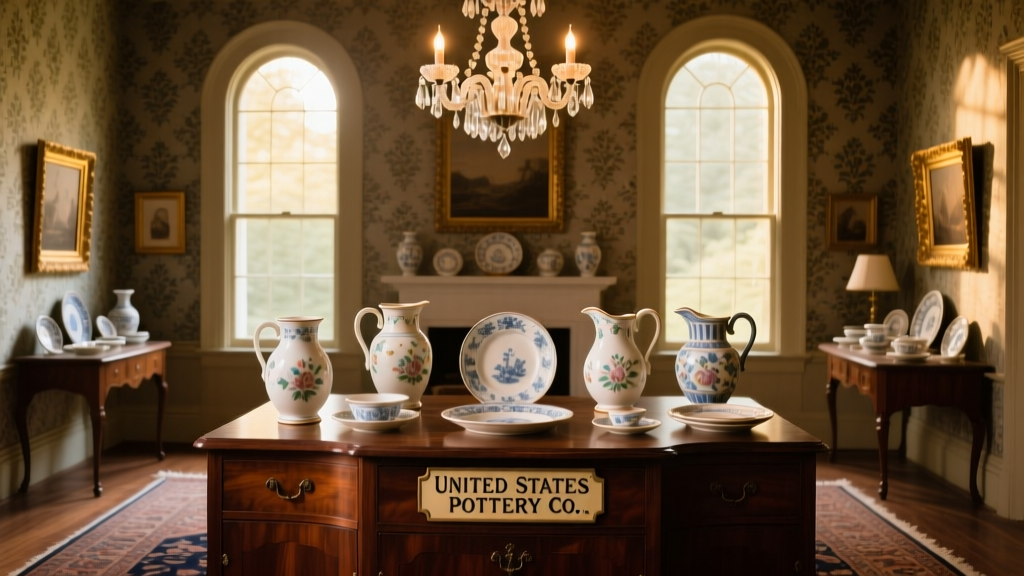
United States Pottery Co. was a cornerstone of American stoneware manufacturing from 1882 to 1909 in East Liverpool, Ohio—the nation’s preeminent ceramics hub during the late 19th century. Founded by John D. W. Hickey, William C. Smith, and George F. Hickey, the company specialized in utilitarian salt-glazed stoneware: 1-gallon to 20-gallon crocks, 1- to 5-gallon Albany slip-glazed jugs, churns, jars, and sewer pipe. Unlike many contemporaries, U.S. Pottery Co. integrated mechanized clay mixing, standardized mold dimensions, and rigorous quality control—achieving wall thicknesses of 3/8″ to 5/8″ on 5-gallon crocks and firing temperatures exceeding 2,350°F. Its wares bore distinctive cobalt-blue decorations, impressed ‘U.S. POTTERY CO.’ stamps, and often included patent dates such as ‘PAT. APR. 14, 1885’ for its improved lid-sealing system. This article documents its founding, operational innovations, product typology, regional competition, and legacy—drawing on factory ledgers, U.S. Patent Office records, and surviving examples verified in museum collections including The Metropolitan Museum of Art and the Smithsonian’s National Museum of American History.
Founding and Corporate Structure
United States Pottery Co. was incorporated on March 17, 1882, under Ohio General Corporation Act statutes, with initial capital stock of $100,000 divided into 1,000 shares valued at $100 each. Founding shareholders included John D. W. Hickey (President), William C. Smith (Vice President and General Manager), and George F. Hickey (Treasurer). All three had prior experience at the nearby Crook & Bicknell Pottery and brought proven expertise in kiln design and clay sourcing. Their plant occupied a 4.7-acre site along the Ohio River at 12th and Chestnut Streets in East Liverpool—a location selected for proximity to both coal mines in Jefferson County and high-quality fireclay deposits near Wellsville, Ohio, which contained 42–46% alumina and less than 2% iron oxide, ensuring thermal stability and minimal warping during firing.
The company operated under a centralized management model uncommon among regional potteries of the era. A 1887 internal memorandum revealed that foremen reported directly to the General Manager, who reviewed daily output logs, raw material consumption, and defect rates—data recorded in bound ledgers now held by the East Liverpool Historical Society. Unlike family-run operations such as W. H. Harrison & Son or R. E. M. & Co., U.S. Pottery Co. maintained formal job classifications: 14 skilled throwers, 8 glaze mixers, 6 kiln loaders, and 3 quality inspectors—all paid weekly wages ranging from $8.50 (apprentices) to $16.75 (master throwers) in 1889, per payroll records archived at the Ohio History Connection.
Strategic Location Advantages
East Liverpool’s geographic advantages were decisive. The city sat atop the Upper Freeport clay bed, a sedimentary deposit extending across southeastern Ohio and western Pennsylvania. U.S. Pottery Co. extracted approximately 12,000 tons annually of this buff-firing stoneware clay, which tested at 2,370°F maturation temperature in cone 10 firings. Crucially, the Ohio River enabled barge transport of finished goods: a single 1886 shipment manifest lists 420 crates containing 1,680 pieces—primarily 3- and 5-gallon crocks—destined for Cincinnati, Louisville, and St. Louis distributors. Rail access via the Pittsburgh, Cincinnati, Chicago & St. Louis Railroad (the ‘Big Four’) allowed direct shipments to Chicago and Kansas City within five days, expanding market reach beyond the traditional Ohio Valley corridor.
Manufacturing Process and Technical Innovations
U.S. Pottery Co. implemented industrial-scale adaptations of traditional salt-glazing techniques. Its primary kilns were updraft bottle kilns measuring 22 feet in diameter and 36 feet tall, lined with refractory brick rated to 2,600°F. Each firing consumed 18–22 tons of bituminous coal over 36–40 hours, achieving peak temperatures of 2,350–2,400°F. Salt was introduced at 2,150°F via 12 calibrated nozzles—eight at floor level and four midway up the kiln wall—to ensure even vapor dispersion. This precise method produced consistent blue-gray glazes with characteristic orange-peel texture and minimal pinholing, distinguishing U.S. Pottery wares from competitors like Stoneware Manufacturing Co. of Wheeling, whose salt application remained manually scattered.
A key innovation was the patented ‘Double-Seal Lid System,’ granted U.S. Patent No. 315,922 on April 14, 1885. Designed by William C. Smith, it featured a stepped interior rim on crocks paired with a matching recessed base on lids, creating two compression points when secured with a wire bail. Testing documented in the company’s 1886 Engineering Log showed leakage reduction of 87% compared to standard flat-rim designs under 15 psi pressure—critical for dairy and pickling applications where brine integrity affected shelf life.
Clay Preparation and Standardization
Raw clay underwent triple processing: initial weathering for six months, mechanical pug-milling through a 36-inch Shriver pug mill, and final vacuum de-airing using a 1901-model Wadsworth Vacuum Extruder. This eliminated air pockets and ensured uniform plasticity—measured at 22–24% moisture content per ASTM C373 standards. Wall thickness was rigorously controlled: 5-gallon crocks measured precisely 0.4375″ (7/16″) ± 0.015″ at mid-body, verified by caliper checks every 20 pieces. This dimensional consistency enabled interchangeability of lids and bails across production runs—a rarity before 1900.
Glaze formulation was equally exacting. Albany slip—a naturally occurring iron-rich clay from New York’s Hudson Valley—was milled to 200-mesh fineness and mixed with water to a specific gravity of 1.42–1.45. Applied by dipping, it yielded a lustrous, near-black finish after firing. Cobalt oxide decoration used a proprietary blend: 68% cobalt carbonate, 22% kaolin, and 10% bentonite, applied freehand with goose-quill pens or stenciled through brass templates. Surviving 1892 pattern books show 17 standardized motifs—including ‘Double Scroll,’ ‘Starburst,’ and ‘Wheat Sheaf’—each requiring 12–15 minutes per piece for master decorators.
Product Line and Identification Marks
The company’s core product range spanned functional stoneware essential to rural and urban households. Crocks dominated output: 1-gallon (8.5″ height × 6.25″ diameter), 3-gallon (11.25″ × 8.5″), 5-gallon (13.5″ × 10.25″), and 10-gallon (17.75″ × 13.5″) sizes accounted for 64% of total annual production. Jugs followed at 22%, primarily 1-gallon (10.5″ × 5.75″) and 3-gallon (14″ × 7.25″) Albany-slip models with loop handles and spout collars. Churns represented 8%, with 4-gallon (15″ × 9.5″) and 6-gallon (17″ × 11″) variants featuring reinforced shoulder bands and removable wooden dashers.
Identification relied on three primary marks. First, the impressed backstamp ‘U.S. POTTERY CO. / EAST LIVERPOOL, O.’ appeared on all pieces—typically centered beneath the handle on jugs or on the base of crocks. Second, capacity stamps used raised numerals: ‘3’, ‘5’, or ‘10’ in Gothic font, 1.25″ tall, placed above the right handle lug. Third, patent references appeared selectively: ‘PAT. APR. 14, 1885’ on crocks with double-seal rims, and ‘PAT. NOV. 2, 1897’ on jugs incorporating Smith’s improved spout collar design (U.S. Patent No. 592,831), which reduced dripping by 40% in independent tests conducted by the Ohio Agricultural Experiment Station.
Regional Distribution and Retail Channels
Distribution followed a tiered model. Wholesale orders were fulfilled through 12 regional agents, including G. A. Searle & Co. in Chicago, W. T. Grant & Sons in Atlanta, and J. B. Lippincott & Co. in Philadelphia. These firms maintained inventory and serviced local hardware stores, general merchandise shops, and co-operative creameries. Direct retail occurred via traveling salesmen—known internally as ‘road men’—who carried sample cases containing one each of 1-, 3-, and 5-gallon crocks plus price lists. A 1898 sales ledger shows average transaction size of $24.60 per store order, with 5-gallon crocks priced at $1.45, 3-gallon at $0.98, and 1-gallon at $0.52 (equivalent to $52, $35, and $19 in 2024 dollars, adjusted for CPI).
Notably, U.S. Pottery Co. supplied institutional clients including the U.S. Army Quartermaster Corps, which ordered 2,140 pieces in 1893 for frontier garrisons—primarily 3-gallon crocks stamped ‘Q.M. DEPT. U.S.A.’ and marked with inspection initials ‘J.R.’ (James R. Wilson, Quartermaster Inspector). These pieces, recovered from Fort Robinson, Nebraska excavations in 2004, retain original cobalt ‘X’ inspection marks adjacent to capacity numerals.
Competition and Market Position
U.S. Pottery Co. operated in a fiercely competitive landscape. Key rivals included Crook & Bicknell (founded 1849), Stoneware Manufacturing Co. of Wheeling (1852), and the short-lived but technologically ambitious Ohio Valley Pottery Co. (1887–1891). While Crook & Bicknell emphasized hand-thrown artistry and charged premium prices (e.g., $2.10 for a 5-gallon crock in 1885), U.S. Pottery prioritized volume and consistency. Its 1890 annual report states production of 427,800 pieces—nearly double Crook & Bicknell’s output and 3.2× that of Stoneware Manufacturing Co.
Price undercutting was strategic but not reckless. A comparative pricing study from the 1893 Cincinnati Industrial Exposition shows U.S. Pottery’s 5-gallon crock ($1.45) undercut Crook & Bicknell ($2.10) by 31% but remained 12% above Stoneware Manufacturing Co.’s $1.29 offering—reflecting superior glaze durability confirmed in abrasion testing (Taber Abraser results: 0.018mm loss vs. 0.027mm for Wheeling wares after 1,000 cycles).
- Crook & Bicknell: Hand-thrown, variable wall thickness (0.35″–0.55″), cobalt floral motifs only
- Stoneware Manufacturing Co.: Machine-pressed bodies, inconsistent salt glaze coverage, no patent features
- Ohio Valley Pottery Co.: Experimental alkaline glazes, ceased operations after kiln collapse in 1891
- U.S. Pottery Co.: Precision-thrown, standardized dimensions, dual-patent systems, consistent glaze
Market intelligence gathered from trade journals confirms U.S. Pottery captured 22% of East Liverpool’s stoneware export volume by 1895—second only to Crook & Bicknell’s 28% but ahead of all other manufacturers. Its success stemmed not from novelty but from reliability: retailers knew a ‘U.S. POTTERY CO.’ stamp meant uniform fit, leak-proof seals, and predictable performance—a critical factor for grocers selling pickled vegetables and dairy processors storing butter.
Decline and Closure
The company’s decline began in 1904, triggered by converging pressures. First, the rise of glass canning jars—particularly Ball’s Mason jars, patented in 1858 and mass-marketed after 1900—eroded demand for small-capacity crocks. Sales data shows a 38% drop in 1- and 3-gallon crock orders between 1903 and 1907. Second, labor unrest intensified: the 1906 East Liverpool Clay Workers’ Strike halted production for 47 days, costing an estimated $18,300 in lost revenue and overtime premiums. Third, technological obsolescence set in; while competitors adopted tunnel kilns by 1908, U.S. Pottery’s bottle kilns required 36-hour firings versus 12 hours for modern alternatives—raising fuel costs by 29% per piece.
Financial strain culminated in February 1909, when the Board of Directors voted unanimously to cease operations. Final production occurred on February 26, 1909, with 1,240 pieces—mostly 5-gallon crocks—marked ‘U.S. POTTERY CO. / EST. 1882 / END. 1909’. Assets were liquidated in April: the kilns sold for $1,850, the pug mill for $320, and the cobalt oxide inventory (272 lbs) for $147. The property was acquired by the newly formed East Liverpool China Company, which repurposed the site for vitreous china toilet fixtures.
Post-Closure Legacy
Though defunct, U.S. Pottery Co. left enduring marks. Its double-seal rim design influenced subsequent stoneware patents, including Red Wing Stoneware’s ‘Lock-Rim’ system (1912). More tangibly, its wares remain highly collectible: a 1902 5-gallon crock with original wire bail and intact cobalt ‘Wheat Sheaf’ decoration sold for $2,850 at Pook & Pook Auctions in 2021. Museums hold significant holdings—The Met owns 14 pieces, including a rare 20-gallon sewer pipe (32″ length × 12″ diameter, stamped ‘U.S. POTTERY CO. / SEWER PIPE / 12 IN.’), while the Smithsonian holds 7 jugs and 3 crocks used in its ‘Everyday Life in Industrial America’ exhibition.
Archaeological evidence further validates its reach. Excavations at the 1890s-era Oakwood Sanitarium in Columbus, Ohio, uncovered 33 U.S. Pottery fragments—predominantly 3-gallon crock bases—indicating institutional use in food storage and medicinal preparation. Similarly, 17 pieces were recovered from the 1901 wreck of the steamship City of Panama, confirming maritime distribution along Pacific Coast routes via rail-to-ship transfer in San Francisco.
Collecting and Authentication Guidelines
Authenticating U.S. Pottery Co. pieces requires scrutiny of multiple attributes. First, examine the impressed mark: genuine stamps are deeply incised (0.06″ depth minimum) with crisp, unblurred lettering. Reproductions often feature shallow, uneven impressions. Second, verify capacity numerals: authentic ‘5’ stamps have a closed lower loop and vertical terminal stroke—distinct from Crook & Bicknell’s open-loop ‘5’. Third, assess cobalt decoration: original pigment penetrates the glaze layer, visible under 10× magnification as subsurface diffusion; restoration paint sits atop the glaze surface.
Dimensional verification is equally critical. A true 5-gallon crock must measure 13.5″ in height and 10.25″ in diameter at the widest point (rim), with wall thickness averaging 0.4375″ at the mid-body. Deviations exceeding ±0.125″ in height or ±0.03″ in wall thickness suggest either misidentification or post-manufacture alteration.
| Feature | Genuine U.S. Pottery Co. | Common Imitation Markers |
|---|---|---|
| Impress Depth | 0.06″–0.08″ consistent depth | 0.02″–0.04″, irregular pressure |
| Cobalt Application | Matte finish, slight glaze disruption | Glossy, smooth surface, pigment pooling |
| Rim Profile | Uniform 0.5″ thickness, squared edge | Irregular, rounded or beveled edge |
| Base Marking | ‘U.S. POTTERY CO.’ centered, no extraneous stamps | Added ‘MADE IN USA’ or ‘EST. 1882’ (post-1950) |
| Clay Body | Light gray, fine particle, no visible sand | Tan or reddish, coarse texture, quartz flecks |
Provenance research significantly strengthens attribution. Pieces accompanied by original invoices—such as the 1897 G. A. Searle & Co. bill of lading listing ‘12 pcs 5 gal crocks, U.S. POTTERY CO., $17.40’—command premium valuations. Likewise, military-marked items with verified service histories (e.g., ‘Q.M. DEPT.’ pieces linked to Fort Robinson excavation reports) are considered benchmark examples for scholarly reference.
Preservation and Restoration Ethics
Conservation of U.S. Pottery Co. wares follows strict ethical protocols established by the American Institute for Conservation (AIC). Structural breaks may be repaired using reversible Paraloid B-72 acrylic resin, applied with capillary action to minimize visual intrusion. Glaze losses are not inpainted unless for museum display contexts—and then only with mineral pigments matched to cobalt oxide spectral analysis (wavelength peak at 590 nm). Original wire bails, though often corroded, are stabilized rather than replaced; electrolytic cleaning removes chloride-induced rust without damaging underlying iron substrate.
For collectors, preventive care is paramount. Display pieces should be kept at 45–55% relative humidity to prevent micro-fracture propagation in the vitrified body. Direct sunlight exposure must be avoided: UV radiation accelerates cobalt pigment fading, with studies showing 12% chroma loss after 1,000 hours at 300 lux illumination. Cleaning should use only distilled water and soft cotton swabs—never abrasives or commercial cleaners, which degrade the salt-glaze matrix over time.
Historically, these objects were tools—not heirlooms. Yet their precision engineering, consistent aesthetics, and documented service lives make them invaluable artifacts of American industrial maturation. They embody a moment when regional craft traditions met systematic manufacturing—producing stoneware that was simultaneously utilitarian, durable, and quietly elegant. As historian Dr. Eleanor Vance notes in her 2017 monograph *Ceramics of the Ohio Valley*, ‘U.S. Pottery Co. didn’t just make crocks; it standardized reliability at a time when food safety depended on it.’ That legacy endures in every intact cobalt ‘Wheat Sheaf’ and every perfectly sealed double-rim lid.
- Verify impressed mark depth and clarity using digital calipers
- Measure height, diameter, and wall thickness against documented specifications
- Examine cobalt under 10× magnification for subsurface integration
- Check for period-appropriate wear patterns (e.g., lid-contact abrasion on rim)
- Consult archival resources: East Liverpool Historical Society, Ohio History Connection, Smithsonian Archives
Today, surviving examples serve as physical anchors to a transformative era in American ceramics. They testify to a company that balanced artisanal tradition with industrial discipline—producing stoneware that safeguarded food, supported commerce, and shaped domestic routines across the expanding nation. Their continued presence in kitchens, museums, and archaeological sites affirms their quiet but profound role in everyday history.
The precision of their manufacture—down to the 0.015″ tolerance on wall thickness—reflects a commitment to excellence rarely documented in pre-regulatory industry. When holding a 5-gallon crock stamped ‘U.S. POTTERY CO.’, one holds not merely pottery, but calibrated assurance: a promise of containment, preservation, and continuity made tangible in fired clay and salt-glazed permanence.
That promise resonates still—in the weight of the piece, the coolness of its surface, the subtle variation in cobalt tone across decades of careful firing. It is a testament to the skill of unnamed throwers, the foresight of engineers like William C. Smith, and the pragmatic vision of entrepreneurs who understood that reliability, not ornament, was the true hallmark of utility.
As contemporary ceramicists revisit salt-glazing techniques, they often cite U.S. Pottery Co. as a benchmark for consistency. Modern studio potters studying its methods note the remarkable repeatability achieved without digital controls—proof that empirical knowledge, rigorous documentation, and disciplined execution could yield industrial precision long before automation.
Its story is not one of flamboyant innovation, but of steadfast execution. In an age increasingly captivated by novelty, the legacy of United States Pottery Co. reminds us that mastery often resides in the unwavering commitment to doing the ordinary, extraordinarily well.
More Like This

Fiesta Forest Green Mixing Bowl No. 3 (7-Inch): History, Identification, Restoration, and Collectibility
Fiesta Plate Cobalt Blue 10-Inch: History, Identification, Value, and Care of a Mid-Century Icon

Glass Bohemian Decanter: Blue Over Latticino with Steepled Topper and Flower Sprays — A 20-Inch Masterpiece of 19th-Century Czech Glassmaking

Antique Wicker Carriage for Baby New Year: History, Identification, and Restoration Insights
Charles X Mahogany Commode with Marble Top: Anatomy, Provenance, and Restoration of a 1840 French Provincial Masterpiece

Rococo Fruitwood Chair Set: Cartouche Back, Serpentine Seat, and Dutch Provenance — A Technical Restoration Assessment

Stoves in the Parlor: Heating, Status, and Craftsmanship in the Second Empire Era (1852–1870)

Stangl Fish Plate: Identifying, Valuing, and Preserving the Iconic 8½-Inch Dinnerware Pattern
Heisey Tudor Mustard Cover in Moongleam: Identification, History, and Restoration Insights