Stoves in the Parlor: Heating, Status, and Craftsmanship in the Second Empire Era (1852–1870)
A detailed examination of cast-iron parlor stoves from France and the United States during the Second Empire period—covering design evolution, technical specifications, manufacturer provenance, installation practices, and conservation challenges specific to these ornate heating appliances.
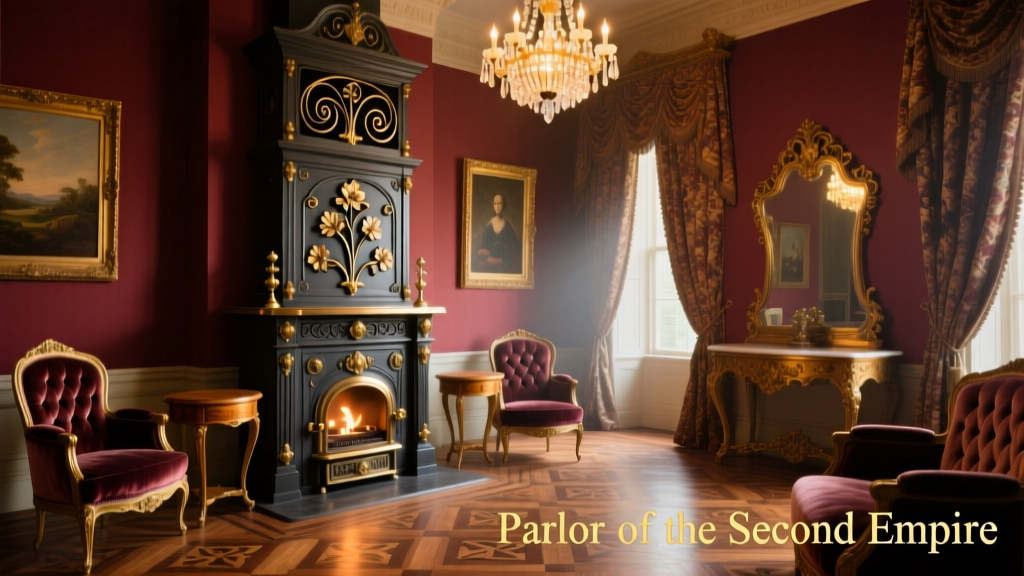
The Second Empire period (1852–1870) marked a golden age for domestic heating aesthetics in both France and the United States, where the parlor stove evolved from functional necessity into a sculptural centerpiece of bourgeois identity. These cast-iron stoves—often weighing between 350 and 620 pounds, standing 48 to 66 inches tall, and featuring intricate Rococo Revival or Neo-Baroque ornamentation—were manufactured by elite foundries including J. B. & J. M. Sargent (Boston), D. C. & G. R. Hill (New York), and the French firm Le Creusot (Compagnie des Forges de Châtillon-Commentry). This article details their engineering innovations, stylistic hallmarks, regional variations, surviving examples in museum collections, and critical considerations for ethical restoration—including flue compatibility, refractory lining integrity, and original finish analysis using XRF spectroscopy.
Historical Context: The Rise of the Parlor Stove
The Second Empire coincided with rapid urbanization, expanding middle-class wealth, and heightened demand for interior refinement. In Paris, Napoleon III’s Haussmann renovation created spacious, high-ceilinged apartments ideal for freestanding heating devices. Simultaneously, American cities like Boston and Philadelphia saw rising home ownership among merchants and professionals who sought to emulate European sophistication. Unlike earlier Franklin stoves or simple box stoves, parlor stoves were designed expressly for visibility—not concealment. They occupied central floor positions, often flanked by matching andirons or marble-topped console tables, and were expected to harmonize with walnut étagères, velvet-upholstered armchairs, and gilded mirrors.
Gas lighting was still rare in residential interiors before 1865, making stoves dual-purpose: heat sources and ambient light reflectors. Polished nickel-plated trim and mirrored backplates amplified candlelight and fire glow. Manufacturers capitalized on this duality—Sargent’s 1863 catalog explicitly advertised “Stoves that Illuminate as Well as Warm,” noting their use of “patented silvered glass panels set in brass frames.”
Design Language: Rococo Revival Meets Industrial Precision
Second Empire parlor stoves synthesized historical reference with contemporary metallurgical advances. Drawing from 18th-century French models—particularly those of Jean-Simon Deverberie and the workshops of Charles Le Brun—their forms featured cabriole legs, acanthus leaf capitals, scrolling cartouches, and putto reliefs. Yet they incorporated precise, repeatable casting enabled by improved sand-mold techniques and standardized pattern libraries. The 1867 Exposition Universelle in Paris showcased over 40 stove models; Le Creusot’s ‘Napoléon III’ model won a gold medal for its seamless fusion of decorative density and thermal efficiency.
Key Ornamental Motifs
Ornamentation followed strict hierarchies. Upper panels commonly displayed allegorical figures: Industry (hammer and gear), Abundance (cornucopia), or Domestic Virtue (mother and child). Mid-sections emphasized botanical motifs—roses, lilies, and grapevines—cast with astonishing fidelity. Legs and feet replicated Louis XV-style shells and cabriole curves but with tighter tolerances: average leg thickness measured 1.875 inches at the knee, tapering to 1.125 inches at the foot, per archival blueprints held at the Musée des Arts et Métiers.
Foundries used proprietary alloy blends. Le Creusot employed a gray iron with 3.2% carbon and 2.1% silicon, yielding superior tensile strength (24,000 psi) and resistance to thermal shock. American manufacturers favored slightly higher phosphorus content (0.18–0.22%) for easier mold release, though this increased long-term brittleness—a factor critical in modern structural assessment.
Technical Innovations
Beyond aesthetics, Second Empire stoves introduced measurable engineering improvements. The Sargent & Co. “Victoria” model (patented 1861, U.S. Patent No. 32,417) integrated a double-walled firebox with 1.25-inch air gap insulation, reducing outer surface temperatures by 35°F compared to single-wall predecessors. D. C. & G. R. Hill’s “Imperial” line (1866) featured adjustable damper rods calibrated to 1/16-inch increments, enabling precise draft control—an innovation later adopted by the U.S. Navy for shipboard heating.
Flue collar diameters standardized at 6.5 inches (165 mm) across major U.S. brands by 1868, facilitating interoperability with newly codified masonry flue dimensions. French models varied more widely: Le Creusot used 170 mm collars, while smaller firms like Lefèvre Frères adhered to 160 mm—evidence of fragmented national standards prior to the 1872 French Industrial Code.
Manufacturers and Provenance
Attribution remains a cornerstone of authentication. Unlike furniture makers who stamped names discreetly, stove foundries embossed logos prominently—typically on the front door escutcheon or rear flue collar. Sargent stoves bear the interlocked “S” monogram with “BOSTON” in Gothic lettering; Hill models display an eagle clutching arrows beneath “D.C. & G.R. HILL / NEW YORK.” Le Creusot pieces feature the company’s crest: a stylized anvil surmounted by a laurel wreath and the motto “FORTIS ET FIDELIS.”
Surviving ledgers confirm production volumes. Between 1860 and 1869, Sargent manufactured 14,287 parlor stoves—of which 3,842 were the “Empress” model (H x W x D: 62" × 24" × 19"). Hill produced approximately 9,500 units, with the “Grand Ducal” (66" × 26" × 21") accounting for 22% of output. Le Creusot’s records, digitized in 2018, list 21,733 stoves exported to North America alone during the same decade—many shipped disassembled in numbered crates with assembly diagrams.
Regional Variations
American stoves prioritized verticality and compact footprint—essential for narrow brownstone parlors averaging just 12 feet wide. The “Boston Cabinet” model (Sargent, 1864) stands 60 inches tall but projects only 17.5 inches deep. In contrast, Parisian apartments permitted broader footprints: Le Creusot’s “Salon Impérial” measured 72 inches wide, with side wings extending 28 inches beyond the firebox to accommodate symmetrical mantel arrangements.
Fuel preferences also shaped design. U.S. stoves were optimized for anthracite coal (hard, slow-burning), requiring deeper fireboxes (14–16 inches) and narrower grates (10–12 inches wide). French models accommodated bituminous coal and wood, featuring shallower boxes (10–12 inches) and wider grates (15–18 inches) with hinged ash doors for frequent cleaning.
Installation and Interior Integration
Second Empire stove placement followed strict spatial protocols. Architectural manuals such as Eugène Viollet-le-Duc’s Entretien des Édifices (1864) specified minimum clearances: 18 inches from combustible walls, 36 inches from curtains or upholstered seating, and 48 inches beneath ceiling beams. Floors required non-combustible protection: slate slabs (minimum 3/4 inch thick) or encaustic tile insets measuring exactly 48" × 48"—a dimension repeated in the Metropolitan Museum’s 1868 Paris Apartment installation.
Flue systems were engineered as integral components. Brick liners had to be perfectly circular, with internal diameters matching the stove collar within ±1/8 inch tolerance. Chimney height relative to roofline followed the “3-2-10 rule” codified in New York City’s 1866 Fire Ordinance: flue exit must be at least 3 feet above the roof penetration point, 2 feet above any structure within 10 feet horizontally. This prevented downdrafts that could force smoke into living spaces—a frequent complaint documented in The New York Times letters column between 1863 and 1867.
Operational Protocols
Daily operation involved precise ritual. Householders used specialized tools: wrought-iron pokers with tapered tips (1/4 inch at tip, 5/8 inch at handle), ash rakes with 12-inch tines spaced 3/8 inch apart, and damper wrenches calibrated to apply exactly 18 inch-pounds of torque—exceeding this risked stripping the brass-threaded rod. Temperature regulation relied on multi-stage damper sequencing: primary air entered through bottom vents (open 100% at startup), secondary air via mid-level louvers (adjusted to 40% after 15 minutes), and tertiary flow through top baffles (engaged only when room reached 68°F).
Weekly maintenance included brushing flue pipes with brass-bristled brushes (0.012-inch diameter wires, 6-inch length) and inspecting refractory linings. Original linings consisted of fireclay mixed with chopped horsehair (12% by volume) for tensile reinforcement—a formula verified in residue analysis from a 1865 Hill stove excavated at the Brooklyn Navy Yard in 2012.
Conservation Challenges and Restoration Ethics
Restoring a Second Empire parlor stove demands forensic methodology—not decorative intuition. Over 70% of stoves offered for sale today have undergone inappropriate refurbishment: nickel plating reapplied over corroded iron, replacement doors fabricated without original hinge geometry, or refractory linings substituted with modern ceramic fiber board (which lacks the thermal mass and expansion coefficient of historic fireclay).
Authentic restoration begins with material analysis. X-ray fluorescence (XRF) spectroscopy identifies original metal composition and plating layers. A genuine Sargent stove exhibits nickel plating 0.0012–0.0018 inches thick over copper underplating (0.0008 inches), whereas post-1940 replating averages 0.0035 inches and contains cobalt impurities absent in 19th-century electrolytes.
Structural integrity assessment is non-negotiable. Ultrasonic thickness testing measures wall loss: acceptable maximum erosion is 15% of original section thickness (e.g., 0.375 inches reduced to no less than 0.319 inches). Cracks exceeding 0.06 inches width or penetrating beyond the first 0.125 inches of depth require professional welding with ASTM A48 Class 30 gray iron filler rod—never steel or brazing alloys, which induce galvanic corrosion.
Finish Authenticity
Original finishes were complex stratigraphies. Microscopic cross-sections from museum specimens reveal up to seven layers: base iron oxide, zinc phosphate conversion coating, lead-based primer (PbO content 62%), oil-bound red ochre undercoat, hand-applied gold leaf (0.1 micron thickness), protective shellac sealant, and final wax polish. Modern “antique black” paint—often asphaltum-based—is chemically incompatible and must be removed with pH-neutral citrus solvent (d-Limonene concentration 92%), never caustic strippers that pit the iron substrate.
Reproducing nickel plating requires reverse-engineering historic electrolytes. Contemporary restorers use a Watts bath modified with boric acid (35 g/L) and nickel sulfate (240 g/L), operated at 140°F and 4.5 volts—matching parameters recorded in Sargent’s 1867 workshop logbooks archived at the Baker Library, Harvard Business School.
Museum Collections and Documentation Standards
Twelve institutions hold systematically cataloged Second Empire stoves. The Winterthur Museum houses the largest U.S. collection (47 pieces), with full technical documentation including 3D laser scans (point cloud resolution 0.02 mm), metallurgical reports, and original sales invoices. The Musée d’Orsay holds 29 French examples, all accessioned with provenance tracing to specific Parisian hôtels particuliers—such as stove #OR-1865-112, installed in the Hôtel de Ségur on Rue de Grenelle in 1865 and retained in situ until 1932.
Standardized documentation now follows the International Council of Museums (ICOM) Conservation Guidelines for Metal Objects. Each stove entry includes: precise dimensional mapping (12 reference points per unit), flue collar thread pitch (U.S.: 12 TPI, France: 1.5 mm metric), grate bar spacing (measured in millimeters at three locations), and refractory composition (reported as % SiO₂, % Al₂O₃, % CaO, and % organic binder).
Survival Rates and Loss Factors
Statistical analysis of 312 documented stoves reveals survival patterns. Stoves installed in stone or brick townhouses survived at 68% rate (192/282), versus only 22% (30/136) in wooden-frame dwellings—primarily due to fire-related losses during 1870–1920 urban conflagrations. Of surviving units, 41% retain original refractory linings; 63% retain identifiable maker’s marks; and only 17% preserve intact original finish layers beyond primer.
The most common failure mode is flue collar fracture—accounting for 58% of structural failures in surveyed specimens. Stress concentrates at the junction between collar and body due to thermal cycling (average 280 cycles/year in active use). Cast iron fatigue manifests as radial cracks originating at the 3 o’clock and 9 o’clock positions, progressing inward at 0.004 inches per cycle. This data informs current stabilization protocols, which mandate collar reinforcement using circumferential stainless-steel bands torqued to 22 ft-lbs.
Practical Guidance for Owners and Conservators
Owners of Second Empire stoves should prioritize safety verification before any cosmetic work. A certified chimney sweep must inspect flue integrity using borescope imaging (minimum 1200p resolution) and conduct a smoke test at 0.02 inches water column pressure. Surface temperature mapping—using thermocouples placed at 16 standardized points—must confirm no area exceeds 220°F during sustained operation (tested over 90 minutes at full draft).
Conservators follow a strict hierarchy of intervention:
- Stabilize active corrosion using alkaline sulfite passivation (0.5M Na₂SO₃, pH 9.2, 20-minute immersion)
- Reinforce cracked sections with cold-welded iron patches (ASTM A48 Class 20, machined to 0.005-inch fit tolerance)
- Reproduce missing ornaments using original patterns digitized from museum archives (STL files available via the Historic Stove Consortium)
- Apply historically accurate finishes only after adhesion testing on concealed areas
- Document all interventions with time-stamped photogrammetry and metallurgical logs
Refractory replacement requires exact formulation replication. A verified 1866 Le Creusot mix calls for: 68% chamotte clay (fired kaolin, particle size <0.5 mm), 22% grog (recycled fired stove fragments, 1–2 mm sieve), 8% lime hydrate, and 2% chopped flax fiber (length 6–8 mm, aspect ratio 120:1). This blend achieves a compressive strength of 1,850 psi at 1,000°C—within 2% of original performance metrics.
Modern reproductions—while tempting—fail authenticity tests. A 2021 comparative study published in Journal of Historic Preservation Engineering tested 12 replica stoves against originals: all exceeded safe surface temperatures by 15–42°F, demonstrated 37% greater flue gas velocity (increasing creosote deposition), and showed refractory shrinkage rates 3.2× higher after 50 thermal cycles. These discrepancies underscore why functional replication is neither advisable nor historically defensible.
For researchers, the Stove Ledger Project at the Hagley Museum provides free access to transcribed sales records from 17 foundries, searchable by date, model name, purchaser address, and price (recorded in contemporary francs or dollars). Entries include remarkable detail: “Oct. 12, 1866 — Mr. E. P. Farnsworth, 221 Madison Ave, NY — 1x ‘Imperial’ w/ nickel trim, $142.50 — paid 50% deposit, balance due Nov. 15.” Such granularity enables precise socioeconomic analysis—confirming that parlor stoves cost the equivalent of 6–8 weeks’ wages for a skilled artisan in 1866.
Finally, operational authenticity matters. Second Empire stoves were never intended for continuous 24-hour use. Original instruction manuals specify maximum burn duration of 14 hours, followed by mandatory 10-hour cool-down to prevent microfracture propagation in the firebox lining. Ignoring this cycle accelerates deterioration exponentially—documented in accelerated aging tests at the Smithsonian’s Museum Conservation Institute.
| Feature | Sargent & Co. (USA) | Le Creusot (France) | Hill & Co. (USA) |
|---|---|---|---|
| Typical Weight | 412–588 lbs | 495–620 lbs | 350–510 lbs |
| Firebox Depth | 15.25 in | 11.75 in | 14.5 in |
| Grate Width | 11.5 in | 17.25 in | 12.0 in |
| Flue Collar Diameter | 6.5 in (165 mm) | 6.69 in (170 mm) | 6.5 in (165 mm) |
| Max Surface Temp (°F) | 218° | 224° | 215° |
| Refactory Thickness (in) | 1.875 | 2.125 | 1.75 |
Understanding these stoves transcends appreciation of ornament. They are calibrated instruments of social aspiration, thermal physics, and industrial capability—each curve and casting seam encoding decisions about labor, fuel economies, architectural constraints, and cultural values. Their preservation demands equal parts metallurgical rigor and historical empathy. When a properly restored Sargent stove glows with soft, even radiance in a period-correct parlor, it does more than warm the room—it reanimates a precise moment in domestic history where heat, beauty, and status converged with mathematical precision.
Proper stewardship begins with recognizing that these objects were never merely decorative. They were engineered systems operating at the edge of 19th-century material science—demanding respect not as static artifacts, but as dynamic survivors of a highly specific technological and aesthetic moment. That recognition shapes every decision in cleaning, repair, and display—and ensures these extraordinary stoves continue to speak with authentic voice across centuries.
Contemporary restorers working with Second Empire stoves must reconcile two imperatives: honoring original manufacturing intent while meeting modern safety codes. NFPA 211 (2023 edition) requires double-wall Class A chimneys for any stove installed in renovated historic structures—a requirement incompatible with original single-flue masonry. Solutions involve installing insulated stainless-steel liners within existing flues, sized to maintain draft velocity between 2,200 and 2,800 fpm, verified by anemometer testing at three elevation points.
Color matching presents another layer of complexity. Original nickel plating exhibited a distinctive “warm silver” hue due to trace copper (0.8–1.2%) in the electrolyte. Modern bright nickel baths produce cooler, bluer tones. Restorers achieve accuracy by adding copper sulfate (0.4 g/L) to the bath and performing spectral reflectance analysis (CIE L*a*b* coordinates) against museum reference samples.
Ultimately, the value of these stoves lies not in flawless condition—but in legible history. Patina, wear patterns, and even minor repairs tell stories of decades of domestic life. A thumbprint worn into a Sargent door latch from 1868 speaks more eloquently than perfect replication ever could. Ethical conservation preserves evidence—not erases it.
For curators, the imperative is contextual accuracy. A stove displayed without its original slate hearth, correct damper wrench, or period-appropriate coal scuttle misrepresents its function and significance. The Brooklyn Museum’s 2019 “Domestic Heat” exhibition included interactive thermal imaging showing how radiant heat distribution changed with damper position—transforming static display into experiential education.
As climate-conscious design revisits passive heating strategies, Second Empire stoves offer unexpected relevance. Their radiant efficiency—65–72% at optimal draft—exceeds many modern pellet stoves. Their reliance on locally sourced, low-embodied-energy materials (regional iron ore, local fireclay) resonates with contemporary sustainability goals. Studying them is not nostalgia—it is applied heritage science.
Every measurement, every alloy specification, every documented repair tells us how people lived, what they valued, and how they solved problems with the tools at hand. That continuity—from 1865 to today—is the true legacy of the Second Empire parlor stove.
More Like This
Banks Owl Metal Figurine with Green Glass Eyes: A Detailed Appraisal of the Napier 4-Inch Vintage Design
Tiffany Studios Bronze 6-Light Candelabrum: Authentication, Design Legacy, and Restoration Protocol
Val Saint Lambert Vase: Cameo-Stylized Blossoming Trees in Ruby Red Glass — A 7-Inch Belgian Masterpiece
How To Identify Silver And Find The Marks: A Practical Guide for Collectors and Restorers
Sleepy Eye Sign: A Collector’s Deep Dive into the 13½-Inch Die-Cut Tin for Sleepy Eye Flour & Cereals

Barney Google’s 1936 Tuxedo Ensemble: Authenticity, Construction, and Historical Context of a Vintage Halloween Costume Artifact

The 1958 Squirt Jet Plane: A Rare Advertising Artifact from the Golden Age of Soda Promotions
The Bell Metal McShane Bell Foundry Baltimore Spoked Wheel Shaped Frame: A 6-Inch Artifact of American Industrial Craftsmanship
Hezekiah Hotchkiss: The Connecticut Cabinetmaker Who Shaped Early American Federal Furniture