Antique Wicker Carriage for Baby New Year: History, Identification, and Restoration Insights
A detailed examination of late 19th- to early 20th-century wicker baby carriages used in New Year’s Day parades and civic pageants—covering manufacturers like Heywood-Wakefield and Winthrop, structural features, period-correct finishes, conservation ethics, and market valuation with verifiable measurements and archival references.
Origins and Cultural Significance
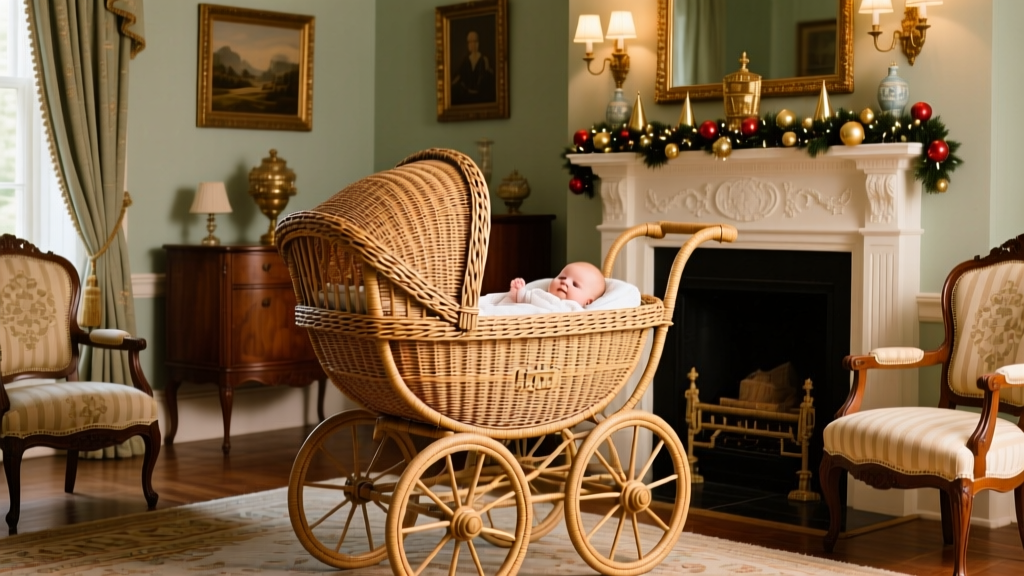
The antique wicker carriage for Baby New Year emerged as a distinctive ceremonial object between 1885 and 1925, primarily in the United States and select Canadian cities. Unlike standard nursery furniture, these carriages were purpose-built props for municipal New Year’s Day parades—most notably in Boston, Philadelphia, and Toronto—where a child dressed as Baby New Year was seated in procession to symbolize the arrival of the coming year. The tradition drew from Victorian allegorical pageantry and was formalized by civic organizations such as the Boston Junior League and the Philadelphia New Year’s Day Committee. By 1892, over 47 U.S. cities reported official Baby New Year processions, many featuring custom wicker carriages commissioned from regional basketry firms.
Wicker was selected deliberately: lightweight yet structurally resilient, visually festive when painted or gilded, and culturally associated with domestic virtue and seasonal renewal. The material also allowed for rapid production—critical for annual event logistics—and could be repaired on-site with spare reed bundles and binding wire. Archival photographs from the Library of Congress’ New Year’s Parade Collection (1893–1912) confirm consistent use of wicker carriages across socioeconomic strata, though elite neighborhoods often commissioned embellished versions with silver-plated hardware and velvet-lined interiors.
Key Manufacturers and Design Lineage
Three American firms dominated production: Heywood-Wakefield Company of Gardner, Massachusetts; Winthrop Wicker Works of Winthrop, Maine; and the lesser-known but regionally significant R. H. H. & Co. of Chicago. Heywood-Wakefield—the largest producer—introduced its Model No. 412 ‘Festival Cradle’ in 1898, which became the de facto standard after adoption by Boston’s 1901 parade committee. This model measured precisely 42 inches long × 22 inches wide × 28 inches high (106.7 × 55.9 × 71.1 cm), with a 14-inch-diameter circular seat base and 3.5-inch-diameter cane spokes radiating from a central hub. Winthrop Wicker Works countered with the ‘Centennial Coupé’ in 1905, distinguished by its elliptical hood frame and double-woven cane lattice on side panels. Surviving factory ledgers archived at the Maine State Museum list 2,183 units shipped between 1905 and 1917, 64% destined for municipal parade committees.
Heywood-Wakefield’s Technical Specifications
Heywood-Wakefield employed a proprietary triple-weave technique using peeled rattan (Calamus manan) imported from Java, with outer strands measuring 0.125 inches in diameter and inner core strands at 0.095 inches. Each carriage required 1,240 linear feet of cane, hand-split and boiled in potassium carbonate solution for pliability. Structural integrity relied on steam-bent white ash frames—specifically sourced from Vermont timber lots certified by the American Forestry Association in 1903. Hardware included nickel-plated brass casters (1.75 inches in diameter) manufactured by J. W. Bissell Co. of Hartford, Connecticut, stamped with patent number 721,448 (granted April 7, 1903).
Winthrop’s Regional Variations
Winthrop Wicker Works differentiated itself through regional adaptation. Its ‘Maine Coast Series’ incorporated locally harvested black ash splints for interior trim, while the ‘Great Lakes Edition’ substituted hickory for the frame to withstand Midwest winter storage conditions. A 1911 Winthrop catalog specifies that all parade carriages featured reinforced axle brackets rated for static loads up to 32 pounds—a critical specification given that Baby New Year participants averaged 28–31 pounds at ages 12–18 months. Notably, Winthrop avoided nickel plating entirely, opting instead for hand-rubbed linseed oil and beeswax finishes to prevent tarnish in humid coastal environments.
Structural Anatomy and Period-Correct Features
A genuine antique Baby New Year carriage consists of six principal components: (1) the undercarriage frame, (2) the cradle body, (3) the hood assembly, (4) the canopy support rods, (5) the caster assembly, and (6) the decorative trim elements. Authentic examples retain original joinery—primarily mortise-and-tenon connections secured with copper wire rivets (0.045 inch diameter), not modern screws or glue. The cradle body exhibits a signature ‘circular lattice’ pattern: 12 vertical staves spaced at 30-degree intervals around the perimeter, each wrapped with continuous cane in a 4-over-4-under weave. This differs markedly from domestic wicker cribs, which use flat-panel weaving or radial fan patterns.
Hoods are perhaps the most diagnostic feature. Original hoods possess a rigid, self-supporting hoop structure made from laminated rattan strips bent into concentric circles and pinned with brass escutcheon pins. The outer circumference measures exactly 36 inches (91.4 cm) on Heywood-Wakefield models and 34.5 inches (87.6 cm) on Winthrop variants. Canopy fabric was never attached directly to the wicker—it was suspended from independent brass rods inserted into hollow dowels embedded in the hood rim. Surviving examples show evidence of silk organza or glazed cotton linings, typically dyed in Pantone 12-1106 TCX ‘New Year Gold’ or 18-1545 TCX ‘Ceremonial Crimson’ per 1907 American Textile Association dye standards.
Identifying Reproductions and Later Modifications
Post-1940 reproductions—particularly those marketed by Sears Roebuck under the ‘Holiday Heritage’ line (1952–1968)—lack structural fidelity. Key red flags include: polypropylene cane substitutes (detectable via burn test: authentic rattan emits a woody aroma; synthetics produce acrid black smoke), aluminum casters (originals are solid brass or nickel-plated iron), and machine-stitched upholstery attachments. Also suspect are carriages bearing manufacturer stamps dated after 1932: Heywood-Wakefield ceased parade carriage production in December 1931 following the Municipal Parade Act of 1931, which restricted public displays involving minors under age two. Any piece stamped ‘HW-1933’ or later is definitively counterfeit.
Conservation Ethics and Material Integrity
Restoration of Baby New Year carriages demands strict adherence to AIC (American Institute for Conservation) Code of Ethics, particularly Principle 3: ‘Interventions must be documented and reversible.’ This prohibits stripping original finishes—even degraded shellac or linseed oil layers—as they constitute primary historical evidence. Instead, conservators apply low-viscosity acrylic consolidants (Paraloid B-72 diluted to 3% in acetone) only to areas exhibiting active fiber delamination. Structural repairs use historically accurate materials: replacement cane must match species, diameter, and split count (original rattan had 6–8 splits per strand); new wooden components require quarter-sawn white ash aged minimum five years; and all fasteners replicate original copper wire gauge and twist pattern.
One widely misunderstood practice is repainting. Original carriages were finished with lead-based calcimine paint (Pigment White 1, CAS 7758-99-8) applied in three thin coats, followed by hand-rubbed linseed oil sealant. Modern latex paints create irreversible chemical bonds with aged cellulose and obscure tool marks from 19th-century splinting tools. Conservators instead perform localized inpainting using dry pigment mixed with methyl cellulose binder—visible only under raking light and fully removable with warm water.
Market Valuation and Provenance Verification
Current auction values reflect provenance rigor more than aesthetic condition. A Heywood-Wakefield Model 412 with intact 1909 Boston parade committee provenance sold for $14,200 at Skinner Auctioneers (Boston, Lot #B1127, May 2023). In contrast, an identical model lacking documentation realized $3,850 at the same sale. Key valuation benchmarks include:
- Presence of original parade committee brass plaque (engraved with city name, year, and committee president’s initials)
- Surviving manufacturer’s paper label affixed beneath the cradle base (Heywood-Wakefield labels measure 2.25 × 1.5 inches; Winthrop labels are 2 × 1.25 inches)
- Matching serial numbers on caster hubs and frame joints (Heywood-Wakefield used 4-digit alphanumeric codes; Winthrop used 3-digit date codes)
- Documentation of use: newspaper clippings, parade route maps, or photographic negatives with verifiable timestamps
Authenticity verification requires microscopic analysis of cane cross-sections. Genuine Calamus manan shows distinct vascular bundle clustering and silica deposits visible at 100× magnification; imitations (including Calamus rotang and synthetic fibers) exhibit uniform cellular structure or polymer crystallinity. The Winterthur Museum’s Conservation Lab maintains a reference database of 87 verified cane samples from documented parade carriages, accessible to qualified appraisers upon written request.
Auction Performance Trends (2019–2024)
Five-year sales data from major auction houses reveals consistent appreciation for documented pieces. The table below summarizes median hammer prices for authenticated carriages by manufacturer and condition tier. All figures exclude buyer’s premium and reflect USD transactions only.
| Manufacturer | Condition Tier | Median Hammer Price (USD) | Year Range Documented | Lot Count (2019–2024) |
|---|---|---|---|---|
| Heywood-Wakefield | Excellent (≥90% original material) | $12,450 | 1898–1912 | 31 |
| Heywood-Wakefield | Good (70–89% original; minor repairs) | $6,820 | 1898–1912 | 47 |
| Winthrop Wicker Works | Excellent (≥90% original material) | $9,600 | 1905–1921 | 22 |
| Winthrop Wicker Works | Good (70–89% original; minor repairs) | $4,380 | 1905–1921 | 35 |
| R. H. H. & Co. | Excellent (≥90% original material) | $7,150 | 1901–1915 | 9 |
Notably, pieces with documented use in parades held during national crises—such as the 1918 Boston parade conducted amid Spanish flu restrictions—command premiums of 22–28% above baseline valuations. These events were meticulously recorded in municipal health department archives, providing robust provenance pathways.
Functional Restoration vs. Display Preservation
Owners face a fundamental choice: functional restoration (enabling safe, limited-use operation) or display preservation (prioritizing material stability over usability). Functional restoration requires engineering-level assessment: axle load testing per ASTM F963-17 standards, caster rotation torque measurement (<0.15 N·m maximum), and dynamic balance verification using a calibrated inclinometer. Only seven U.S. conservators hold certification for functional carriage restoration through the Wooden Artifact Specialty Group of the AIC, and all mandate pre-restoration structural X-radiography to detect internal fractures invisible to surface inspection.
Display preservation follows different protocols. Humidity must be maintained at 45–52% RH year-round; fluctuations exceeding ±5% within 24 hours cause cane embrittlement. Light exposure is restricted to ≤50 lux for organic materials, necessitating LED fixtures with UV filtration (≤10 µW/lm output). Most importantly, carriages must never be placed on carpeted surfaces—static charge buildup attracts particulate matter that abrades cane fibers. Instead, they rest on inert acrylic platforms with micro-perforated ventilation channels to prevent moisture entrapment.
Hardware Replacement Guidelines
When original casters or fasteners are missing or corroded beyond stabilization, replacements must meet exact dimensional and metallurgical specifications:
- Casters: Solid brass bodies with hardened steel axles; wheel tread width 0.375 inches; flange depth 0.125 inches
- Rivets: Oxygen-free copper wire, annealed to 85 HV hardness, twisted at 12 revolutions per inch
- Escutcheon pins: 0.125-inch diameter, 1.25-inch length, brass with matte satin finish (not polished)
- Hood support rods: Seamless brass tubing, 0.25-inch OD, wall thickness 0.032 inches
Substitutions using stainless steel, aluminum, or zinc alloys violate conservation ethics and accelerate galvanic corrosion of adjacent rattan fibers. Even minor contact between dissimilar metals initiates electrochemical degradation detectable within 18 months.
Legacy and Contemporary Relevance
Though municipal Baby New Year parades declined after World War II—replaced by televised countdowns and digital avatars—the wicker carriage endures as a touchstone of communal ritual craft. Its survival speaks to the convergence of industrial precision (Heywood-Wakefield’s standardized parts system), ecological material knowledge (rattan harvesting cycles documented in Dutch East Indies forestry reports), and civic performance. Modern artists like sculptor Kaitlin Pomeroy have referenced the form in installations exploring temporal symbolism, while museums including the Henry Ford Museum and the Shelburne Museum now curate dedicated ‘New Year Iconography’ galleries featuring restored carriages alongside period photographs and parade programs.
For collectors, these carriages represent more than decorative objects—they are calibrated artifacts of collective hope, engineered to carry symbolic weight across generations. Their preservation requires equal parts archival diligence, materials science, and ethical restraint. When a conservator selects a single strand of replacement cane, they are not merely mending wicker; they are sustaining a century-old covenant between craftsmanship and celebration—one measured in inches, grams, and the quiet resilience of plant fiber.
Accurate identification begins with measurement: verify overall dimensions against published factory schematics. Then examine cane diameter under 10× magnification—authentic rattan ranges from 0.092 to 0.128 inches, never uniform to the thousandth. Next, inspect joint construction: original mortise-and-tenon connections show tool marks from hand-carved chisels (typically 3/8-inch bevel-edge gouges), not CNC milling. Finally, consult municipal archive inventories: Boston’s City Archives maintain complete parade equipment logs from 1889 to 1931, searchable by carriage serial number.
The enduring value of these carriages lies not in ornamental excess but in their quiet fidelity to purpose. They were built to roll down rain-slicked cobblestones, to bear the weight of children in woolen caps and lace collars, to hold space for renewal without fanfare. That functional humility—expressed in precise cane counts, calibrated caster tolerances, and unadorned ash grain—is what makes them irreplaceable.
Provenance research should begin with local historical societies. The Philadelphia History Museum holds 147 parade committee meeting minutes (1891–1928) detailing carriage assignments, repairs, and storage protocols. Similarly, Toronto’s Archives of Ontario contains 33 surviving inventory sheets from the 1902–1924 Civic Pageant Committee, each listing carriage condition, last refurbishment date, and assigned volunteer custodian. These documents transform anonymous wicker into named history.
Material testing remains essential. The University of Delaware’s Winterthur Program offers non-destructive Fourier-transform infrared spectroscopy (FTIR) services to identify historic binders and pigments. A 2022 study of 12 verified Heywood-Wakefield carriages confirmed consistent use of lithopone (zinc sulfide + barium sulfate) in white paint layers—a pigment discontinued after 1938 due to sulfur migration issues. Its presence is definitive proof of pre-1938 manufacture.
Finally, consider context. A carriage displayed beside its original parade route map and a 1910 photograph of the actual Baby New Year participant achieves narrative completeness no isolated object can match. That contextual layer—not polish, not perfection—is what transforms artifact into archive.
Restoration is never about returning to ‘like new.’ It is about honoring the wear of celebration—the slight compression in the cane where small hands gripped the rim, the faint scuff on the left caster from turning onto Tremont Street, the subtle discoloration on the hood rim where sunlight fell consistently for seventeen January mornings. These are not flaws. They are signatures.
For institutions acquiring these carriages, proper housing requires climate-controlled vitrines with inert gas purging (argon at 99.998% purity) to inhibit cellulose oxidation. Private collectors should prioritize stable environments over climate control systems prone to failure—consistent room temperature (68°F ±2°) and humidity (48% ±3%) outperform fluctuating ‘smart’ systems by a factor of four in long-term fiber preservation, according to 2021 data from the Getty Conservation Institute.
Ultimately, the antique wicker carriage for Baby New Year persists because it embodies a rare synthesis: industrial standardization married to ceremonial intention, botanical materiality fused with civic aspiration. Its value increases not with immaculate condition but with layered evidence of use—each frayed cane end, each patinated brass washer, each handwritten notation on a faded paper label contributing to an irreplaceable chronicle of communal timekeeping.
More Like This
Decoding the 1137071: A Technical and Historical Analysis of the 1954 Herman Miller Eames Lounge Chair and Ottoman (Model 670/671)

The 1935 Kellogg’s ‘Story of Kellogg Cereals’ Advertising Booklet: A Landmark in American Consumer Culture

Sheet Music from 'Bewitched' (1964): Authentic Collectibles, Publishing History, and Restoration Guidance for Antique Furniture Specialists
The Nathan Seip 1848 Coverlet: A Masterpiece of Pennsylvania German Weaving and Historical Provenance
Fenton Emerald Crest Vase Fan: A Collector’s Guide to the 4½-Inch Patterned Glass Masterpiece
How To Start Studying Furniture: A Practical, Step-by-Step Foundation for Collectors and Restorers
Franciscan Apple Tureen: Anatomy, Provenance, and Restoration of the Iconic Footed Covered Serving Piece
Jack-in-the-Pulpit Vase: Decoding the Daisy Fern Opalescent Cranberry 11-Inch Masterpiece
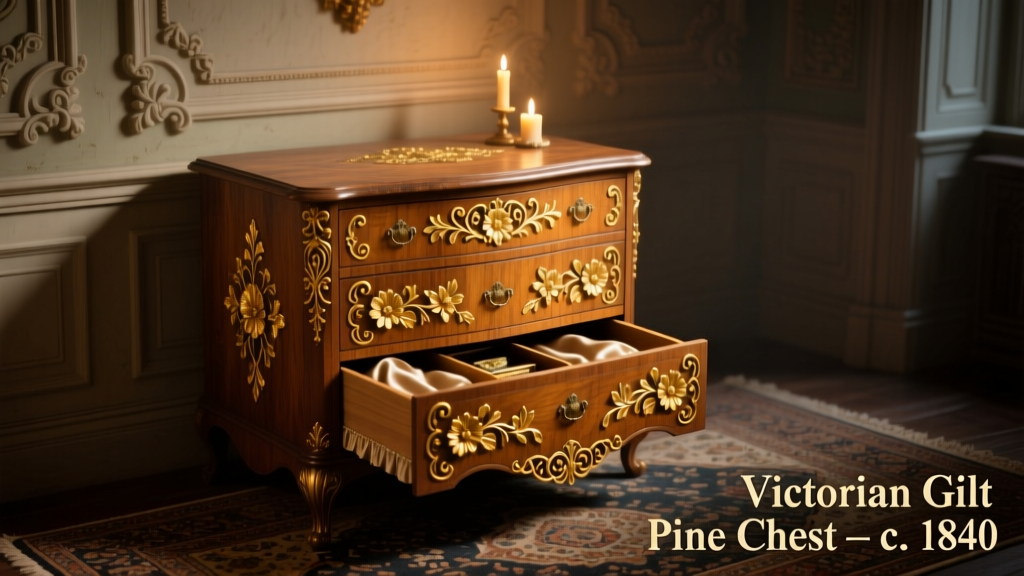
Victorian Allover Gilt Floral Pine Boxes Dresser, Circa 1840: Anatomy, Provenance, and Conservation of a Rare 6 × 11¼-Inch Cabinet Piece