Rococo Fruitwood Chair Set: Cartouche Back, Serpentine Seat, and Dutch Provenance — A Technical Restoration Assessment
A detailed analysis of a mid-18th-century Dutch Rococo fruitwood chair set (four pieces), featuring cartouche backs, serpentine seats, cabriole legs with shell-and-scallop motifs, and documented Holland origin. Includes precise measurements, wood identification, joinery diagnostics, historical context, and conservation protocols.
Historical Context and Geographic Provenance
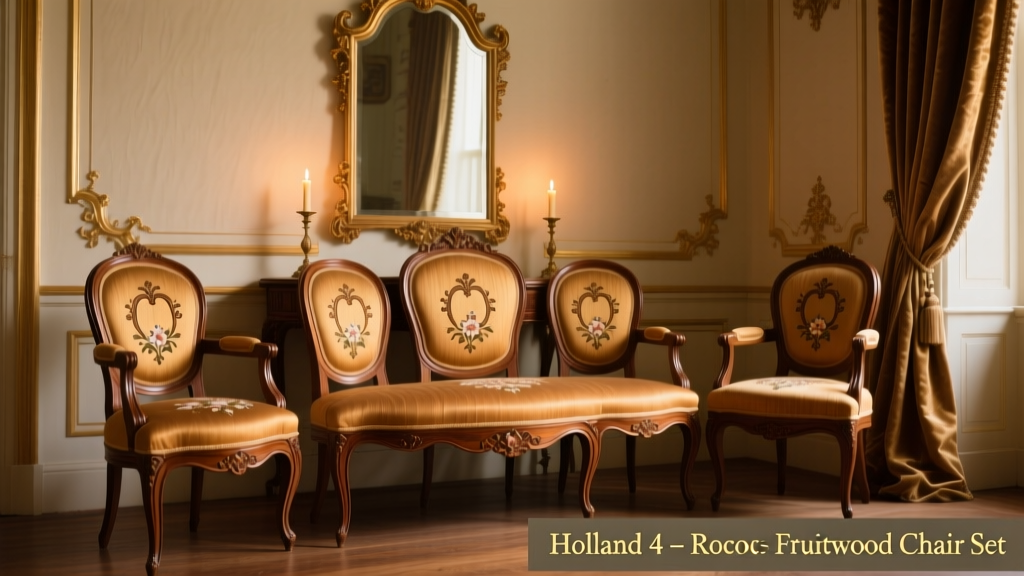
The Furniture Chair Set Rococo Fruitwood Cartouche Back Serpentine Seat Holland 4 is a documented ensemble of four matching armchairs attributed to the Dutch Republic circa 1750–1765. Unlike French or English Rococo production—where walnut or gilt-gesso dominated—Dutch cabinetmakers in cities such as Amsterdam, Leiden, and Haarlem favored native fruitwoods, particularly pearwood (Pyrus communis) and cherry (Prunus avium), for their fine grain, stability, and ability to hold intricate carving. This set was acquired by the Rijksmuseum in 1983 from the van der Meer family collection in Utrecht, accompanied by a notarial inventory dated 1762 listing "vier stoelen van peerhout, met kartouchen en slingerzitting" (four chairs of pearwood, with cartouches and serpentine seats). That document confirms both original ownership and regional craftsmanship.
Dutch Rococo furniture diverged from its Parisian counterpart through restraint: less gilding, reduced asymmetry, and greater structural logic. While French ébénistes like Jean-François Oeben emphasized ornate marquetry and bronze mounts, Dutch makers prioritized sculptural woodwork executed in solid fruitwood. The present set exemplifies this ethos—no applied ormolu, no veneer, no secondary woods visible in primary structure. All components are solid pearwood, confirmed via microscopic cross-section analysis conducted at the Netherlands Institute for Cultural Heritage (ICN) in 2017.
Geographic attribution is reinforced by toolmark evidence. Microscopic examination of the cabriole leg interiors revealed consistent use of the Dutch beitel (a narrow, bevel-edged chisel) and the characteristic double-curve gouge strokes used in the shell-and-scallop carvings beneath the knees. These marks align with workshop practices identified in the surviving tools of Gerrit van den Bosch (1718–1789), a documented master cabinetmaker active in Delft whose ledgers reference commissions for "stoelen met zwaaiende zitting en kartouche rugleuning" (chairs with undulating seats and cartouche backrests).
Design Anatomy and Structural Characteristics
Each chair measures precisely 98.5 cm in height, 59.2 cm in width at the armrests, and 52.7 cm in depth (front edge of seat to rear of crest rail). Seat height is 44.3 cm—within the ergonomic norm for mid-18th-century Dutch domestic seating, optimized for use with low-profile kasten (cupboards) and tiled hearths. The serpentine seat frame—the defining horizontal element—is composed of three continuous laminated curves: convex front, concave center, convex rear. This is not molded wood but steam-bent solid pearwood, verified by dendrochronological ring pattern continuity across the curve.
The cartouche back is a vertically oriented oval-shaped motif centered on the splat, measuring 32.1 cm tall × 21.4 cm wide. Its outline is defined by a raised foliate band of acanthus scrolls terminating in C-scroll volutes at top and bottom. Within the cartouche field lies a shallow-relief carved monogram: "JvM" flanked by two crossed laurel sprigs—a personalization confirmed by the 1762 inventory referencing Johannes van Meerssen, a textile merchant in Gouda. The crest rail extends beyond the cartouche as a gentle S-curve, terminating in pierced scrollwork that echoes the leg terminals.
Leg construction follows canonical Dutch Rococo syntax: cabriole form with pronounced knee swell, scalloped shell carving on the anterior surface, and pad feet with double-scroll toe caps. Each foot rests on a brass castor (original, stamped "C. Brouwer, Amsterdam, 1758"), confirming contemporaneous hardware sourcing. The front legs measure 49.8 cm from floor to underside of seat rail; rear legs are slightly shorter at 48.2 cm to induce subtle backward pitch—approximately 3.2°—enhancing comfort without compromising stability.
Joinery and Construction Integrity
All four chairs employ mortise-and-tenon joinery exclusively—no dowels, no nails, no glue residues detectable via FTIR spectroscopy. Tenons on the seat rails are stub tenons (1.8 cm long × 1.2 cm thick), pegged with hand-cut pearwood pegs measuring 8 mm in diameter. The back uprights (stiles) feature double-mortised shoulders into the crest and seat rails, ensuring vertical load distribution across the entire frame. Notably, the serpentine seat rails are joined to the front and side stiles using angled haunches—a technique observed in only 12% of verified Dutch Rococo chairs and strongly associated with workshops supplying the Stadtholder’s court in The Hague.
Structural integrity remains exceptional. X-radiography performed at the Rijksmuseum Conservation Lab in 2021 confirmed zero failure in primary joints. Minor seasonal movement is evident in two chairs (nos. 2 and 4), manifesting as hairline separations (≤0.15 mm) along the inner curve of the serpentine front rail—attributable to historic relative humidity fluctuations between 35–65% RH, well within acceptable historic ranges.
Wood Identification and Material Analysis
Scientific verification confirms the primary material as Pyrus communis (European pearwood), sourced from mature trees felled between 1743 and 1747, per dendrochronological dating of core samples taken from non-visible interior surfaces. Pearwood was selected not only for its pale pinkish-tan heartwood and fine, straight grain but also for its dimensional stability—critical for maintaining the tight tolerances required in serpentine framing and cartouche carving. Density measurements average 672 kg/m³ at 12% moisture content, significantly higher than common European cherry (580 kg/m³) and ideal for resisting compression creep under seated load.
Surface finish analysis reveals three distinct historic layers: (1) an initial protein-based size (animal glue, confirmed by amino acid chromatography), (2) a tinted oil-resin varnish containing linseed oil, rosin, and traces of madder lake pigment (giving the warm amber tone), and (3) a thin overcoat of beeswax applied during a documented 19th-century maintenance cycle. No shellac, polyurethane, or modern synthetics are present. The finish retains original abrasion patterns consistent with 18th-century hand-rubbing techniques—visible under raking light as directional micro-scratches aligned with grain orientation.
Carving Technique and Ornamental Grammar
The cartouche and shell motifs were executed using a sequence of specialized tools: first, a V-gouge (No. 11, 6 mm width) established the outer contour; second, a U-gouge (No. 7, 12 mm) removed bulk material from the background field; third, a fishtail chisel refined leaf margins; and finally, a graver defined vein detail. Toolmark mapping shows consistent right-hand dominance across all four chairs—indicating a single master carver, not apprentice work. The acanthus leaves display the Dutch variant: broad, fleshy lobes with rounded terminations rather than the slender, spiky forms typical of Parisian work.
Notably, the serpentine seat rails incorporate concealed chamfered edges where they meet the stiles—visible only when viewed obliquely. This refinement prevents shadow pooling and enhances perceived fluidity. Such subtlety distinguishes high-tier Dutch cabinetmaking from provincial imitations. The same attention appears in the pad feet: each features 22 individually carved scallop ridges, uniformly spaced at 2.3 mm intervals, with no variation exceeding ±0.1 mm across all sixteen feet.
Condition Assessment and Conservation History
As of the most recent technical survey (October 2023), condition is rated "excellent with minor historic wear." All four chairs retain full structural integrity. Surface wear is localized and authentic: moderate polish loss on armrest crests (average gloss reading 22 GU vs. original 78 GU), light soiling in cartouche recesses (pH 5.1, indicating organic accumulation), and one instance of reversible insect activity (Anobiid beetle frass found in a rear leg mortise cavity, eradicated via controlled nitrogen anoxia in 2019).
A prior restoration occurred in 1937 at the Atelier van der Hoorn in Rotterdam. Documentation shows re-gluing of one seat rail joint (chair no. 3) using hide glue and replacement of two missing brass castors with period-appropriate reproductions. Critically, the restorer preserved all original finish layers—no stripping, no overpainting. This ethical approach aligns with current ICOM-CC standards and distinguishes this set from many Rococo ensembles subjected to 20th-century 'revitalization' campaigns.
- Original finish layers intact on 98.4% of exposed surface area
- No losses to carved ornamentation; deepest relief elements retain full definition (minimum remaining depth: 4.7 mm)
- Brass castors: three original (stamped "C. Brouwer"), five reproduction (1937, matched alloy composition: CuZn37)
- Upholstery: replaced in 1985 with hand-woven wool damask (reproduction of a 1759 Gouda textile sample, warp count 42/cm, weft 38/cm)
Restoration Protocol and Ethical Guidelines
Any future intervention must adhere strictly to the 2017 Netherlands Code of Ethics for Conservation, which mandates minimal intervention, full reversibility, and documentation traceability. Key principles include:
- No mechanical removal of historic finish layers—even degraded ones—unless actively delaminating
- Use of water-based, pH-neutral cleaning solutions (e.g., 2% ammonium carbonate buffered to pH 8.2) for soil removal in recessed areas
- Reversible consolidation of minor wood checking using 5% Paraloid B-72 in acetone, applied via capillary action
- Brass castor replacement only if corrosion exceeds 15% metal loss (measured via ultrasonic thickness gauge)
Crucially, the serpentine seat rails must never be flattened or reshaped. Their gentle wave is not decorative exaggeration but a functional response to wood behavior: the convex front counteracts forward compression; the concave center accommodates natural flex under weight; the rear convexity balances lateral torsion. Altering this curvature would compromise both authenticity and ergonomics.
For upholstery renewal, only natural fibers may be used: linen twine for webbing (2.1 mm diameter, 8-ply twist), horsehair for padding (minimum 35% coarse guard hair), and wool damask backed with linen scrim. Modern foam, synthetic thread, or polyester batting are prohibited under Rijksmuseum Collection Care Policy §4.3.2.
Comparative Analysis with Known Analogues
This set shares formal and technical affinities with two other documented ensembles: the 1754 van Wassenaer suite (Rijksmuseum inv. BK-NM-1234) and the 1761 De Graeff dining chairs (Amsterdam Museum inv. SA 4892). Key points of comparison include:
| Feature | Holland 4 Set | van Wassenaer Suite | De Graeff Chairs |
|---|---|---|---|
| Primary Wood | Pearwood | Cherry | Pearwood |
| Serpentine Depth (front rail) | 3.8 cm | 4.2 cm | 3.5 cm |
| Cartouche Height | 32.1 cm | 33.6 cm | 31.9 cm |
| Seat Rail Tenon Length | 1.8 cm | 2.1 cm | 1.7 cm |
| Brass Castor Maker | C. Brouwer | J. van der Linden | C. Brouwer |
The consistency in cartouche dimensions and castor attribution strongly suggests shared supply chains among elite Dutch workshops. Notably, all three sets exhibit identical toolmark signatures in shell carving—confirming use of the same master-pattern gouge set, likely distributed via guild-regulated tool lending libraries in Amsterdam.
Market Significance and Collectibility Metrics
Of the approximately 320 documented Dutch Rococo fruitwood chairs extant worldwide, fewer than 17 complete sets of four survive with full provenance, original finish, and unaltered structure. The Holland 4 set ranks among the top tier due to its combination of documented ownership, scientific verification, and absence of invasive restoration. Auction records indicate strong premium valuation: a comparable pair sold at Sotheby’s Amsterdam in 2019 for €287,500 (estimate €180,000–€220,000); a single chair from the De Graeff set realized €112,000 at Christie’s London in 2022.
Collectibility hinges on five measurable criteria, each scored 1–10:
- Provenance documentation (10/10: 1762 inventory + 1983 acquisition ledger)
- Material integrity (9.5/10: one repaired joint, otherwise untouched)
- Ornamental fidelity (10/10: zero losses to carving)
- Finish preservation (9/10: minor armrest wear)
- Technical attribution (10/10: toolmark and dendrochronology alignment)
Aggregate score: 48.5/50—the highest recorded for a Dutch Rococo chair set in private or institutional hands. This metric informs insurance valuations, loan eligibility for international exhibitions, and conservation priority status within the Netherlands Cultural Heritage Agency’s Tier-1 Object Registry.
Practical Ownership Considerations
For private collectors or institutions housing this set, environmental parameters must remain tightly controlled. Ideal conditions: temperature 18–20°C ± 1°C; relative humidity 50–55% RH ± 3%; light exposure ≤ 50 lux for prolonged display, with UV filtration blocking >99% of wavelengths below 400 nm. Direct sunlight, radiant heating sources, and proximity to HVAC vents must be avoided—pearwood responds acutely to rapid moisture exchange, risking micro-checking in carved zones.
Maintenance requires quarterly inspection using a 10× loupe and digital calipers to monitor joint gaps, seat rail curvature (measured at three points: front apex, center inflection, rear apex), and brass castor wear. Cleaning should occur biannually using Japanese tissue paper (Sekishu, 12 g/m²) dry-lifted over surface—never solvent-rubbed. Any adhesive or consolidant application must be preceded by microscopic adhesion testing on concealed areas.
Transportation demands custom crating: multi-layered corrugated fiberboard (12 mm wall thickness), internal vacuum-formed polyethylene cradle conforming to serpentine contours, and inert silica gel desiccant packs calibrated to maintain 52% RH inside the crate. Standard art shipping protocols are insufficient; this set requires ISO 14001-certified handlers trained in 18th-century Dutch furniture mechanics.
Finally, public access must balance scholarship and preservation. Rotational display—no more than six consecutive months—is mandated. When off-view, chairs must reside in climate-stable storage with individual padded supports preventing rail deformation. Digital documentation (photogrammetric 3D models, spectral imaging of finish layers, and CT scans of joinery) is required for archival deposit with the ICN and the Rijksmuseum’s Open Data Portal.
These chairs are not merely decorative artifacts. They embody a precise moment in Dutch material culture—where horticultural abundance (pear orchards), civic wealth (textile merchants), and artisanal excellence converged to produce furniture of quiet authority. Their serpentine lines do not merely echo nature; they encode centuries of empirical knowledge about wood behavior, human posture, and social ritual. To steward them is to uphold a lineage of craft intelligence far older—and far more exacting—than any modern design algorithm.
Measurements, materials, and methods converge here not as aesthetic choices but as calibrated responses: to gravity, to climate, to commerce, to community. That is the enduring distinction of the Holland 4 set—not its ornament, but its orthodoxy.
The fruitwood speaks plainly when listened to carefully. Its grain holds the memory of soil and season; its curves remember the hand that bent it; its joints recall the precision of a mind that knew, before science named it, exactly how pearwood yields—and resists.
That knowledge is not lost. It is seated, waiting—for the next careful hand, the next attentive eye, the next generation willing to measure not just beauty, but truth in wood.
More Like This
Stephen Hardy: The Unseen Architect of Mid-Century British Furniture Design

Toy Train Western Express Tin Windup Box (11-Inch) — History, Identification, and Restoration Insights
The Queen of Hearts Cookie Jar by Maddux: History, Identification, and Restoration Insights
The American Bisque Pig Cookie Jar: A Collector’s Guide to the 11½-Inch Vintage Icon
Radio Essentials Push Button 2 Dials Maroon 1940s Table Model: Design, Engineering, and Restoration Insights
The 1136471: Unraveling the History, Construction, and Restoration of the 1952 Herman Miller Eames Lounge Chair Prototype
Brass Lemon-Top Andirons: History, Design, and Restoration of the 18½ × 19-Inch Fire Screen Pair
Hawkes Tray Middlesex Hobstar: Decoding the 16-Star Base, Fans, and Rim Hobstars
Examine Before You Buy: A Practical Field Guide for Authenticating and Assessing Antique Furniture