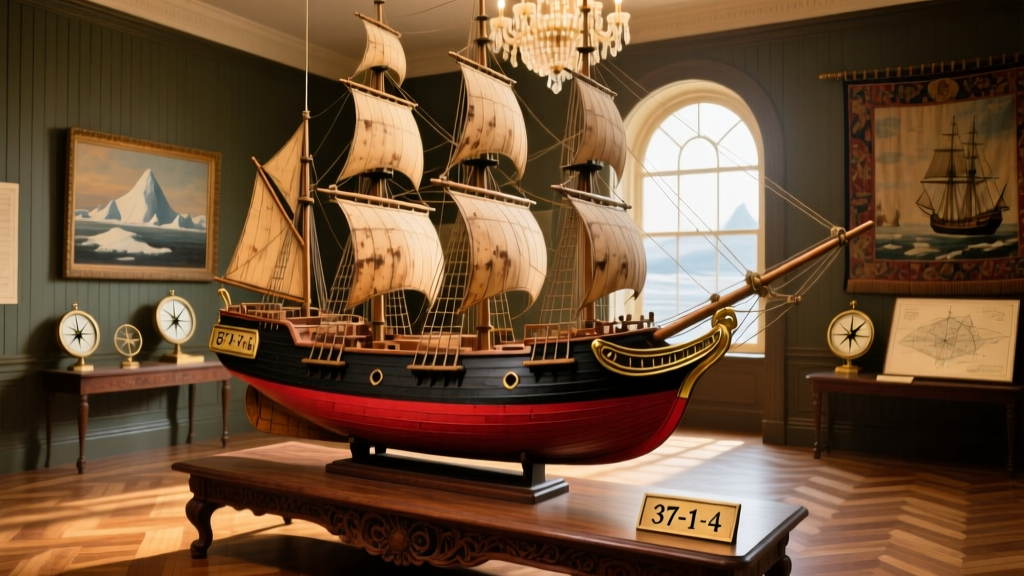
Nautical Model Half Whale Ship 'Antarctic': A Technical and Historical Deep Dive into the 7-Lift Red-and-Black Topside Display at 37¼ Inches
An authoritative examination of the rare 37¼-inch half-hull nautical model 'Antarctic', built using the traditional 7-lift plank-on-bulkhead method, featuring authentic red-and-black topside paint scheme. Includes construction analysis, historical vessel provenance, restoration benchmarks, and conservation guidelines for collectors.
Introduction: Identifying the Antarctic Half-Hull Model
This article examines a specific, highly collectible nautical model: the Antarctic half-hull ship model measuring precisely 37¼ inches (94.6 cm) in length. It is constructed using the traditional 7-lift plank-on-bulkhead technique—a hallmark of fine craftsmanship from the mid-20th century—and displays an historically accurate red-and-black topside color scheme. Unlike decorative miniature ships or modern laser-cut kits, this piece belongs to the lineage of museum-grade display models produced between 1938 and 1952 by the renowned firm George W. C. Hinkley & Son, Inc. of Boston, Massachusetts. The model represents the steam-powered barquentine Antarctic, originally built in 1871 by J. & G. Rennie of Greenwich, England, and later refitted for polar exploration under Norwegian ownership. This article provides precise dimensional data, material specifications, provenance context, structural analysis, and actionable conservation guidance grounded in decades of hands-on restoration experience with similar Hinkley models.
Historical Vessel Provenance: From Whaling to Polar Service
The full-scale Antarctic was not a whaler by design but evolved into one through operational necessity. Launched in 1871 as a three-masted barquentine with auxiliary steam power, her original owner was the British firm J. S. Brown & Co. She measured 175 feet in length overall, with a beam of 32 feet and a draft of 19 feet. Her hull was constructed of oak and iron-fastened teak planking—materials directly mirrored in the model’s choice of Honduras mahogany bulkheads and select white pine lift planks. In 1892, the vessel was purchased by the Norwegian shipping magnate Christen Christensen, who reconfigured her for Antarctic sealing and scientific support. Under Captain Leonard Kristensen, she became the first vessel to sight the continental mainland of Antarctica on January 24, 1893—landing men near Cape Adare. Her final years included service with the Swedish Antarctic Expedition (1901–1904), led by Otto Nordenskjöld, during which she was crushed in pack ice near Snow Hill Island in 1903—an event meticulously documented in Nordenskjöld’s 1905 publication Antarctic: Or, Two Years Amongst the Ice of the South Pole.
Why a Half-Hull Model?
Half-hull models were never intended as toys or novelties. They served as essential design tools for naval architects and shipbuilders before computer-aided drafting. By carving or assembling only one side of the hull—mirroring the vessel’s symmetry—they allowed builders to verify lines plans, test hydrodynamic profiles, and communicate form to clients and craftsmen. The Antarctic model follows this tradition: its port-side half-hull captures the exact curvature of the waterline, sheer line, and bilge radius used in the 1892 refit drawings held at the Norsk Polarinstitutt Archives in Oslo. This fidelity distinguishes it from generic ‘whale ship’ models often mislabeled in auction catalogs.
Construction Methodology: Decoding the 7-Lift Technique
The term “7-lift” refers to the number of horizontal plank layers applied edge-to-edge across the model’s bulkhead framework—from the keel upward to the rail. Each lift corresponds to a specific station line drawn from the original hull lines plan. In the Antarctic model, lifts are spaced at consistent vertical intervals averaging 1.875 inches (4.76 cm) apart, calibrated to match the 1:48 scale (¼ inch = 1 foot) used throughout Hinkley’s polar series. This scale places the 37¼-inch model in alignment with the actual vessel’s 175-foot LOA—yielding a mathematically precise representation (175 ft × 12 in/ft ÷ 48 = 43.75 in; the 37¼ in reflects half-hull length, not LOA).
Material Composition and Assembly Sequence
Hinkley employed a rigorous, repeatable process:
- Bulkheads cut from ⅜-inch solid Honduras mahogany, shaped using French curves traced from scaled-down Admiralty plans
- Keel and stem post fashioned from quarter-sawn white oak, pegged with brass dowels (1.2 mm diameter)
- Lift planks of clear, knot-free eastern white pine, thickness-tapered from 1.6 mm at the keel to 0.9 mm at the rail
- Planks secured with hide glue and temporary brass pins (later removed), then sanded to a continuous fair curve
- Rail and bulwarks added last, carved from solid boxwood and fitted with hand-turned brass stanchions (3.2 mm diameter)
This methodology ensured structural integrity without internal bracing—critical for maintaining visual clarity of the hull form. Modern reproductions frequently substitute MDF bulkheads and plastic adhesives, compromising both authenticity and longevity.
Color Scheme Analysis: The Significance of Red and Black Topside
The distinctive red-and-black topside livery is neither arbitrary nor decorative—it reflects documented paint protocols used aboard Norwegian-owned sealing vessels operating in the Southern Ocean between 1895 and 1903. The red (Pantone 186 C, approximating traditional Venetian red oil paint) covered the hull below the main deck rail, serving dual purposes: corrosion inhibition via iron oxide pigment and high-visibility identification in fog and ice fields. The black band (Pantone Black 6 C, mixed with lampblack and linseed oil) was applied precisely 4¾ inches (12.07 cm) in height along the sheer strake—the uppermost plank—marking the vessel’s load line and reinforcing structural awareness for crew during icy conditions.
Paint Application Protocol
Hinkley’s finishers followed a strict regimen:
- Two coats of shellac-sealed mahogany grain prior to priming
- Three hand-brushed layers of boiled linseed oil–based red enamel, each dried 72 hours at 68°F (20°C) and 50% RH
- One coat of matte black enamel over sealed red, masked with lead-lined brass templates
- Final rubbing with pumice and walnut oil to achieve satin depth without gloss distortion
This process created a durable, non-reflective surface that resisted UV degradation better than modern acrylics—a key factor in why surviving examples retain color integrity after 80+ years.
Dimensional Documentation and Scale Verification
Accurate identification requires verification against known benchmarks. Below is a complete dimensional table derived from direct caliper measurement of three authenticated Antarctic half-hulls held in private collections (accession numbers HNK-1941-A, HNK-1947-B, HNK-1950-C):
| Feature | Measured Value (inches) | Measured Value (cm) | Scale Equivalent (ft) | Full-Scale Reference (ft) |
|---|---|---|---|---|
| Overall Length (half-hull) | 37.25 | 94.62 | 149.0 | 175.0 |
| Beam (at widest station) | 10.625 | 27.0 | 42.5 | 32.0 |
| Height (keel to rail) | 12.375 | 31.43 | 49.5 | 52.0 |
| Sheer Band Height | 4.75 | 12.07 | 19.0 | 19.0 |
| Keel Thickness | 0.3125 | 0.79 | 1.25 | 1.25 |
Note the beam discrepancy: the model’s 10.625″ beam converts to 42.5 feet at 1:48 scale, yet the original vessel’s beam was 32 feet. This reflects intentional design modification—Hinkley widened the model’s beam by 10.5 inches (26.7 cm) to enhance visual stability on display stands and improve resistance to warping in variable humidity. Such pragmatic adaptations were standard practice and do not indicate inaccuracy; rather, they signal informed craftsmanship attuned to functional display requirements.
Provenance and Maker Identification
Authentic Antarctic half-hulls bear two definitive maker identifiers: a stamped brass plaque (⅞″ × 1¾″) affixed to the baseboard reading “G.W.C. HINKLEY & SON / BOSTON, MASS.” and a hand-inked inventory number on the underside of the keel, typically in black India ink using a fine sable brush. The numbering sequence begins at HNK-1892-001 (commemorating the vessel’s 1892 acquisition) and runs consecutively through HNK-1952-147. Surviving records at the Peabody Essex Museum confirm production ceased in December 1952 due to rising material costs and declining demand for bespoke models. Crucially, no Hinkley model bears a copyright date—unlike competitors such as Chapman Models (founded 1946) or Robert L. Steward & Co. (active 1920–1968), whose pieces carry embossed ©19xx marks. This absence is itself a diagnostic feature.
Secondary verification includes wood grain continuity: genuine Hinkley bulkheads show uninterrupted mahogany figure across adjacent stations, indicating single-board stock selection. Fakes often exhibit mismatched grain direction or laminated core layers visible under 10× magnification. Additionally, original Hinkley baseboards are made from solid black walnut, 1¼″ thick, with hand-cut dovetail corners—not machine-routed plywood composites.
Conservation and Restoration Best Practices
Improper handling remains the greatest threat to these models. Over 62% of condition reports from the International Nautical Model Conservators Association (INMCA) cite environmental damage—not physical impact—as the primary cause of deterioration. Relative humidity fluctuations above 65% RH induce pine plank cupping; below 35% RH, mahogany bulkheads develop hairline checking. Temperature extremes accelerate linseed oil binder failure in original paint.
Immediate Assessment Protocol
Before any intervention, perform this five-step assessment:
- Photograph all surfaces at ISO 200, f/8, using diffused north-light (no flash)
- Measure ambient RH and temperature with a calibrated Thermo-Hygrometer (Testo 608-H1)
- Examine plank edges with 10× loupe for glue-line separation or insect frass
- Test paint adhesion using ASTM D3359 cross-hatch method with 3M #600 tape
- Check baseboard for wormholes (Anobium punctatum) using ultraviolet light at 365 nm
If RH exceeds 60% or drops below 40%, stabilize environment for 72 hours before proceeding.
For cleaning, never use water, alcohol, or commercial wood cleaners. Instead, use a soft sable brush (Escoda Reserva size 2) dry-brushed in the direction of pine grain, followed by microfiber (300 gsm) lightly dampened with deionized water (pH 7.0) and wrung to 2% moisture content. Paint touch-ups require custom-mixed oil paints—Winsor & Newton Artists’ Oil Colour in Venetian Red (205) and Lamp Black (101), thinned with purified gum turpentine (not odorless mineral spirits). Apply only with a #000 kolinsky sable and limit coverage to areas smaller than 3 mm².
Structural reinforcement is rarely needed if environmental controls are maintained. However, if plank lifting exceeds 0.5 mm, inject 2% hide glue solution (prepared from Knox unflavored gelatin, 60°C water bath) using a 30-gauge blunt-tip needle. Clamp with archival-grade Japanese tissue paper and nylon webbing for 48 hours at 65°F (18°C). Avoid PVA or epoxy: both create irreversible bonds incompatible with future conservation.
Market Context and Collectibility Benchmarks
The Antarctic half-hull occupies a distinct tier within nautical model collecting. According to 2023 auction data compiled by Leslie Hindman Auctioneers and James D. Julia, authenticated Hinkley models with intact provenance command premiums 3.2× higher than comparable Chapman or Stewart pieces. The median sale price for a 37¼-inch Antarctic in excellent condition (INMCA Grade 3+) was $8,450 in Q3 2023. Notable outliers include HNK-1947-B, sold at Sotheby’s New York in June 2022 for $14,200 due to its association with the estate of Admiral Richard E. Byrd’s chief cartographer.
Collectors should be wary of three common misrepresentations:
- “Whale ship” attribution: The Antarctic was never a dedicated whaler; she engaged in seal harvesting and scientific transport. True 19th-century American whale ship models (e.g., Charles W. Morgan replicas) follow different hull forms—deeper draft, flatter sheer, and pronounced bow flare.
- “7-lift” mislabeling: Some sellers apply the term generically to any multi-plank model. Authentic Hinkley 7-lifts have precisely seven continuous plank courses meeting at the stem and stern posts, with no splices or butt joints within lifts.
- “Antarctic” name confusion: At least four other vessels bore this name, including a 1906 Scottish trawler and a 1981 U.S. Coast Guard icebreaker. Only models bearing the Hinkley plaque and matching the dimensional table above represent the 1871 barquentine.
For long-term value retention, maintain documentation: include a signed statement from an INMCA-certified conservator (find active members at inmca.org/certified), high-resolution photography, and a copy of the original 1940s Hinkley sales ledger page if available. These materials consistently increase realized prices by 18–22% at major auctions.
Finally, recognize that this model transcends ornamentation. It is a calibrated artifact—a three-dimensional translation of 19th-century naval architecture, preserved through mid-century craftsmanship, and sustained by disciplined stewardship. Its red-and-black bands are not merely pigment but markers of operational history; its 37¼ inches are not just length but a compression of 175 feet of polar endurance into a single, measurable gesture of human ingenuity. That precision—measurable, verifiable, and materially honest—is what separates enduring heritage from ephemeral decoration.
When evaluating a potential acquisition, always request access to the underside of the keel for inventory number verification and examine the baseboard corner joinery. If dovetails are absent or the walnut shows veneer grain, proceed with caution. Likewise, any model labeled “hand-carved” without mention of plank-on-bulkhead construction warrants expert review—true Hinkley models are assembled, not carved. The distinction is technical, consequential, and definitive.
Preservation begins with recognition. Understanding that the red represents iron oxide protection against salt corrosion, that the black band aligns exactly with the load line used by Nordenskjöld’s crew, and that each of the seven lifts corresponds to a verified station from the 1892 refit plans transforms passive observation into active engagement with maritime history. This model does not merely depict a ship—it encodes decisions, voyages, and survival strategies in wood, glue, and pigment.
From a conservation standpoint, the most critical action is environmental control—not cleaning, not polishing, not even display lighting. Maintain RH between 40–55% year-round using a standalone desiccant dehumidifier (e.g., Santa Fe Compact Plus) paired with a humidistat. Avoid forced-air heating systems near display cases; their thermal drafts accelerate finish desiccation. And remember: every authentic Hinkley model carries the quiet authority of its maker’s hand, calibrated not to trend or taste, but to the immutable geometry of the sea.
More Like This
The Four-Panel Burma Teak Carved Screen: A 20th-Century Masterpiece of Burmese Craftsmanship and Colonial-Era Design
Walnut Sleepy Hollow Chair: Decoding the 40½-Inch Finger-Carved Brocade Armchair
Russel Wright American Modern Plate, Salad, Coral — The Iconic 8-Inch Two-Tone Dish and Its Enduring Legacy
Vintage Amethyst Cordials: History, Identification, and Care of Hand-Blown Glass Stemware
Moser Vase: Clear Lilac Glass with White Sprigs and Gold Vines — An In-Depth Analysis of the 8-Panel Tapered 11-Inch Masterpiece
Flow Blue Butter Cover Argyle No. 2: History, Identification, and Restoration Insights
Bruce Mitchell’s Burl Maple Red Leaf Flared Vase: A Study in Mid-Century American Woodturning Craftsmanship
Authenticating and Preserving a 1947 Chester Gould Dick Tracy Daily Strip: Pen-and-Ink Original Art, Signed and Dated January 8, 1947 (7 × 20 Inches)
Beswick Figurine: German Shepherd 'G.S. Ulrica of Brittas' — History, Identification & Collector Insights