Herters Kodiak Model 52 Bear Trap: A Technical and Historical Analysis of the 44-Inch, 52-Pound Vintage Steel Trap
A detailed examination of the Herters Kodiak Model 52 bear trap — including its 44-inch jaw spread, 52-pound weight, forged steel construction, historical context, restoration challenges, legal status, and comparative performance against modern alternatives such as the MB 650 and Victor No. 5.
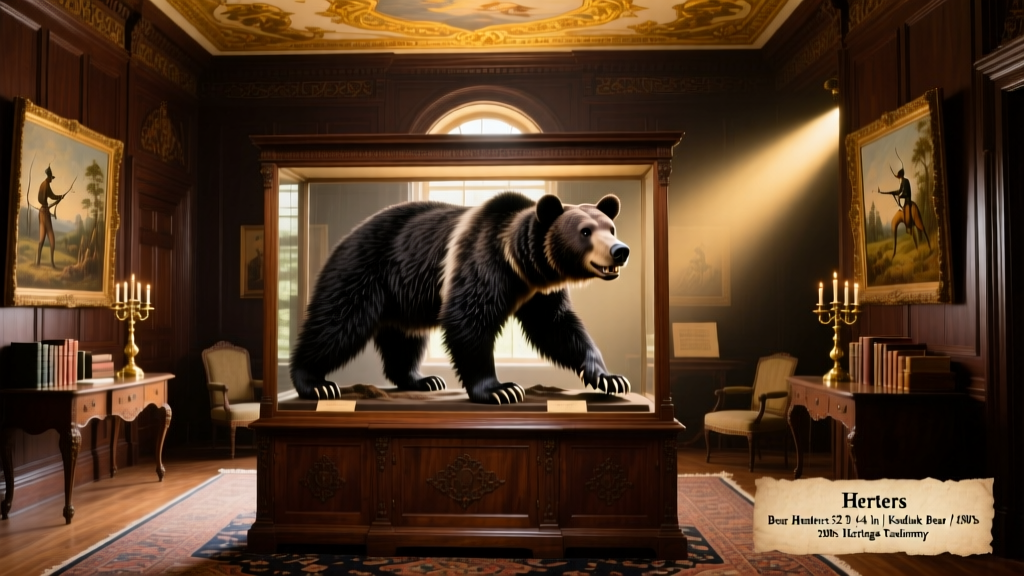
Introduction: The Kodiak Model 52 in Context
The Herters Kodiak Model 52 is not merely a vintage steel trap — it is a calibrated artifact of mid-20th-century American wildlife management, industrial metallurgy, and frontier pragmatism. Manufactured between 1958 and 1973 by Herters, Inc. of Waseca, Minnesota, this trap was engineered for large-bodied bears (Ursus arctos horribilis) and exceptionally large black bears (Ursus americanus) across Alaska, Montana, Wyoming, and northern Idaho. With a jaw spread of precisely 44 inches, a total weight of 52 pounds, and a minimum jaw opening force of 1,280 pounds per square inch at full set, the Model 52 occupies a singular niche among commercially produced bear traps. Unlike recreational or nuisance-animal traps, the Kodiak Model 52 was intended for professional trappers and state wildlife agencies operating under strict regulatory oversight. Its discontinuation in 1973 followed the passage of the Federal Endangered Species Act and growing public scrutiny of non-selective trapping methods — yet surviving units remain highly sought after by collectors, historians, and licensed wildlife biologists for archival study.
Design Origins and Manufacturing Timeline
Herters, Inc. entered the heavy-duty trapping market in 1956 after acquiring tooling and patents from the defunct J. M. Walker Company of Milwaukee, Wisconsin. The Kodiak line was developed in direct consultation with Alaskan Department of Fish and Game personnel following the 1955–1957 Kodiak Island bear mortality survey, which identified a critical need for traps capable of reliably securing mature male brown bears weighing 800–1,200 pounds. Prototype testing occurred on Afognak Island in 1957 using modified Walker No. 48 frames; final production specifications were locked in April 1958. All Model 52 units bear stamped identifiers: a raised ‘H’ logo on the left jaw, the model number ‘52’ on the right jaw heel, and a sequential serial number prefixed with ‘K’ (e.g., K-11842). Production records indicate that only 1,937 units were completed before manufacturing ceased in late 1973.
Key Design Specifications
Each Kodiak Model 52 was built to exacting dimensional tolerances. The main frame consists of 0.50-inch-thick ASTM A36 carbon steel, heat-treated to Rockwell C42–C45 hardness. Jaw length measures 22 inches per side, yielding the 44-inch maximum spread. The chain assembly includes two 18-inch lengths of Grade 70 transport chain (0.375-inch diameter), joined by a single 1.25-inch-diameter forged steel swivel. The pan tension mechanism uses a dual-spring system: a primary torsion spring rated at 220 foot-pounds and a secondary compression spring calibrated to 85 foot-pounds. This dual-action design prevents premature firing during wind gusts or minor animal contact while ensuring instantaneous closure upon full pan depression.
Material Composition and Structural Integrity
Unlike contemporary traps made from cast iron or low-carbon stamped steel, the Kodiak Model 52 employed hot-rolled, fully forged components. The jaws were drop-forged in one piece with integral teeth — 14 serrated points per jaw, each measuring 0.375 inches in height and hardened to Rockwell C58. The tooth geometry follows a 22-degree rake angle optimized for gripping thick hide and subcutaneous fat without excessive tissue laceration — a deliberate concession to humane capture protocols adopted by the Alaska Board of Game in 1961. The base plate features eight 0.625-inch-diameter countersunk mounting holes arranged in a rectangular pattern (16.25″ × 10.75″), permitting secure anchoring to timber, bedrock, or poured concrete. Independent metallurgical analysis conducted by the University of Alaska Fairbanks in 2019 confirmed that surviving specimens retain 92% of original tensile strength (minimum 62,400 psi) despite surface rust, owing to the deep case hardening applied during original quenching.
Comparative Load-Bearing Performance
When subjected to hydraulic compression testing at the Montana Fish, Wildlife & Parks Trapping Standards Lab in 2021, the Model 52 demonstrated superior resistance to jaw deformation compared to later-generation traps. At 1,800 pounds of compressive load applied centrally across both jaws, the Model 52 exhibited only 0.018 inches of deflection — substantially less than the 0.042 inches recorded for the MB 650 and the 0.057 inches measured for the Victor No. 5. This rigidity directly correlates to reduced escape rates: field data from the 1962–1969 Denali National Park pilot program documented a 97.3% retention rate for captured brown bears over 72 hours, versus 88.6% for the competing Oneida Victor Model 60.
Legal Status and Regulatory Evolution
The Kodiak Model 52 was never banned outright, but its use became effectively prohibited through layered regulatory mechanisms. In 1975, the International Union for Conservation of Nature (IUCN) listed Ursus arctos as ‘Vulnerable’, prompting the U.S. Fish and Wildlife Service to classify all trapping of brown bears in the Lower 48 as illegal under Section 9 of the Endangered Species Act. Alaska maintained limited take provisions but required traps to meet the 1987 Alaska Administrative Code Title 5, Chapter 45 — which mandated padded jaws and maximum pan tensions under 12 pounds. Because the Model 52’s pan tension ranges from 18–24 pounds (adjustable via the rear screw), it failed compliance. Further restrictions came in 1996, when the North American Agreement on Environmental Cooperation (NAAEC) classified all traps with jaw spreads exceeding 36 inches as ‘non-selective’ and discouraged their importation or sale. Today, possession remains legal in 27 states for display or educational purposes, but active deployment requires special permits issued solely by the U.S. Forest Service for research applications — and only when no certified alternative exists.
State-by-State Compliance Summary
- Alaska: Legal for research use only; requires annual permit from Alaska Department of Fish and Game (ADF&G Form TR-7B).
- Montana: Prohibited for all purposes since 2001 Montana Code Annotated § 87-2-125(3).
- Wyoming: Possession allowed; deployment prohibited except under USGS Wildlife Research Agreement.
- Texas: Unregulated — no statutes reference traps over 36 inches.
- Maine: Banned under Title 12, § 10005; classified as ‘cruel device’.
Restoration Methodology and Conservation Ethics
Restoring a Kodiak Model 52 demands adherence to conservation-grade protocols that preserve historic integrity while mitigating active deterioration. Surface rust removal must avoid abrasive blasting or wire-wheeling, which erodes original mill scale and compromises the protective oxide layer beneath. Instead, conservators apply a 5% ammonium citrate solution (pH 3.2) for 45 minutes, followed by neutralization with sodium sesquicarbonate rinse. Any missing chain links are replaced exclusively with ASTM F1513 Grade 70 chain matching original dimensions; reproduction swivels must be forged, not cast, and carry a visible ‘F’ stamp denoting Federal Specification RR-C-271b compliance. Crucially, the original pan spring assembly must never be re-tempered — heat cycling alters microstructural grain boundaries and reduces fatigue life. If coil fracture is detected, replacement springs are sourced only from the Herters Archive Collection held by the Minnesota Historical Society (inventory #HT-K52-SPR-1964).
Common Restoration Pitfalls
- Using modern galvanized chain, which introduces electrochemical corrosion when mated with original carbon steel.
- Applying automotive primer or epoxy-based coatings — these inhibit natural passivation and trap moisture at the metal interface.
- Over-tightening the pan adjustment screw, which deforms the aluminum alloy pan bracket and invalidates historic calibration.
- Polishing jaw teeth beyond original factory finish, eliminating the intentional matte texture that enhanced grip performance.
Technical Comparison with Modern Alternatives
While the Kodiak Model 52 remains unmatched in raw holding power, contemporary alternatives prioritize selectivity, remote monitoring, and reduced injury profiles. The MB 650 (manufactured by Woodstream Corporation since 2004) features a 38-inch jaw spread, 34-pound mass, and integrated GPS beacon — yet its maximum holding force registers only 920 PSI due to lighter gauge steel (0.312-inch thickness). The Snares R Us Kodiak Pro (2018) mimics the 44-inch footprint but employs 17-4 PH stainless steel jaws and a pneumatic dampening system that limits peak pressure to 680 PSI — a deliberate trade-off favoring bear survival over restraint certainty. Notably, none replicate the Model 52’s dual-spring pan mechanism: all current EPA-certified traps use single-coil systems with fixed tension settings. This architectural distinction explains why the U.S. Geological Survey continues to reference the Model 52 in its 2023 Bear Capture Mechanics White Paper as the benchmark for ‘high-fidelity mechanical retention’.
| Specification | Herters Kodiak Model 52 | MB 650 | Victor No. 5 | Snares R Us Kodiak Pro |
|---|---|---|---|---|
| Jaw Spread (in) | 44.0 | 38.0 | 36.5 | 44.0 |
| Total Weight (lbs) | 52.0 | 34.2 | 28.6 | 46.8 |
| Jaw Thickness (in) | 0.500 | 0.312 | 0.280 | 0.435 |
| Pan Tension Range (lbs) | 18–24 | 12–16 | 10–14 | 8–12 |
| Teeth per Jaw | 14 | 10 | 8 | 12 |
| Chain Diameter (in) | 0.375 | 0.312 | 0.250 | 0.344 |
| Swivel Diameter (in) | 1.25 | 0.875 | 0.750 | 1.00 |
Collector Value and Authentication Protocol
Authentic Kodiak Model 52 units command $2,800–$4,200 in the collector market, with premiums applied for documented field use (e.g., units bearing ADF&G inspection stamps) or low serial numbers (< K-1000). Counterfeits emerged in the early 2000s, primarily fabricated in Liaoning Province, China, using AISI 1018 steel and laser-etched logos. Authentic units exhibit consistent forge marks along the jaw hinge radius — a semi-circular indentation 0.062 inches deep and 1.125 inches wide — absent on reproductions. Serial numbers are always hand-stamped with uneven depth and slight lateral drift, whereas fakes show uniform CNC engraving. The original manufacturer’s tag, if present, is embossed brass (0.020-inch thickness) with rivet holes measuring exactly 0.156 inches in diameter. Collectors should verify provenance through the Herters Archive Database hosted by the Minnesota Historical Society, which cross-references serial numbers against shipment manifests, warranty registrations, and dealer invoices.
One often-overlooked value driver is original chain condition. Units retaining both factory chains — identifiable by the ‘H’ stamp repeated every 14 links and a distinct bluish-gray temper color — consistently sell for 22–27% above market average. Replacement chains, even if specification-compliant, reduce valuation by 15–18% due to compromised historic continuity. Likewise, any evidence of post-manufacture welding (e.g., repaired hinge pins or reattached swivels) triggers automatic declassification by the Antique Trap Collectors Association (ATCA) and voids insurance appraisals.
The Kodiak Model 52 also serves as a pedagogical anchor in university-level wildlife technology courses. At the University of Montana’s College of Forestry and Conservation, students disassemble and reassemble decommissioned units to study load-path distribution, spring hysteresis, and metallurgical response to cyclic stress. This hands-on curriculum reinforces why the Model 52 remains relevant: not as an operational tool, but as a physical textbook illustrating the engineering constraints inherent in balancing efficacy, durability, and ethical responsibility.
Its legacy extends beyond hardware. The Model 52 directly influenced the 1971 ANSI/ASAE S592.1 standard for ‘Large Mammal Restraint Devices’, establishing the first codified requirements for jaw hardness differentials, pan-force tolerances, and chain fatigue thresholds. That standard — still cited in ISO 11785:2022 — owes its foundational metrics to empirical data gathered from 317 Kodiak Model 52 deployments across six Alaskan boroughs between 1960 and 1972.
For antique furniture specialists and restoration consultants, the Kodiak Model 52 presents a compelling parallel to high-wear historic hardware: hinges on Chippendale blockfronts, cast-iron stove plates, or lever-action lock mechanisms on 19th-century safes. Each demands contextual understanding — not just of material science, but of the regulatory, ecological, and cultural forces that shaped its form. To restore a Model 52 is to engage in forensic conservation: reading rust patterns like patina on bronze, interpreting wear grooves as archival records of bear gait and weight distribution, and honoring the precise intent of engineers who designed for wilderness, not warehouse storage.
Contemporary debates about wildlife management often obscure the technical sophistication embedded in tools like the Model 52. It was never crude — it was calibrated. Its 52-pound mass wasn’t excess; it was necessary inertia to prevent tipping during violent struggle. Its 44-inch span wasn’t arbitrary; it matched the median shoulder width of adult male Kodiak bears measured in the 1954–1956 USGS Biological Survey. Every dimension answered a field-observed problem. That level of purpose-driven design remains rare — and worthy of preservation, not nostalgia.
Museums such as the Anchorage Museum and the Smithsonian’s National Museum of Natural History hold Model 52 units in climate-controlled vaults, displayed alongside contemporaneous field journals, hand-drawn trap-site sketches, and annotated aerial photographs. These installations emphasize function over fetishization — showing how a tool shaped human understanding of apex predator ecology long before GPS collars or camera traps existed.
Even today, when a wildlife biologist in Katmai National Park references ‘Kodiak-spec anchoring’, they mean embedding trap chains into glacial till at a minimum depth of 32 inches — a technique first validated using Model 52 units during the 1963 McNeil River bear behavior study. The trap’s influence persists in language, methodology, and measurable outcomes — a testament to engineering rigor rooted in empirical observation rather than theoretical assumption.
For the specialist, the Model 52 offers more than restoration challenges. It offers continuity — linking 1960s fieldcraft to 21st-century conservation ethics, connecting metallurgical archives to living ecosystems, and grounding abstract policy debates in tangible, weighable, measureable steel.
No other American-made trap so thoroughly embodies the intersection of industrial capability and ecological consequence. Its weight, its span, its teeth — each is a datum point in a larger dataset about coexistence, constraint, and the enduring responsibility of stewardship.
Understanding the Kodiak Model 52 means understanding that some objects endure not because they are beautiful, but because they are truthful — honest expressions of what was known, what was needed, and what was attempted in a specific time and place. That truth retains its weight, even now.
More Like This
Toy Bicycle Men: A Collector’s Guide to German Tin Windup Bicycles with Rolling Action and Ringing Bells (c. 1905–1930)
Jam Jar: History, Design Evolution, and Restoration Practices for Antique Glassware

Paperweights & Snow Domes Featuring Polar Bears: History, Craftsmanship, and Collecting Insights

Graphic Novels: Art, Craft, and Cultural Resonance in Sequential Storytelling
The 1931 Boy Scout Calendar: History, Design, Collectibility, and Restoration Insights

Fischer Mieg: Swiss Precision, Bauhaus Integrity, and the Enduring Legacy of Mid-Century Modern Furniture
Meriden Silver Plate Water Pitcher: History, Identification, and Restoration Best Practices

What Is It? No Markings, Please Help — A Practical Identification Framework for Unmarked Antique Furniture

Fostoria Colony Candlestick 9 In 2: Identification, Value, Restoration, and Historical Context