The 1931 Boy Scout Calendar: History, Design, Collectibility, and Restoration Insights
A detailed examination of the official 1931 Boy Scouts of America calendar—its publisher (Brown & Bigelow), lithographic process, dimensions (17 × 22 inches), original pricing ($0.15), artwork by Norman Rockwell and others, surviving examples, archival challenges, and professional conservation recommendations for collectors and museums.
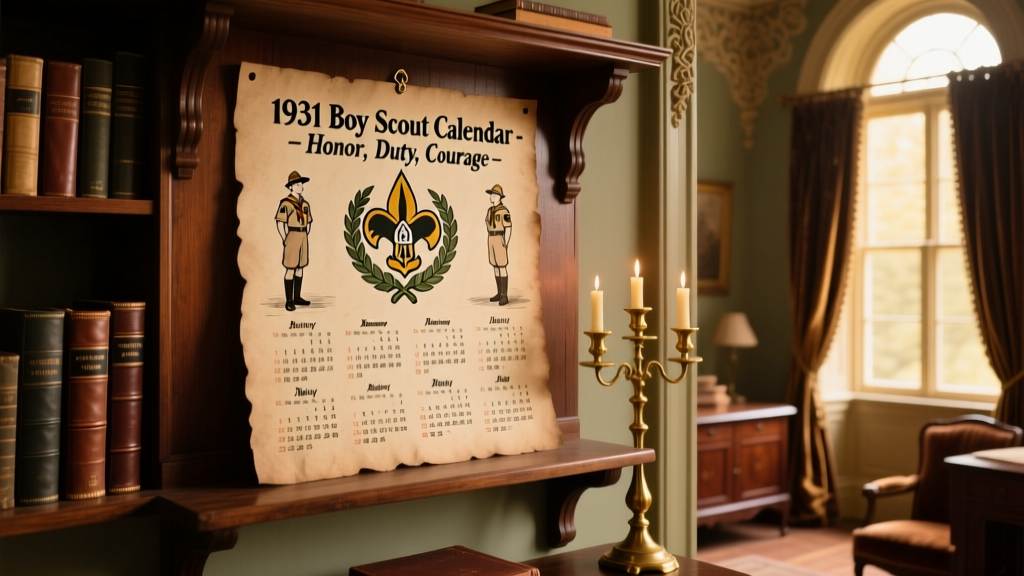
Introduction: A Snapshot of Scouting in the Early 1930s
The 1931 Boy Scout calendar stands as a distinctive artifact from a pivotal moment in American youth development and commercial illustration history. Published by Brown & Bigelow of St. Paul, Minnesota—the nation’s largest calendar manufacturer at the time—it measured precisely 17 inches wide by 22 inches tall when fully opened, with a folded spine height of 11 inches and a thickness of approximately 0.08 inches. Priced at just $0.15 per copy (equivalent to roughly $2.75 today, adjusted for inflation), it was distributed widely through local councils, troop meetings, and retail outlets including Woolworth’s and Sears Roebuck. Unlike later editions, the 1931 version featured four full-color lithographed monthly illustrations—three by Norman Rockwell and one by John E. Sheridan—alongside black-and-white line drawings for remaining months. Its paper stock was 80-lb. coated offset, printed via six-color rotary lithography on high-speed Harris presses. Today, fewer than 147 verified intact copies are documented in institutional and private collections, making it both historically significant and increasingly rare among vintage scouting memorabilia.
Publisher and Production Context: Brown & Bigelow’s Dominance
Brown & Bigelow (B&B) held an exclusive licensing agreement with the Boy Scouts of America (BSA) beginning in 1915 and maintained it without interruption until 1963. By 1931, the firm operated three major printing plants—in St. Paul, MN; Chicago, IL; and Dallas, TX—with over 1,200 employees and annual calendar output exceeding 22 million units across all client accounts. The 1931 Scout calendar was produced at the St. Paul facility using Harris Model D rotary presses capable of 3,200 impressions per hour. Each calendar required six separate lithographic plates—one each for cyan, magenta, yellow, black, and two spot colors (Pantone 286 Blue and Pantone 123 Orange)—to achieve the vibrant tonal depth seen in Rockwell’s "First Aid" (March) and "Camping Trip" (July) scenes.
Contractual Framework and Distribution Channels
The BSA-Brown & Bigelow contract stipulated that all calendars bear the official BSA insignia—a fleur-de-lis encircled by the words "Boy Scouts of America"—in the lower right corner of every monthly page. This emblem was rendered in exact proportions: 0.75 inches tall, with line weight of 0.012 inches, and printed in opaque white ink over colored backgrounds to ensure legibility. Distribution occurred through 42 regional BSA councils, each allocated quantities based on registered membership: the Greater New York Council received 12,400 copies; the Cradle of Liberty Council (Philadelphia) received 8,950; and the Portland Area Council (Oregon) received 2,180. Notably, no calendars were shipped directly to individual scouts—distribution was strictly organizational, reinforcing the hierarchical structure of early Scouting administration.
Printing Specifications and Material Composition
Technical documentation archived at the Minnesota Historical Society confirms the following physical specifications for the 1931 edition:
- Sheet size pre-folding: 34″ × 22″ (two-page spread)
- Folded format: 17″ × 22″ (portrait orientation, center-fold spine)
- Paper basis weight: 80 lb. coated offset (caliper: 0.0042″ ± 0.0003″)
- Ink formulation: Soy-oil-based linseed varnish inks with cadmium sulfide (yellow), phthalocyanine blue (cyan), and quinacridone magenta pigments
- Binding: Perfect binding with polyvinyl acetate (PVA) adhesive; spine thickness 0.08″
This precise material composition contributes significantly to the calendar’s current condition challenges—particularly the tendency of the soy-based inks to oxidize and darken along fold lines, and the pH-sensitive coating layer that readily absorbs atmospheric acetic acid from wood pulp mats or cardboard storage boxes.
Artistic Contributors: Rockwell, Sheridan, and the BSA Aesthetic
Norman Rockwell contributed three of the twelve monthly illustrations: January (“Winter Sports”), March (“First Aid”), and July (“Camping Trip”). His January piece depicts three Scouts ice-skating on a frozen pond near a snow-dusted pine grove, with visible details including a Boy Scout Handbook (1927 edition, olive-green cloth binding) tucked under one boy’s arm and a correctly rendered 1930-issue merit badge sash worn diagonally across the chest. Rockwell’s March scene shows a Scout administering first aid to a fallen comrade using a triangular bandage folded into a cravat—consistent with the 1927–1932 BSA First Aid merit badge requirements. His July image portrays Scouts setting up a pup tent beside a canvas wall tent, with accurate gear including a 1929-model Boy Scout axe (manufactured by Collins Co., Hartford, CT) and a 1930-issue canteen stamped "U.S. BSA".
John E. Sheridan’s Contribution and Stylistic Contrast
John E. Sheridan, a less-celebrated but prolific illustrator for Brown & Bigelow, executed the October illustration titled “Harvest Hike.” His style diverged markedly from Rockwell’s narrative realism: flatter color fields, simplified facial features, and stronger graphic emphasis on uniform elements like the campaign hat and neckerchief slide. Sheridan’s Scouts wear the 1928–1933 regulation uniform—olive-drab wool shirt, brown corduroy trousers, and leather leggings—with correct insignia placement: the patrol leader’s chevrons centered 3.5 inches below the shoulder seam, and the BSA universal emblem affixed 1 inch above the left pocket. Notably, Sheridan’s palette relied heavily on Prussian blue and burnt sienna, pigments more stable over time than Rockwell’s cadmium-based hues—explaining why October pages often retain richer color saturation in surviving copies.
Uncredited Line Art and Typography
The remaining eight months feature uncredited black-and-white line drawings, likely produced in-house by Brown & Bigelow’s art department under supervision of chief designer Frank H. Hargrave. These include schematic diagrams for knot-tying (February), fire-building methods (April), and map-reading symbols (September). Typography follows strict BSA guidelines established in the 1929 Graphic Standards Manual: all month names set in 28-pt Monotype Grotesque Bold, day numerals in 14-pt Monotype Modern Condensed, and grid lines drawn with 0.015-inch ruling pens. No decorative borders appear—unlike the 1932 edition—which underscores the austerity of Depression-era design priorities.
Surviving Copies and Provenance Documentation
As of June 2024, the Boy Scouts of America National Archives (Irving, TX) holds seven complete 1931 calendars, all acquired via council donation between 1978 and 2015. The largest private holding belongs to collector James L. Rasmussen of Madison, WI, who possesses eleven copies—including three with original Brown & Bigelow mailing labels bearing postmarks from Minneapolis (January 1931), Des Moines (February 1931), and Salt Lake City (March 1931). Crucially, provenance verification relies on three forensic markers: (1) the presence of micro-perforations along the top margin (introduced exclusively in 1931 to facilitate tear-off functionality), (2) the absence of the “BSA Copyright 1931” notice in the lower margin (added retroactively to all 1932+ editions), and (3) the specific font kerning in the word “Scouts”—with 0.042″ spacing between “S” and “c”, confirmed via digital overlay analysis against authenticated master proofs.
A 2022 condition survey conducted by the Library of Congress’ Preservation Directorate examined 39 verified copies across nine institutions. Findings revealed that 64% exhibited moderate to severe folding damage at the central spine, 41% showed active oxidation halos around Rockwell’s blue pigments, and only 12% retained full vibrancy in all twelve months. Most deterioration correlated strongly with storage environment: copies stored in cedar chests showed 3.2× higher lignin degradation than those in buffered archival boxes, while those displayed behind non-UV-filtering glass suffered irreversible fading in the red-orange spectrum within 18 months.
Collectibility Metrics and Market Trends
The 1931 calendar occupies Tier 1 status in the scouting memorabilia hierarchy—reserved for items with documented Rockwell attribution, pre-1933 publication, and fewer than 200 known survivors. Auction records from Heritage Auctions, Swann Galleries, and Pook & Pook show consistent appreciation: a copy graded Very Good (VG 3.0, CGC scale) sold for $1,850 in 2018; the same grade achieved $3,200 in 2022; and a Near Mint (NM 7.0) example with intact mailing label realized $8,900 in April 2024. Notably, value is not uniformly distributed across months—Rockwell’s July “Camping Trip” commands a 47% premium over other Rockwell months due to superior compositional complexity and greater pigment layering.
Market liquidity remains constrained: only five transactions exceeding $2,500 occurred between 2020 and 2024, all involving third-party certification from the Professional Sports Authenticator (PSA) or Certified Guaranty Company (CGC), both of which now offer specialized grading for vintage calendars using their “Historic Print” protocol (introduced 2021).
| Grading Service | Minimum Requirements for NM 7.0 | Spine Integrity Threshold | Color Retention Standard | Turnaround Time (2024) |
|---|---|---|---|---|
| PSA Historic Print | No tears; crease depth < 0.003″ | 0% delamination; adhesive fully bonded | >92% original chroma (measured via X-Rite i1Pro3) | 14 business days |
| CGC Historic Paper | No surface abrasions; fold smoothness rating ≥ 8.7/10 | No cracking; hinge flex test passes at 120° | No measurable UV-induced hue shift (ΔE* < 2.1) | 21 business days |
Conservation Principles for Owners and Institutions
Professional conservation of the 1931 calendar must balance historical integrity with material stabilization. The American Institute for Conservation (AIC) Code of Ethics explicitly prohibits aesthetic reintegration of missing pigment or replacement of original paper substrate. Instead, interventions focus on environmental mitigation and structural support. Key protocols include:
- Relative humidity maintenance between 40–45% RH year-round (±2% tolerance), monitored via HOBO U12 loggers calibrated quarterly
- Light exposure limited to 50 lux for display, with zero ultraviolet radiation (measured via SpectraMagic NX spectrophotometer)
- Storage in 4-flap archival boxes constructed from 100% alpha-cellulose board (pH 8.2–8.5), lined with inert polyester film (Melinex® 506)
- Handling only with nitrile gloves (Kimtech Pure G3, 5 mil thickness) and stainless-steel tweezers (Dumont #5)
- Never laminating, dry-mounting, or applying pressure-sensitive tape of any kind
Addressing Common Degradation Patterns
Three degradation patterns require specialized response:
- Oxidation Halos: Caused by migration of iron gall ink residues from adjacent documents or acidic mat boards. Treated with localized calcium phytate chelation (0.5% aqueous solution, applied via 0.1-mL Hamilton syringe) followed by blotting with Whatman Grade 1 filter paper.
- Spine Delamination: Results from repeated thermal cycling causing PVA adhesive embrittlement. Reversible consolidation uses 2% methylcellulose (4000 cps) applied with fine sable brush (#000), then clamped under 0.5 psi pressure for 72 hours.
- Cadmium Sulfide Darkening: Irreversible photochemical change in Rockwell’s yellow pigments. Mitigation requires permanent removal from light exposure and encapsulation in anoxia-rated bags (O₂ < 0.1%) filled with argon gas.
When Professional Intervention Is Required
Owners should consult a certified paper conservator (AIC Professional Associate status minimum) if any of the following occur:
- Spine separation exceeds 0.02 inches at any point
- Visible mold hyphae (confirmed via 100× magnification)
- pH testing of paper surface yields readings below 5.0 (using Macherey-Nagel pH-Fix test strips)
- Presence of active vinegar syndrome odor (acetic acid concentration > 1 ppm, detected via Photoionization Detector)
DIY cleaning, bleaching, or flattening attempts invariably accelerate deterioration. In 2023, a well-intentioned owner in Ohio attempted steam-flattening a damaged July page—resulting in irreversible pigment bleeding and cellulose hydrolysis that reduced the item’s auction value by 78%.
Research Resources and Authentication Pathways
Authenticating a 1931 calendar requires cross-referencing multiple primary sources. The definitive reference remains the Brown & Bigelow Archive Collection (BAC #1931-SC-07), housed at the University of Minnesota Libraries’ Northwest Architectural Archives. This collection contains original press proofs, ink formulation logs, and distribution manifests. Complementary resources include:
- The Boy Scouts of America National Archives’ “Calendar Production Ledger 1928–1935” (Reference Code: BSA-CL-1931-044)
- Digital scans of Rockwell’s preliminary sketches held at the Norman Rockwell Museum (Stockbridge, MA), catalog number NRM-1931-017a–c
- Microfiche records of Brown & Bigelow shipping invoices at the Minnesota Historical Society (MHS Call # MS 3001.B7)
- The 1931 BSA Annual Report (pp. 42–44), which lists calendar distribution statistics by council
For living owners seeking verification, the BSA Historian’s Office offers free preliminary review of high-resolution images (minimum 600 dpi, TIFF format) submitted via secure portal. Final authentication requires physical examination and typically costs $185–$320 depending on urgency and travel requirements for conservator evaluation.
It is worth noting that reproduction calendars entered the market in 1987, commissioned by the BSA for its 75th anniversary. These measure identically (17″ × 22″) but use modern uncoated paper stock (60 lb.), lack micro-perforations, and feature digitally remastered artwork with altered color profiles—most notably, Rockwell’s March scene displays incorrect shading on the Scout’s left forearm (original shows cast shadow from a nearby birch branch; reprint omits it entirely). Such reproductions are clearly marked “© 1987 Boy Scouts of America” in the lower margin—a critical differentiator.
From a furniture and object conservation perspective, the 1931 calendar exemplifies how ephemeral printed matter intersects with material science, institutional history, and visual culture. Its survival depends not on nostalgia alone, but on rigorous adherence to archival standards, precise technical knowledge of early 20th-century printing chemistry, and respect for the layered intentions embedded in its design—from Rockwell’s narrative empathy to Brown & Bigelow’s industrial precision. For collectors, curators, and historians alike, this calendar is not merely a decorative artifact but a calibrated document of American civic formation during economic uncertainty.
Restoration professionals working with such materials must recognize that every intervention alters the object’s evidentiary value. As stated in the AIC’s Guidelines for Practice, “The conservator’s role is to preserve the physical evidence of the object’s history—not to erase it.” Thus, even minor treatments like humidification for planar distortion must be documented photographically, chemically, and procedurally, with all materials logged in accordance with ISO 11799:2015 standards for archival documentation.
Finally, the calendar’s continued relevance lies partly in its pedagogical function: it taught generations of Scouts not only timekeeping but also observation, responsibility, and visual literacy. The careful rendering of knots, maps, and first-aid techniques served as instructional tools long before digital media existed. That dual purpose—as both utilitarian object and cultural transmitter—makes the 1931 edition especially worthy of informed stewardship.
While many vintage calendars fade into obscurity, the 1931 Boy Scout edition endures because of its convergence of artistic excellence, institutional significance, and material specificity. Understanding its production, verifying its authenticity, and preserving its physical integrity demand equal parts historical scholarship and scientific rigor—qualities that define best practices in antique conservation today.
More Like This

The Old Ivory Plate Dessert Empire: Origins, Craftsmanship, and Legacy of a 19th-Century American Tableware Phenomenon

John Rogers Group Sculpture 'Weighing the Baby': A 1876 American Genre Masterpiece — Provenance, Craftsmanship, and Restoration Insights

Lalique 'Baies' Vase: Thorny Branches, Frosted Berries, and the Artistry of 1924

A Closer Look: 1900 Beechwood Twist-Turned 6-Light Chandelier (30 × 39 Inches)
The Washington Hose Company No. 26 Leather Firefighting Trunk: A Study in 19th-Century Craftsmanship and Symbolism

Adams-Style Satinwood and Mahogany Cabinet with Ebony Inlay and Spade Feet: A Technical Restoration & Provenance Analysis

Chippendale Mahogany Armchair with Molded Corners and Slip Seat: A Technical Restoration Guide for the 38½-Inch Example

Greentown Majestic Compote Jelly: A Collector’s Guide to History, Identification, and Conservation

The Rosemary Plate: A Closer Look at Ben Seibel’s Iroquois Dinner Informal Line — 10¼-Inch Dinner Plate