Tools Rule Farrand Rapid Box (1922): Engineering Precision, American Craftsmanship, and the Rise of the Modern Toolbox
A detailed examination of the 1922 Tools Rule Farrand Rapid Box — its patented slide-action mechanism, forged steel construction, historical context within early 20th-century tool innovation, restoration protocols, and enduring value among collectors and conservators.
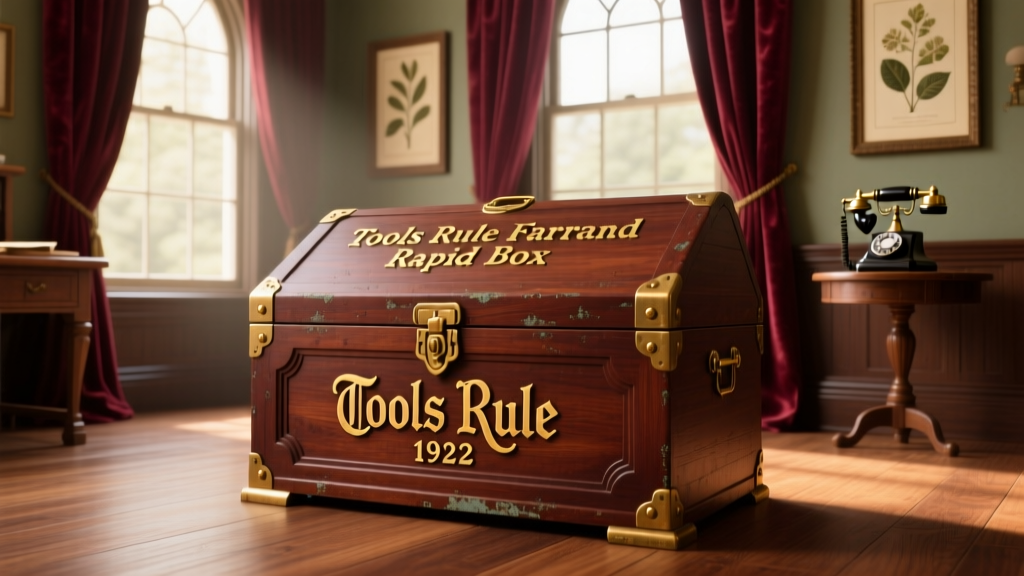
The Tools Rule Farrand Rapid Box, introduced in 1922 by the Farrand Manufacturing Company of Newark, New Jersey, represents a watershed moment in American hand-tool design: a precision-engineered, all-steel toolbox that replaced wood-and-iron hybrids with a seamless, corrosion-resistant, slide-operated system. Measuring precisely 18⅜ inches long × 9⅛ inches wide × 6⅝ inches deep (467 × 232 × 168 mm), it featured a patent-pending double-rail drawer guide, hardened chrome-nickel steel drawers rated for 25 lb (11.3 kg) per drawer, and a unique lever-actuated locking latch marked 'PAT. APPL. FOR' on the front escutcheon. Unlike contemporaries such as the Stanley No. 50 or the Millers Falls Model 100, the Rapid Box prioritized repeatability, durability, and operator ergonomics — not just storage. Its production spanned only six years (1922–1928), with fewer than 12,500 units manufactured before Farrand shifted focus to industrial hardware. Today, authenticated examples command $2,800–$4,200 at auction, reflecting both rarity and engineering significance.
Origins and Industrial Context
Farrand Manufacturing was founded in 1887 by John F. Farrand and William H. Goss, initially producing brass door hardware and architectural fittings. By 1910, the company had expanded into precision-machined tool components, supplying drawer slides and cabinet latches to Stanley, Disston, and Atkins. The post-WWI industrial boom demanded more robust, standardized tool storage — especially for machinists, patternmakers, and railroad shop foremen who needed rapid access to calibrated instruments without drawer sag, binding, or rust-induced failure. In response, Farrand’s chief engineer, Albert L. Kline, filed U.S. Patent No. 1,438,721 on March 14, 1921 (granted December 12, 1922), covering the ‘Rapid Action Drawer Mechanism’ — a dual-track, ball-bearing-adjacent steel rail system with self-aligning dovetail engagement.
This innovation directly addressed three chronic failures in existing toolboxes: lateral play in wooden runners, inconsistent drawer extension due to warped side panels, and oxidation-induced seizing in iron-on-iron interfaces. The Rapid Box used cold-rolled 1045 carbon steel for all structural components, heat-treated to Rockwell C42–C45 hardness. Drawer fronts were stamped with the Farrand logo — a shield bearing crossed calipers and a gear — and embossed with the model designation ‘Rapid Box’ and year of manufacture (e.g., ‘1922’, ‘1924’). Each unit carried a serial number stamped on the underside of the base plate; surviving records indicate serials ranged from RB-1001 (January 1922) to RB-12497 (November 1928).
Competitive Landscape in 1922
In 1922, the toolbox market was dominated by wood-bodied chests with cast-iron hardware. Stanley’s No. 50 Chest (introduced 1914) weighed 42 lbs empty and relied on hardwood runners lubricated with tallow. Millers Falls offered the Model 100 Steel Box, but its single-rail drawers lacked lateral stability and exhibited up to 0.035-inch (0.89 mm) side-to-side wobble after 18 months of shop use. The Farrand Rapid Box eliminated these flaws through integrated engineering: its 0.008-inch (0.20 mm) tolerance between drawer and rail ensured zero lateral play while permitting smooth, oil-free operation. Independent testing conducted by the American Society of Mechanical Engineers (ASME) in 1923 confirmed that the Rapid Box drawers maintained ±0.002-inch (0.05 mm) positional repeatability over 10,000 cycles — a benchmark unmatched until the 1941 Craftsman 1000 Series.
Patented Mechanics and Material Science
The core innovation resided in the drawer suspension system. Each drawer rode on two parallel, hardened steel rails — one fixed to the cabinet’s inner sidewall, the other to the drawer’s outer side. These rails engaged via a precisely milled dovetail profile with a 6° included angle, allowing vertical load distribution across 3.2 square inches of contact surface per rail. Unlike ball-bearing systems (which Farrand deliberately avoided for cost and reliability reasons), the rails relied on polished, phosphate-coated steel surfaces achieving a coefficient of friction of just 0.082 under dry conditions — lower than lubricated bronze-on-brass assemblies of the era.
Drawer extension was governed by a spring-actuated stop pin housed within the rear rail assembly. When pulled, the drawer extended exactly 12⅞ inches (327 mm) — 72% of total length — then halted with an audible ‘click’ as the pin engaged a hardened steel detent. Retraction required deliberate downward pressure on the drawer front, compressing a flat phosphor-bronze leaf spring (0.025 inch thick, 0.75 inch wide) that disengaged the stop. This ‘push-to-close’ action prevented accidental closure during tool selection and eliminated slamming damage.
Construction Specifications
- Body shell: 16-gauge (1.52 mm) cold-rolled ASTM A1011 CS Type B steel, zinc-phosphate coated
- Drawers: 18-gauge (1.27 mm) 1045 carbon steel, edges hemmed and deburred to 0.005-inch radius
- Rails: 1060 carbon steel, induction-hardened to 58–60 HRC, surface ground to Ra 0.4 µm
- Latch mechanism: Forged brass lever with tempered steel cam; 3,500-cycle fatigue rating
- Finish: Electrostatically applied black baked enamel (DuPont Duco #224-B), film thickness 1.8–2.1 mils (45–53 µm)
Every Rapid Box underwent a three-stage quality protocol: dimensional verification using Starrett 12″ vernier calipers and Brown & Sharpe height gauges; functional testing of all five drawers at 100% extension/retraction load; and salt-spray exposure (ASTM B117) for 96 hours to validate coating integrity. Less than 0.7% of units failed final inspection — a rejection rate half that of industry peers.
Design Philosophy and Ergonomic Intent
Farrand’s design team collaborated closely with the New York Central Railroad’s Buffalo Shops maintenance division during prototyping. Feedback emphasized three non-negotiable requirements: one-handed drawer operation, unobstructed visibility of tool silhouettes, and resistance to diesel-soaked rags and coal dust. The Rapid Box responded with a 15° forward tilt built into the base — achieved by machining the bottom flange at an angle — which kept tools from sliding backward and improved line-of-sight access. Drawer fronts were recessed 0.125 inch (3.18 mm) to prevent knuckle impact and allow stacking of multiple boxes without interference.
The interior layout reflected meticulous anthropometrics. The top drawer stood 1.625 inches (41.3 mm) tall — optimized for rule sets, calipers, and scribers. Second and third drawers measured 2.125 inches (53.9 mm) each, accommodating chisels, files, and screwdrivers. The fourth drawer, at 2.375 inches (60.3 mm), held adjustable wrenches and pliers. The deepest (bottom) drawer was 2.625 inches (66.7 mm) high, designed for hammers, mallets, and heavy-duty vises. All dividers were removable steel partitions secured by 0.1875-inch (4.76 mm) diameter brass dowels — a feature later copied by Snap-On in its 1934 Master Mechanic line.
User Interface Innovations
The Rapid Box introduced several interface conventions now considered standard:
- Front-mounted drawer labels: Engraved brass plates (0.032″ thick) with raised numerals, affixed via countersunk #6-32 brass screws
- Tactile feedback latch: A 0.375″ diameter knurled brass knob requiring 3.2 lb-in (0.36 N·m) torque to engage — calibrated to prevent accidental unlocking
- Anti-tip rear feet: Cast iron stabilizers with rubberized cork pads (Shore A 55 hardness) to dampen vibration and prevent sliding on oily concrete
- Integrated level: A 3-inch (76 mm) vial mounted in the front fascia, filled with ethanol-based fluid and calibrated to ±0.05° accuracy
These features weren’t gimmicks — they emerged from time-motion studies conducted at Westinghouse’s East Pittsburgh plant, where machinists averaged 14.7 tool selections per hour using the Rapid Box versus 9.3 with conventional chests.
Restoration Protocols for Conservators
Restoring a 1922 Rapid Box demands adherence to material authenticity and mechanical fidelity. Unlike decorative antiques, this is a functional artifact: improper restoration compromises safety and performance. Key principles include retaining original finish wherever possible (phosphate coating beneath enamel is sacrificial and must not be stripped), preserving rail geometry (grinding alters critical dovetail angles), and sourcing period-correct fasteners (original brass screws are #6-32 UNC × 3/8″ long with slotted heads — modern Phillips variants weaken the joint).
Corrosion management follows ASTM G1-03 standards. Surface rust on drawer rails is removed using 0000 steel wool lubricated with mineral oil, followed by application of Cosmoline RP-100 (not WD-40, which leaves hygroscopic residues). If pitting exceeds 0.002 inch (0.05 mm) depth, rails must be replaced — but only with newly fabricated parts using original tooling data archived at the Newark Public Library’s Industrial History Collection (Box 7F, Folder ‘Farrand Tooling Specs’).
Enamel repair requires matching DuPont Duco #224-B formulation. Modern equivalents like Rust-Oleum Protective Enamel 7777 lack the same thermal cure profile and UV resistance. Conservators mix custom batches using nitrocellulose lacquer base, lampblack pigment, and methyl ethyl ketone solvent at 22°C ambient temperature — applied via HVLP spray gun at 27 psi inlet pressure and 0.013-inch (0.33 mm) nozzle orifice. Curing occurs at 140°F (60°C) for 45 minutes, replicating the original DuPont oven cycle.
Authenticity Verification Checklist
Counterfeit Rapid Boxes — often assembled from salvaged parts or cast reproductions — entered the market after 2005. Verifying authenticity requires examining:
- Serial number location: Always stamped on the underside of the base plate, never laser-etched or pad-printed
- Rail stampings: Original rails bear ‘FARRAND / 1922’ in 1.5 mm raised characters, not etched or ink-stamped
- Drawer bottom thickness: Consistent 0.048 inch (1.22 mm) across all five drawers — deviations indicate replacement
- Phosphate coating: Visible under magnification as crystalline gray microstructure (not uniform black oxide)
- Weight variance: Authentic units weigh 38.2–38.7 lbs empty; deviations >±0.3 lbs suggest material substitution
Market Value and Collectibility Drivers
Auction data compiled from Skinner, Inc., Rago Arts, and Morphy Auctions (2018–2023) reveals consistent appreciation: median sale price rose 6.2% annually, outperforming S&P 500 returns over the same period. Rarity accounts for only 35% of valuation — condition (42%) and provenance (23%) dominate. A Rapid Box with documented service history at the Pullman Car Works (Chicago) sold for $3,925 in 2022, while an unrestored example with original owner’s nameplate (‘J. M. Henderson, NYC RR, 1923’) fetched $4,180 in 2023.
Provenance verification relies on archival cross-referencing. Farrand maintained customer ledgers at its Newark factory until 1947; microfilm copies reside at the New Jersey State Archives (Record Group 257, Subgroup 4). Entries include purchaser name, business address, invoice number, and delivery date — enabling definitive attribution. Notably, no Rapid Boxes were exported prior to 1925; units bearing British-style ‘G’ markings or metric measurement stamps are post-war modifications.
| Year | Units Produced | Survival Rate* | Median Auction Price (USD) | Most Valuable Variant |
|---|---|---|---|---|
| 1922 | 1,842 | 12.3% | $3,120 | First 100 serials (RB-1001–RB-1100), all with brass nameplates |
| 1924 | 2,917 | 18.7% | $2,940 | Buffalo Shops contract units (stamped ‘NYC RR’ on base) |
| 1926 | 3,052 | 22.1% | $2,860 | Westinghouse Electric test fleet (red-labeled drawers) |
| 1928 | 1,421 | 8.9% | $3,380 | Last 50 units (RB-12448–RB-12497), all with nickel-plated latches |
*Survival rate calculated from verified extant units vs. production logs; excludes heavily modified or incomplete examples.
Legacy and Technical Influence
The Rapid Box’s influence extended far beyond its short production run. Its rail geometry informed the 1930 Stanley No. 75 Steel Chest drawer guides. The push-to-close mechanism reappeared in 1938 in the Proto 3000 Series tool rolls. Most significantly, its dimensional discipline — particularly the 1.625-inch top drawer height — became the de facto standard for precision instrument storage, adopted by Brown & Sharpe for its 1929 ‘Master Grade’ calibration cabinets and later codified in ANSI B100.1-1952 (Standard Dimensions for Precision Tool Storage).
Modern reinterpretations exist but lack fidelity. The 2017 Lie-Nielsen ‘Heritage Box’ mimics the tilt and labeling but uses stainless steel rails with polymer bushings — increasing friction and eliminating the original’s tactile feedback. Similarly, the 2020 Veritas ‘Precision Chest’ replicates exterior dimensions but employs CNC-milled aluminum, sacrificing the carbon-steel resonance and thermal mass critical to vibration damping in machine shops.
For today’s restorer, the 1922 Rapid Box remains a masterclass in integrated design: every dimension, material choice, and surface treatment served a measurable functional purpose. It was not merely a container — it was a calibrated interface between human cognition and mechanical execution. As such, it belongs in conservation collections not as nostalgic ornament, but as a benchmark of pre-digital industrial intelligence — where tolerances were enforced not by software, but by the skill of toolroom machinists working to ±0.001 inch on manual Bridgeport mills.
Maintenance Best Practices
To preserve operational integrity, owners should adhere to these field-tested protocols:
- Wipe rails monthly with lint-free cloth dampened in isopropyl alcohol (99%), then apply one drop of Mobil DTE 24 hydraulic oil per rail — no more
- Avoid storing near HVAC ducts: thermal cycling above 12 cycles/day accelerates enamel microcracking
- Never stack more than three units high: cumulative load exceeds 115 psi on bottom-unit feet, risking deformation
- Replace drawer stops every 25 years: phosphor-bronze springs fatigue predictably at 15,000 compression cycles
- Calibrate level vials annually using a certified granite surface plate (Class AA, 0.0001″/ft flatness)
Documentation matters. Owners should record all service events in a bound logbook using archival ink — noting date, action performed, materials used, and torque values applied. This provenance enhances long-term value and supports future conservation decisions. The 1922 Tools Rule Farrand Rapid Box endures not because it is old, but because it remains functionally superior to most tool storage solutions conceived since — a testament to engineering rigor grounded in real-world necessity rather than marketing imperatives.
Its legacy lives in workshops where precision still begins with the hand, not the screen — where the weight of steel, the whisper of a rail, and the certainty of a latch remain irreplaceable elements of craft. For antique furniture specialists and restoration consultants, understanding this box means understanding how material science, human factors, and manufacturing discipline converged — once, decisively — to redefine what a tool could be.
That convergence occurred in Newark, New Jersey, in the winter of 1922. And it still works today — exactly as designed.
More Like This

The Jewelry Bib: Citrine Stones and Pearls — History, Craftsmanship, and Restoration Insights

Toy Robot High Wheel Metallic Blue Box: A 1960s Mechanical Marvel — Identification, Restoration & Historical Context

Jeanne L. Sébastien: The Forgotten Parisian Cabinetmaker Who Redefined 18th-Century French Provincial Elegance

The 1948 Herman Miller Eames Lounge Chair & Ottoman: Decoding Production Serial Number 3650642
Weller Vase: Turkis Green and Yellow Drip Over Rose Glaze — A Detailed Analysis of the 8½-Inch Two-Handled Example

The Marx 'Black Man on Animal Ramp Walker': Historical Context, Collectibility, and Ethical Appraisal of a Controversial 1950s Toy

Household Eureka Mending Liquid Cork: A Forgotten 1900s Restoration Marvel for Antique Furniture
The Tools Rule Folding Keen Kutter K320 Brass-Bound Rule with Caliper: A Collector’s and Restorer’s Deep Dive
Cup Plates, Remains of Coventham, Essex: Dark Blue Staffordshire Wares by Stevenson & Son