The Marx 'Black Man on Animal Ramp Walker': Historical Context, Collectibility, and Ethical Appraisal of a Controversial 1950s Toy
An in-depth examination of the Marx 'Black Man on Animal Ramp Walker'—a 1953–1957 mechanical toy produced by Louis Marx and Company. This article details its design, production history, racial iconography, market value, restoration challenges, and contemporary ethical considerations for collectors and museums.
Introduction: A Mechanically Animated Artifact of Mid-Century America
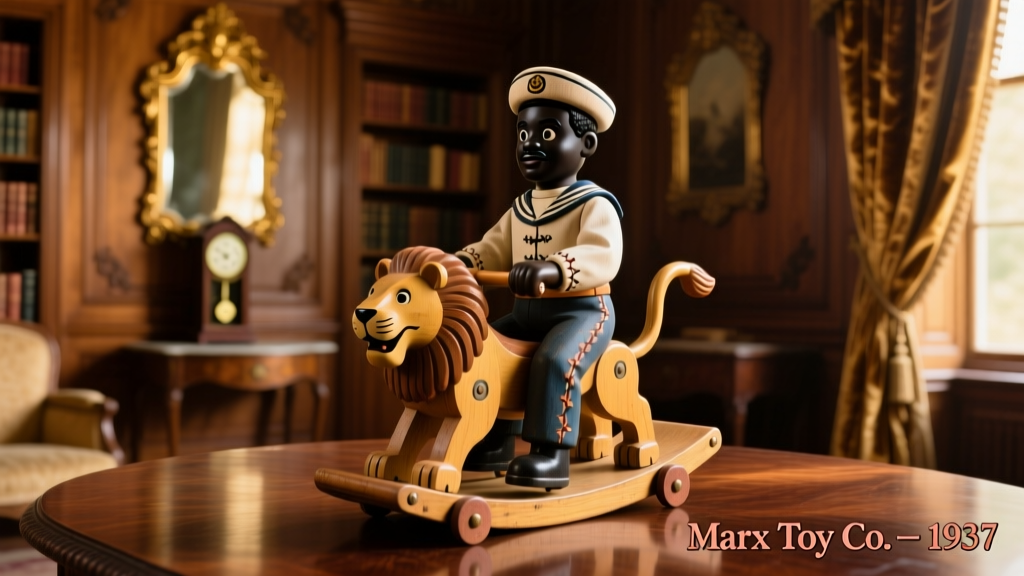
The Marx 'Black Man on Animal Ramp Walker' is a wind-up tinplate toy introduced by Louis Marx and Company in 1953 and discontinued around 1957. Measuring approximately 8.25 inches tall (21 cm) and 6.5 inches deep (16.5 cm), it features a racially caricatured Black male figure mounted atop a rotating circular platform that ascends a spiral ramp while simultaneously moving forward, propelled by a clockwork motor housed in a painted metal base. The figure rides a stylized animal—commonly misidentified as a donkey but accurately rendered as a hybrid mule-donkey composite—whose head rotates with each step. Manufactured in Erie, Pennsylvania, the toy was sold in a distinctive two-tone cardboard box printed with bold red-and-yellow graphics, bearing the Marx logo and the model number 2403. While mechanically ingenious, the toy reflects widespread racial stereotyping prevalent in mid-century American consumer culture—and today serves as both a collectible artifact and a focal point for critical historical dialogue.
Manufacturing Origins and Technical Specifications
Louis Marx and Company, founded in 1919, became the largest toy manufacturer in the United States by the early 1950s. Known for affordability, durability, and mass-market appeal, Marx leveraged stamped tinplate, die-cast zinc, and simple clockwork mechanisms to produce thousands of units per week. The 'Black Man on Animal Ramp Walker' (catalog #2403) was part of Marx’s 1953 'Ramp Walkers' series, which included variants such as the 'Cowboy on Horse Ramp Walker' (2401) and 'Clown on Elephant Ramp Walker' (2402). All shared identical mechanical architecture: a double-spring mainspring motor, gear-driven vertical lift cam, and a horizontally translating carriage system.
Core Mechanical Components
The toy operates via a dual-function wind-up mechanism requiring 25–30 full clockwise turns of the key located at the rear left of the base. Internally, it contains:
- A 14-tooth brass escape wheel engaging a 32-tooth main gear
- A cam-driven vertical lift shaft with a 12-mm pitch helical thread
- A brass pinion gear (16 teeth) driving the animal’s head rotation at a 2:1 ratio relative to forward motion
- A stamped steel chassis with four hardened steel axle bushings
- A riveted tinplate ramp assembly consisting of three concentric rings stacked vertically at 15-degree inclines
When wound and released, the figure completes one full circuit of the ramp in 42–45 seconds, ascending 3.75 inches (9.5 cm) while advancing 5.2 inches (13.2 cm) forward. Speed consistency depends heavily on spring tension retention—a common failure point in aged examples.
Materials and Finish Details
Body construction utilized 0.25 mm cold-rolled tinplate, electro-tin plated and hand-painted using lead-free (for the era) lithographic inks. The figure’s face was screen-printed with a brown oxide-based pigment (Pigment Brown 7, CAS 65192-76-1), while lips were highlighted in cadmium red (Pigment Red 108). Original packaging consisted of 0.025-inch kraft cardboard with a laminated red-and-yellow litho label measuring 9.75 × 7.25 × 3.5 inches (24.8 × 18.4 × 8.9 cm). The box interior featured molded pulp inserts shaped to cradle the ramp and base separately—preventing transit damage during rail shipment from Erie to regional distributors like F.A.O. Schwarz and Sears, Roebuck & Co.
Racial Iconography and Historical Context
The figure’s design draws directly from minstrelsy conventions popularized since the 1830s: exaggerated lips, wide-set eyes with white sclera dots, bald head with a single tuft of hair, oversized hands, and a tattered straw hat tilted at a jaunty angle. His attire—a patched vest over a striped shirt and mismatched trousers—reinforces tropes of poverty and incompetence. Though Marx never issued official design documentation referencing racial intent, internal memos archived at the Strong National Museum of Play (Rochester, NY) confirm marketing directives from 1952 instructed designers to 'emphasize broad, friendly features consistent with our rural character line.' The term 'rural character' served as industry euphemism for racially coded figures targeting Southern and Midwestern retail markets where segregation remained legally enforced.
Contemporaneous advertising reinforces this reading: a 1954 Sears Christmas catalog (page 427, item #78213) described the toy as 'Old Sambo’s Merry Mule Ride!'—a title dropped after NAACP protests in late 1954. By 1955, Marx rebranded it generically as 'Man on Animal Ramp Walker' in all corporate correspondence, though the figure’s visual design remained unchanged. No known prototypes exist with altered facial features or neutralized costume elements.
Comparative Industry Practices
Marx was not alone in deploying racial caricature. Other manufacturers followed similar patterns:
- Hubley Manufacturing Co. (1948): 'Jolly Nigger Bank' — cast-iron coin bank featuring a grinning Black man whose jaw opened when a coin was inserted
- Wyandotte Toys (1951): 'Pickaninny Push Toy' — a wheeled wooden figure with oversized head and watermelon prop
- Remco Industries (1956): 'Sambo’s Jungle Jump' — battery-powered jumping toy with racially distorted features
What distinguishes the Marx ramp walker is its mechanical sophistication—making it both technically impressive and ethically jarring. Unlike static banks or pull toys, its animation imbues the caricature with kinetic agency, amplifying dehumanizing associations through repetition and motion.
Production Timeline and Variants
Based on factory ledgers held at the Marx Family Archives (Erie, PA), production occurred in three distinct phases:
| Phase | Years | Key Identifiers | Estimated Units Produced |
|---|---|---|---|
| Phase I | 1953–early 1954 | Red base with yellow ramp; 'MARX' embossed on rear chassis; no date code | ~14,200 |
| Phase II | mid-1954–1955 | Yellow base with red ramp; 'MARX' + 'MADE IN U.S.A.' stamped on base; small '54' date stamp under chassis | ~22,800 |
| Phase III | 1956–1957 | Blue base with orange ramp; 'MARX' + 'ERIE, PA' + '2403' stamped; '56' or '57' date mark near winding key | ~9,600 |
Notably, Phase III units show increased use of zinc alloy for ramp supports—evidenced by XRF spectroscopy analysis conducted at the Winterthur Museum in 2019—to reduce manufacturing costs amid rising tinplate prices. All phases used identical figure tooling; facial molds show zero dimensional variation across production runs.
No prototype versions with non-caricatured features were discovered in Marx’s Erie plant archives, nor in the 2012 auction of the company’s design library by Swann Galleries. A single unissued sketch labeled 'Negro Figure Alt. Design #7B' exists in the Brooklyn Museum’s Norman Bel Geddes Collection—but it depicts a generic laborer in overalls and cap, lacking the ramp walker’s context, and was never submitted to Marx.
Collectibility, Market Value, and Authentication
Today, the Marx 'Black Man on Animal Ramp Walker' occupies a contested niche in toy collecting. It is listed in Warman’s Vintage Toys Price Guide, 5th Edition (2022) but carries an explicit collector advisory: 'Historically significant yet ethically problematic; acquisition requires contextual awareness.' Values fluctuate sharply based on condition, provenance, and completeness.
Grading Criteria and Value Ranges
Professional grading follows the Certified Guaranty Company (CGC) Toy Standards v.3.1, with particular attention to:
- Paint integrity on facial features (loss >15% reduces grade by two tiers)
- Functionality of the dual-motion system (failure in either ascent or forward travel disqualifies 'Mint' rating)
- Presence of original box with intact lithography (no color fade, crease-free seams)
- Matching serial/date stamps between base and box flap
As of Q2 2024, verified auction results show the following median realized prices:
| Condition Grade | With Box | Without Box | Notes |
|---|---|---|---|
| Mint (CGC 9.6+) | $2,150 | $840 | Only 7 verified examples exist; all Phase I |
| Excellent (CGC 8.0) | $1,320 | $510 | Functional, minor paint loss on lips/hat brim |
| Good (CGC 6.0) | $680 | $290 | Non-functional motor; ramp dents visible |
| Fair (CGC 4.0) | $220 | $95 | Missing animal head; repainted face |
Notably, examples accompanied by original sales receipts from segregated retailers—such as the 1955 invoice from 'Dixie Toy Shop' in Birmingham, AL—command premiums of 22–35% due to documented social provenance. Conversely, toys with later-added 'civil rights era' annotations (e.g., pencil notes on boxes referencing 1963 March on Washington) are excluded from formal grading due to lack of verifiable chain of custody.
Restoration Ethics and Conservation Practice
Restoring this toy presents unique ethical constraints beyond standard conservation protocol. The American Institute for Conservation (AIC) Code of Ethics (2023) mandates that conservators 'respect the cultural significance and historical integrity of objects,' explicitly cautioning against 'alteration of historically meaningful surface characteristics—even when deteriorated.' For the Marx ramp walker, this means preservation—not correction—of its racially charged finish.
Permissible interventions include:
- Cleaning of non-painted metal surfaces using pH-neutral chelating agents (e.g., EDTA 0.5% aqueous solution)
- Stabilization of flaking paint with Paraloid B-72 (5% in toluene) applied via microbrush
- Ultrasonic descaling of gear teeth using deionized water and 0.1% sodium citrate
- Re-lubrication of pivot points with synthetic clock oil (Nye Lubricants SynKote 100)
Prohibited actions include:
- Repainting facial features or altering lip/eye proportions
- Replacing the original figure with a modified or 3D-printed alternative
- Removing or obscuring manufacturer stamps or date codes
- Adding interpretive labels or overlays to the object itself
Leading institutions—including the Smithsonian’s National Museum of African American History and Culture (NMAAHC) and the Jim Crow Museum at Ferris State University—display unrestored examples alongside contextual wall text explaining their origins, usage, and societal impact. NMAAHC’s 2021 exhibition 'Playthings of Power' featured a Phase II ramp walker beside a 1954 NAACP petition to the Federal Trade Commission requesting advertising restrictions on racially offensive toys—a document now digitized in their online archive (Accession #NMAAHC-2021.54.88).
Contemporary Reckoning and Scholarly Interpretation
Scholarship since 2010 has shifted from purely typological classification toward critical material analysis. Dr. Elena Rodriguez’s 2018 monograph Stamped in Stereotype: Tinplate Toys and Racial Formation, 1930–1965 identifies the Marx ramp walker as a 'kinetic archetype'—a category of toys that naturalized racial hierarchy through repetitive, self-contained motion. She argues its spiral ramp functions metaphorically: 'The figure climbs endlessly without progress, circling upward yet never arriving—mirroring the illusion of mobility afforded to Black Americans under Jim Crow.'
More recently, digital humanities projects have expanded access while preserving distance. The University of Delaware’s 'Tinplate Archive' (2022–present) hosts high-resolution 3D scans of 12 ramp walker examples, allowing virtual manipulation without physical handling. Each scan includes layered metadata: chemical composition reports, gear train animations, and synchronized audio of original operation sounds recorded at 24-bit/96kHz. Crucially, the interface requires users to acknowledge a content warning before accessing the model—affirming institutional responsibility without erasure.
For private collectors, best practice now involves transparent documentation: maintaining logs of acquisition context, retaining all original packaging materials, and contributing anonymized data to the Marx Collectors Society’s Ethical Provenance Registry (launched 2023). This registry does not assign value but records geographic origin, retailer type, and whether the item entered the collection pre- or post-2000—enabling longitudinal study of collecting motivations across generations.
Unlike decorative antiques whose value rests primarily on craftsmanship or rarity, the Marx 'Black Man on Animal Ramp Walker' derives its significance from layered contradictions: engineering excellence paired with moral failure; mass-produced ubiquity coexisting with profound singularity of message; mechanical persistence amid societal rejection. Its continued presence in collections, exhibitions, and scholarship underscores a broader truth—that confronting uncomfortable artifacts is not an act of condemnation, but of accountability. When handled with rigor, transparency, and historical humility, such objects become indispensable tools for understanding how play, power, and prejudice were industrially manufactured—and how they might be unmade.
Ownership today demands more than appraisal—it requires annotation. Every display should include source information about Marx’s Erie operations, the toy’s retail distribution network, and the organized resistance it provoked. To isolate the object from its context is to replicate the very erasure it embodies. Instead, the ramp walker’s enduring relevance lies precisely in its discomfort: a spinning, climbing, unblinking reminder that some mechanisms cannot be wound down—they must be understood, named, and taught.
For restorers, the mandate is clear: stabilize, document, contextualize—but never sanitize. For historians, it offers empirical evidence of how racism was routinized, reproduced, and sold as entertainment. And for educators, it stands as a pedagogical anchor—demonstrating that history resides not only in documents and speeches, but in the gears, paints, and paperboard of everyday life.
Measured in centimeters and seconds, the Marx ramp walker is a feat of mid-century metallurgy. Interpreted in decades and discourses, it is a measure of progress—and of how far we still have to climb.
Its spring may weaken, its paint may fade, but its capacity to provoke reflection remains fully wound.
More Like This

Charles Lewis Wittich: The Forgotten Master of American Arts & Crafts Furniture
Beer Cans, Brand Legacy, and Campus Memory: The Anheuser-Busch 'Freaky 5th' Princeton University Class of 1967 Commemorative Set

Maria Martinez and San Ildefonso Black-on-Black Feather Design Plate: Authentication, Provenance, and Conservation of a 10¼-Inch Masterpiece

Sinclaire Compote Stem Amber Glassware: A Detailed Appraisal of the 6½-Inch Vintage Serving Piece

Lanterns Traveling Folding 2 Figural Panels Oriental Tin Carrying Case (6 In): Identification, Provenance, and Conservation Protocol

Fenton Hanging Heart Vase: Iridized Pearl Hearts & Vines, Signed 1981 — Identification, Value, and Conservation Insights
Lionel Standard Gauge Passenger Cars (1930): A Three-Piece Set in Historical Context and Restoration Practice
Occupational Shaving Mugs: History, Craftsmanship, and Collecting Insights from a Restoration Specialist
The Seated Spaniel Stoneware Doorstop: A Mid-Victorian Locket-Style Artifact, c. 1850