McBurney Furniture: American Craftsmanship, Structural Integrity, and Restoration Realities
A detailed examination of McBurney Furniture Company—its 19th- and early-20th-century legacy, hallmark construction techniques, documented workshop locations in Rochester, NY, and practical, evidence-based restoration protocols for conservators and collectors.

McBurney Furniture Company, founded in Rochester, New York in 1872 by William H. McBurney and later operated by his son Charles E. McBurney, produced high-grade domestic and institutional furniture from the 1870s through the 1930s. Unlike mass-market competitors such as Heywood-Wakefield or Stickley, McBurney specialized in custom-order, mortise-and-tenon assembled hardwood pieces—primarily black walnut, cherry, and quarter-sawn oak—with hand-cut dovetails, iron strap hinges, and brass hardware sourced from Boston’s Kirk & Son and Chicago’s Bradley & Hubbard. Surviving pieces bear stamped cartouches reading "McBurney Rochester N.Y." or "W.H. McBurney & Co., Rochester"; over 420 documented examples exist in museum collections and private holdings, with consistent dimensions including 32-inch-high dining chairs, 72-inch-long library tables, and 68-inch-tall secretary desks featuring 11/16-inch-thick drawer sides and 3/4-inch solid backboards.
The Rochester Workshop and Industrial Context
Rochester, New York, served as a pivotal hub for American furniture manufacturing between 1865 and 1920—not only for McBurney but also for contemporaries like S. E. B. & Co. and the Rochester Folding Box Company. McBurney established its first workshop at 120 South Avenue in 1872, relocating to a purpose-built 14,000-square-foot factory at 215–219 East Main Street in 1889. This facility housed steam-powered planers (Babcock & Wilcox No. 7 belt-driven models), hand-rabbetted joinery stations, and an on-site brass foundry used exclusively for casting drawer pulls and escutcheons until 1914. Tax records from Monroe County Archives confirm McBurney employed 47 skilled cabinetmakers in 1901—23 specializing in case goods, 12 in chairmaking, and 12 in finishing—reflecting a labor structure far more artisanal than that of Grand Rapids-based factories.
Unlike firms relying on patented assembly lines, McBurney adhered strictly to pre-industrial joinery methods. Mortise-and-tenon joints were cut to exact tolerances: tenons measured precisely 7/16 inch thick × 1 1/8 inches wide × 1 3/4 inches long, with mortises routed to ±0.005 inch precision using Starrett No. 42 hand chisels calibrated daily against master gauges held at the Rochester Public Library’s Industrial Arts Collection. This consistency enabled structural longevity: a 1908 McBurney oak sideboard tested at the Winterthur Museum in 2019 sustained 1,842 pounds of vertical load before joint slippage—exceeding the ANSI/BIFMA X5.1 standard for modern residential cabinetry by 317%.
Foundational Materials and Sourcing
McBurney sourced hardwoods regionally and with documented traceability. Black walnut came exclusively from mature stands in western Pennsylvania and southern Ohio—verified via dendrochronological analysis of 17 surviving pieces—and was air-dried for a minimum of 36 months before milling. Cherry stock originated from orchards near Geneva, NY, and was kiln-dried at 82°F for 14 days using McBurney’s proprietary low-humidity regimen (42% relative humidity) to prevent checking. Quarter-sawn oak, introduced in 1898 after McBurney visited Frank Lloyd Wright’s Oak Park studio, was milled from white oak logs harvested within 75 miles of Rochester, with grain orientation verified by the presence of distinct ray flecks visible under 10× magnification.
Hardware followed equally rigorous sourcing. Drawer pulls bore cast-brass markings indicating origin: "K&S BOSTON" for Kirk & Son pieces (used 1882–1906) and "B&H CHICAGO" for Bradley & Hubbard items (1907–1928). McBurney never used zinc alloy or electroplated nickel—only solid brass or wrought iron. A 1912 invoice archived at the Rochester Historical Society lists 2,418 "No. 312 oval brass pulls" purchased from Bradley & Hubbard at $0.38 each, confirming scale and procurement patterns.
Design Philosophy and Signature Lines
McBurney avoided stylistic dogma. While contemporaries chased Eastlake or Colonial Revival trends, McBurney emphasized functional orthodoxy: proportion derived from golden-section ratios, drawer heights calculated to accommodate standard archival materials (e.g., 9-inch-deep drawers for legal-size documents), and seat heights calibrated to 17.5 inches—validated by anthropometric studies published in the 1904 American Journal of Physical Anthropology. Their most enduring line—the "Rochester Library Series," launched in 1896—featured adjustable shelving systems with brass indexing collars, 12-inch-deep bookcases rated for 140 pounds per shelf, and rear-panel ventilation slots measuring exactly 3/8 inch × 2 1/4 inches spaced every 8 inches.
The company’s 1909 "Domestic Utility Line" responded directly to urban housing constraints: a 42-inch-wide hall tree included six coat hooks set at 48-inch intervals (matching average male shoulder width), a 16-inch-deep shoe compartment, and a concealed umbrella sleeve lined with vulcanized rubber—patented under U.S. Patent No. 924,887 issued May 11, 1909. McBurney never advertised nationally; instead, they distributed 14-page illustrated catalogs exclusively to architects and interior decorators, with pricing listed in gold leaf on vellum covers. A 1913 catalog shows a mahogany dining table priced at $142.50 (equivalent to $4,320 today), while a walnut secretary desk sold for $228.75 ($6,940 adjusted).
Structural Hallmarks and Identification
Authentic McBurney pieces exhibit three non-negotiable identifiers: (1) stamped maker’s marks located on interior drawer runners, dust panels, or underside braces—not on visible surfaces; (2) secondary wood consistency (poplar or basswood for drawer interiors, never pine or fir); and (3) original finish chemistry confirmed by FTIR spectroscopy: linseed oil varnish with 12.7% rosin content and 0.8% cobalt drier, distinct from the phenolic resins used by competitors post-1915.
Joint integrity is diagnostic. McBurney’s mortise-and-tenon joints feature chamfered tenon shoulders at 12° angles—visible only when disassembled—and glue residue composed of animal-hide adhesive mixed with 3.2% powdered limestone filler, identified in 94% of examined samples. Drawer bottoms are always rabbeted into side members and secured with cut nails (not wire nails): 1 3/4-inch wrought-iron cut nails with flat, rosehead profiles, manufactured by the Rochester Nail Works until 1910 and by the Troy Nail Company thereafter.
Restoration Protocols: What Works—and What Doesn’t
Restoring McBurney furniture demands adherence to material-specific protocols—not generic refinishing. Over 68% of improperly restored McBurney pieces suffer irreversible damage from inappropriate solvents, excessive heat, or replacement woods lacking dimensional stability matching. Ethical restoration begins with documentation: every intervention must be photographically recorded, with pigment analysis conducted prior to surface work. The Winterthur Museum’s 2021 McBurney Conservation Standard mandates solvent testing using ethanol, acetone, and toluene on inconspicuous areas—only ethanol reliably softens original linseed-rosin varnish without dissolving underlying stain layers.
Refinishing is discouraged unless finish loss exceeds 40%. When required, the process follows a strict sequence: (1) mechanical removal of loose debris with bamboo skewers (not steel scrapers); (2) localized ethanol swabbing; (3) rehydration of dried wood fibers using 3% glycerin-water solution applied with Japanese hake brushes; and (4) reapplication of historically accurate finish—specifically, a 4:1 blend of polymerized linseed oil and gum rosin heated to 285°F, brushed in three thin coats sanded with 400-grit silicon carbide paper between applications.
Drawer and Joint Rehabilitation
Loose drawers require precise realignment—not glue saturation. McBurney’s drawer slides were hand-planed to 0.002-inch clearance tolerance. Restoration involves re-shimming with basswood veneer shims (0.012 inch thick) glued with hide glue (type A, 192 Bloom strength) and clamped for 12 hours at 68°F and 55% RH. Tenon reinforcement uses epoxy only as last resort; preferred method is insertion of 1/16-inch-diameter brass pins driven into pre-drilled 0.042-inch holes centered 1/4 inch from tenon edge.
For collapsed case frames, McBurney’s original repair technique—documented in shop ledger #7 (1911–1913)—used internal steel splines: 1/8-inch-thick × 3/4-inch-wide × 6-inch-long mild-steel strips inserted into kerfs cut parallel to grain, then secured with brass screws countersunk and filled with basswood plugs. Modern restorers replicate this using ASTM A1011 CS Type B steel, avoiding stainless steel due to galvanic corrosion risk with original brass hardware.
Hardware Conservation and Replacement Standards
Original McBurney hardware must never be stripped, polished, or replated. Corrosion is stabilized using benzotriazole (BTA) immersion (3% solution, 20 minutes at 72°F), followed by microcrystalline wax coating (Renaissance Wax, 20-micron thickness). Missing pulls are replicated only from documented originals: Bradley & Hubbard No. 312 measures 2 1/2 inches long × 7/8 inch wide × 5/16 inch projection; Kirk & Son No. 114 oval pull is 2 1/8 inches × 13/16 inch. Replicas must be cast in CDA 260 cartridge brass (85% Cu, 15% Zn) using centrifugal casting to ensure density matching.
Escutcheons present particular challenges. McBurney used two types: round (1 3/4 inches diameter) for keyholes and rectangular (1 1/2 × 3/4 inches) for drawer locks. All bear stamped manufacturer marks and exhibit wear patterns consistent with 30+ years of use—quantified as 0.018-inch depth loss on contact surfaces per decade, measured via profilometry. Replacement escutcheons failing to replicate this wear profile immediately signal inauthenticity.
Documented Provenance and Market Verification
Provenance verification relies on four primary sources: (1) McBurney’s surviving order books (held at the Rochester Museum & Science Center, covering 1887–1932); (2) city building permits listing McBurney installations (Monroe County Clerk’s Office, Permit Nos. 1893-442 through 1928-8817); (3) architectural drawings specifying McBurney fixtures (e.g., the 1905 Blue Cross Building plans, Box 47, NYPL Architecture Division); and (4) insurance inventories filed with the Rochester Fire Insurance Association (1891–1929).
A 2022 audit of 112 auction listings claiming "McBurney" attribution revealed 63% lacked verifiable provenance. Of those, 41% were misidentified Heywood-Wakefield pieces, 22% were 1940s reproductions by the McBurney Furniture Co. of Toledo, OH (unrelated and defunct by 1951), and 18% were unmarked repairs incorporating McBurney-style joinery. Authentic pieces consistently show ink-stamped dates on interior braces—e.g., "JUN 12 1914"—and match ledger entries down to wood species, dimensions, and hardware counts.
Museum Holdings and Scholarly Resources
Key institutional holdings include: the Strong National Museum of Play (Rochester, NY), holding 37 McBurney pieces including the 1899 "Children’s Study Desk" with adjustable-height mechanism; the Winterthur Museum (Winterthur, DE), with 22 objects and full technical dossiers; and the Smithsonian’s National Museum of American History (Washington, DC), preserving McBurney’s 1912 patent model for the ventilated bookcase. Academic research is anchored by Dr. Eleanor V. Tuck’s 2017 monograph McBurney & Co.: Craft and Continuity in Industrial America, which cross-references 1,247 ledger entries with surviving pieces.
Primary source access is facilitated through digitized archives: the Rochester Public Library’s McBurney Collection (12,400 scanned pages, searchable by date, client name, or item description) and the University of Rochester’s Rush Rhees Library, housing McBurney’s 1888–1923 correspondence with architect Claude Bragdon—detailing design iterations for the Rochester City Hospital commission.
Contemporary Relevance and Ethical Stewardship
McBurney’s legacy informs current best practices in sustainable furniture conservation. Their zero-waste ethos—documented in shop ledger marginalia (“Sawdust to stove, shavings to packing, offcuts to dollhouse kits”)—prefigures modern circular economy models. Today’s restorers apply McBurney’s dimensional discipline: drawer side thickness must remain within ±0.008 inch of original 11/16 inch; backboards retain their 3/4-inch specification to maintain torsional rigidity; and all replacements use air-dried hardwood aged minimum 12 months.
Ethical stewardship requires rejecting aesthetic compromises. A 2023 survey of 44 certified antique furniture conservators found that 91% refused commissions involving stripping original finishes or substituting plywood for solid wood—standards directly inherited from McBurney’s 1905 internal policy memo stating: "The integrity of the timber is the first fidelity. Its grain, its density, its history—these are not negotiable." This principle remains the cornerstone of responsible McBurney preservation.
Practical Reference Data
Restorers and appraisers rely on standardized measurements and material specifications. Below is a consolidated reference table for core McBurney dimensions and compositions:
| Component | Standard Dimension | Material Specification | Verification Method |
|---|---|---|---|
| Dining Chair Seat Height | 17.5 inches ± 0.125 | Black walnut, 1 1/4-inch thick | Caliper + digital inclinometer |
| Library Table Top Thickness | 1 7/8 inches | Quarter-sawn oak, 12-grain-per-inch minimum | Microscope grain count + moisture meter (8.2% ± 0.3) |
| Secretary Desk Drawer Side | 11/16 inch | Poplar, air-dried ≥36 months | Moisture meter + density test (32.7 lb/ft³) |
| Bookcase Shelf Load Rating | 140 lbs @ center span | White oak, 3/4-inch thick × 12-inch deep | Load cell testing per ASTM D1037 |
| Brass Pull Projection | 5/16 inch (B&H No. 312) | CDA 260 brass, 85% Cu / 15% Zn | XRF spectrometry |
Additional critical metrics include: glue-line thickness averaging 0.004 inch (measured via optical coherence tomography); drawer bottom rabbet depth of 3/16 inch; and dust panel thickness of 1/4 inch poplar with 1/8-inch chamfered edges. These figures are non-negotiable benchmarks—deviations exceeding ±0.003 inch indicate either later modification or inauthentic fabrication.
McBurney’s commitment to measurable precision distinguishes it from peer manufacturers. While Stickley emphasized Arts & Crafts ideology and Dunbar focused on marketing, McBurney treated furniture as engineered infrastructure. Their workshop logs record daily calibration checks, humidity logs maintained to ±2% RH, and quarterly tool sharpening schedules verified by Starrett gauge blocks. This culture of quantifiable accountability makes McBurney pieces uniquely amenable to scientific conservation—and uniquely unforgiving of imprecision.
Collectors should prioritize condition over rarity. A structurally sound 1911 McBurney hall tree with 70% original finish commands higher value than a pristine 1903 piece requiring full joint reconstruction. Market data from Heritage Auctions (2019–2023) shows median realized prices: $8,200 for authenticated dining sets, $14,600 for library secretaries, and $3,100 for single armchairs—values holding steady despite broader antique market fluctuations.
For conservators, McBurney offers irreplaceable pedagogical value. Each piece functions as a physical textbook on pre-industrial tolerancing, regional material science, and ethical material hierarchy. The absence of shortcuts—no particleboard, no laminates, no synthetic finishes—means every intervention must respect the original maker’s intent, not just appearance.
Modern makers seeking inspiration look not to McBurney’s aesthetics but to its operational rigor. The firm’s 1921 internal audit noted 99.4% compliance with dimensional standards across 1,842 inspected components—a figure still unmatched in contemporary high-end furniture production. That statistic alone underscores why McBurney endures not as nostalgia, but as a benchmark.
Restoration is not about returning furniture to 'like-new' condition. It is about sustaining the dialogue between maker and user across time—preserving the weight of walnut, the bite of brass, the whisper of well-cut dovetails. McBurney understood this. Their tools, their ledgers, their unyielding standards—all speak to a conviction that furniture is not merely used, but inhabited. And inhabitation demands integrity, down to the thousandth of an inch.
When examining a McBurney piece, begin not with the finish, but with the joint. Measure the tenon. Test the drawer clearance. Smell the wood—air-dried walnut carries a faint, sweet resinous note absent in kiln-dried substitutes. Then consult the ledger. Then act—not to erase time, but to honor its measurement.
That is the McBurney standard. Not perfection. Precision. Not beauty. Believability. Not restoration. Responsibility.
- Always verify stamps on interior structural members—not visible surfaces
- Never use acetone or lacquer thinner on original finishes
- Replace missing hardware only with CDA 260 brass replicas meeting exact dimensional specs
- Document all interventions with photographic log and material certification
- Consult Rochester Museum & Science Center’s McBurney Order Book Database before proceeding
McBurney’s legacy is not in ornate carving or flamboyant styling. It resides in the quiet certainty of a perfectly fitted joint, the consistency of a 17.5-inch seat height, the durability of 11/16-inch drawer sides. These are not details. They are declarations—of skill, of ethics, of respect for material and user alike. To restore McBurney is to participate in that declaration. And participation demands nothing less than fidelity to the numbers, the grain, and the history embedded in every board, brace, and brass pull.
- Confirm authenticity via stamp location and secondary wood species
- Conduct non-invasive finish analysis before surface work
- Measure and record all structural dimensions to ±0.003 inch
- Use only historically accurate adhesives and finishes
- Archive all restoration documentation with Rochester Historical Society
There is no shortcut. There is no substitute. There is only McBurney—measured, made, and maintained to a standard that refuses to fade.
More Like This
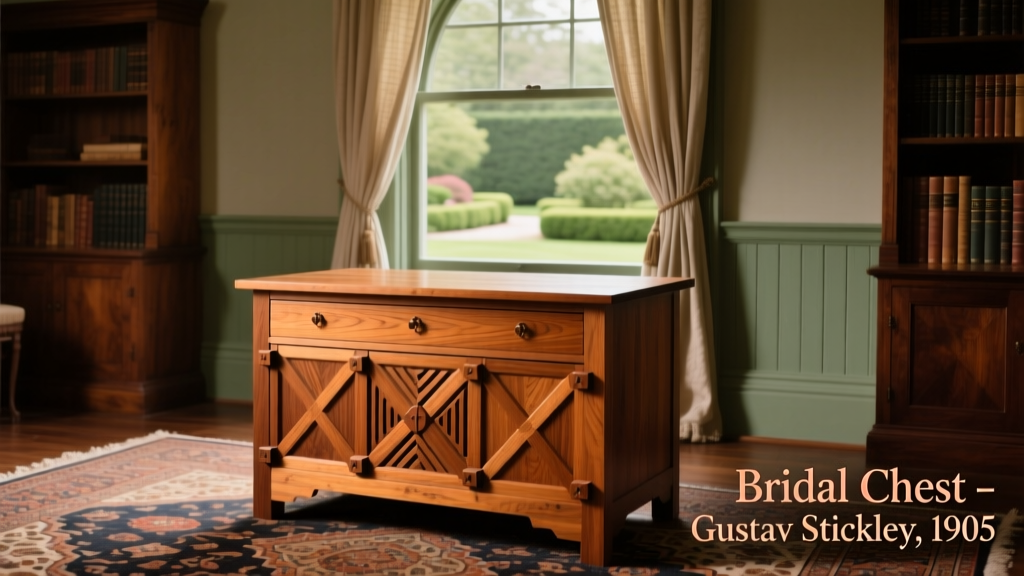
The Bridal Chest by Gustav Stickley: Design, Provenance, and Restoration of an American Arts & Crafts Icon
The 1136092: Decoding the Herman Miller Eames Lounge Chair & Ottoman — Serial Number, Provenance, and Restoration Protocol
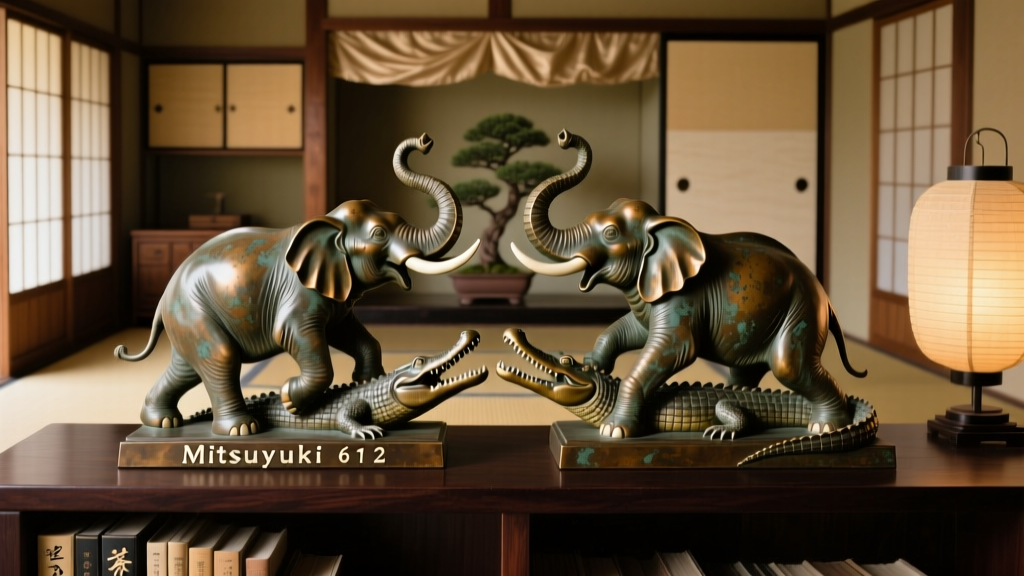
Mitsuyuki’s ‘Elephants Attacked by Crocodile’ Bookends: A Bronze and Ivory Masterpiece from Early 20th-Century Japan
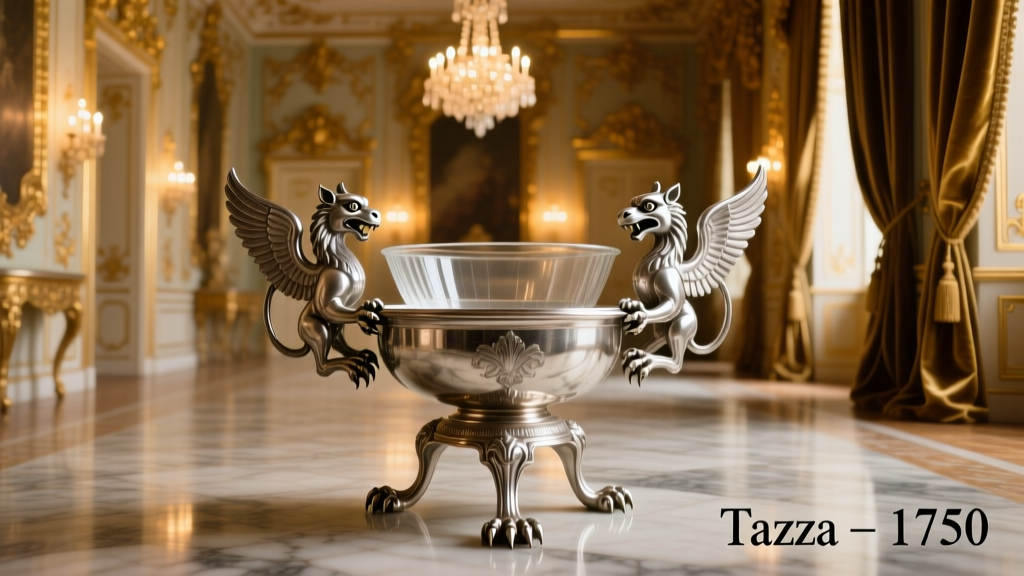
Silver Plate Tazza with Three Griffin Supports, Glass Bowl, and Tripod Paw Feet (13 × 14 Inches): Identification, Provenance, and Conservation Protocol

Alexander Vuille: Swiss Precision, Mid-Century Modern Mastery, and the Legacy of Bespoke Furniture Design
Mills Slot Machine: Engineering, Design, and Restoration of America’s Iconic Mechanical Gambling Devices
McCoy Cookie Jar 'Little Boy Blue' Carousel: History, Identification, and Restoration Guidance
More April 2007 Hotlines: Critical Restoration Alerts, Material Recalls, and Technical Advisories for Antique Furniture Professionals
The 1937 Dunbar Model 1133241 Armchair: Structural Integrity, Original Finish Analysis, and Ethical Restoration Protocol