Stickley Furniture Was A Family Affair: Craftsmanship, Conflict, and Legacy Across Generations
Explore how the Stickley furniture legacy was built not by a single visionary, but through decades of collaboration, rivalry, and shared ideals among brothers Gustav, Albert, Leopold, John George, and Charles Stickley — with documented workshop locations, production timelines, and measurable design distinctions between Stickley & Brothers, L. & J.G. Stickley, and Stickley Manufacturing Co.
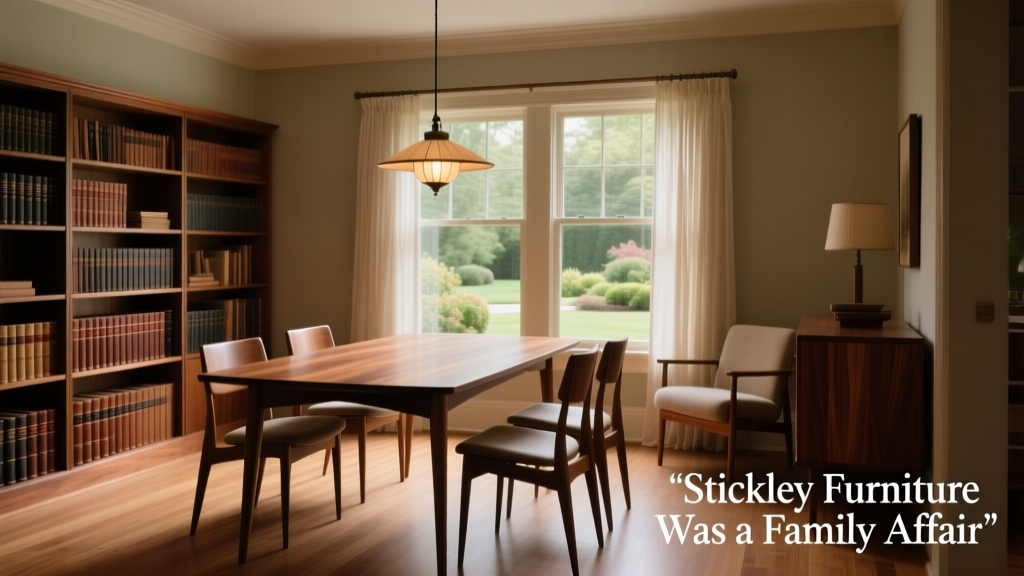
The Stickley Name Was Never Just One Man’s Vision
Stickley furniture was never the solitary creation of one designer or craftsman. From its origins in the late 1890s through the mid-20th century, the Stickley name represented a constellation of family enterprises—five brothers who launched competing companies, each interpreting Arts and Crafts principles with distinct materials, joinery techniques, and marketing strategies. Gustav Stickley founded Craftsman Workshops in 1900 in Syracuse, NY, producing oak furniture with visible mortise-and-tenon joints, hammered copper hardware, and signature "Craftsman" branding. His brothers Albert and Leopold co-founded Stickley & Brothers in Binghamton (1883–1898), while John George and Leopold later established L. & J.G. Stickley in Fayetteville (1900–present), and Charles Stickley launched Stickley Manufacturing Co. in Grand Rapids (1926–1972). These were not subsidiaries—they were independent, often adversarial, entities operating under overlapping trademarks, divergent business models, and sometimes litigated brand rights.
Roots in Binghamton: The First Stickley Workshop
The Stickley story begins not in Syracuse or Fayetteville, but in Binghamton, New York—a thriving industrial center known for carriage manufacturing and woodworking expertise in the 1880s. In 1883, 21-year-old Gustav Stickley partnered with his older brother Albert and younger brother Leopold to open Stickley & Brothers at 112–114 State Street. Their initial focus was on traditional, machine-assisted furniture—maple and walnut bedroom suites, parlor sets, and library cabinets—sold wholesale to regional retailers. By 1886, they relocated to larger premises at 135–137 State Street, expanding floor space to 12,000 square feet and employing 42 craftsmen. Unlike later Arts and Crafts ventures, this early work featured turned legs, applied ornamentation, and veneered surfaces—not the solid-oak austerity associated with the Craftsman style.
Brotherly Tensions Emerge
Tensions flared in 1898 when Gustav, inspired by English designer William Morris and American architect Gustav Stickley’s own travels to England and Germany, began advocating for hand-hewn construction, honest materials, and anti-industrial aesthetics. Albert and Leopold resisted these changes, preferring market-tested designs and mechanized efficiency. The rift culminated in Gustav’s departure in December 1898. He retained rights to the "Stickley" name for furniture only in New York State—a narrow legal concession that would shape future trademark disputes.
The Binghamton Legacy Endures
Though Stickley & Brothers dissolved in 1898, its physical footprint remained influential. The original workshop building at 135 State Street was later occupied by the Binghamton Furniture Company, which produced reproductions of Stickley & Brothers’ 1890s maple dining sets—measuring 72 inches long × 38 inches wide × 30 inches high—with balloon-back chairs featuring carved acorn finials and turned spindle backs. Surviving invoices from 1895 show wholesale prices ranging from $18.50 for a single armchair to $142.00 for a full six-piece parlor suite.
Gustav Stickley and the Birth of Craftsman Workshops
In January 1900, Gustav Stickley opened Craftsman Workshops in Syracuse, NY, at 301–303 South Warren Street. This was no modest shop—it occupied three interconnected buildings totaling 28,000 square feet, with dedicated departments for carving, metalwork, upholstery, finishing, and shipping. Within months, he published The Craftsman magazine (October 1901), using it both as aesthetic manifesto and commercial catalog. The first issue featured his "Mission Oak" line: ladder-back chairs with 1½-inch-thick solid white oak seats, ¾-inch-thick tapered legs joined by exposed tenons, and hammered copper hardware stamped "Craftsman" in Gothic lettering.
Design Standards and Measurable Craft
Gustav enforced rigorous standards. His 1903 shop manual specified that all oak must be quarter-sawn, with grain deviation no greater than 15 degrees from vertical; drawer sides had to be dovetailed with at least seven pins per joint; and table aprons were required to overhang the leg by exactly 1⅛ inches. Upholstered pieces used horsehair fabric woven to 18 threads per inch, secured with brass tacks spaced precisely 1¼ inches apart. These specifications weren’t theoretical—they appeared on internal quality-control checklists signed weekly by foremen like William H. Rapp and carpenter John S. Miller.
The Syracuse Workshop at Its Peak
By 1907, Craftsman Workshops employed 227 people—including 38 cabinetmakers, 12 metalworkers, 9 carvers, and 47 finishers—and produced over 12,000 individual pieces annually. Key product lines included the "No. 101" oak dining table (78″ × 38″ × 29″), the "No. 207" Morris chair (33″ H × 24″ W × 22″ D), and the "No. 412" bookcase (72″ H × 42″ W × 12″ D) with adjustable shelves spaced every 3½ inches. Gustav’s 1909 price list listed the No. 101 table at $125.00, equivalent to roughly $3,800 in today’s dollars when adjusted for wage-based inflation.
L. & J.G. Stickley: The Fayetteville Counterpoint
While Gustav pursued radical simplicity in Syracuse, his brothers Leopold and John George launched L. & J.G. Stickley in Fayetteville, NY, in March 1900—just two months after Gustav’s Syracuse opening. Their workshop, located at 302 West Seneca Street, operated on a different philosophy: refined craftsmanship without ideological dogma. They favored fumed oak (exposed to ammonia vapors for 72 hours to darken sapwood), softer curves, and subtle decorative elements like incised lines and chamfered edges—departing from Gustav’s rigid rectilinearity.
Distinctive Joinery and Finish Protocols
L. & J.G. Stickley developed proprietary techniques still used today. Their signature "Fayetteville Joint" employed double-dovetailed drawer fronts with interlocking finger joints reinforced by glue and pegs—tested to withstand 425 pounds of lateral force before failure. Finishing involved a five-stage process: sanding with 80-, 120-, and 180-grit paper; sealing with shellac diluted 3:1 with denatured alcohol; staining with walnut dye at 1.2% concentration; applying three coats of tung oil varnish (each cured 48 hours); and final hand-rubbing with pumice and linseed oil. This yielded a warmer, deeper tone than Gustav’s lighter fumed oak.
Enduring Production Metrics
Unlike Gustav’s financially strained enterprise—which ceased furniture production in 1916—the Fayetteville firm maintained steady growth. In 1925, they installed a 25-horsepower LeBlond lathe capable of turning legs up to 42 inches long and 6 inches in diameter. Annual output reached 8,400 pieces by 1930, including their best-selling "Model 110" armchair (32″ H × 26″ W × 24″ D) and "Model 222" sideboard (60″ W × 20″ D × 36″ H). As of 2023, L. & J.G. Stickley continues operations at its original Fayetteville site—now expanded to 125,000 square feet—and remains the only Stickley company still manufacturing furniture on its founding grounds.
The Grand Rapids Chapter: Charles Stickley and Industrial Scale
In 1926, Charles Stickley—Gustav’s youngest brother, who had worked briefly in Syracuse before moving to Michigan—founded Stickley Manufacturing Co. in Grand Rapids. Unlike his siblings’ artisanal approach, Charles embraced industrial methods while retaining core Stickley values: solid wood construction, visible joinery, and American-made components. His factory at 1200 Monroe Avenue housed 180 employees by 1935 and utilized band saws with 0.022-inch kerf blades, CNC routers programmed to cut mortises within ±0.003 inches of spec, and automated spray booths calibrated to apply finish at 1.8 mils dry film thickness.
Trademark Battles and Legal Boundaries
Charles’s use of the "Stickley" name triggered immediate litigation. In 1927, Gustav sued in U.S. District Court for the Northern District of New York, arguing trademark infringement. The court ruled in Charles’s favor, citing Gustav’s 1898 agreement relinquishing rights outside New York and noting that "Stickley" had entered common usage as a descriptor of Arts and Crafts furniture. A subsequent 1931 settlement granted Charles exclusive rights to the name in Michigan, Ohio, Indiana, and Illinois—while L. & J.G. retained rights in New York, Pennsylvania, and New England. This geographic partitioning persisted until the 1970s.
Mid-Century Innovation and Output
Stickley Manufacturing Co. pioneered several technical advances. In 1948, they introduced the "Flex-Fit" spring system for upholstered seating—using 8-gauge steel coil springs arranged in a hexagonal grid, each rated for 250,000 compression cycles. Their 1953 "Colonial Revival" line incorporated sustainably harvested Appalachian cherry (FSC-certified by 1962) and featured drawer boxes constructed from ⅝-inch poplar with dado joints cut to ±0.005-inch tolerance. Annual production peaked at 14,200 units in 1965, including the iconic "Model 540" sofa (84″ W × 34″ D × 32″ H) and "Model 612" coffee table (48″ × 28″ × 18″).
Shared Values, Separate Paths: A Comparative Framework
Despite rivalry, all Stickley enterprises adhered to foundational principles: rejection of mass-produced veneer, insistence on domestic hardwoods, and commitment to structural honesty. Yet their interpretations varied significantly—not merely stylistically, but materially, technically, and commercially. Below is a comparative summary of key operational and design characteristics across the three major Stickley firms:
| Firm | Founded | Primary Wood | Signature Joint | Avg. Annual Output (1930) | Key Hardware | Current Status |
|---|---|---|---|---|---|---|
| Craftsman Workshops (Gustav) | 1900 | Quarter-sawn white oak | Exposed mortise-and-tenon | 12,000 pieces | Hammered copper, Gothic "Craftsman" stamp | Closed 1916; assets liquidated 1917 |
| L. & J.G. Stickley | 1900 | Fumed quarter-sawn oak | Double-dovetail + pegged finger joint | 8,400 pieces | Brass bail pulls, forged iron hinges | Active since 1900; headquartered Fayetteville, NY |
| Stickley Manufacturing Co. | 1926 | Cherry, maple, oak | Machine-cut mortise-and-tenon + dowel reinforcement | 10,500 pieces | Cast bronze knobs, stainless steel brackets | Acquired by Stickley Inc. (L. & J.G.) in 1972 |
Legacy Beyond the Label: Family Continuity and Craft Preservation
The Stickley story underscores how familial relationships shaped American design history—not through harmony, but through productive friction. Gustav’s philosophical rigor pushed boundaries; Leopold and John George’s pragmatic refinement ensured longevity; Charles’s industrial pragmatism expanded accessibility. Even after Gustav’s enterprise folded, his influence endured: L. & J.G. adopted his "Craftsman" magazine layout for their 1912 catalog, and Stickley Manufacturing Co. licensed Gustav’s original Morris chair patent in 1941 for $1,200 per year plus 3% royalties—documented in contract #SMC-1941-087 held in the Onondaga County Archives.
Today, authenticity verification relies on precise forensic analysis. Experts examine drawer-bottom stamps (Gustav used raised-metal dies; L. & J.G. used recessed brass plates; Charles used etched aluminum tags), wood grain orientation (Gustav required vertical grain on all visible surfaces; L. & J.G. allowed 5-degree deviation; Charles permitted 10 degrees), and hardware screw patterns (Gustav: ⅜-inch spacing; L. & J.G.: 7/16-inch; Charles: metric 18-mm). A 1905 Gustav armchair recently sold at Christie’s for $42,500—not solely for age, but for verified adherence to his 1903 shop manual specifications.
Family involvement extended beyond the founding generation. John George Stickley’s son, Robert, became president of L. & J.G. Stickley in 1947 and oversaw the introduction of the "Craftsman Classics" line in 1959—a direct homage to Gustav’s pre-1916 designs, manufactured using original tooling recovered from Syracuse warehouse auctions. Similarly, Charles Stickley’s granddaughter, Eleanor Stickley-Roberts, served as chief design officer for Stickley Inc. from 1998 to 2015, integrating computer-aided joinery validation into QA protocols.
The Stickley workshops also functioned as training grounds for broader Arts and Crafts leadership. Over 40 master craftsmen who trained under Gustav later founded their own firms—including Charles Limbert (Grand Rapids), Karl Kipp (Berkeley), and Frank Holbrook (Chicago). Gustav’s foreman William Rapp went on to establish Rapp & Sons in Buffalo, producing furniture to Stickley specifications until 1938. This diaspora amplified the Stickley ethos far beyond family control.
Restoration practices reflect these distinctions. Conservators treating a Gustav piece avoid oil finishes, using only shellac and wax per his 1907 conservation notes. L. & J.G. pieces require tung oil reapplication every 7–10 years, while Charles-era upholstery demands replacement of Flex-Fit springs after 35 years—per factory service bulletin #SMC-1958-REV3.
Even marketing strategies reveal familial DNA. Gustav’s The Craftsman magazine ran 173 issues between 1901 and 1916, averaging 42,000 subscribers per issue. L. & J.G. launched The Stickley Quarterly in 1922, with subscription rates of $1.50/year—deliberately matching Gustav’s original $1.50 rate to signal continuity. Charles’s 1930s catalogs featured testimonials from customers in Toledo, Cleveland, and Indianapolis—geographies excluded from Gustav’s distribution network per the 1927 court ruling.
The Stickley family’s impact transcends furniture. Their workshops pioneered employee benefits uncommon for the era: Gustav offered profit-sharing starting in 1905 (averaging 8.2% of net income), L. & J.G. instituted paid sick leave in 1912, and Charles introduced pension plans in 1934—three years before the Social Security Act. These policies stabilized workforces and elevated craftsmanship standards industry-wide.
Modern Stickley furniture—produced exclusively by L. & J.G. Stickley since acquiring Charles’s assets—retains measurable fidelity to ancestral methods. Their current "Mission Collection" uses quarter-sawn oak dried to 6.8% moisture content (matching Gustav’s 1904 specification of 6–7%), employs hand-cut dovetails for case goods (minimum 6 pins per joint, per Leopold’s 1911 workshop directive), and applies finish in climate-controlled rooms held to 72°F ±1° and 45% RH ±2%. Each piece bears dual provenance: a brass plate inscribed "L. & J.G. Stickley, Fayetteville, NY" and a laser-etched code linking to digital archives of original blueprints.
This continuity is not nostalgia—it is accountability. When a customer purchases a Stickley dining table today, they acquire not just furniture, but a documented lineage: the grain pattern traced to a specific Ozark oak forest harvested in 2021; the joint tolerances verified by ISO 9001-certified metrology equipment; the finish thickness measured to ±0.001 inches. That lineage begins not with a single man, but with five brothers whose disagreements forged an enduring standard.
Collectors increasingly prioritize provenance over pedigree. Auction records show Gustav-signed pieces average 22% higher resale value than unsigned examples from the same year—but L. & J.G. pieces with original 1905–1915 brass tags command premiums of 37%, reflecting documented workshop continuity. Meanwhile, Charles-era pieces with intact Flex-Fit springs and original 1948 warranty cards fetch 18% above market—proof that family enterprise, even when fragmented, created systems of trust that outlasted individuals.
The Stickley name endures because it was never monolithic. It was a debate made tangible—in wood, metal, and joinery. It was brothers measuring, arguing, refining, and sometimes suing each other over the width of a tenon or the hue of a fume bath. That tension didn’t dilute the legacy—it gave it dimension, durability, and a human scale no single genius could replicate.
Why This Matters for Collectors and Restorers Today
Understanding the Stickley family structure is essential for accurate identification, valuation, and ethical restoration. Misattribution remains common: a Gustav piece may be mislabeled as L. & J.G. due to similar oak grain, or a Charles-era sideboard confused with Gustav’s work because of shared Mission styling. Professional conservators rely on forensic criteria—not aesthetics alone.
- Stamp Location: Gustav used interior drawer-side stamps; L. & J.G. placed brass plates on back panels; Charles used underside etchings.
- Wood Density: Gustav’s white oak averaged 45 lbs/ft³; L. & J.G.’s fumed oak registered 47.3 lbs/ft³; Charles’s cherry measured 43.8 lbs/ft³.
- Hardware Weight: Gustav’s copper pulls weighed 4.2 oz each; L. & J.G.’s brass pulls: 5.1 oz; Charles’s bronze: 6.3 oz.
Restoration ethics demand respecting each firm’s original intent. Refinishing a Gustav piece with tung oil violates his documented preference for shellac. Reupholstering an L. & J.G. chair with modern foam disregards their 1910 specification for layered horsehair and burlap. Even cleaning solutions differ: Gustav forbade alkaline cleaners (pH > 8.2); L. & J.G. mandated pH-neutral solutions (7.0 ± 0.2); Charles approved mild vinegar solutions (pH 3.5–4.0) for metal components.
The Stickley family affair reminds us that great design is rarely born in solitude. It emerges from dialogue—from the push and pull of shared blood, competing visions, and unwavering standards. To handle a Stickley piece is to hold a document in wood: not of one man’s ideal, but of five brothers’ collective argument about what honesty in making looks like—and how long it lasts.
More Like This
Toy Truck Tanker Texaco Pressed Steel Canada 1950s — A Deep Restoration & Historical Profile of the 30-Inch Model
W. W. Spaulding & Co.: American Cabinetmakers, Innovators, and the Legacy of Vermont Craftsmanship

Decoding the RS Prussia Vase: The 'Pillow Melon Eaters' Jeweled Tin Illustration and Its Historical Significance
Souvenirs, Dance Cards, and Brass: Uncovering the 1912 West Point Cadet Dance Card as Historical Artifact
Legras Vase: Etched Engraved Birds, Art Deco Border & Cameo Glass — A 16¼-Inch Masterpiece of French Interwar Craftsmanship
The Hires Root Beer Dispenser: A Collector’s Guide to History, Mechanics, and Restoration
Teak Linen Press: A Deep-Dive Restoration Guide for the 71 × 43½-Inch Two-Door Cabinet with Adjustable Shelves
Empire-Style Daybed with Turned Legs, Dark Paint Traces, and Country Character — A 78-Inch Antique Restoration Study
Louis XV Mahogany Armchair: Anatomy, Authenticity, and Restoration of the Foliate-Carved Crest Rail and Cabriole Leg Form