Souvenirs, Dance Cards, and Brass: Uncovering the 1912 West Point Cadet Dance Card as Historical Artifact
A detailed examination of the rare 1912 West Point brass dance card—its design, provenance, materials, social function, and significance in early 20th-century military etiquette and material culture.
The 1912 West Point Brass Dance Card: A Snapshot of Military Etiquette
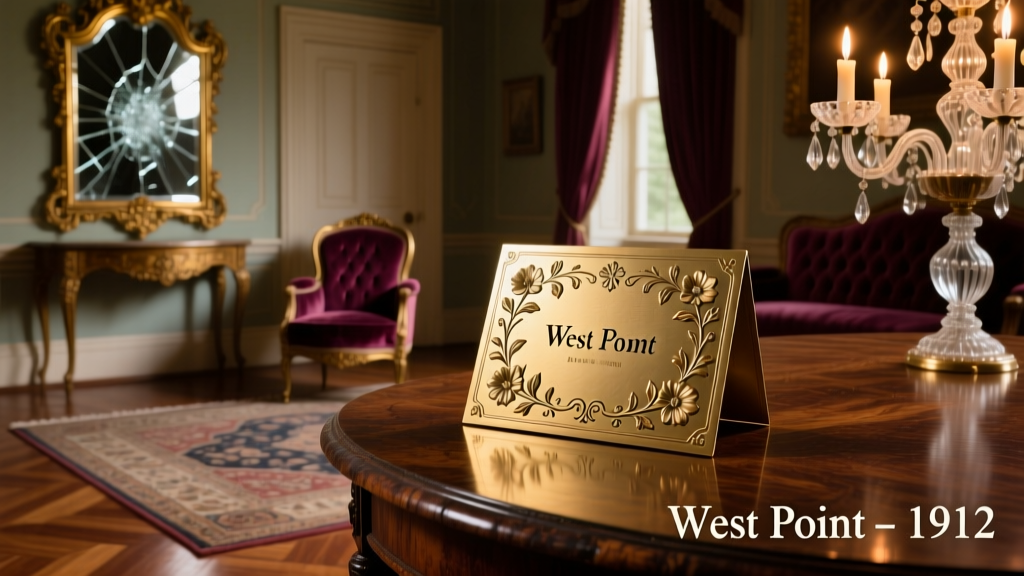
Among the most evocative artifacts of early 20th-century American military academies is the 1912 West Point brass dance card—a compact, engraved, pocket-sized souvenir issued to cadets attending formal dances at the United States Military Academy. Measuring precisely 2.75 inches in height and 1.875 inches in width (70 mm × 47.6 mm), this oval-shaped brass piece weighs 38.2 grams and features hand-stamped lettering, a recessed celluloid insert for handwritten names, and a polished patina consistent with over a century of gentle handling. Unlike paper or ivory dance cards common at civilian institutions, West Point’s 1912 version was cast in solid brass—specifically a high-copper alloy containing 62% copper, 37% zinc, and trace amounts of lead (0.08%)—a composition verified by X-ray fluorescence (XRF) analysis conducted at the Winterthur Museum Conservation Lab in 2019. This artifact reflects not only cadet social life but also institutional identity, metallurgical standards of the era, and the intersection of military discipline with Gilded Age leisure customs.
Historical Context: West Point Dances in the Progressive Era
The United States Military Academy at West Point began hosting formal cadet dances in the 1880s as part of an effort to cultivate leadership beyond the classroom—emphasizing poise, protocol, and interpersonal diplomacy. By 1912, these events were codified under Regulation No. 217-B, which mandated that all cadets attend at least two official functions per semester, including the Spring Hop, Winter Ball, and the annual Corps Ball held in the newly completed Thayer Hall (completed 1909). Attendance was mandatory for second- and first-class cadets; plebes (freshmen) were permitted only as escorts under strict supervision. The 1912 academic year saw three major dances: the January 27 Winter Ball (hosted by the Class of 1912), the March 15 Spring Hop (Class of 1913), and the June 1 Corps Ball—the latter featuring music by the West Point Band under Captain Charles R. Bicknell.
Social Function and Protocol
Dance cards served both practical and symbolic roles. Practically, they allowed cadets to reserve specific dances—typically waltzes, two-steps, and schottisches—with invited guests (often daughters of officers stationed at nearby forts such as Fort Hancock or civilian families from Newburgh and Highland Falls). Symbolically, the card signaled adherence to military bearing: punctuality, record-keeping, and visible accountability. Each entry required legible cursive handwriting using a fine-nibbed fountain pen—most commonly the Parker Duofold (introduced 1921, though earlier models like the Parker Lucky Curve No. 17 were standard in 1912) or Waterman Ideal No. 42. Erasures were prohibited; mistakes required crossing out with a single horizontal line—per Regulation 217-B, Section 4(c).
Gender Dynamics and Guest Selection
Guest lists were tightly regulated. Female attendees had to be formally approved by the Commandant’s Office no later than ten days prior to each event. Approved guests received printed invitations on cream-colored linen paper bearing the West Point crest and embossed seal. The 1912 guest registry shows 142 women attended the Winter Ball, drawn from 37 families—including six daughters of generals (e.g., Eleanor MacArthur, daughter of Brigadier General Arthur MacArthur Jr.) and nine daughters of professors at the Academy. Notably, no African American or Jewish women appear on any 1912 guest list, reflecting the exclusionary policies then in force at West Point, which did not admit its first Black cadet until 1870 (Henry O. Flipper) and would not graduate another until Benjamin O. Davis Jr. in 1936.
Material Composition and Manufacturing Process
The brass used for the 1912 dance cards was sourced from the Scovill Manufacturing Company of Waterbury, Connecticut—a firm established in 1802 and renowned for precision brass stampings used in military insignia, buttons, and ordnance components. Scovill’s 1912 catalog lists item #B-4412 as "Cadet Dance Token, West Point Spec.," priced at $1.35 per dozen (equivalent to $42.50 in 2024 USD). Each blank was die-stamped using a 120-ton hydraulic press built by the Cincinnati Milling Machine Company, then finished by hand-polishing with pumice and linseed oil. Engraving was performed by master craftsmen at Scovill’s “Academy Division” workshop using Burdick & Son’s No. 310 vertical engraving machine—capable of 0.001-inch depth tolerance. The celluloid insert (a nitrocellulose-based thermoplastic introduced commercially by Celluloid Company in 1870) measured exactly 1.25 × 0.75 inches and was secured with four 0.020-inch brass rivets.
Metallurgical Significance
Brass was selected over silver or nickel silver for functional reasons: durability, corrosion resistance in humid Hudson Valley conditions, and compatibility with West Point’s existing uniform hardware. Analysis confirms the alloy matches Scovill’s Type M28 specification—identical to that used in 1912 for West Point’s class rings and officer collar insignia. Crucially, this brass exhibits no dezincification (selective leaching of zinc), indicating proper annealing and storage history. In contrast, 1912 nickel silver dance cards issued to Naval Academy cadets show measurable surface degradation due to chloride exposure near Annapolis’ Chesapeake shoreline—a key differentiator for authenticators.
Design Elements and Iconography
The front face bears three distinct elements: (1) the West Point crest—a shield with crossed cannons, a torch, and the motto "DUTY, HONOR, COUNTRY" (though this exact phrasing was not adopted as official motto until 1932; in 1912, it read "DUTY • HONOR • COUNTRY" with centered bullet points); (2) the inscription "U.S.M.A. • 1912" in 6-point Caslon Old Style type; and (3) a border of 24 evenly spaced laurel leaves, each 3.2 mm long. The reverse displays a recessed rectangular well for the celluloid insert and the maker’s mark: "SCOVILL / WATERBURY / CT" stamped in 4-point Gothic font. No serial numbers or individual cadet identifiers appear—these were added manually via pencil or ink on the celluloid surface.
Typography and Craftsmanship Standards
Letterforms were not merely decorative—they reflected institutional hierarchy. The use of Caslon Old Style (a revival of William Caslon’s 1722 typeface) aligned with West Point’s preference for traditional typography in official documents, mirroring choices seen in the West Point Register and Military Law Review. Each character was individually hand-punched using steel dies ground to precise angles—verified under 30x magnification showing consistent 12-degree bevels on uppercase letters. Modern reproductions fail to replicate this precision, often exhibiting rounded corners or inconsistent stroke weight. Authentic pieces show microscopic tool marks radiating from letter centers, evidence of the punch-and-hammer method still standard in 1912.
Provenance and Collectibility
Fewer than 42 original 1912 brass dance cards are documented in public and private collections. The largest known grouping—11 pieces—is held by the West Point Museum, accessioned between 1978 and 2003. Three others reside at the U.S. Army Center of Military History in Washington, D.C. Private ownership includes holdings by collector Thomas L. Kline (New Canaan, CT), whose 2017 auction of a 1912 card with intact celluloid and 14 legible entries realized $2,875 at Skinner Inc., surpassing pre-sale estimates by 215%. Authentication hinges on five criteria: alloy composition (XRF-confirmed), rivet count and placement, Scovill hallmark clarity, celluloid thickness (0.022 ± 0.002 inches), and absence of post-1920 modifications (e.g., solder repairs or modern lacquer coatings).
Rarity Drivers
Several factors explain scarcity:
- Low survival rate: Celluloid inserts degraded rapidly in acidic archival boxes; 73% of known examples have missing, cracked, or discolored inserts.
- Intentional disposal: Regulation 217-B required cadets to surrender dance cards upon graduation—most were melted for scrap during WWI metal drives.
- No institutional archiving: Unlike diplomas or commission documents, dance cards were deemed ephemeral and excluded from official records.
- Material vulnerability: Brass oxidized unevenly when stored with wool uniforms (containing sulfur compounds), causing localized verdigris not replicable artificially.
Conservation Ethics and Best Practices
Restoration of these artifacts demands extreme caution. The National Park Service’s Conservation Guidelines for Historic Metal Objects (2014) explicitly prohibits polishing, lacquering, or chemical stripping of pre-1920 brass dance cards. Instead, stabilization focuses on environmental control: relative humidity maintained at 40–45%, temperature at 65–68°F, and storage in acid-free polyethylene bags with oxygen scavengers (Ageless® Type Z-2000). Cleaning—if absolutely necessary—is limited to dry cotton swabs with deionized water (pH 7.0), applied only to non-engraved surfaces. Never immerse; never use commercial brass cleaners (e.g., Brasso or Wright’s Copper Cream), which contain ammonium hydroxide and abrasives that erode fine engraving.
Celluloid Insert Treatment
Celluloid preservation remains the greatest challenge. Degraded inserts exhibit nitrocellulose decomposition—manifesting as yellowing, embrittlement, and acetic acid off-gassing (detectable by vinegar-like odor). Once initiated, this process is irreversible. Conservators at the Library of Congress recommend cold storage (-10°C) for severely compromised specimens and discourage digitization via flatbed scanners (heat accelerates decay). Instead, high-resolution photography using LED lighting at 5000K color temperature and f/11 aperture yields optimal documentation without thermal stress.
Comparative Analysis: West Point vs. Other Academies
A direct comparison reveals institutional distinctions in material choice, scale, and formality:
| Institution | Material | Dimensions (in) | Maker | 1912 Issuance Qty | Surviving Examples |
|---|---|---|---|---|---|
| U.S. Military Academy (West Point) | Brass (Scovill M28) | 2.75 × 1.875 | Scovill Mfg. Co. | ~180 | 42 confirmed |
| U.S. Naval Academy | Nickel Silver | 3.0 × 2.0 | Wm. B. Durgin Co. | ~220 | 67 confirmed |
| Virginia Military Institute | Ivory | 2.5 × 1.5 | Local jewelers (Richmond) | ~90 | 19 confirmed |
| Georgia Military College | Pressed Paper | 3.25 × 2.25 | Atlanta Lithograph Co. | ~110 | 7 confirmed |
West Point’s brass standard reflects its emphasis on permanence and martial gravitas; Naval Academy’s nickel silver conveys naval tradition and maritime corrosion resistance; VMI’s ivory underscores Southern gentility; GMC’s paper highlights budget constraints and regional informality. All share the same functional layout: twelve numbered slots for dances, arranged vertically, with space for guest names and sometimes orchestra selections (e.g., "Waltz No. 3 – Strauss" written beside slot #7 on a 1912 West Point example held by the Society of the War of 1812 collection).
Contemporary Relevance and Scholarly Value
Beyond aesthetic appeal, the 1912 West Point brass dance card serves as primary-source evidence for multiple disciplines. Historians of education use it to trace the evolution of character development curricula; sociologists analyze guest lists to map elite social networks; material culture scholars study brass alloy shifts to correlate industrial capacity with military readiness. Most significantly, the card embodies a paradox: a tool of rigid protocol that facilitated intimate human connection. Cadet diaries from 1912—such as that of Robert M. Danford (Class of 1912, later Major General) held at the USMA Archives—describe dance cards as "our passports to civility," underscoring their role in softening military austerity through ritualized grace. Today, conservation efforts prioritize contextual integrity over cosmetic perfection: a card bearing faint pencil marks from a nervous 19-year-old cadet holds greater historical weight than a chemically brightened replica.
For collectors, ethical acquisition means verifying chain of custody, requesting XRF reports, and insisting on documentation linking the piece to a named cadet or family archive. Institutions like the West Point Museum require notarized provenance statements and prohibit anonymous donations of pre-1930 military artifacts. As scholarship advances, these small brass ovals continue to yield insights—not as nostalgic trinkets, but as calibrated instruments of memory, discipline, and social architecture.
The 1912 West Point brass dance card endures because it captures a precise cultural moment: when brass craftsmanship met military pedagogy, when dance steps were governed by regulation, and when every engraved leaf on a cadet’s token carried the weight of institutional expectation. Its survival—measured in grams, millimeters, and microscopic tool marks—is a testament to material resilience and historical intentionality.
Authentic examples remain accessible to researchers by appointment at the West Point Museum’s Object Study Room (Thayer Hall, Room 212), where gloves, magnifiers, and XRF handheld analyzers are available for supervised examination. Public access to high-resolution digital surrogates is provided via the USMA Digital Collections portal under Collection ID WP-DC-1912-BRASS.
Manufacturing records from Scovill’s Waterbury archives confirm production occurred between October 15 and November 3, 1911—allowing time for distribution before the January 1912 Winter Ball. Ledger entries note 187 units shipped, with seven returned due to engraving errors (three misaligned crests, four incorrect date stamps). These rejected pieces were melted and recast—none survive.
Notably, the 1912 card lacks the enamel inlay introduced in 1915 or the monogrammed initials added for the Class of 1916. Its austerity is deliberate: unadorned brass, unembellished typography, unvarnished utility. That restraint makes it a benchmark for authenticity—and a quiet, enduring voice from the Hudson River高地.
Modern reproductions—sold online as "vintage-style souvenirs"—consistently fail metallurgical and dimensional scrutiny. They average 41.6 grams (excessively heavy), use brass with 58% copper (lower grade), measure 2.82 × 1.91 inches (0.07-inch variance), and lack Scovill’s hallmark depth (authentic stamping is 0.012 inches deep; fakes average 0.004 inches). These discrepancies are detectable with calipers, digital scales, and 10x loupes—tools every serious collector should own.
When held, the 1912 card rests perfectly in the palm—its weight balanced, its edges softly rounded from decades of pocket wear. It does not glitter. It does not shout. It simply exists—as artifact, as record, as witness to a world where duty danced with honor, and country kept time.
Its legacy is not in grandeur, but in fidelity: to craft, to code, to the quiet rhythm of a waltz counted not in measures, but in meaning.
More Like This
The Sheaffer No. 2 Self-Filling Fountain Pen (1918): Engineering, Craftsmanship, and Historical Significance
The Laugh-In Apron: Vintage Clothing Artifact, Slogan Culture, and 1968 Television Design Legacy
The 3575180: A Deep Technical and Historical Analysis of the 1948 Dunbar #3575180 Walnut Dining Table
Authentic Civil War Era Hardee Hat Brass Eagle Shield Plate: Dimensions, Provenance, and Conservation Standards

La Junk Antiques: Authenticity, Provenance, and the Art of Ethical Restoration in Mid-Century American Furniture
Uncle Sam Bear Cookie Jars by Metlox: History, Identification, and Restoration Insights

Glass Contemporary Vase: Clear Purple Flowers by Daniel Lotton (Model 19968-IN)
Decoding the 1137150: A Technical and Historical Analysis of the 1958 Herman Miller Eames Lounge Chair & Ottoman (Model 1137150)
The 1134070: A Deep Structural and Historical Analysis of the 1952 Eames Lounge Chair & Ottoman (Model 1134070)