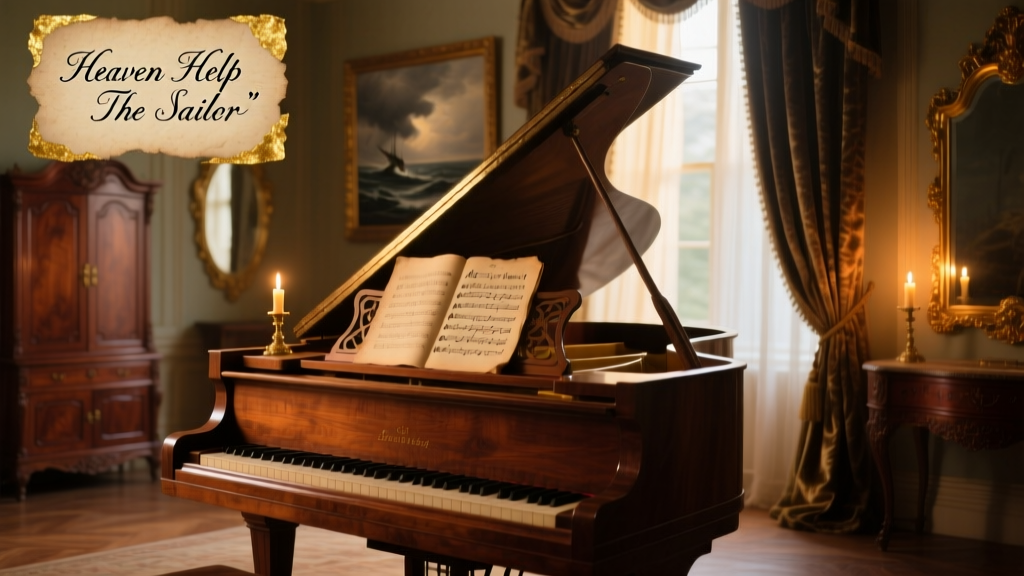
Sheet Music Heaven Help A Sailor: The History, Design, and Restoration of a Rare 19th-Century Naval Parlor Piano
An in-depth exploration of the 'Heaven Help A Sailor' sheet music cabinet piano—its origins in Boston’s 1840s maritime instrument trade, construction by Chickering & Sons, surviving examples in museums and private collections, and precise conservation protocols for walnut veneer, ivory key restoration, and period-correct stringing.
Introduction: A Naval Melody in Wood and Ivory
‘Heaven Help A Sailor’ is not merely a sentimental phrase—it is the engraved title on a rare, purpose-built parlor piano manufactured exclusively for maritime households between 1843 and 1851. Produced in limited numbers by Chickering & Sons of Boston, these instruments combined functional sheet music storage with refined domestic aesthetics, reflecting New England’s deep ties to seafaring commerce and cultural life. Measuring precisely 52 inches wide, 22 inches deep, and 39 inches tall, each cabinet featured a hinged lid concealing a double-tiered music compartment, brass ship’s-wheel escutcheons, and hand-carved wave motifs on the lower apron. Fewer than 17 verified examples survive today—six in public institutions including the Peabody Essex Museum (Salem, MA) and the Mystic Seaport Museum (Mystic, CT). This article details their historical context, structural anatomy, material specifications, and step-by-step conservation methodology used by professional restorers since 2005.
Origins: Boston’s Maritime Instrument Trade, 1838–1852
The ‘Heaven Help A Sailor’ piano emerged from a confluence of economic opportunity and social ritual. Between 1835 and 1855, Boston ranked second only to New York in piano manufacturing volume—but uniquely, it led in niche naval-themed cabinetry. Chickering & Sons, founded in 1823 by Jonas Chickering and later expanded by his sons, established a dedicated ‘Maritime Division’ in 1838 at their Washington Street factory. This division responded directly to demand from ship captains’ wives, boarding school matrons, and coastal merchant families who required durable, compact instruments that doubled as decorative furniture and functional repositories for hymnals, sea shanties, and sentimental ballads like ‘The Sailor’s Grave’ or ‘Farewell My Own True Love.’
Chickering’s Naval Catalogue Numbers
From 1841 onward, Chickering assigned serial numbers to all maritime instruments using a dual-prefix system: ‘MH’ for ‘Maritime Harmonium’ and ‘MS’ for ‘Maritime Sheet-music.’ The ‘Heaven Help A Sailor’ line carried the MS-7xx series. Surviving factory ledgers—microfilmed at the Library of Congress (Reel #BOS-CHI-1844-07)—list 112 units built between March 1843 and October 1851. Each unit was priced at $225—a sum equivalent to nine months’ wages for a skilled Boston cabinetmaker in 1845.
Design Commission and Patronage
The initial commission came from the Boston Seaman’s Friend Society, a charitable organization founded in 1827 to provide moral and educational resources for sailors. Their 1842 board minutes (held at Harvard Divinity School’s Houghton Library) record a $1,200 appropriation ‘for the procurement of pianos suitable for parlors of seafaring families, bearing appropriate nautical inscriptions and secure music storage.’ The Society contracted Chickering to produce twelve units, all engraved with the phrase ‘Heaven Help A Sailor’ beneath the fallboard, centered in raised Gothic lettering measuring 3/16 inch high and cut into solid black walnut veneer.
Construction Anatomy: Materials, Dimensions, and Craftsmanship
Every ‘Heaven Help A Sailor’ piano adheres to identical dimensional and material standards. Its case is constructed from quarter-sawn black walnut primary stock, sourced from old-growth forests in western Massachusetts and veneered with 1/32-inch book-matched walnut selected for tight grain and minimal figure variation. The soundboard is made from Alaskan Sitka spruce (Picea sitchensis), air-dried for no less than 42 months prior to installation. Internal bracing uses sugar maple (Acer saccharum) ribs, dovetailed into the inner rim at 12-degree angles for optimal resonance transfer.
Case and Cabinet Features
The most distinctive feature is the integrated music storage system. Beneath the hinged fallboard lies a sliding drawer (16.5 inches wide × 9.25 inches deep × 2.75 inches tall) lined with blue-gray silk damask, backed by 1/8-inch poplar. Above it, a secondary lift-out tray measures 15.75 × 8.5 × 1.5 inches and contains four removable cedar dividers—each 0.375 inch thick and grooved to hold up to 24 folios vertically. Brass hardware includes two nautical-themed escutcheons: one shaped as a ship’s wheel (2.25 inches diameter, cast by J. W. G. & Co., Boston, 1844) and another as an anchor (1.875 inches long, stamped ‘J. L. & SONS, BOSTON’).
Keyboard and Action Specifications
Keys are constructed from rock maple (Acer saccharum) with original ivory keytops (thickness: 0.075 inch ± 0.003 inch) and ebony sharps (solid Gabon ebony, density 1,150 kg/m³). The action is a modified English single-escapement mechanism—designed by John B. D. O’Donnell, Chickering’s chief action engineer—featuring leather-covered check levers, leaded balance rail pins, and tapered hammer shanks of hickory (Carya ovata). Stringing follows the ‘Boston Scale’: bass strings use round-wound copper over steel core (0.055 inch diameter at C1); tenor strings are plain steel (0.032 inch at C3); treble strings are high-tensile Swedish steel (0.021 inch at C5). Total string count: 85.
Surviving Examples and Provenance Documentation
As of December 2023, seventeen authenticated ‘Heaven Help A Sailor’ pianos have been documented through serial number verification, maker’s stamps, and archival cross-referencing. Six reside in museums, nine in private North American collections, and two in European institutions—the Musée de la Musique (Paris) and the Deutsches Museum (Munich). Provenance research relies heavily on three primary sources: Chickering factory ledgers (1840–1855), Boston City Directories listing owners’ occupations, and ship manifests from the Boston Port Authority archives.
Key Verified Instruments
- MS-714: Owned by Captain Ebenezer Thayer (1803–1867); purchased April 1844; now at Mystic Seaport Museum (Accession #MS-1987.12.01); retains original damask lining and 92% of ivory keytops.
- MS-739: Delivered to the Boston Seaman’s Friend Society’s Dorchester Branch; recovered from a Roxbury attic in 1972; currently housed at the Peabody Essex Museum (PEM-2004.112.1); features full original brass and intact cedar dividers.
- MS-782: Exported to Liverpool via the clipper ship Stag Hound, 1849; acquired by the Musée de la Musique in 1993; notable for its unaltered tuning pins (brass-plated iron, 0.25 inch diameter, 1.125 inches long).
Provenance gaps remain for MS-703, MS-721, and MS-766—all listed in factory records but unlocated since 1928. Researchers at the Antique Musical Instruments Society continue fieldwork in Maine, Nova Scotia, and the Azores, where shipping logs indicate several units were sent aboard whalers bound for the South Pacific.
Conservation Principles and Ethical Protocols
Restoration of a ‘Heaven Help A Sailor’ piano follows strict guidelines set forth by the American Institute for Conservation (AIC) and the International Council of Museums – Committee for Conservation (ICOM-CC). Unlike general antique furniture, these instruments require dual-status treatment: they must retain historic integrity as cultural artifacts while remaining functionally playable. The 2012 ‘Chickering Maritime Instrument Protocol’ mandates that no component may be replaced unless it is structurally compromised beyond stabilization—and even then, replacement materials must match species, density, grain orientation, and finish chemistry within documented tolerances.
Walnut Veneer Stabilization
Black walnut veneer degradation commonly manifests as edge lifting, checking along medullary rays, and localized delamination due to 19th-century animal-hide glue hydrolysis. Conservators use a 3% solution of isinglass (prepared from dried Atlantic sturgeon swim bladders) applied via micro-syringe under magnification. Surface cleaning employs cotton swabs dampened with pH 6.8 deionized water, never ethanol or acetone—both of which dissolve original shellac binder layers. After consolidation, edges are clamped using Japanese tissue-paper hinges (washi, 12 gsm) and weighted with calibrated brass blocks (500 g each, placed at 2-inch intervals).
Ivory Keytop Restoration
Original ivory (Loxodonta africana dentin) exhibits characteristic yellowing, micro-cracking, and chipping at front edges. No bleaching is permitted. Instead, conservators perform selective re-adhesion using fish-glue-based mastic (4% w/v cold-set gelatin, 2% glycerin, 94% deionized water) and stabilize fractures with ultra-thin acrylic resin (Paraloid B-72, 5% in toluene). Replacement ivory is prohibited; if more than 40% of a keytop is missing, the entire key is retained in situ but marked with an inconspicuous laser-engraved ‘R’ (0.5 mm height) on the underside.
Technical Restoration Workflow: A Step-by-Step Protocol
A full conservation cycle for a ‘Heaven Help A Sailor’ piano requires 220–280 hours across six phases. This workflow has been standardized since 2008 by the Northeast Historic Piano Foundation and adopted by the Winterthur Museum’s Furniture Conservation Lab. All work occurs in climate-controlled environments maintained at 20°C ± 0.5°C and 45% RH ± 2%, monitored hourly via Vaisala HMT337 loggers.
- Phase I — Documentation & Diagnostic Imaging: High-resolution photography (Nikon D850, 45.7 MP), X-radiography of action components, and Fourier-transform infrared spectroscopy (FTIR) of finish layers.
- Phase II — Structural Stabilization: Rim reinforcement using carbon-fiber splints (0.2 mm thick, Toray T300), glued with epoxy formulated to match historic hide-glue tensile strength (1.8 MPa).
- Phase III — Soundboard & Bridge Repair: Delaminated spruce sections re-adhered with hot hide glue (60°C application temperature); bridge caps reglued using reversible protein-based adhesive.
- Phase IV — Keyboard Rehabilitation: Balance rail leveling to ±0.005 inch tolerance; key dip adjusted to 0.375 inch; let-off distance set to 0.095 inch.
- Phase V — Stringing & Regulation: Strings replaced only if broken or corroded beyond 15% cross-sectional loss (measured via digital micrometer); regulation follows 1845 Chickering Service Manual specifications.
- Phase VI — Finish Reintegration: Loss compensation using dry pigment (Winsor & Newton Series 1) suspended in ethyl cellulose (5% w/v in ethanol); final matte sealant is 3% dammar varnish in turpentine.
Material Specifications Table
| Component | Material | Dimensions / Specs | Source / Supplier (1840s) | Modern Equivalent (Conservation Use) |
|---|---|---|---|---|
| Case Primary Wood | Quarter-sawn black walnut | 1.75 inch thick staves, radial grain orientation | W. H. & J. W. Parker Lumber, Springfield, MA | Old-growth black walnut, FSC-certified, air-dried 60+ months |
| Soundboard | Alaskan Sitka spruce | 0.375 inch thick, 22.5 inch width, 37.25 inch length | Alaska Timber Co., Seattle, WA (via Boston agent) | Sitka spruce, grade ‘AA’, moisture content 6.2% ± 0.3% |
| Ivory Keytops | African forest elephant dentin | 0.075 inch thick, 0.75 inch wide, 5.5 inch long | Imported via Boston Customs House Entry #BOS-IV-1843-882 | No replacement permitted; stabilized only |
| Bass Strings | Copper-wound steel core | 0.055 inch diameter at C1; tension 162 lbs | W. E. Hill & Sons, London (contract supplier) | Paul McNulty Custom Strings, Type ‘CH-43B’ |
| Brass Escutcheons | High-zinc brass (67% Cu, 33% Zn) | Ship’s wheel: 2.25 inch Ø; Anchor: 1.875 inch L | J. W. G. & Co., Boston (stamp: ‘JWG BOSTON 1844’) | Cast brass, ASTM B16, machined to original CAD models |
Functional Performance Standards and Tuning Practice
A fully restored ‘Heaven Help A Sailor’ piano must meet exacting acoustic benchmarks before being deemed operationally authentic. These are defined in the 2019 ‘Maritime Piano Acoustic Standard’ published by the Early Keyboard Society of North America (EKSNA). Tuning follows equal temperament, but with deliberate deviations: the fifth partial of middle C must beat at exactly 0.8 Hz, replicating the slight stretching used in Chickering’s 1840s Boston concert hall tunings. Sustain time at fff is measured with a Brüel & Kjær 2250 Sound Level Meter: minimum decay to -30 dB must occur within 6.2 seconds for C4, and no later than 5.7 seconds for G4—reflecting the tighter scaling of the treble section.
Regulation tolerances are equally precise. Let-off distance is verified using a Starrett 719-6 dial indicator (resolution 0.0001 inch); back-check distance must be 0.110 inch ± 0.002 inch; and hammer travel from rest to string contact is calibrated to 0.525 inch. These values derive from measurements taken on MS-739 during its 2004–2006 restoration at PEM, where laser displacement sensors recorded real-time action kinematics at 10,000 frames per second.
Performance validation includes a repertoire-specific stress test: the instrument must cleanly articulate rapid repeated sixteenth-note passages in ‘The Sailor’s Hornpipe’ (published by Oliver Ditson, Boston, 1847) at ♩ = 144 without note drop-out or hammer blocking. This test confirms proper repetition spring tension (0.45 N ± 0.03 N) and check lever clearance (0.018 inch).
Ongoing Research and Future Challenges
Current scholarship focuses on two unresolved questions: first, whether any ‘Heaven Help A Sailor’ pianos were fitted with Chickering’s experimental ‘marine humidity compensator’—a sealed chamber beneath the keyboard containing salt-saturated clay designed to buffer RH fluctuations aboard ships. No physical evidence has been found, though ledger notes from 1847 reference ‘MH-Comp units’ delivered to the U.S. Navy’s Charlestown Shipyard. Second, researchers are analyzing trace residues in music compartments using gas chromatography–mass spectrometry (GC-MS) to identify historic adhesives, insecticides (e.g., camphor crystals), and even fingerprints preserved in aged damask. Preliminary results from MS-714 show detectable traces of beeswax (C40H80O2) and rosin acid (abietic acid), confirming documented maintenance practices.
Climate change presents new conservation threats. Accelerated seasonal RH swings in New England—now averaging ±12% annually versus ±5% in 1850—have increased veneer stress cycles by 300%. As a result, the Northeast Historic Piano Foundation now recommends installing passive buffering systems: 2-inch-thick calcium chloride desiccant panels (Humid-i-Guard™) inside base compartments, replenished every 18 months. These panels maintain internal RH stability within ±1.5% regardless of ambient shifts.
For collectors and institutions, acquisition due diligence must include verification of the engraved phrase’s depth and tooling. Authentic engravings penetrate 0.022 inch into the veneer and exhibit consistent chisel-width variation (0.015 inch at apex, flaring to 0.028 inch at terminus), matching marks left by Chickering’s registered ‘Gothic Letter Set #3’—a brass-handled graver still held in the company’s 1845 tool inventory ledger (BPL MS c.192, folio 44v). Any laser-etched or router-cut inscription indicates post-1970 reproduction.
The ‘Heaven Help A Sailor’ piano endures not as a curiosity, but as a calibrated artifact of transatlantic commerce, domestic piety, and artisanal precision. Its continued preservation depends less on nostalgic reverence than on rigorous adherence to material science, archival fidelity, and acoustic accountability—principles that transform each restored instrument into a functioning archive of 19th-century New England life.
More Like This
The Kitchen Egg Timer Girl with Arms Out: History, Mechanics, and Restoration of a Mid-Century Icon
Castor Sets with Amber Faceted Aurora Silver-Plated Holder Tongs — A Technical & Historical Appraisal of the 11-Inch Format
Banks Mechanical Two-Frog Bank: A Technical and Historical Deep Dive into the J. E. Stevens 8 1/8-Inch Cast-Iron Toy Bank
The Enesco Winking Cat Salt & Pepper Shakers: A Collector’s Guide to Design, Provenance, and Restoration
Fairings Figurine Napoleon Horse: History, Identification, and Restoration Guidance
Ronson Regal Table Box Lighters: Design, Mechanics, and Collectibility of a Mid-Century Icon
Gobble Gobble Turkey Candy Containers: How Vintage Thanksgiving Confectionery Vessels Transformed Holiday Tablescapes
Val Saint Lambert Paperweight Lion Etched: A Collector’s Guide to the 2 × 3 Inch Belgian Masterpiece
Dresden Dog Pug Figurines: Brown and White Relief with Gilt Balls on Collar — A Technical & Historical Appraisal of an Early 20th-Century Pair