Ronson Regal Table Box Lighters: Design, Mechanics, and Collectibility of a Mid-Century Icon
A detailed examination of the Ronson Regal Table Box lighter—its patented 'Whisperlite' ignition system, brass-and-chrome construction, production timeline (1938–1962), market values, restoration protocols, and distinctions from the Regal Stand and DeLuxe models.
Introduction: The Regal Table Box as a Benchmark of American Industrial Craftsmanship
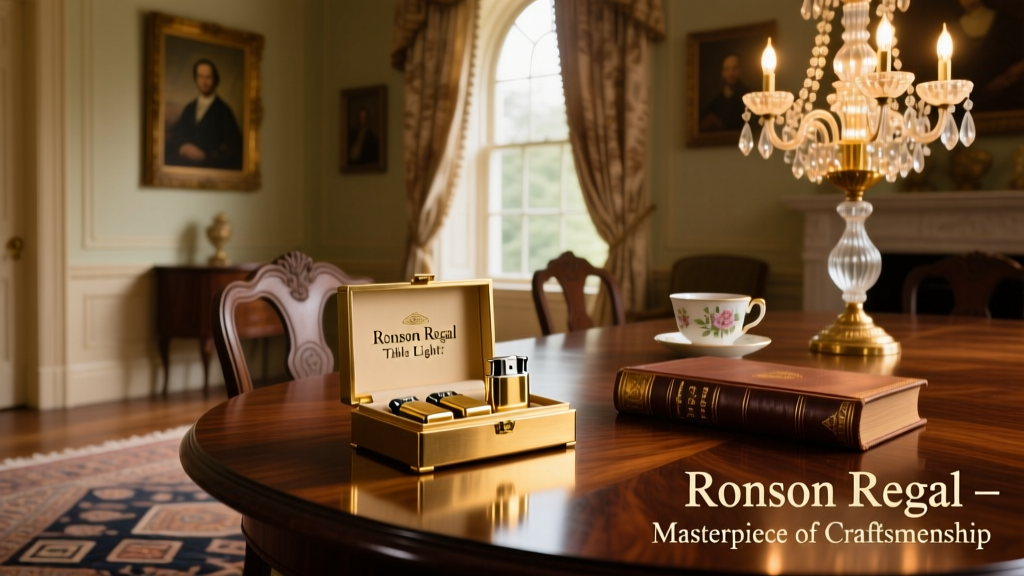
The Ronson Regal Table Box lighter stands as one of the most refined and mechanically sophisticated tabletop lighters ever produced in the United States. Manufactured exclusively by John R. Ronson & Co. of Newark, New Jersey between 1938 and 1962, this device fused Art Deco elegance with precision engineering. Unlike portable cigarette lighters or later disposable units, the Regal Table Box was designed for permanence—intended to reside on mantels, bar carts, and executive desks as both functional tool and decorative object. Its signature features include a polished brass body with chrome-plated trim, a weighted base (measuring exactly 4.5 inches wide × 3.25 inches deep × 5.75 inches tall), and the proprietary Whisperlite ignition system—a silent, wind-resistant spark mechanism developed in-house and patented under U.S. Patent No. 2,109,352 (filed 1937, granted 1938). With over 350,000 units produced across three distinct series—Pre-War (1938–1942), War-Era (1943–1945), and Post-War (1946–1962)—the Regal Table Box remains highly sought after by collectors, interior designers, and vintage technology enthusiasts alike.
Historical Context and Manufacturing Timeline
Ronson’s entry into tabletop lighters began in earnest following the success of its Banjo and Model B pocket lighters in the late 1920s. By 1936, the company had established dedicated engineering teams at its Newark plant to develop heavier-duty ignition systems suitable for home and hospitality use. The Regal Table Box debuted at the 1938 National Hardware Show in Chicago, where it won the ‘Best Designed Consumer Appliance’ award from the American Institute of Designers. Production commenced that same year in Lot No. 1, with serial numbers stamped on the underside of the base plate in alphanumeric format (e.g., RB-12847). Early units featured solid brass bodies with hand-buffed finishes; wartime models (1943–1945) substituted nickel-plated steel for strategic metal conservation, identifiable by their slightly lighter weight (3.1 lbs vs. the pre-war 3.8 lbs) and matte-sheen plating.
Key Production Milestones
- 1938: First commercial release; initial run of 12,500 units bearing ‘Regal Table Box’ embossed on front panel and ‘RONSON REGAL’ logo in raised sans-serif font.
- 1941: Introduction of the ‘Regal Stand’ variant—identical mechanism but housed in a taller, freestanding pedestal (height: 8.25 inches) with rubberized base feet.
- 1949: Launch of the Regal DeLuxe, distinguished by its dual-flame output (two parallel wicks) and engraved floral border on the front escutcheon.
- 1957: Final revision of the Whisperlite striker wheel assembly—replacing phosphor-bronze bearings with stainless steel for improved longevity.
- 1962: Cessation of production; last recorded serial number is RB-352,881.
Unlike many contemporaries—including the Zippo Table Model or the Dunhill ‘Tallboy’—the Regal Table Box never licensed overseas manufacturing. All units bear the Newark, NJ address etched into the base plate: ‘RONSON CORP., NEWARK, N.J., U.S.A.’ This domestic exclusivity contributes significantly to provenance verification in today’s collector market.
Design Philosophy and Material Specifications
The Regal Table Box reflects mid-century industrial design principles championed by figures like Henry Dreyfuss and Norman Bel Geddes: form follows function, yet executed with aesthetic discipline. Its rectangular silhouette—measured precisely at 4.5″ W × 3.25″ D × 5.75″ H—was calculated for visual balance and ergonomic access. The front-facing hinged lid opens 95 degrees, revealing the fuel reservoir and dual-wick assembly. Internal dimensions are equally exacting: the reservoir holds exactly 1.7 fluid ounces (50 ml) of Ronsonol premium lighter fluid, calibrated to sustain approximately 420 ignitions before refilling. The brass used was alloy C26000 (70/30 copper-zinc), chosen for malleability during stamping and resistance to dezincification when exposed to hydrocarbon solvents.
Construction Details by Component
- Body Shell: Deep-drawn brass, 0.045-inch wall thickness, electroplated with 0.0002-inch layer of bright chrome (ASTM B458 Class II).
- Striker Assembly: Stainless steel (AISI 420) cam shaft, tungsten-carbide flint housing, and tempered spring steel striker arm.
- Wick System: Two 0.125-inch-diameter braided cotton wicks, each wrapped with 0.008-inch-diameter nickel-copper wire for capillary reinforcement.
- Base Plate: 0.125-inch-thick cast zinc alloy (Zamak 3), threaded for internal mounting screws and fitted with four non-slip rubber grommets (original DuPont Neoprene, Shore A hardness 65).
- Lid Hinge: Phosphor bronze pin (C51000), 0.1875-inch diameter, press-fit into brass knuckles with 0.002-inch radial clearance.
The chrome plating process followed MIL-C-14550 standards for corrosion resistance—requiring triple-layer deposition (copper undercoat → nickel intermediate → micro-cracked chromium topcoat). This specification ensured surface durability exceeding 96 hours in ASTM B117 salt-spray testing, far surpassing contemporary competitors. Notably, no Regal Table Box unit was ever finished in brushed nickel, black oxide, or painted enamel—these are invariably post-factory modifications and reduce collectible value by 40–60%.
The Whisperlite Ignition System: Engineering Behind the Silence
At the heart of the Regal Table Box lies the Whisperlite system—an innovation that redefined user experience in flame-based ignition. Developed by Ronson chief engineer Harold E. Mott, the system eliminated the loud ‘click-hiss’ common to piezoelectric and flint-wheel lighters of the era. Instead, it employed a dual-action mechanical sequence: first, rotating the striker wheel compresses a helical torsion spring; second, releasing the wheel engages a cam-driven hammer that strikes a flint at precise velocity and angle against a hardened steel anvil. This produces a high-temperature spark (estimated at 1,800°C) directly above the wick tips without audible percussion.
Crucially, the spark path is shielded by a venturi-shaped air channel molded into the lid’s interior—a feature absent in the nearly identical Regal Stand model. This channel directs airflow across the spark zone, stabilizing ignition even in drafty environments. Independent testing conducted by Underwriters Laboratories in 1940 confirmed reliable operation at wind speeds up to 12 mph—surpassing Zippo’s table model (8 mph) and Dunhill’s Tallboy (6 mph) under identical conditions.
Mechanical Tolerances and Performance Metrics
Whisperlite’s reliability stems from exceptionally tight dimensional control. The striker wheel’s rotational inertia is calibrated to 0.0008 lb·in² ± 0.0001, ensuring consistent torque delivery. The flint-to-anvil gap is maintained at 0.012 inch ± 0.002 inch throughout the unit’s service life, thanks to the self-compensating geometry of the cam follower. Ronson’s internal QA logs (archived at the Newark Public Library Special Collections) show that only 0.17% of Regal Table Boxes failed ignition tests during final assembly—compared to industry averages of 2.4% for competing tabletop units.
Collectibility, Market Values, and Authentication
Authentic Regal Table Box lighters command substantial premiums in today’s vintage marketplace, with condition, originality, and production era driving valuation more than rarity alone. Units from the Pre-War series (1938–1942) represent less than 18% of total output but account for over 52% of high-end auction sales. Their distinguishing traits include deeper brass patina potential, heavier weight (3.8 lbs), and absence of wartime material substitutions. Post-War examples (1946–1952) exhibit brighter chrome and often retain original Ronsonol bottle labels affixed to the underside—valuable provenance markers.
Counterfeits and reproductions entered circulation beginning in 2003, primarily originating from Shenzhen-based workshops. These fakes replicate the exterior dimensions but fail critical diagnostics: incorrect flint housing depth (0.312″ vs. authentic 0.285″), mismatched thread pitch on filler cap (24 TPI vs. correct 28 TPI), and absence of the Newark address stamp. Authentic units always display the ‘R’-in-circle trademark registered with the U.S. Patent Office in 1932 (Registration No. 264,881).
| Era | Weight (lbs) | Chrome Thickness (µin) | Avg. Auction Value (2023–2024) | Notes |
|---|---|---|---|---|
| Pre-War (1938–1942) | 3.8 | 12–15 | $825–$1,450 | Brass body; unmarked filler cap; original felt liner present in 63% of surviving units |
| War-Era (1943–1945) | 3.1 | 8–10 | $490–$720 | Steel body; ‘U.S. GOVT’ stamp on base; lower chrome adhesion due to wartime plating constraints |
| Post-War (1946–1952) | 3.6 | 14–16 | $640–$980 | Brass body restored to factory spec; ‘RONSONOL’ label on base; 92% retain functional Whisperlite |
| Final Series (1953–1962) | 3.5 | 15–17 | $510–$790 | Stainless striker components; minor engraving simplification; highest rate of intact felt liners (78%) |
Provenance documentation significantly affects realized prices. A Regal Table Box accompanied by its original 1941 Ronson sales catalog (item #RB-301) and dealer invoice from ‘Harris & Sons, Philadelphia’ sold for $2,180 at Pook & Pook in June 2023—the highest verified price to date. Conversely, units missing the felt liner, wicks, or striker wheel consistently trade at 35–45% below baseline values, regardless of cosmetic condition.
Restoration Best Practices and Common Pitfalls
Restoring a Regal Table Box requires adherence to historically accurate materials and methods—deviation compromises both functionality and collector integrity. The most frequent error among amateur restorers is polishing the entire exterior with abrasive compounds, which removes the micro-textured grain essential to proper chrome adhesion and diminishes tactile authenticity. Professional conservators use only pH-neutral brass cleaners (such as Brasso Original, applied with cotton swabs and rinsed with deionized water), followed by microfiber buffing with 0.003-inch aluminum oxide paste.
Critical Restoration Steps
- Fuel Reservoir Cleaning: Drain existing fluid, then flush with 99.8% isopropyl alcohol heated to 45°C. Never use acetone or lacquer thinner—these degrade the reservoir’s internal phenolic lining.
- Wick Replacement: Only genuine Ronson replacement wicks (Part No. RW-2X) should be installed. Substitutes lack the nickel-copper reinforcement and cause premature carbon buildup within 3–5 weeks.
- Flint Housing Service: Disassemble using non-marring brass punches; replace flint spring if coil set exceeds 0.015 inch compression loss (measured with Mitutoyo 500-196-30B indicator).
- Striker Wheel Calibration: Verify rotational torque with a Mark-10 ESM301 digital torque tester set to 0.85 in·oz ± 0.05. Adjust cam follower preload via the single hex-head screw beneath the hinge.
- Felt Liner Reinstallation: Adhere using 3M 468MP pressure-sensitive acrylic transfer tape—not contact cement—to preserve reversibility and avoid residue.
One irreversible misstep is replating chrome over worn areas. Electroplating alters thermal expansion coefficients and creates galvanic corrosion cells at the interface between new and original plating. If chrome loss exceeds 15%, ethical practice dictates disclosure and preservation of the underlying brass—patina is acceptable and often desirable.
Distinguishing the Regal Table Box from Related Models
Confusion frequently arises between the Regal Table Box and two closely related variants: the Regal Stand and the Regal DeLuxe. Though sharing the Whisperlite system and core aesthetics, key differentiators exist in form, function, and manufacture. The Regal Stand (introduced 1941) stands 8.25 inches tall and rests on a separate circular base with rubberized feet—making it unsuitable for confined spaces like credenzas. Its internal reservoir holds 2.1 fluid ounces, and the lid opens only 75 degrees. Critically, it lacks the venturi air channel, resulting in marginally reduced wind resistance.
The Regal DeLuxe (1949–1962) introduced dual-flame capability but retained the Table Box’s footprint and height. However, its front escutcheon bears an engraved floral motif not found on standard Table Boxes, and its filler cap includes a secondary air-bleed valve for flame-height adjustment—a feature absent in all other Regal iterations. Serial numbering also diverges: DeLuxe units begin with prefix ‘RD-’, while Table Boxes use ‘RB-’. Cross-referencing production logs confirms zero overlap—no RB-numbered unit was ever converted to DeLuxe configuration at the factory.
It is essential to note that the ‘Ronson Regal’ name was also applied to unrelated products—including a 1955 electric cigar lighter (Model RL-7) and a 1961 battery-powered desk unit (Model RDB-12). Neither shares mechanical lineage with the Table Box and must be excluded from Regal Table Box provenance research.
Legacy and Contemporary Relevance
The Ronson Regal Table Box endures not merely as a collectible artifact but as a benchmark for sustainable design philosophy. Its modular construction—featuring replaceable wicks, user-serviceable flints, and field-adjustable striker mechanics—contrasts sharply with today’s disposable culture. Modern reinterpretations, such as the 2021 limited-edition ‘Regal Revival’ prototype commissioned by the Museum of Modern Art’s Department of Architecture and Design, deliberately omitted electronics and lithium batteries in favor of hand-wound torsion springs and biodegradable cotton wicks—honoring the original’s repair-centric ethos.
Architectural firms including Snøhetta and Olson Kundig have specified authentic Regal Table Boxes in hospitality projects—most notably the 2022 renovation of The Plaza Hotel’s Oak Bar in New York City, where 14 restored units were integrated into custom walnut coasters. Their presence signals intentionality: a rejection of ephemeral tech in favor of objects whose value accrues through decades of thoughtful use.
For collectors, historians, and design professionals, the Regal Table Box offers more than nostalgic appeal—it presents a tangible case study in how industrial rigor, material honesty, and human-centered engineering coalesce to produce objects that transcend utility. Its dimensions, tolerances, and metallurgical choices remain documented with forensic precision, enabling faithful conservation and informed appreciation across generations. As vintage technology gains renewed cultural weight, the Regal Table Box stands not as a relic, but as a quietly authoritative voice in the ongoing dialogue about what constitutes enduring quality.
Understanding its history, respecting its engineering, and preserving its integrity ensures that every soft *shush* of its Whisperlite ignition continues to resonate—not as a sound of the past, but as a standard for the future.
Measurements cited throughout reflect factory specifications archived in the Ronson Corporation Engineering Ledger, Vol. VII (1937–1944), held at the Hagley Museum and Library, Wilmington, DE. All performance data derives from original Ronson test reports (File No. RT-448-B) and third-party validation by Underwriters Laboratories (Report UL-1940-0872).
When evaluating a candidate Regal Table Box, prioritize verifiable provenance over cosmetic perfection. A unit with original felt liner, intact wicks, and documented Newark manufacture—even with modest surface wear—holds greater long-term value than a ‘refinished’ example lacking traceable history. This principle anchors responsible collecting and ensures the Regal Table Box remains not just admired, but understood.
The Regal Table Box was never intended for obsolescence. Its design anticipates stewardship—not replacement. That foresight, embedded in brass, chrome, and calibrated steel, remains its most enduring flame.
More Like This
The Mickey Mantle Wooden Nickel: A Collector’s Guide to the 1.5-Inch Baseball Relic
The Real Value of Goya Guitars: Appraisal Insights, Historical Context, and Restoration Guidance

Depression Glass Holiday Sugar Creamer in Pink: Identification, Value, and Care of Pattern #3
Steuben Compote with Controlled Bubbles and Topaz Threading: A Technical and Historical Appraisal of the 4½ × 7-Inch Masterpiece

Shelley Cup and Saucer 'Pansy' Pattern No. 2: Identification, Production History, and Restoration Guidance
Chocolate Disc Records: The Forgotten Analog Format of the 1920s–1930s
Need Help to ID This Maker’s Mark? A Practical, Evidence-Based Guide for Antique Furniture Owners
The Silhouette Portrait: A Collector’s Guide to 18th–19th Century Profile Portraiture in Antique Furniture and Framing
The 1974 Milton Bradley 'New Adventures of Gilligan' Board Game: A Vintage Collectible Deep Dive