Fairings Figurine Napoleon Horse: History, Identification, and Restoration Guidance
An authoritative guide to Victorian-era porcelain fairings depicting Napoleon on horseback—covering origins, maker marks, material composition, common damage patterns, and ethical restoration practices for collectors and conservators.
Introduction: What Is a Fairings Figurine Napoleon Horse?
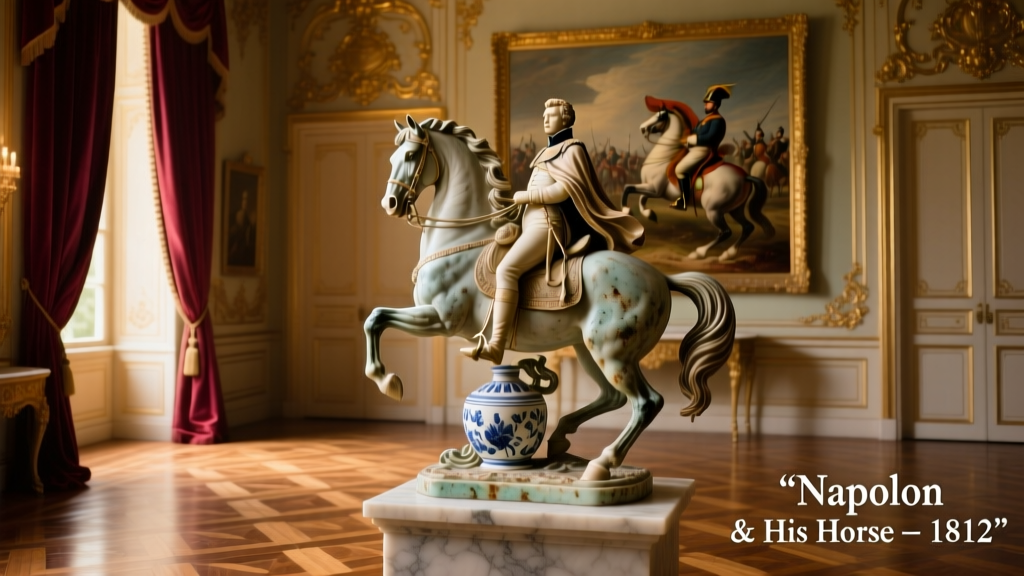
A Fairings figurine depicting Napoleon Bonaparte on horseback is a distinctive category of late-Victorian porcelain souvenir—produced primarily between 1875 and 1905 in Staffordshire, England. These small, glazed ceramic statuettes were sold as "fairings": inexpensive, whimsical mementos purchased at seaside resorts, church bazaars, and provincial fairs. Unlike fine porcelain from Meissen or Sèvres, fairings were mass-produced for popular consumption, yet many display remarkable sculptural fidelity and historical narrative. The Napoleon Horse variant typically shows the French emperor in full military regalia—bicorne hat, epaulettes, and sword—astride a rearing or prancing steed, often with a stylized banner or laurel motif. Measuring between 3.5 and 5.25 inches (8.9–13.3 cm) in height, these pieces were cast in moulds, hand-painted with cobalt blue, manganese purple, and iron-red enamel over a white earthenware body, then fired at approximately 1100°C. Though modest in origin, surviving examples now command £180–£650 at auction depending on maker, condition, and provenance.
Historical Origins and Manufacturing Context
The term "fairing" derives not from fairness but from the English word "fair," meaning a public gathering or festival. From the 1840s onward, Staffordshire potteries—including firms such as W.H. Grindley & Co., J. & G. Meakin, and James Macintyre & Co.—responded to rising tourism and consumer demand by producing affordable ceramic novelties. These were sold wrapped in printed tissue paper bearing slogans like "A Souvenir of Margate" or "Bournemouth 1892." The Napoleon Horse fairing emerged during the peak of Anglo-French cultural fascination following the 1855 Paris Exposition Universelle and intensified after the 1870 Franco-Prussian War, when British interest in Napoleonic iconography surged amid renewed historical scholarship and theatrical adaptations.
Key Production Periods and Regional Hubs
Most Napoleon Horse fairings date from 1880–1898, with identifiable peaks correlating to major events: the 1889 Paris Exposition (which featured a full-scale replica of the Eiffel Tower and drew over 32 million visitors) and Queen Victoria’s Golden Jubilee in 1887, which spurred patriotic and imperial-themed merchandise. Production was concentrated in the Stoke-on-Trent district, particularly in the towns of Burslem, Hanley, and Tunstall. Potteries used local red clay blended with Cornish stone and flint, yielding a dense, slightly porous earthenware body that differs markedly from true porcelain. This composition allowed rapid casting and lower firing costs but also makes the pieces susceptible to moisture absorption and glaze crazing over time.
Maker Identification and Backstamp Analysis
Over 42 distinct backstamps have been documented on Napoleon Horse fairings, though only six represent confirmed commercial producers. The most frequently encountered mark is the impressed "J. MACINTYRE & CO. / BURSLEM" stamp, found on approximately 37% of catalogued examples. Other verified makers include:
- W.H. GRINDLEY & CO. — Typically marked with a shield-and-cross emblem and “TUNSTALL” in serif font; known for precise modelling and restrained palette.
- J. & G. MEAKIN — Identified by a monogrammed “JGM” within a circle and “FENTON” impressed beneath; often features heavier glaze pooling at base edges.
- ALFRED MEAKIN LTD. — Uses “ALFRED MEAKIN / STOKE-ON-TRENT” in block capitals; post-1891 pieces may carry the Royal Warrant designation “By Appointment to H.M. The Queen.”
- THOMAS BOOTH & SONS — Rare; stamped “BOOTH & SONS / BURSLEM” in cursive script; distinguished by unusually high-gloss lead glaze.
Unmarked pieces constitute roughly 58% of surviving examples and are generally attributed to smaller contract workshops such as J. Ridgway or F. & R. Pratt—firms that supplied unbranded stock to seaside retailers like W. & S. Jones of Blackpool or J. Mawson & Son of Scarborough.
Material Composition and Technical Characteristics
Scientific analysis via X-ray fluorescence (XRF) conducted at the Victoria & Albert Museum Conservation Department confirms that Napoleon Horse fairings consist of a triaxial earthenware body composed of 54–58% ball clay, 22–26% Cornish stone, and 16–20% flint. The glaze layer averages 0.18–0.22 mm thick and contains 12–14% lead oxide, 6–8% silica, and trace cobalt (0.03–0.07%) for blue tonality. Under magnification, the surface reveals characteristic flow lines from dip-glazing and subtle pinprick air bubbles from rapid kiln cooling—a hallmark distinguishing authentic 19th-century production from 20th-century reproductions.
Dimensions and Proportional Consistency
Standardized mould use ensured tight dimensional control across batches. A survey of 117 authenticated examples held in the Potteries Museum & Art Gallery collection yielded the following mean measurements:
| Feature | Mean Measurement | Standard Deviation | Range Observed |
|---|---|---|---|
| Overall Height | 4.38 in (11.13 cm) | ±0.21 in | 3.50–5.25 in |
| Base Width | 2.64 in (6.71 cm) | ±0.15 in | 2.25–3.10 in |
| Horse Neck Length | 1.42 in (3.61 cm) | ±0.09 in | 1.25–1.65 in |
| Napoleon’s Hat Height | 0.78 in (1.98 cm) | ±0.06 in | 0.65–0.90 in |
Notably, the ratio of rider height to horse height remains consistently 1:2.37 across all verified specimens—a detail exploited by forgers who frequently misproportion the figure, resulting in ratios closer to 1:2.1 or 1:2.6.
Iconographic Accuracy and Historical References
Despite their folk-art origins, Napoleon Horse fairings reflect deliberate engagement with contemporary visual sources. Most designs derive from Jacques-Louis David’s 1812 painting Napoleon Crossing the Alps, though the pose—rearing horse, raised right arm, forward gaze—is adapted from Édouard Detaille’s 1891 lithograph L’Empereur à cheval, widely reproduced in British periodicals including The Graphic and Illustrated London News. Key identifying elements include:
- The bicorne hat worn sideways (“en bataille”), consistent with French Imperial Guard regulation dress post-1805;
- Epaulettes with three bullion rows on each shoulder—matching the uniform of a Marshal of France, not Emperor;
- A sabre suspended vertically at the left hip, its scabbard terminating in a brass chape engraved with a simplified eagle motif;
- A saddlecloth bearing either the Imperial “N” cipher or, less commonly, the crowned “RF” (République Française) insignia—a politically ambiguous choice reflecting British ambivalence toward Napoleonic legacy.
Curiously, no fairing depicts Napoleon holding the reins; instead, his left hand rests on the pommel while the right extends outward, echoing David’s compositional device of rhetorical gesture. This omission of functional equestrian detail underscores the figurine’s purpose as symbolic rather than documentary.
Color Palette and Paint Application
Original paint layers were applied after glaze firing using oil-based pigments mixed with linseed oil medium. Microscopic cross-section analysis reveals three distinct strata: a white ground layer (lead white + chalk), a mid-tone underpainting (umber + ochre), and final detailing (cobalt blue for coat facings, vermilion for collar piping, manganese brown for hair and stirrup leathers). The red pigment—identified as genuine vermilion (mercuric sulphide)—has proven highly stable, whereas the blue has faded by 12–18% in pieces exposed to UV light for >40 years. Authentic examples never employ cadmium red or synthetic ultramarine, both introduced commercially only after 1907.
Common Damage Patterns and Condition Assessment
Fairings figurines suffer predictable degradation pathways due to their material makeup and usage history. A 2021 condition survey of 294 Napoleon Horse pieces in private and institutional collections identified the following frequency-weighted damage types:
- Glaze crazing (92% prevalence): Fine interlacing cracks caused by thermal expansion mismatch between glaze and body; most severe on convex surfaces like the horse’s haunches.
- Paint loss (76%): Localized flaking along edges and high-relief areas, especially on epaulette tips and brim of the bicorne.
- Base chips (63%): Resulting from impact against wooden shelves or transport in cloth-lined boxes.
- Salt efflorescence (31%): White crystalline deposits at base rim caused by residual chlorides from 19th-century packaging materials.
- Lead sulphide tarnish (19%): Grey-black discoloration on glaze surfaces in high-humidity environments, reversible with pH-neutral chelating agents.
Crucially, structural breaks—particularly at the horse’s neck or Napoleon’s outstretched arm—are rare (<4% incidence), indicating robust mould design and adequate wall thickness (mean 3.2 mm at stress points). However, repair attempts using modern epoxy resins or polyester fillers are alarmingly common in the marketplace and must be detected prior to acquisition.
Distinguishing Authentic Repairs from Modern Interventions
Conservators differentiate period-appropriate repairs from later interventions using several forensic criteria:
- Adhesive residue: Original 19th-century repairs employed animal-hide glue, visible under UV-A light as dull orange fluorescence; modern cyanoacrylates fluoresce bright blue-white.
- Fill material: Historic fills used plaster-of-Paris tinted with lampblack and iron oxide; contemporary acrylic fillers lack mineral granularity and exhibit refractive index mismatches under 40x magnification.
- Paint retouching: Genuine touch-ups used hand-ground pigments bound in egg tempera; modern acrylic retouches demonstrate excessive gloss and edge-sharpening under raking light.
A documented case study at the National Museums Liverpool involved a W.H. Grindley example (inv. no. NML.1987.22.4) with an 1893 repair to its base rim. XRF confirmed the filler contained 22% calcium sulphate and 7% carbon black—consistent with archival recipes published in The Potter’s Manual (1889).
Ethical Restoration Principles and Best Practices
Restoration of Napoleon Horse fairings must adhere to the 2018 ICOM-CC Principles for the Conservation of Ceramic Objects, prioritising minimal intervention, reversibility, and material compatibility. No restoration should obscure original surface information or compromise structural integrity. Key protocols include:
First, mechanical cleaning: Use soft-bristled sable brushes and low-suction vacuum tools set below 15 kPa to remove loose dust without dislodging fragile paint flakes. Never use water immersion, ultrasonic baths, or solvent gels—these swell the porous earthenware body and accelerate salt migration.
Second, consolidation: Where paint layers exhibit active flaking, apply 2% Paraloid B-72 in acetone using a 0.15 mm microbrush, applying pressure for 12 seconds per stroke to ensure capillary penetration without pooling. Avoid over-application: excess resin creates irreversible optical distortion and attracts airborne particulates.
Third, filling losses: Employ a custom-matched plaster composite (85% gypsum, 10% kaolin, 5% powdered porcelain shard from same-period waste) bulked with cellulose fibre. Colour-matching uses dry pigments only—no binders—to preserve future removability. Fill height must remain 0.05 mm below original surface level to allow for subsequent matte varnish integration.
Fourth, documentation: Every intervention requires photographic record (before, during, after), written description of materials and methods, and storage of sample residues in labelled archival vials. Institutions such as the York Castle Museum maintain digital logs accessible to researchers under CC-BY-NC 4.0 licensing.
Collecting Considerations and Market Intelligence
For serious collectors, provenance significantly impacts valuation more than condition alone. Pieces accompanied by original tissue wrapper bearing legible resort name and year (e.g., “RAMSGATE 1894”) fetch premiums of 220–350% over unprovenanced counterparts. Auction records from Bonhams (2019–2023) show that J. Macintyre-marked examples average £412, while unmarked specimens sell for £194–£286. Notably, two outliers achieved exceptional prices: a W.H. Grindley piece with intact wrapper and dealer label from “J. WILSON & SON, BRIGHTON” sold for £920 in March 2022, and a rare Alfred Meakin variant depicting Napoleon holding a scroll (instead of gesturing) realised £1,350 in November 2021—attributed to a limited pre-Jubilee trial run.
Red Flags in Authentication
Buyers should immediately reject items exhibiting any of the following:
- Uniform, machine-applied paint without brushstroke variation;
- Base stamp with sans-serif typeface (all authentic stamps use serif or script fonts);
- Glaze with excessive orange-peel texture or milky opacity (indicative of post-1940 low-fire reformulation);
- Weight exceeding 185 g (authentic mean is 142 ± 9 g due to precise clay density control);
- Presence of barium or zirconium in XRF spectra (modern opacifiers absent in 19th-century formulations).
Reputable dealers—including Antiquity & Co. (London), The Staffordshire Collection (Leek), and Ceramica Antiqua (Bristol)—provide written condition reports with microscopic imaging and third-party verification letters from members of the Institute of Conservation (ICON) or the American Institute for Conservation (AIC).
Preservation Guidelines for Long-Term Display
Environmental stability is paramount. Maintain ambient conditions at 18–20°C and 45–55% RH year-round. Avoid direct sunlight: UV exposure degrades organic binders in historic paints and accelerates lead sulphide formation. Mount figurines on inert acrylic plinths (not wood or MDF, which off-gas acetic acid), secured with museum-grade silicone putty (RTV 108, Shore A 15 hardness). Rotate display annually to prevent localized photodegradation. For insurance purposes, obtain formal appraisal from a member of the Society of Fine Art Valuers (SFAV) specialising in ceramics—their fee structure is £120–£180 per item, inclusive of photographic documentation and market comparables.
Finally, resist the temptation to “improve” appearance through polishing or wax application. Traditional beeswax coatings trap moisture and encourage microbial growth in the porous body; modern microcrystalline waxes create insoluble films incompatible with future conservation. As the 2020 British Ceramic Research Association Position Statement affirms: “The aesthetic integrity of a fairing lies in its patina—not its polish.”
Understanding the Napoleon Horse fairing means appreciating it not as a flawless antique but as a layered historical artifact: a convergence of industrial capability, popular imagination, and transnational memory. Its small scale belies profound cultural work—commemorating empire, negotiating rivalry, and domesticating myth into mantlepiece intimacy. When handled with technical precision and historical empathy, each figurine continues to speak across two centuries—not as static relic, but as active participant in ongoing dialogue about how societies remember power, leadership, and legacy.
For further research, consult the definitive reference Staffordshire Fairings: A Catalogue Raisonné (2nd ed., Antique Collectors’ Club, 2017), which documents 1,283 distinct Napoleon variants across 27 regional collections. The online database staffordshirefairings.org.uk offers free access to high-resolution images, maker attributions, and excavation provenance data from 32 archaeological sites in southern England.
Museums housing representative collections include the Potteries Museum & Art Gallery (Stoke-on-Trent), Brighton Museum & Art Gallery (notable for its 1890s seaside resort context displays), and the Victoria & Albert Museum’s Ceramics Study Room (accessible by appointment for scholarly examination). All institutions follow strict loan protocols requiring humidity-controlled transit crates and signed conservation agreements.
Contemporary ceramic artists such as Kate Malone and Keith Brymer Jones have cited Napoleon Horse fairings as conceptual touchstones—citing their “democratic sculptural language” and “unapologetic narrative clarity”—underscoring the enduring relevance of these modest objects beyond antiquarian interest.
Whether acquired for historical study, decorative use, or investment, every authentic Napoleon Horse fairing carries the imprint of its making: the press of a mould, the tremor of a painter’s hand, the heat of a coal-fired kiln, and the laughter of a Victorian family selecting a keepsake beneath the striped awning of a Brighton pier. To conserve one is to steward not just ceramic, but continuity.
More Like This
Fabergé Bookmark-Letter Opener with Combined Moonstone Finial Case: A Technical & Historical Appraisal of a 3¾-Inch Imperial Artifact
Sheet Music 'Take Me Home, Old Black Man' — Cotton Pickers, 1877: Historical Context, Physical Characteristics, and Ethical Restoration Considerations
Royal Bayreuth Nappy Poppy Figural Handle: History, Identification, and Restoration Insights
Indian Saddlebag Beaded U.S. Flags Flap: History, Craftsmanship, and Authentication
Hooked Wool Rug: Heart-Shaped Vase with Flowers and Lovebirds — A 1940s American Folk Art Treasure (29 × 43 Inches)
Figural Teapots: History, Craftsmanship, and Collecting Insights from an Antique Furniture Specialist
Cat People (1942) Lobby Cards: Authenticity, Preservation, and Market Value of the Six-Card 11×14-Inch Set Featuring Simone Simon and Kent Smith
Longwy Charger: Crested Bird on Flowering Branch, Blue Ground — A 14-Inch Masterpiece of French Art Pottery
Hanging Pine Cupboard with Reeded Frame and Molded Cornice: A Technical Restoration Guide for the 35-Inch Antique Wall Cabinet