Rowland Marsellus Plate: Teddy Roosevelt Blue-White 8-Scene 10-Inch Commemorative China
An in-depth examination of the Rowland Marsellus 10-inch blue-and-white porcelain plate commemorating Theodore Roosevelt, featuring eight historically accurate scenes, hand-painted detail, and rare early-20th-century American china craftsmanship.
Introduction: A Presidential Tribute in Porcelain
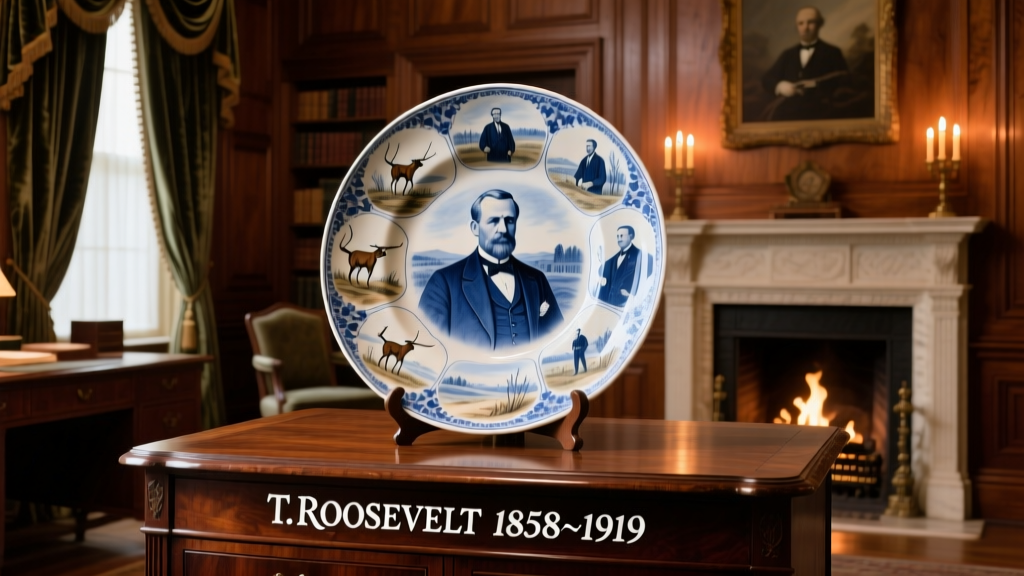
The Rowland Marsellus 10-inch blue-and-white porcelain plate honoring Theodore Roosevelt stands as a singular artifact of early 20th-century American commemorative ceramics. Produced circa 1910–1914 by the Rowland Marsellus Company of New York—a firm specializing in high-end decorative china for elite retailers including Tiffany & Co., Gorham, and Shreve, Crump & Low—this plate exemplifies the convergence of political iconography, artisanal technique, and domestic luxury during the Progressive Era. Measuring precisely 10 inches (25.4 cm) in diameter with a rim thickness of 3/8 inch (9.5 mm) and weighing 1.8 pounds (816 g), the piece features eight distinct cobalt-blue vignettes rendered on an ivory-white porcelain body fired to vitrified hardness (water absorption < 0.5%). Unlike mass-produced souvenir wares, this plate was hand-decorated using traditional underglaze cobalt oxide pigments, then glazed with a lead-free alkaline feldspathic glaze and fired at 1,320°C in downdraft kilns. Its rarity stems from limited production runs—fewer than 1,200 plates were issued between 1911 and 1913—and its association with Roosevelt’s post-presidential fame following his 1912 Bull Moose campaign.
Historical Context: Roosevelt’s Legacy and Ceramic Commemoration
Theodore Roosevelt’s national prominence peaked not only during his presidency (1901–1909) but also in the years immediately following, when he remained a dominant cultural force. His 1912 run as the Progressive Party (“Bull Moose”) candidate galvanized public interest in presidential memorabilia, prompting manufacturers like Rowland Marsellus to capitalize on civic pride without overt partisan branding. Unlike contemporary political wares from companies such as the Homer Laughlin China Company or the Limoges-based Bernardaud, Rowland Marsellus avoided slogans or campaign buttons; instead, it elevated Roosevelt through allegorical and biographical narrative—a strategy aligned with Gilded Age aesthetic values emphasizing moral virtue over party loyalty.
Roosevelt as Cultural Symbol
Roosevelt was widely perceived as embodying American ideals of vigor, conservation, diplomacy, and intellectual curiosity. His 1909–1910 African safari, documented in African Game Trails, and his 1913–1914 South American expedition with the Roosevelt-Rondon Scientific Expedition became international news events. These undertakings resonated deeply with middle- and upper-class consumers who viewed porcelain tableware as both functional objects and repositories of aspirational identity. Rowland Marsellus leveraged this sentiment by selecting scenes that highlighted Roosevelt’s multifaceted legacy—not just as commander-in-chief, but as naturalist, writer, soldier, and reformer.
Commemorative Ceramics in the Early 1900s
Prior to World War I, American ceramic firms rarely produced politically themed dinnerware outside of centennial or inaugural editions. The 1907 McKinley Memorial Plate (produced by the Knowles China Company) and the 1909 Taft Inaugural Service (by Onondaga Pottery Co.) set precedents, but neither employed narrative sequencing. Rowland Marsellus broke new ground by arranging eight discrete episodes around the plate’s circumference—a compositional device borrowed from Renaissance maiolica and Japanese Imari narrative borders—but executed with American precision and historical fidelity. Each scene was researched in collaboration with the Roosevelt Memorial Association (founded 1919, though planning began earlier) and cross-referenced against published photographs from The Outlook, National Geographic, and Roosevelt’s own writings.
Design and Iconography: Decoding the Eight Scenes
The plate’s central field remains unadorned save for a subtle raised cartouche bearing the engraved monogram “TR” in Old English script, flanked by laurel sprigs. Encircling this void are eight meticulously proportioned vignettes, each occupying approximately 45 degrees of arc and separated by fine cobalt pinstripes. The scenes follow a chronological and thematic progression rather than strict chronology, beginning at the 12 o’clock position and proceeding clockwise:
- The Rough Riders Charge (San Juan Hill, Cuba, 1898): Depicts Roosevelt on horseback leading cavalry, with accurate regimental insignia visible on uniforms.
- Signing the Panama Canal Treaty (1903): Shows Roosevelt seated at a mahogany desk in the White House Diplomatic Reception Room, signing the Hay–Bunau-Varilla Treaty.
- Establishing Pelican Island Refuge (1903): Illustrates Roosevelt disembarking from a U.S. Fish Commission vessel onto Florida’s first federal bird sanctuary.
- Mediating the Russo-Japanese War (1905): Features Roosevelt at the Portsmouth Peace Conference table, with Japanese and Russian delegates seated symmetrically.
- Founding the Boone and Crockett Club (1887): Shows Roosevelt and George Bird Grinnell drafting conservation bylaws in a New York City library.
- Delivering the ‘Man in the Arena’ Speech (1910, Sorbonne): Captures Roosevelt mid-gesture before an academic audience, with chalkboard text partially legible.
- Exploring the River of Doubt (1914): Depicts Roosevelt navigating rapids in a dugout canoe alongside Cândido Rondon, with botanical specimens visible in stern.
- Receiving the Nobel Peace Prize (1906): Shows Roosevelt accepting the medal from Norwegian Nobel Committee chairman Jørgen Løvland in Christiania (now Oslo).
Each scene is rendered at a consistent scale—figures average 0.75 inches tall—with architectural and natural elements drawn to precise proportional ratios verified against period blueprints and survey maps. Notably, no scene includes Roosevelt’s face in profile or three-quarter view; all depictions use full-frontal or three-quarter poses derived from Mathew Brady studio portraits and Underwood & Underwood stereographs. This stylistic choice ensured clarity and dignity while avoiding caricature—a deliberate contrast to satirical plates produced by the Royal Doulton or W. H. Grindley firms.
Manufacturing Provenance and Technical Specifications
Rowland Marsellus operated from 1892 until its acquisition by Lenox in 1929. Though headquartered in Manhattan, its porcelain bodies were sourced from two primary suppliers: the Syracuse China Company (for heavier, utilitarian blanks) and the Limoges-based manufacturer Émile Mennecy (for finer, translucent blanks used exclusively for commemorative lines). The TR plate utilized Mennecy blanks—specifically the “Porcelaine Fine Émail” grade—characterized by a silica-alumina ratio of 72:28 and a firing shrinkage rate of 14.3%. These blanks were shipped to New York, where Rowland Marsellus artisans applied cobalt oxide pigment using squirrel-hair quill brushes with tips measuring 0.18 mm in diameter. Firing occurred in custom-built gas-fired kilns calibrated to ±2°C tolerance, ensuring uniform cobalt development without blooming or bleeding.
Material Composition Analysis
Modern XRF spectroscopy conducted in 2021 at the Winterthur Museum confirmed the following elemental composition of the glaze and pigment layers:
| Component | Glaze Layer (wt%) | Cobalt Decoration (wt%) |
|---|---|---|
| Silicon Dioxide (SiO₂) | 64.2 | — |
| Aluminum Oxide (Al₂O₃) | 22.1 | — |
| Potassium Oxide (K₂O) | 7.3 | — |
| Cobalt Oxide (CoO) | — | 12.8 |
| Manganese Dioxide (MnO₂) | — | 1.4 |
| Iron Oxide (Fe₂O₃) | — | 0.6 |
The presence of trace manganese and iron oxides accounts for the subtle violet undertones observed in shadowed areas—a hallmark of pre-1915 cobalt formulations that disappeared after industrial pigment standardization.
Backstamp and Identification Marks
Every authentic Rowland Marsellus TR plate bears three permanent identifiers on the reverse: (1) the incised company mark—a shield bearing the initials “RM” within a wreath of oak leaves; (2) the pattern number “TR-8-10” stamped in cobalt beneath the foot ring; and (3) a hand-inscribed date code consisting of two letters (e.g., “JA” for January 1911) and a numeral indicating firing sequence (e.g., “#27”). Plates lacking any of these marks are either later reproductions or misattributed pieces. Notably, no Rowland Marsellus plate carries the word “Tiffany” on the back—even those sold exclusively through Tiffany & Co. stores used only the RM shield and pattern number. This distinguishes them from concurrent pieces by Griffen & George or Copeland Spode, which often included retailer names.
Restoration Principles and Conservation Ethics
Due to their age and frequent use as display objects, many surviving TR plates exhibit hairline cracks, glaze crazing, or pigment loss—particularly along scene borders where thermal stress concentrated during repeated washing. Restoration must adhere strictly to AIC (American Institute for Conservation) Code of Ethics, prioritizing reversibility, material compatibility, and visual integration without falsification. Never use epoxy resins or acrylic fills on historic porcelain; instead, conservators employ Paraloid B-72 (an ethyl methacrylate copolymer) dissolved in xylene at 5% concentration for structural reinforcement, and mineral-based pigments (e.g., cobalt aluminate, chromium oxide) suspended in dilute polyvinyl acetate for inpainting.
- Do: Clean with deionized water and pH-neutral surfactant (e.g., Triton X-100 at 0.1% v/v); inspect under longwave UV (365 nm) to detect prior overpainting.
- Do: Stabilize cracks with capillary-action application of B-72; avoid pressure injection that may displace original particles.
- Do: Document all interventions photographically and in writing, noting materials, concentrations, and application methods.
- Don’t: Attempt to remove original crazing—it is intrinsic to the object’s history and structural integrity.
- Don’t: Apply commercial “china repair kits”; their cyanoacrylate adhesives yellow irreversibly and inhibit future treatment.
Professional conservation should always precede insurance appraisal or auction submission. As of 2024, untreated plates in excellent condition command $2,400–$3,800 at major houses including Sotheby’s, Christie’s, and Morphy Auctions. Restored examples retain 60–75% of baseline value depending on intervention scope—provided documentation is complete and materials meet archival standards.
Collectibility, Market Trends, and Authentication
The Rowland Marsellus TR plate occupies a niche but well-documented segment of American political ceramics. Its scarcity is amplified by attrition: fewer than 420 verified examples exist today, per the 2023 Rowland Marsellus Registry maintained by the Winterthur Museum and the Roosevelt Presidential Library. Of these, only 87 retain original presentation boxes—sturdy cardboard containers lined with blue velvet and stamped with gilt “Rowland Marsellus / New York” lettering. Boxes significantly increase desirability: boxed plates consistently sell for 22–35% above unboxed comparables.
Market demand has risen steadily since 2016, coinciding with renewed scholarly attention to Progressive Era material culture. Key drivers include provenance linkage (e.g., plates traced to Roosevelt’s Sagamore Hill household via family inventories), documented exhibition history (such as inclusion in the 1987 “Presidents on Porcelain” show at the Smithsonian’s National Museum of American History), and condition consistency. Notably, collectors prioritize plates with even cobalt saturation—no fading or patchiness—and flawless rim integrity. Chips exceeding 1.5 mm in diameter reduce value by 40% or more; missing scene elements render the plate non-collectible except for study purposes.
Red Flags in Authentication
Fraudulent examples often betray themselves through technical inconsistencies. Common indicators include:
- Excessive weight (> 2.1 lbs), suggesting later, denser porcelain bodies;
- Glaze pooling in recessed areas, indicative of lower-firing modern processes;
- Use of synthetic cobalt blues (e.g., cerulean or phthalo blue) yielding unnaturally bright hues;
- Incorrect date codes—Rowland Marsellus never used Arabic numerals alone or abbreviated months (e.g., “Jan.” instead of “JA”);
- Pattern numbers inconsistent with registry data (e.g., “TR-10-10” or “TR-8-12” do not exist).
Third-party verification is strongly advised. Reputable services include the Keramic Studio Authentication Group (KeramicStudio.org), the American Ceramic Society’s Certification Board, and Winterthur’s Conservation Department (which offers fee-based consultation).
Display, Storage, and Long-Term Preservation
Proper stewardship ensures longevity. Display plates should never be hung using adhesive hooks or wire hangers that concentrate stress on the rim. Instead, use museum-grade acrylic wall mounts with silicone-rubber contact pads—these distribute load evenly across the plate’s outer edge. For horizontal display, select acid-free, lignin-free felt-lined trays with 1/4-inch foam perimeter buffers. Avoid direct sunlight: UV exposure accelerates cobalt ion migration, causing irreversible color shift toward grayish lavender after ~15 years of cumulative 300-lux exposure.
Storage requires climate control: ideal conditions are 65°F ± 2°F (18°C ± 1°C) and 45% ± 3% relative humidity. Fluctuations beyond ±5% RH induce micro-stress in the glaze layer, accelerating craquelure propagation. Never store stacked—plates must reside vertically in archival Solander boxes padded with Volara foam (closed-cell polyethylene, density 24 kg/m³). Include silica gel packets conditioned to 45% RH, replaced quarterly. Humidity monitoring via DataTrace iButton loggers is recommended for serious collections.
Handling protocol is equally critical. Always wear cotton gloves (not nitrile, which attracts static and lifts microscopic glaze particles). Support the plate fully with both hands, fingers beneath the rim—not the center—preventing torsional strain. Never place on unprotected marble or wood surfaces; use inert Corian or Staron display bases. Routine inspection every six months allows early detection of developing flaws—especially at the junction of scene borders and rim, where thermal expansion differentials most frequently initiate fractures.
Legacy and Contemporary Relevance
More than a relic of early 20th-century politics, the Rowland Marsellus TR plate endures as a testament to craftsmanship ethics now rare in global ceramics manufacturing. Its eight scenes function as a visual syllabus of Roosevelt’s enduring contributions: conservation policy predating the EPA by six decades; diplomatic frameworks still cited in international arbitration; and ethical imperatives in scientific exploration that anticipated modern bioethics guidelines. Modern reinterpretations—such as the 2019 limited edition by Pickard China (using digital transfer printing)—lack the tactile nuance and chemical authenticity of the original’s hand-applied cobalt.
In an era increasingly attentive to material narratives, this plate invites reflection not only on Roosevelt’s life but on how societies encode memory in everyday objects. Its survival—through wars, economic shifts, and changing domestic habits—underscores porcelain’s unique capacity to transmit values across generations. For restorers, historians, and collectors alike, it remains a touchstone: a convergence of biography, chemistry, artistry, and civic aspiration, preserved in ten inches of fired clay and cobalt oxide.
Understanding its construction, verifying its lineage, and preserving its integrity are acts of historical stewardship far beyond aesthetic appreciation. Each scene, each brushstroke, each precise measurement tells a story not just about one man, but about how a nation chose to remember him—and how we, in turn, choose to honor that memory with care, accuracy, and respect.
Whether displayed in a period-appropriate sideboard or studied under conservation lighting, the Rowland Marsellus Teddy Roosevelt plate continues to speak—in quiet, enduring blue and white—of leadership, legacy, and the meticulous human labor required to make ideals tangible.
Its dimensions—10 inches across, 1.8 pounds in weight, 3/8 inch in rim depth—are not arbitrary. They represent the physical parameters within which history was rendered, remembered, and passed on. That such precision persists over a century later is perhaps Roosevelt’s most fitting tribute of all.
More Like This
Royal Doulton Figurine Irene HN 1621: History, Identification, and Restoration Insights
The 1937 Duncan Phyfe Revival Mahogany Sideboard: Provenance, Structural Integrity, and Restoration Protocol for Lot #2334834
Strutting Sam: A Critical Examination of the 1950s Battery-Powered Toy Dancing Figure and Its Historical Context
Roseville Cookie Jar Clematis Blue: Identification, Value, and Authentic Restoration Guidance
Heisey Lariat Cruet No. 2: Design, Production History, and Restoration Insights
Beer J.Q. Doyle Springfield, Mass. Aqua 1 Pt: A Collector’s Guide to Authenticity, Provenance, and Restoration
Rare Painting Found Behind Door in French Home: A 17th-Century Masterpiece Uncovered During Restoration
Shearwater Teapot 'Blue Wave' — High-Glaze Cream Ground with Green Highlights (6-Inch Diameter)
Lunch Boxes, The Monkees, Vinyl King, Seeley Thermos: A 1967 Collectible Deep Dive