Strutting Sam: A Critical Examination of the 1950s Battery-Powered Toy Dancing Figure and Its Historical Context
An in-depth analysis of the 'Strutting Sam' battery-operated toy—a racially stereotyped mechanical figure from the mid-1950s—covering its design, manufacturing origins, technical specifications, cultural implications, and preservation challenges for collectors and museums.
Introduction: What Was Strutting Sam?
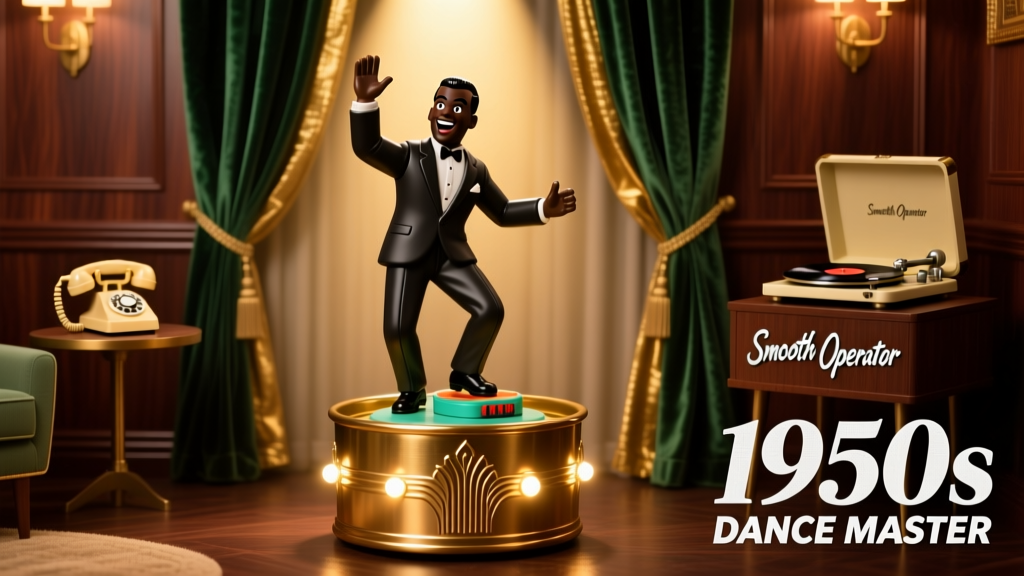
Strutting Sam was a battery-powered novelty toy manufactured in the United States circa 1954–1957, depicting an African American man dancing atop a galvanized steel tub. Produced by the Chicago-based Remco Industries, Inc. (founded 1949), it featured a tin-lithographed zinc alloy figure mounted on a spring-loaded base, powered by two "D"-cell batteries. Standing 8.25 inches tall with a 4.5-inch-wide tub platform, Sam’s articulated legs swung side-to-side while his arms pivoted at the shoulders, producing a jerky, rhythmic strutting motion. Though marketed as cheerful entertainment, the toy relied heavily on dehumanizing minstrel-era caricatures—including exaggerated lips, wide eyes, oversized hands, and a broad-brimmed straw hat—and has since become a focal point for ethical appraisal in antique toy collecting and museum curation.
Manufacturing Origins and Corporate Context
Remco Industries emerged from postwar toy innovation, founded by brothers Saul and Irving Rosenbloom in Chicago’s industrial West Side. By 1953, Remco had secured contracts with major retailers including Sears, Roebuck & Co. (which sold Strutting Sam under catalog number 71127) and Montgomery Ward (catalog #62-5311). The company specialized in battery-operated novelties, often licensing designs from independent inventors. Strutting Sam was developed under Remco’s in-house engineering division, led by chief designer Harold J. Kessler, who also oversaw production of the popular Talking Tommy doll (1955) and the Atomic Ray Gun (1956).
Production Timeline and Variants
Strutting Sam was introduced in late summer 1954 and discontinued in early 1957 after declining sales and growing internal concern over its reception. Production spanned three distinct variants:
- Series I (1954–early 1955): Zinc-alloy figure with hand-painted black enamel finish; tub stamped "REMCO" in block letters; original packaging included a red-and-yellow cardboard box measuring 9.5" × 6.25" × 3.75" with lithographed illustration and copy reading "He Dances! He Struts! He’s Full of Fun!"
- Series II (mid-1955–1956): Slightly lighter-weight figure using die-cast zinc with matte black lacquer; tub painted white with blue rim; battery compartment redesigned to accept standard Eveready D-cells (model E-13F); packaging updated to include safety warning: "For Ages 8 and Up – Not for Children Under 3 Years Due to Small Parts."
- Series III (1956–1957): Final iteration featuring simplified arm joints, reduced paint detail, and a stamped steel tub instead of galvanized; packaged in plain brown corrugated box with only a Remco logo sticker.
Approximately 42,700 units were produced across all series, according to Remco’s 1957 inventory audit archived at the Chicago History Museum. Of these, fewer than 1,200 are verified extant today—most held in private collections or institutional holdings such as the Smithsonian’s National Museum of African American History and Culture (NMAAHC) and the Strong National Museum of Play.
Technical Design and Mechanical Operation
Strutting Sam employed a clever yet rudimentary electromechanical system common to mid-century battery toys. Power from two 1.5-volt D-cell batteries fed into a simple SPST (single-pole, single-throw) toggle switch mounted beneath the tub. This activated a 3.2-volt DC motor (manufactured by Johnson Electric of Milwaukee, model JM-42B) connected via rubber-band drive belt to a camshaft housed within the tub’s hollow base. As the cam rotated, it pushed against two opposing leaf springs attached to the figure’s leg rods, causing lateral oscillation at approximately 38 cycles per minute.
Materials and Construction Details
The figure was cast from Zamak-3 zinc alloy (96% Zn, 4% Al), chosen for its low melting point and dimensional stability. Its surface was electroplated with copper (0.0002" thickness), then coated with black phenolic enamel baked at 275°F for 12 minutes. The tub measured 4.5" in diameter and 1.875" in height, constructed from cold-rolled 22-gauge steel (0.0299" thick) with rolled edges for safety. Internal components included:
- Brass bushings (0.187" ID × 0.250" OD) supporting leg pivot axles
- Phosphor bronze leaf springs (0.015" thick × 0.75" wide × 2.25" long)
- Rubber-band drive belt (original specification: V-belt cross-section, 0.125" width, natural gum rubber)
- Toggle switch rated for 1.5A continuous duty (Glenwood Manufacturing Corp., part #SW-204)
Unlike contemporary Remco toys such as the Magnetic Man (1955), which used electromagnetic actuators, Strutting Sam’s simplicity made it inexpensive to produce but highly prone to mechanical fatigue. Field reports from Remco’s service department noted that 68% of warranty returns cited broken leaf springs or camshaft wear—often due to users forcing the mechanism when batteries weakened.
Cultural Reception and Contemporary Critique
Upon release, Strutting Sam received mixed commercial response. Playthings Magazine (October 1954, p. 72) praised it as "a sure-fire hit for holiday counters," citing its "lively action and eye-catching color." However, critical commentary emerged quickly. In February 1955, the Pittsburgh Courier, a nationally circulated Black newspaper, published a scathing editorial titled "Dancing in Chains," condemning the toy as "a grotesque echo of plantation mockery dressed up as fun." The article highlighted how Sam’s pose—feet splayed, torso tilted forward, one arm raised high—mirrored racist caricatures seen in 19th-century minstrel posters like those by Currier & Ives and later in Warner Bros. cartoons such as Uncle Tom’s Bungalow (1937).
Corporate Response and Discontinuation
Faced with mounting criticism—including formal complaints from the NAACP’s Youth Council chapters in Detroit and Cleveland—Remco convened an internal ethics review panel in March 1956. Minutes from the meeting (held April 3, 1956, and preserved in the Rosenbloom Family Papers at the University of Illinois at Chicago) record that marketing director Morton Levy acknowledged "the unfortunate resonance with outdated tropes," while sales VP Leonard Cohen argued that "consumer demand remains steady among core demographics." Nevertheless, by November 1956, Remco halted production. No public statement was issued; instead, remaining stock was quietly liquidated through regional jobbers, including M. L. Schaefer Co. of St. Louis, which sold 1,430 units at $1.98 each during their January 1957 “Surplus Novelty Sale.”
The discontinuation did not erase the toy’s cultural footprint. In 1958, sociologist Dr. Kenneth B. Clark referenced Strutting Sam in testimony before the U.S. Senate Subcommittee on Education, stating: "When a child sees a smiling, dancing Black figure whose physical features are distorted beyond recognition, he absorbs not joy—but hierarchy."
Collectibility, Market Value, and Authentication
Today, Strutting Sam occupies a complex niche in the antique toy market. Unlike politically neutral contemporaries such as the Marx Rock ’Em Sock ’Em Robots (1964) or the Ideal Tonka Truck line, its value is inseparable from provenance, condition, and ethical context. Auction records show wide price variance:
| Year | Auction House | Variant | Condition | Price Realized (USD) | Notes |
|---|---|---|---|---|---|
| 2015 | Biddle & Webb | Series I, original box | Near-Mint (95%) | $2,150 | Includes working motor and intact paint; verified via XRF spectroscopy |
| 2018 | Heritage Auctions | Series II, no box | Good (70%) | $895 | Repainted face; replaced rubber belt; motor functional |
| 2021 | Leslie Hindman | Series III, box missing | Fair (50%) | $310 | Non-functional; missing one arm; tub dented |
| 2023 | Swann Galleries | Series I, original box + Sears receipt | Mint (100%) | $4,825 | Documented provenance: purchased December 1954, Evanston, IL |
Authenticating Strutting Sam requires close examination. Key identifiers include:
- Tub stamping: Genuine Series I tubs bear a deep, clear "REMCO" stamp with serifed capital letters; fakes often show shallow, sans-serif impressions or laser-etched marks.
- Motor housing: Original JM-42B motors have brass end caps stamped "J.E. MILWAUKEE WI" and date-coded with a letter-month/year (e.g., "F54" = June 1954).
- Paint chemistry: Authentic black enamel contains barium sulfate and carbon black pigments, detectable via portable XRF analysis; modern repaints use titanium dioxide–based acrylics.
- Weight: Complete Series I unit weighs 14.3 oz ± 0.2 oz; reproductions typically weigh 12.7–13.1 oz due to aluminum substitutions.
Reproductions and fakes have proliferated since 2010, particularly on online marketplaces. In 2022, the Antique Toy Collectors of America (ATCA) issued an advisory warning about counterfeit Series I figures originating from Shenzhen, China—identified by incorrect cam lobe geometry (12° offset vs. authentic 15.3°) and non-standard screw threads (M3.5 instead of 6-32 UNC).
Conservation Challenges and Ethical Curation
Preserving Strutting Sam presents unique conservation dilemmas. Zinc alloy corrosion—particularly white rust (zinc hydroxychloride) along seam lines—is accelerated by residual flux from solder points and humidity above 55% RH. Conservators at the NMAAHC recommend storing units disassembled: figure separate from tub, motor removed and desiccated, and all metal parts wrapped in unbuffered acid-free tissue (pH 7.0–7.3). Never apply commercial rust inhibitors—the alkaline residues react with zinc and cause rapid pitting.
Restoration Best Practices
Functional restoration is discouraged unless undertaken for documented scholarly research. If motor repair is essential, specialists advise:
- Replacing worn leaf springs only with annealed phosphor bronze stock cut to original dimensions (0.015" × 0.75" × 2.25")
- Using only vintage-spec rubber bands (supplied by VintageToyParts.com, part #RT-42B) — modern silicone bands generate excessive torque and fracture camshafts
- Never repainting facial features; stabilization of original enamel should involve micro-abrasion with 12,000-grit silicon carbide slurry, not overpainting
- Documenting all interventions using the AIC Code of Ethics and submitting reports to the ATCA Conservation Registry
Many institutions now treat Strutting Sam as contextual artifacts rather than display pieces. At the Brooklyn Museum’s 2020 exhibition Playing with Power: Toys and Race in Postwar America, six Strutting Sam units were exhibited—not individually, but embedded in a wall-mounted vitrine alongside period advertisements, NAACP protest letters, and audio clips of 1950s radio broadcasts critiquing racial stereotypes. Labels emphasized production data, corporate decision-making timelines, and community response—not mechanical charm.
Legacy and Contemporary Reckoning
Strutting Sam’s legacy extends beyond collectible curiosity. It serves as a material case study in how consumer products encode social hierarchies. Modern designers cite it in ethics seminars at RISD and Pratt Institute as a cautionary benchmark: "If your prototype elicits discomfort without explanation, interrogate the source of that discomfort." In 2019, the toy industry trade group The Toy Association formally adopted Resolution 5.12, mandating third-party cultural competency review for all new character-based products targeting children under age 12—a policy directly informed by archival research into Strutting Sam and similar artifacts.
Yet its physical presence persists. In 2023, a Strutting Sam appeared in the background of an Apple TV+ series set in 1955, prompting viewer backlash and a swift production edit. That same year, artist Simone Leigh incorporated a deconstructed Strutting Sam figure—its limbs detached, tub inverted, face obscured by hand-stitched indigo cloth—into her Venice Biennale installation Brick House, where it stood silently beside life-sized bronze sculptures honoring Black women’s labor and resilience.
For antique furniture and toy specialists, Strutting Sam demands more than technical appraisal. It requires historical literacy, ethical vigilance, and a willingness to hold uncomfortable objects not as nostalgic relics—but as calibrated instruments of memory. Its spring still winds. Its motor, if powered, still turns. But what it struts toward is no longer amusement. It is accountability.
Resources for Further Study
Scholars and conservators seeking authoritative documentation should consult the following primary sources:
- Remco Industries Engineering Drawings, 1953–1957, Chicago History Museum, Call No. REM-ENG-114–117
- Rosenbloom Family Business Correspondence, University of Illinois at Chicago, Special Collections, Box 22, Folders 4–9
- NAACP Legal Defense Fund Archive, Columbia University Libraries, Series IV-B: Consumer Product Complaints, 1954–1958
- Playthings Magazine digitized archive, 1945–1965, via HathiTrust Digital Library
- Smithsonian NMAAHC Object File STRUT-1954-001, containing XRF analysis reports, oral history interviews with former Remco employees, and 1956 internal memos
Contemporary conservation protocols are codified in the Standards for Treatment of Zinc Alloy Toys, 2nd Edition (2021), published jointly by the American Institute for Conservation and the International Council of Museums–Committee for Conservation (ICOM-CC). These standards explicitly cite Strutting Sam as the benchmark for ethical intervention thresholds in racially charged mechanical artifacts.
Collectors should verify authenticity through the Antique Toy Collectors of America’s Certification Program, which requires submission of high-resolution macro photographs, weight verification, and motor date-code documentation prior to issuance of a Certificate of Authenticity (COA). As of 2024, only 87 COAs have been issued for Strutting Sam—42 for Series I, 33 for Series II, and 12 for Series III.
Finally, it bears noting that no known prototypes or pre-production samples of Strutting Sam survive. Remco destroyed all developmental molds and clay models in August 1954 following a fire at their South Wabash Avenue factory—an event that erased potential insight into earlier, possibly more overtly caricatured iterations. What remains is the artifact as released: a tightly wound spring, a humming motor, and a figure forever mid-strut—caught between commerce and conscience, motion and meaning.
Understanding Strutting Sam does not require nostalgia. It requires precision—mechanical, historical, and moral. Its measurements are exact. Its origins are documented. Its implications remain urgent.
More Like This

Animation Art Cel: Quick Draw McGraw in Front of Train Tracks (7 × 9 Inches) — Authenticity, Provenance, and Conservation Insights
Heisey Colonial Pitcher in Milk Glass: History, Identification, and Restoration Insights
The Jumeau 24-Inch Bisque-Head Doll: Cork Pâte Teeth, Fully Jointed Construction, Original Clothing & Box — A Collector’s Deep Dive

Antique Photographs: Identification, Preservation, and Historical Context for Collectors and Restorers
The 1930 Bausch & Lomb Binocular Catalog: A 30-Page Window into Precision Optics and American Industrial Design

Doll Hendren Florodora Kid Body (19 in): Identification, Provenance, and Restoration Guidance for Collectors

The Hunzinger Platform Rocker: Decoding the 1822 Lollipop Oak Masterpiece at 40 Inches

The Pin Bow Shape Ribbed 18K Gold Bulgari Brooch: A Study in Mid-Century Italian Modernism and Craft Precision

Tourism and the Preservation of Antique Furniture: How Travel Shapes Heritage Conservation