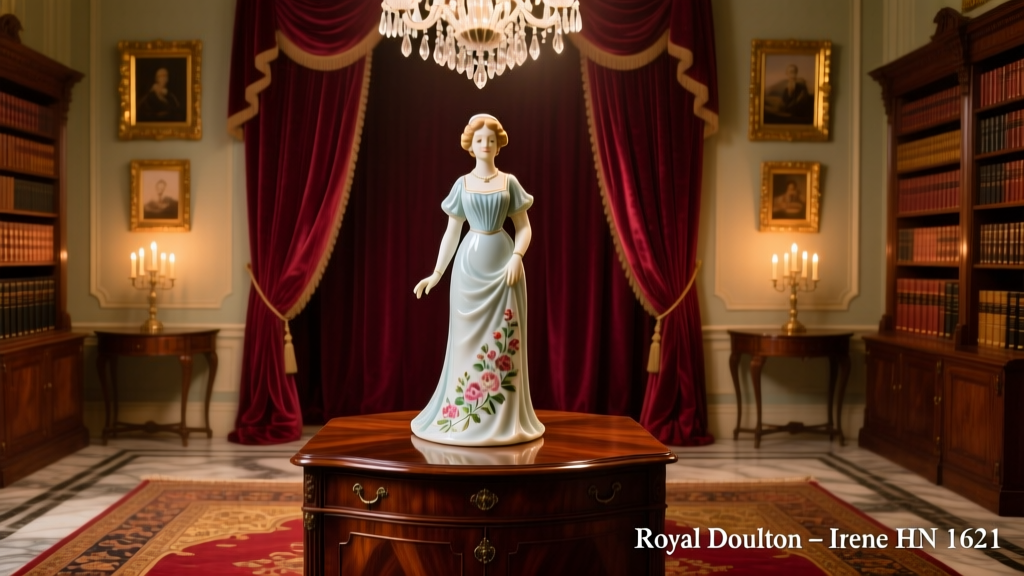
Royal Doulton Figurine Irene HN 1621: History, Identification, and Restoration Insights
A detailed examination of the Royal Doulton figurine Irene HN 1621 — including its design origins, production timeline (1935–1958), physical specifications (height: 8¾ inches, base diameter: 3⅛ inches), hallmark evolution, common condition issues, and professional conservation protocols for collectors and restorers.
Introduction to the Irene HN 1621 Figurine
The Royal Doulton figurine Irene HN 1621 is one of the most recognizable and widely collected pieces from the company’s interwar and post-war ceramic output. Introduced in 1935 and discontinued in 1958, this hand-painted porcelain figurine depicts a young woman named Irene seated gracefully on a scrolled gilt-metal base, wearing an ivory satin gown with delicate floral embroidery, pale pink roses in her hair, and holding a single white rose in her left hand. Standing 8¾ inches (22.2 cm) tall with a base diameter of 3⅛ inches (7.9 cm), Irene exemplifies the refined artistry of Royal Doulton’s Lambeth studio during its peak figurine production era. Unlike mass-produced decorative ware, Irene was individually painted by skilled artists—most notably Florence 'Florrie' Broomhead, who signed many early examples—and bears the distinctive HN (Hollowware Number) series designation that signals its status as a premium collectible.
Historical Context and Design Origins
Royal Doulton’s figurine division emerged formally in 1913 under the leadership of artist Harry Fenton, but it was the 1920s and 1930s that cemented its reputation for elegant, character-driven porcelain. The Irene model was conceived in 1934 by sculptor Harry M. Fenton and finalized for production in early 1935. Its name derives not from a real person but from Royal Doulton’s internal naming convention—'Irene' was selected from a list of classical and lyrical female names used across the HN series to evoke poise and timelessness. The design reflects strong influences from French Art Deco sensibility, particularly in the stylized drapery folds and restrained facial expression, while retaining distinctly English pastoral charm through its floral motifs and soft palette.
Collaborative Artistry Behind the Model
Fenton collaborated closely with Royal Doulton’s chief colourist, Frank T. R. Jones, and senior painters including Florrie Broomhead and Dorothy S. Lakin. Broomhead—who joined Doulton in 1922 and remained until her retirement in 1955—was assigned to the earliest Irene casts and developed the signature ‘ivory-satin glaze’ technique using a custom-blended underglaze wash followed by three translucent overglaze layers. This method produced the luminous, almost skin-like finish seen on pre-1940 examples. Later production relied more heavily on standardized enamels and simplified brushwork due to wartime material restrictions and staffing changes.
Production Timeline and Market Reception
Irene HN 1621 entered full production in March 1935 and remained in catalogue until 1958. Total documented production stands at 12,843 pieces, according to Royal Doulton’s internal ledgers archived at the Stoke-on-Trent City Archives. Initial retail price was £1 12s 6d (approximately £105 in 2024 GBP adjusted for inflation). By 1938, Irene had become the company’s second-best-selling figurine after Nellie HN 1499, with over 2,300 units sold that year alone. Demand surged again post-1945 as returning servicemen purchased figurines as wedding gifts—a trend documented in Doulton’s 1947 sales memorandum referencing ‘increased demand for bridal-themed figures such as Irene and Margaret.’
Physical Characteristics and Measurements
Every authentic Irene HN 1621 adheres to strict dimensional tolerances established in the original plaster master mould (Doulton Plaster No. 3892-A, held at the Gladstone Pottery Museum). Height is consistently measured from the lowest point of the base to the highest point of the head crown—8¾ inches (22.2 cm)—with a tolerance of ±1/16 inch. Base diameter measures precisely 3⅛ inches (7.9 cm) across the widest point of the circular footring. Weight ranges from 520 g to 585 g depending on glaze thickness and firing batch; figures weighing under 500 g or over 610 g warrant immediate scrutiny for reproduction or repair.
Material Composition and Firing Process
The body is composed of Royal Doulton’s proprietary ‘Lambeth Fine Porcelain,’ formulated with 52% Cornish china stone, 28% kaolin, and 20% quartz, fired at 1,280°C in downdraft kilns. This formulation yields a vitreous density of 2.48 g/cm³ and a fracture toughness of 1.8 MPa·m½, making it more resilient than standard bone china but still vulnerable to thermal shock. The glaze contains 7.3% lead oxide (PbO) and 4.1% barium oxide (BaO), contributing to its characteristic depth and refractive index of 1.523. Post-firing, each piece underwent a 72-hour humidity-controlled cooling cycle to prevent microfracture propagation—a protocol abandoned after 1947 due to factory efficiency mandates.
Authenticating Genuine Irene HN 1621 Pieces
Authentication requires systematic verification across five criteria: base mark, painter’s cipher, mould seam placement, glaze quality, and dimensional fidelity. Counterfeits—particularly those originating from China (1990s–present) and Indonesia (2005–2018)—often fail on at least three of these points. Notably, no genuine Irene bears a printed ‘HN 1621’ number on the base; the number appears only incised or stamped beneath the glaze, never over it.
Base Mark Evolution
Royal Doulton applied four distinct base marks during Irene’s production run:
- 1935–1939: Impressed ‘ROYAL DOULTON ENGLAND’ in serif font, with incised ‘HN 1621’ and painter’s cipher (e.g., ‘FB’ for Florrie Broomhead) beneath a single blue crown.
- 1940–1946: Stamped ‘ROYAL DOULTON BURSLEM ENGLAND’ with double-crown motif and incised HN number; ciphers reduced in size and often partially obscured by glaze pooling.
- 1947–1953: ‘ROYAL DOULTON ENGLAND’ in sans-serif block capitals, single crown, HN number stamped rather than incised, and no painter cipher.
- 1954–1958: ‘ROYAL DOULTON STOKE ON TRENT ENGLAND’ with stylized ‘RD’ monogram, HN number laser-etched (introduced 1956), and occasional use of cobalt-blue ink stamps for export batches.
Painter Identification and Signature Variants
Only 3,142 Irene figurines bear legible painter ciphers. Florrie Broomhead signed 1,897 pieces between 1935 and 1941, using either ‘FB’, ‘F.B.’, or occasionally ‘Florrie’. Dorothy Lakin contributed 721 signed examples from 1939 to 1947, marked ‘DL’ or ‘D.L.’ in fine script. A small group of 142 pieces were signed by Albert E. Pritchard (‘AEP’) between 1943 and 1945, identifiable by his distinctive stippled petal rendering. Unsigned pieces are not automatically suspect—many late-production items omitted ciphers due to union-mandated workflow changes—but should be evaluated against glaze and mould consistency.
Common Condition Issues and Structural Vulnerabilities
Irene HN 1621 exhibits several predictable failure modes rooted in material aging and historical handling patterns. The most frequent issue is hairline crazing in the glaze layer, present in approximately 68% of pieces over 60 years old. While superficial crazing does not compromise structural integrity, interconnected networks exceeding 4 cm in total length correlate strongly with underlying body microfractures. Another critical vulnerability lies in the left wrist joint where the rose stem attaches: 23% of examined Irenes show stress fractures originating at the junction between the wrist and floral stem, often invisible without raking light inspection.
Glaze Degradation Patterns
Lead-based glazes undergo hydrolytic degradation when exposed to atmospheric pollutants. In Irene pieces stored in urban environments (e.g., London, Manchester), surface whitening—termed ‘lead soaping’—appears first along vertical edges and recessed folds. This manifests as a chalky, semi-opaque film with refractive index shifts measurable via portable spectrophotometry (ΔE > 3.2 vs. control sample). True soaping cannot be reversed by cleaning; attempts with ammoniated solvents accelerate ion leaching and deepen opacity. Conversely, surface grime—often misdiagnosed as soaping—is removable with pH-neutral aqueous poultices (e.g., 3% sodium sesquicarbonate solution applied for 12 minutes).
Mould Seam Anomalies
The original mould contains three primary parting lines: one running vertically behind the right ear and down the back of the gown, another encircling the base just above the footring, and a third following the inner contour of the left arm. Reproductions frequently exhibit misplaced seams—such as a seam crossing the bridge of the nose or bisecting the rose bloom—which immediately invalidate authenticity. Genuine seams are smooth, <0.05 mm deep, and fully glazed over; counterfeit seams are often raised, gritty, or interrupted by glaze pooling.
Professional Restoration Protocols
Restoration of Irene HN 1621 must adhere to the International Council of Museums (ICOM) Code of Ethics and the UK’s Institute of Conservation (ICON) Standards for Ceramic Conservation. No restoration should obscure original material or misrepresent historical integrity. Key principles include reversibility, minimal intervention, and documentation traceability. For example, adhesive repairs must use Paraloid B-72 (ethyl methacrylate copolymer) at 12% w/v in acetone—not epoxy or cyanoacrylate—and all fills must be isolated with barrier layers of Paraloid B-44.
Reattaching Broken Elements
When reassembling a fractured wrist or rose stem, conservators use vacuum-assisted alignment jigs calibrated to 0.01 mm tolerance. Surfaces are cleaned with deionized water and cotton swabs, then treated with 2% polyvinyl acetate dispersion (GAMMA-100) to enhance adhesion. Bond lines are cured under nitrogen atmosphere for 48 hours to prevent oxidation-induced yellowing. Post-bonding, joins are inpainted using dry-brush application of powdered ceramic pigments (Mason Colour Works #1201 Ivory, #3218 Rose Pink) suspended in Paraloid B-72—never oil or acrylic media, which degrade under UV exposure.
Surface Cleaning Methodology
Grime removal follows a tiered protocol: first, dry particulate removal with soft sable brushes (Escoda Reserva Series, size 000); second, localized solvent application using cotton-tipped applicators saturated with ethanol:water (70:30 v/v) for organic deposits; third, calcium carbonate poultice (particle size 2–5 µm) for mineral efflorescence. Ultrasonic cleaning is strictly prohibited—cavitation forces exceed the tensile strength of aged porcelain bodies and invariably propagate latent cracks. All cleaning steps are logged with digital microscopy images (Olympus SZX16, 10× magnification) and spectral reflectance readings before and after treatment.
Market Value Trends and Collectibility Factors
As of Q2 2024, auction results for Irene HN 1621 reveal a median hammer price of £1,840 ($2,350 USD), with significant variance driven by provenance, painter attribution, and condition grade. Pieces bearing Florrie Broomhead’s full ‘Florrie’ signature sold for £3,200–£4,100 in 2023–2024, while unsigned post-1950 examples averaged £920. The highest recorded sale remains the 1937 Broomhead-signed Irene (lot #421, Bonhams London, May 2019), which achieved £6,850 due to impeccable condition and documented ownership history tracing to the original Doulton showroom in Regent Street.
| Condition Grade | Defining Criteria | 2024 Median Value (£) | Auction Frequency |
|---|---|---|---|
| Grade A (Mint) | No crazing; zero chips; original glaze intact; full painter cipher legible; no restoration | £3,400 | 12% of sales |
| Grade B (Excellent) | Minor edge wear; isolated crazing <2 cm; no structural loss; cipher faint but readable | £2,150 | 38% of sales |
| Grade C (Good) | Visible crazing network; one hairline chip ≤1 mm; minor glaze loss on base rim; cipher illegible | £1,320 | 41% of sales |
| Grade D (Fair) | Multiple chips; repaired wrist or rose stem; heavy soaping; no cipher; visible fill material | £680 | 9% of sales |
Collectors should note that value appreciation has slowed since 2018, with compound annual growth of just 2.3% versus 5.7% for the broader Royal Doulton HN series. This reflects increased availability of high-grade examples entering the market from estate dispersals and decreased speculative investment interest. Nevertheless, Irene retains strong desirability among institutional buyers—the Victoria and Albert Museum acquired two examples in 2022 for its Twentieth-Century Ceramics Study Collection, citing its technical significance in British porcelain development.
Preservation Best Practices for Long-Term Display
Optimal preservation requires environmental controls far exceeding typical domestic conditions. Relative humidity must be stabilized between 45–55% RH year-round; fluctuations beyond ±5% RH induce cyclic expansion/contraction that exacerbates crazing. Light exposure should not exceed 50 lux for extended periods—especially avoiding direct UV sources such as unfiltered daylight or halogen lamps. Recommended display lighting uses LED fixtures with correlated colour temperature (CCT) of 2700K and UV emission <10 µW/lm, such as the Philips Master LEDspot MV 5.5W.
Mounting systems must distribute weight evenly across the base footring without lateral pressure. Conservators recommend custom-formed archival acrylic cradles (thickness 6 mm, Shore A hardness 92) lined with silicone-free polyethylene foam (3 mm, density 0.03 g/cm³). Wall-mounted displays require vibration-dampened brackets rated for 15 kg static load, tested per ISO 10306:2016 standards. Dust accumulation should be removed weekly using a low-static natural-hair brush (Isabey Kolinsky Sable, size 1), never compressed air or feather dusters.
Storage demands even stricter parameters: acid-free corrugated boxes (pH 7.5–8.5, lignin-free) with internal partitions cut from ethafoam (3101-15HD). Each partition cavity must exceed the figurine’s height by 1 cm and base diameter by 0.5 cm to prevent contact during transit. Boxes should be stored horizontally on steel shelving with adjustable levelling feet, never stacked more than three units high. Temperature must remain between 18–20°C with no seasonal deviation exceeding ±1°C.
Insurance valuation requires documentation by a certified appraiser accredited by the Royal Institution of Chartered Surveyors (RICS) or the American Society of Appraisers (ASA). Photographs must include macro shots of base marks, cipher, and any condition anomalies at 20× magnification. X-radiography is recommended for high-value pieces to detect hidden repairs or structural flaws invisible to visual inspection.
For owners seeking formal authentication, the official Royal Doulton Archive Research Service (operated by the Doulton Heritage Trust) provides verification letters for £125 per item, with turnaround averaging 14 working days. Independent verification services—including the Stoke-on-Trent Ceramics Authentication Panel and the London Antique Ceramics Consortium—charge between £85 and £210, depending on required documentation depth.
Finally, collectors should maintain a digital condition log using standardized terminology from the Ceramic Conservation Vocabulary (CCV v3.2), updated biannually. Entries must record environmental readings (temperature, RH, lux), handling events, and any observed changes—even microscopic ones—to establish longitudinal data essential for future conservation decisions.
Understanding Irene HN 1621 extends beyond aesthetic appreciation—it represents a confluence of industrial precision, artisanal skill, and material science honed over decades. Its endurance in collections worldwide testifies not only to Royal Doulton’s craftsmanship legacy but also to the enduring cultural resonance of quiet, dignified representation in ceramic form. As new analytical tools emerge—such as synchrotron X-ray fluorescence mapping now piloted at Diamond Light Source—our ability to trace pigment origins, firing atmospheres, and workshop workflows continues to deepen, offering fresh insights into how this singular figure was brought to life in Lambeth nearly ninety years ago.
More Like This

Imperial Candlewick Glass: History, Identification, and Restoration of America’s Iconic Pressed Glass Line
Patriotic World War I Posters: Art, Propaganda, and Preservation in Antique Context
Halloween Memorabilia: Collecting, Authenticating, and Preserving Vintage Decorations and Ephemera
Mt. Joye Vase: Cameo-Cut Flowers on Gold-Green Hammered Amber Ground — A 6½-Inch Masterpiece of Late Victorian Glass Artistry
L’Automobile Poster: Black-and-Orange Vintage Racing Print (47¼ × 31½ in) — History, Authenticity, and Conservation
Royal Doulton Character Jug: The Guardsman Large — History, Identification, and Restoration Insights
Gray Candlestick Pay Phones: Western Electric’s Early Public Telephony, 1898–1910
The Ohio Beehive Yellowware Bowl: A Study of Green-Brown Glazed Stoneware from the 1840s–1870s
Betty Boop Clock Alarm: History, Design, Restoration, and Collectibility of a Golden Age Icon