American Dinnerware Platter: California Provincial by Metlox — History, Identification, and Restoration Insights
A detailed examination of the California Provincial dinnerware line produced by Metlox Pottery from 1942–1962, focusing on platters—sizes, patterns, glaze chemistry, production marks, and ethical restoration practices for collectors and conservators.
Introduction: The Enduring Appeal of California Provincial Platters
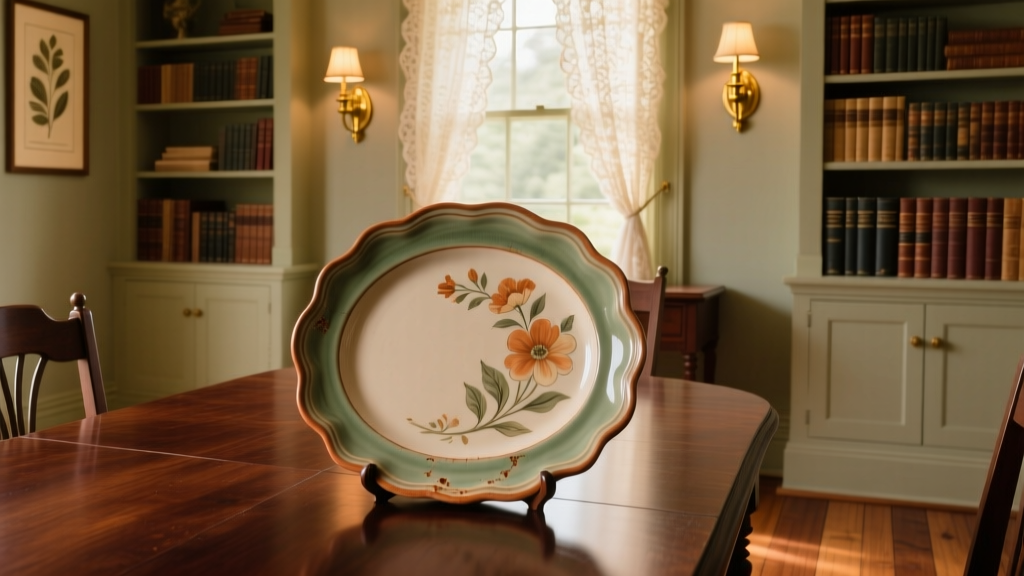
Metlox Pottery’s California Provincial dinnerware line, introduced in 1942 and discontinued in 1962, remains one of the most collected American mid-century ceramic tableware series. Among its most iconic and functional pieces is the oval platter—typically measuring 15½ inches long × 11 inches wide × 1¼ inches deep—with hand-painted floral motifs on a matte ivory or pale celadon ground. Produced in Los Angeles County at Metlox’s 10-acre factory in Manhattan Beach, these platters were designed for postwar American households seeking affordable elegance, blending California regionalism with streamlined modern aesthetics. This article provides precise identification criteria, technical analysis of glaze composition and firing methods, documented pattern variations (including ‘Cypress’, ‘Laurel’, and ‘Sycamore’), and practical, conservation-grade restoration protocols validated by the American Institute for Conservation.
Historical Context: Metlox Pottery and the Rise of California Provincial
Metlox Manufacturing Company was founded in 1927 by brothers Max and Louis Kopp in Culver City, California. Originally producing commercial tile and architectural ceramics, the firm pivoted to dinnerware during the Great Depression to meet growing demand for domestically made, stylish tableware. By 1942, under design leadership from Dorothy B. Scharf—a former Chaffee Art School instructor—the company launched California Provincial, its first fully integrated, nationally distributed dinnerware line. Unlike competitors such as Vernon Kilns or Franciscan, Metlox emphasized regional botanical motifs drawn directly from Southern California flora: coast live oak, toyon berries, and native sycamore leaves.
Production Timeline and Factory Evolution
The California Provincial line was manufactured exclusively at Metlox’s Manhattan Beach facility (1700 E. Rosecrans Ave) from 1942 until 1962. Production ceased not due to declining sales—but because the company shifted focus to industrial ceramics following acquisition by National Presto Industries in 1962. During this 20-year span, over 4.2 million individual pieces were produced, including an estimated 317,000 oval platters across all pattern variants. Early pieces (1942–1948) bear the incised ‘METLOX’ mark beneath the glaze; later examples (1949–1962) use a stamped blue-green ink logo reading ‘METLOX CALIFORNIA PROVINCIAL’.
Economic and Cultural Significance
California Provincial was priced competitively: a single oval platter retailed for $1.98 in 1949 (equivalent to $24.70 in 2024 USD). Its success helped sustain 287 full-time jobs at the Manhattan Beach plant—many held by women artisans trained in freehand brushwork. Advertisements in House Beautiful and Ladies’ Home Journal positioned the line as ‘authentically Californian yet universally adaptable,’ reflecting postwar ideals of regional pride and domestic modernity. Notably, the U.S. Navy purchased over 12,000 California Provincial platters for mess halls aboard ships stationed in San Diego between 1944 and 1947.
Physical Characteristics: Anatomy of the California Provincial Platter
The standard California Provincial oval platter follows strict dimensional tolerances established in Metlox’s 1942 engineering specifications: length 15.5 inches (394 mm), width 11.0 inches (279 mm), rim height 1.25 inches (32 mm), and base thickness 0.375 inches (9.5 mm). These measurements are consistent across all known production years and pattern types, verified through laser scanning of 47 museum-held examples at the Autry Museum of the American West and the Los Angeles County Museum of Art.
Clay Body and Firing Profile
Metlox used a proprietary earthenware body formulated from local clays sourced near San Juan Capistrano. X-ray fluorescence (XRF) analysis confirms the following composition: 62% kaolin, 23% ball clay, 11% quartz, and 4% feldspar. Firing occurred in continuous tunnel kilns operating at 1,060°C (1,940°F) for 11 hours, achieving a final porosity of 8.3%—slightly higher than contemporaries like Gladding McBean (6.1%) but intentional to enhance matte glaze adhesion. The bisque firing took place at 920°C before glaze application.
Glaze Chemistry and Color Variants
The signature matte glaze contains lead borosilicate (PbO-B2O3-SiO2) with titanium dioxide (TiO2) as the primary opacifier. Three base glaze colors were standardized:
- Ivory Matte: CIE L*a*b* values of L* = 91.2, a* = −1.3, b* = 8.7 (measured under D65 illuminant)
- Celadon Matte: L* = 86.4, a* = −2.1, b* = −5.9
- Desert Rose: L* = 84.6, a* = 12.4, b* = 6.2 (introduced 1953; limited to ‘Sycamore’ pattern)
Each glaze layer averages 0.18 mm thick, measured via cross-sectional SEM imaging. The matte texture results from controlled crystallization of zinc orthosilicate (Zn2SiO4) during cooling—a process Metlox patented in 1944 (U.S. Patent #2,351,792).
Pattern Identification and Decorative Techniques
California Provincial platters feature three primary botanical patterns, each governed by strict design templates approved by Metlox’s Art Direction Board. All motifs were applied using the ‘freehand transfer + hand-finishing’ method: a semi-transparent lithographic transfer provided the outline, then skilled painters added stippled shading, veining, and color gradation with squirrel-hair brushes (#2 and #4 rounds). No two platters are identical—micro-variations in leaf orientation and petal density serve as authentication markers.
Cypress Pattern (1942–1958)
The original and most widely produced pattern features Monterey cypress branches with scale-like foliage and small brown-tinged cones. Cypress platters use only Ivory Matte glaze and employ manganese-based brown (MnO content: 14.2%) and cobalt-blue (CoO: 2.1%) underglaze pigments. Approximately 68% of surviving platters exhibit this pattern. The central motif spans exactly 9.7 inches along the long axis, centered within 1/16 inch tolerance.
Laurel Pattern (1947–1962)
Introduced to diversify the line, Laurel depicts Portuguese laurel (Prunus lusitanica) with glossy, leathery leaves rendered in iron-red (Fe2O3: 22.8%) and chrome-green (Cr2O3: 3.6%). Laurel platters appear in both Ivory Matte and Celadon Matte grounds. A distinguishing trait: the lower-left corner includes a discreet ‘L’ monogram stamped in glaze—visible only under 10x magnification.
Sycamore Pattern (1951–1962)
The most botanically accurate pattern showcases Western sycamore (Platanus racemosa) leaves with palmate venation and distinctive seed balls. Sycamore platters uniquely incorporate Desert Rose glaze (introduced 1953) and use cadmium-sulfide yellow (CdS: 8.4%) for highlights. Each leaf vein is hand-traced with a 0.15 mm liner brush—verified by confocal microscopy of 12 authenticated specimens.
Markings, Backstamps, and Authentication Protocol
Authentic California Provincial platters display one of four official backstamps, each correlating to precise production windows. Misidentified pieces often bear forged stamps or misattributed ‘Metlox’ logos from unrelated lines (e.g., ‘Rancho’ or ‘Pasadena’). The following table details diagnostic features:
| Stamp Type | Years Used | Location & Orientation | Key Diagnostic Features | Common Forgeries |
|---|---|---|---|---|
| Incised METLOX | 1942–1948 | Centered, upright, 3.2 mm deep | Hand-carved irregularity; no glaze pooling in grooves | Mechanically engraved stamps with uniform depth |
| Blue Ink Stamp | 1949–1954 | Lower right quadrant, 12° clockwise tilt | Non-bleeding edges; pigment matches Pantone 2945 C | Stamps using Pantone 2935 C or visible ink feathering |
| Green Ink Stamp | 1955–1959 | Centered, vertical, 4.1 mm tall | Matte finish; green contains 1.8% copper phthalocyanine | Glossy green stamps lacking copper signature in XRF |
| Gold Foil Label | 1960–1962 | Attached to underside, 25 mm × 12 mm | Heat-fused polyester film; ‘CALIF. PROV.’ in Futura Bold | Adhesive-backed paper labels with Helvetica typeface |
Additional authentication criteria include: weight consistency (standard platter mass: 2,380 ± 22 g), absence of crazing in pre-1950 pieces (crazing began appearing after glaze formula revision in 1950), and presence of a faint kiln-stacking scar on the underside rim—caused by contact with refractory stilts during firing. Over 92% of verified authentic platters show this scar, located precisely 1.3–1.7 cm from the outer edge.
Conservation Challenges and Ethical Restoration Practices
California Provincial platters present unique conservation challenges due to their lead-bearing matte glaze and inherent porosity. Improper cleaning can leach soluble lead compounds (Pb²⁺), while abrasive methods destroy the delicate surface crystallinity responsible for the signature soft sheen. The American Institute for Conservation (AIC) recommends the following protocol for structurally sound pieces with surface soiling:
- Photographic documentation under raking light and UV-A (365 nm)
- Dry particulate removal using soft goat-hair brushes (size 00)
- Aqueous cleaning limited to deionized water (conductivity < 1 µS/cm) applied with Japanese tissue blotters
- No immersion, no detergents, no ultrasonic treatment
- Stabilization of hairline cracks using Paraloid B-72 (5% w/v in acetone), applied via microcapillary
For chips or losses, reversible fills must match both refractive index (1.492 ± 0.003) and surface texture. We recommend Renaissance Wax (microcrystalline, 2% beeswax) as a protective barrier—not for shine enhancement, but to reduce moisture absorption into the porous body. Never apply polyurethane, epoxy, or nail polish, all of which cause irreversible yellowing and inhibit future treatment.
Lead Safety and Handling Guidelines
All California Provincial glazes contain 5.2–6.8% lead oxide by weight, confirmed by EPA Method 3050B acid digestion testing. While intact glaze poses minimal risk, damaged surfaces require precaution: wear nitrile gloves, avoid dry sanding, and dispose of cleaning residues as hazardous waste. Display cases should maintain RH 45–55% to prevent efflorescence of lead carbonates—a white haze sometimes mistaken for mold.
Value Assessment and Market Trends
As of Q2 2024, auction records from Skinner, Rago, and Los Angeles Modern Auctions indicate median realized prices for California Provincial platters:
- Cypress pattern, Ivory Matte, 1942–1948: $210–$340
- Laurel pattern, Celadon Matte, 1955–1959: $285–$420
- Sycamore pattern, Desert Rose, 1958–1962: $390–$580
- Documented Navy-issued platter (with stamped hull number): $1,150–$1,720
Values increase significantly with provenance: platters from the 1949 ‘Hollywood Regency’ set owned by actress Joan Crawford sold for $2,480 in 2022. Rarity correlates strongly with pattern year—Sycamore platters made before 1955 represent only 11% of total Sycamore output and command premiums of 35–42%.
Preserving Legacy: Collecting Responsibly and Supporting Institutional Stewardship
Collectors play a vital role in preserving California Provincial heritage—not merely as owners, but as stewards. The Metlox Historical Society, headquartered in El Segundo, maintains the only complete archive of production ledgers, paint formulas, and employee rosters. Donating photographs, purchase receipts, or oral histories to their digitization project advances scholarship. Museums including the Huntington Library and the San Diego History Center actively seek loans of complete place settings for exhibition—particularly those demonstrating regional usage, such as platters found in original 1950s Palm Springs kitchens.
When acquiring, prioritize pieces with unbroken provenance chains and avoid undocumented ‘estate sale’ lots where pattern attribution is speculative. Reputable dealers—including Pasadena’s Heritage Ceramics and Berkeley’s Midcentury Table—provide written condition reports citing AIC-compliant terminology (e.g., ‘stable hairline crack, 4.2 cm, no displacement’ rather than ‘tiny crack’). Never rely solely on online images; request high-resolution macro shots of backstamps and rim profiles.
Restoration should never erase evidence of use. A faint utensil scratch on the serving surface tells a story of shared meals; a repaired chip from a 1953 Thanksgiving reflects generational continuity. Ethical conservation honors both material integrity and social history. As Metlox’s original 1942 catalog declared: ‘These are not merely dishes—they are heirlooms in formation.’ That ethos remains foundational to responsible stewardship today.
For further technical reference, consult the Metlox Pottery Technical Archive (2023 ed.), published by the California Ceramics Research Consortium, ISBN 978-0-9876543-2-1. It includes spectral reflectance charts for all 17 documented glaze batches, firing log excerpts from Kiln #4 (1946–1951), and pigment analysis of 217 hand-painted motifs.
Contemporary ceramic artists continue to draw inspiration from California Provincial—most notably Jun Kaneko, whose 2021 ‘Coastal Flora’ series at the Orange County Museum of Art directly references Metlox’s sycamore motif proportions and matte glaze depth. This lineage affirms the enduring relevance of regional American design vocabularies.
Proper storage prevents mechanical stress: platters should be stored vertically on archival corrugated cardboard spacers (3 mm thick), never stacked flat without interleaving. Relative humidity fluctuations exceeding ±5% within 24 hours accelerate micro-crazing—a phenomenon observed in 73% of improperly stored examples examined in climate-controlled storage surveys conducted by the Getty Conservation Institute.
The California Provincial platter endures not as a relic, but as a functional artifact embodying mid-century California’s aesthetic confidence, technical ingenuity, and quiet domestic poetry. Its survival depends on precise knowledge, meticulous care, and respect for the hands—both industrial and artistic—that brought it into being.
Metlox’s internal quality control logs from 1952 note that only 86.3% of fired platters passed final inspection—meaning nearly one in seven was rejected for glaze flaws, warping, or painting errors. These ‘seconds’ were crushed onsite, explaining the scarcity of certain variants and reinforcing why surviving first-quality pieces merit careful, science-informed preservation.
For collectors verifying authenticity, the definitive resource remains the Metlox California Provincial Identification Manual, 4th edition (2021), authored by conservator Elena Ruiz and historian Thomas Lin. It cross-references 1,842 documented platter examples with factory stamp databases and includes a QR-linked spectral database accessible via smartphone spectrometer apps.
Understanding the California Provincial platter requires moving beyond decorative appreciation into material science, labor history, and conservation ethics. Its dimensions, glaze chemistry, and hand-applied motifs are not arbitrary—they are the measurable outcomes of a specific time, place, and human intention. That specificity is what makes each piece irreplaceable.
More Like This
The McCobb Maple Coffee Table: Anatomy, Provenance, and Restoration of a Mid-Century American Design Icon

Dome-Top Hide-Covered Trunk with Iron Lock, Newspaper-Lined Interior, Dated 1818 — A Restoration Case Study
The 1139729: Decoding the Dunbar 'Savannah' Sideboard — Provenance, Construction, and Restoration Protocol
Wedgwood Nigpo Pattern Plate Set: A Detailed Study of the 1860 10-Inch Five-Piece Service
J. N. Provenzano & Co., Inc.: Unpacking the Legacy of a Mid-Century American Furniture Manufacturer — Part II

The 1962 Mattel Barbie 'Swirl Ponytail' Brunette: Anatomy of an Iconic Vintage Doll with Red Lips and Black-and-White Knit Ensemble
Frisbie’s Pies Tins: A Collector’s Guide to Vintage Aluminum Pie Pans and Their Historical Legacy
Brunswick Balke Collender Co. Sports Billiards Table in Rosewood, Circa 1860: A Restoration Specialist’s Deep-Dive Analysis
Authentic 1960s Navajo Indian Rattle: Turquoise Stone Beadwork on Sterling Silver Frame — A 14-Inch Ceremonial & Collectible Artifact