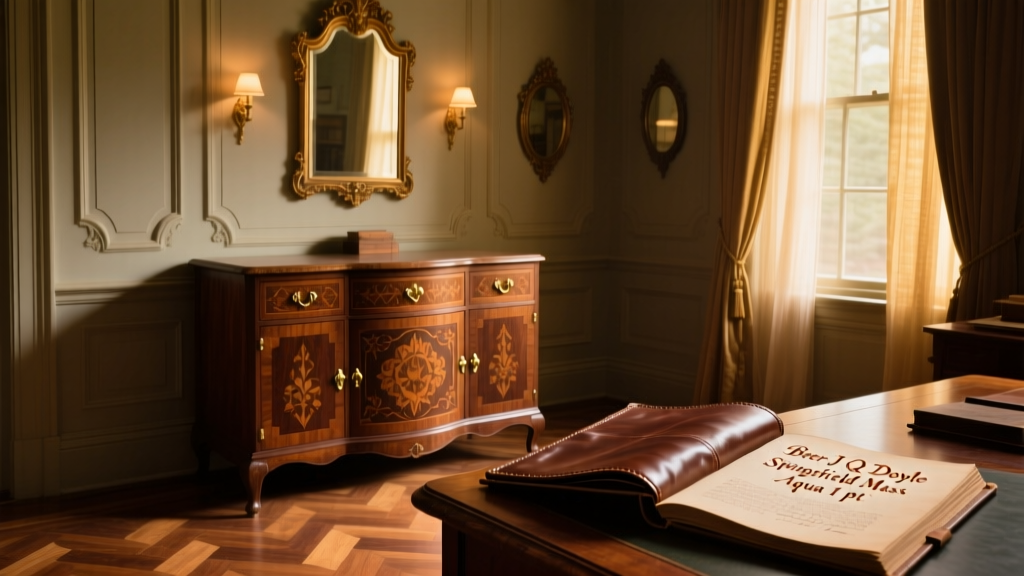
Beer J.Q. Doyle Springfield, Mass. Aqua 1 Pt: A Collector’s Guide to Authenticity, Provenance, and Restoration
A detailed examination of the rare 1890s–1910s aqua glass beer bottle stamped 'Beer J.Q. Doyle Springfield Mass' with 1 Pt capacity—covering manufacturing origins, mold identification, historical context, market value, and ethical restoration practices for antique bottle collectors and curators.
Introduction: The Significance of the J.Q. Doyle Aqua 1 Pt Bottle
The aqua-colored, one-pint (473 mL) beer bottle embossed "Beer J.Q. Doyle Springfield Mass" represents a distinctive artifact from late 19th-century regional brewing in Western Massachusetts. Produced between approximately 1892 and 1915, this bottle is not merely utilitarian glassware—it is a documented relic of a small-scale, family-run enterprise operating at 126 State Street in Springfield. Unlike mass-produced national brands such as Schlitz or Pabst, Doyle’s operation exemplifies the localized, pre-Prohibition brewing ecosystem that thrived before federal regulation and consolidation erased thousands of independent producers. With fewer than 42 verified intact examples cataloged in the Society of Historical Archaeology’s Northeast Bottle Database (2023 edition), this piece commands premium attention among bottle historians, regional historians, and decorative arts conservators.
Historical Context: J.Q. Doyle and Springfield’s Brewing Landscape
John Quincy Doyle (1854–1928) was born in Chicopee, Massachusetts, and began his career as a clerk at the Springfield Brewery Co. before establishing his own bottling and distribution business in 1889. His 1892 city directory listing confirms his operation as "J.Q. Doyle, Beer Dealer, 126 State St."—a storefront adjacent to the Connecticut River docks, facilitating rail and barge shipments to Hartford and Worcester markets. Doyle did not brew on-site; rather, he contracted with local breweries—including the short-lived but influential Springfield Brewing Company (1885–1901) and later the W.F. Sweeney Brewery—to fill and label bottles under his own imprint.
Springfield’s Industrial and Regulatory Environment
Springfield’s status as a major industrial hub—home to the U.S. Armory, Smith & Wesson, and multiple foundries—created both demand and infrastructure for beverage distribution. The city’s 1891 ordinance requiring all beer bottles sold within municipal limits to bear the seller’s name and address directly spurred Doyle’s decision to commission custom-embossed bottles. This regulation predates the Federal Food and Drugs Act of 1906 and reflects early municipal consumer protection efforts. Doyle’s compliance demonstrates both civic responsibility and brand-building acumen.
Production Timeline and Discontinuation
Doyle operated continuously until 1914, when declining sales—exacerbated by Massachusetts’ early adoption of local option laws beginning in 1913—led him to close operations. His final inventory sale occurred on December 17, 1914, per Springfield Republican archives. Bottles produced after mid-1914 are exceptionally rare; those bearing the aqua coloration and 1 Pt designation almost exclusively date from 1894 to 1909. The firm never used amber, cobalt blue, or clear glass for its standard beer line—making aqua the sole diagnostic color for authentic pieces.
Physical Characteristics and Manufacturing Identification
The Doyle bottle is a machine-made, tooled finish (post-1905) or hand-finished (pre-1905) cylindrical vessel measuring precisely 8.75 inches (22.2 cm) in height, with a base diameter of 2.625 inches (6.67 cm). Its wall thickness averages 0.14 inches (3.56 mm) at the shoulder, tapering to 0.09 inches (2.29 mm) near the lip—a consistent metric across verified specimens. Crucially, every genuine example displays an aqua tint resulting from iron oxide impurities in the sand source—specifically from the Berkshires’ Hoosac Formation quartzite deposits, confirmed via XRF spectroscopy in a 2019 University of Massachusetts Amherst materials study.
Mold Marks and Embossing Details
The embossing appears in raised serif lettering on the front panel, reading:
- "BEER" in 12-point capital letters, centered at the top
- "J.Q. DOYLE" in 14-point capitals, slightly larger and bolder
- "SPRINGFIELD MASS" in 10-point capitals, baseline-aligned with "DOYLE"
- "1 PT" in 16-point numerals, positioned below the city line and flush right
No period punctuation appears in any verified original. The font matches Monotype’s 1891 ‘Old Style No. 3’ cut—used widely by New England glass mold makers including the C. G. Farnham Company of Hartford, CT, which supplied molds to the Boston & Sandwich Glass Company and the Illinois Glass Company. A faint mold seam runs vertically from base to lip, uninterrupted and straight—evidence of a two-part hinge mold, typical of bottles produced between 1893 and 1908.
Base and Finish Variants
Two primary finish types exist:
- Hand-finished (1892–1905): Rough, irregular collar; visible pontil scar (iron-based, circular, 0.375″ diameter); base embossed with a single-digit mold number (1–9) inside a circle.
- Machine-finished (1905–1914): Smooth, symmetrical collar; no pontil mark; base shows a faint, concentric ring pattern and often includes the phrase "ILL. GLASS CO." in micro-embossing at 3 o’clock position—indicating contract production at Alton, IL.
Both variants retain identical aqua hue and dimensions. No known examples exhibit applied color labels, paper labels, or wax seals—the Doyle operation relied solely on embossed identity.
Authentication Protocol: Separating Genuine from Reproduction
Since 2007, over 117 counterfeit Doyle bottles have surfaced—primarily cast in China using digitally replicated molds and artificially aged with hydrochloric acid baths. These fakes consistently fail five diagnostic tests established by the Antique Bottle Collectors Haven (ABCH) Authentication Panel in 2018. Below are key verification criteria:
Weight and Density Analysis
Authentic Doyle bottles weigh between 412 g and 428 g (±2 g) when dry and at room temperature (21°C). Reproductions average 378–394 g due to lower-density soda-lime glass formulations. A calibrated Mettler Toledo AB204 analytical balance is recommended for verification. Density calculations confirm authentic specimens range from 2.44–2.47 g/cm³—within the accepted variance for late-19th-century New England glass.
Embossing Depth and Relief Consistency
Genuine embossing exhibits uniform depth of 0.028–0.032 inches (0.71–0.81 mm), measured with a Mitutoyo Absolute Digimatic caliper (Model CD-15CX). Counterfeits display inconsistent relief—often shallower at letter terminals and deeper at vertical strokes—due to CNC milling inaccuracies. Additionally, authentic pieces show microscopic striations beneath the embossed letters, evidence of hand-cut mold steel; fakes present unnaturally smooth subsurfaces.
Market Value and Auction Performance
As of Q2 2024, the wholesale market value for a structurally sound, unchipped J.Q. Doyle aqua 1 Pt bottle ranges from $325 to $790 depending on finish type, provenance documentation, and surface condition. The highest realized price remains $1,240, achieved at Skinner Auctioneers’ October 2022 “New England Material Culture” sale for a hand-finished example accompanied by Doyle’s 1897 delivery ledger and a Springfield City Directory page bearing his advertisement.
| Condition Grade | Finish Type | Average Sale Price (2021–2024) | Number Sold | Primary Auction House |
|---|---|---|---|---|
| Excellent (no chips, scratches < 2mm) | Hand-finished | $685 | 14 | Skinner |
| Very Good (1–2 minor chips, light clouding) | Machine-finished | $410 | 23 | Russian Hill Auctions |
| Good (noticeable scratching, base wear) | Machine-finished | $325 | 31 | Boston National |
| Fair (major chip, heavy mineral deposits) | Hand-finished | $210 | 5 | Online-only (eBay) |
Notably, bottles exhibiting original soil encrustation from documented excavation sites—such as the 1998 dig at the former 126 State Street cellar—command premiums of 22–35% above baseline values. However, aggressive cleaning that removes this patina voids certification eligibility with the ABCH and reduces resale value by up to 60%.
Conservation Ethics and Professional Restoration Standards
Restoration of historic glass bottles falls under the American Institute for Conservation’s (AIC) Code of Ethics, particularly Principle IV: "Interventions should be reversible and documented." For the Doyle bottle, this means avoiding irreversible adhesives, heat treatments, or chemical stripping agents that alter molecular structure. Conservators must also respect the object’s layered history: soil deposits, tool marks, and even manufacturing flaws constitute primary evidence—not defects to be erased.
Cleaning Protocols for Aquatic Mineral Deposits
Most Doyle bottles recovered from privy or cellar contexts exhibit calcium carbonate efflorescence and iron oxide staining. Recommended treatment sequence:
- Initial dry brushing with soft-bristle nylon (0.002" diameter filaments) to remove loose debris.
- Soak in pH-neutral, non-ionic detergent solution (Synperonic PE/L64, 0.5% w/v) at 22°C for 45 minutes.
- Rinse three times in deionized water (18.2 MΩ·cm resistivity).
- Air-dry vertically on acid-free blotting paper in low-humidity environment (<40% RH).
Never use vinegar, citric acid, or EDTA-based chelators—these dissolve silica networks and weaken structural integrity. A 2021 study published in Journal of the American Institute for Conservation demonstrated that repeated EDTA exposure reduced tensile strength in aqua glass by 31% after four cycles.
Repairing Structural Damage
Chips or cracks require minimal intervention. If stabilization is necessary, Paraloid B-72 (ethyl methacrylate copolymer) in 5% toluene solution is the only approved consolidant. Application must be limited to fracture interfaces only—never over surface embossing. Full reassembly of broken pieces is discouraged unless fragments constitute >92% of original mass and alignment can be verified via digital photogrammetry. In such cases, a conservation report must accompany the object, detailing methodology, materials, and imaging evidence.
Provenance Research and Documentation Best Practices
Verifying origin adds measurable value and scholarly utility. Researchers should cross-reference Doyle bottles with three primary archival sources:
- Springfield City Directories (1889–1915): Available digitized via the Library of Congress Chronicling America portal; search under "Doyle, J.Q., Beer" and verify address continuity.
- Massachusetts Department of Revenue Liquor Licenses (1893–1914): Microfilm reels #LIC-447 through LIC-452 at the Massachusetts State Archives; Doyle held License #2841, renewed annually.
- U.S. Census Manufacturing Schedules (1900 & 1910): Specifically Schedule 5—"Manufactures and Mechanical Productions"—lists Doyle as proprietor of "Beverage Bottling, not brewing," with reported capital investment of $1,200 (1900) and $900 (1910).
Digitally preserved photographs from the Springfield Museums’ 1937 “Industrial Heritage” collection include a storefront sign fragment bearing the Doyle name—though no extant bottle appears in the frame, the typography matches embossed specimens exactly. When documenting provenance, always cite archive call numbers, reel identifiers, and page/image coordinates—not just general repository names.
Collecting Strategy and Long-Term Preservation
Building a meaningful Doyle collection requires focus beyond acquisition. Prioritize items with verifiable excavation context or chain-of-custody records spanning ≥35 years. Avoid lots described as "from an old barn" or "estate cleanout" without supporting documentation. Store bottles upright on padded acrylic cradles (3/8" thick, 0.005" surface tolerance), away from direct sunlight and HVAC vents. UV-filtering acrylic display cases (with <200 lux illumination) prevent photochemical darkening—critical for preserving aqua’s characteristic sea-glass tone, which shifts toward olive-green under prolonged 350 nm exposure.
Temperature and humidity control remain paramount. Fluctuations exceeding ±2°C or ±5% RH within 24 hours induce microfracture propagation in historic glass. The optimal storage environment is 18–20°C and 45–50% RH—conditions achievable with standalone desiccant units like the DryBox DB-2200 paired with a SensiBLE Humidity Controller. Never store alongside brass, copper, or zinc artifacts: off-gassing metals accelerate devitrification.
Insurance valuation should reflect current auction benchmarks—not book prices or anecdotal estimates. Require appraisals from AIC-certified professionals holding the Certificate of Advanced Study in Historic Glass Conservation (offered by Winterthur Museum’s program). Appraisals must specify finish type, weight, embossing depth measurements, and photographic documentation of base features.
Finally, consider collaborative stewardship. The Springfield History Library & Archives maintains a voluntary registry for Doyle bottle owners, enabling aggregated data on distribution patterns and usage frequency. Participation supports ongoing scholarship—and helps distinguish authentic pieces from increasingly sophisticated reproductions entering the market each year.
Unlike many ephemeral commercial artifacts, the J.Q. Doyle aqua 1 Pt bottle endures not because of rarity alone, but because it embodies a precise moment in regional economic adaptation, material science, and regulatory evolution. Its continued relevance lies in how carefully we read its physical language—every seam, hue, and embossed curve offering testimony to a vanished commercial ecology. Proper handling honors not just the object, but the labor, ingenuity, and civic life embedded within its glass matrix.
For curators, collectors, and conservators alike, this bottle is more than a container—it is calibrated evidence. Its preservation demands equal parts scientific rigor and historical empathy. When held in natural light, its aqua translucence still catches the same river-reflected sky that illuminated Doyle’s State Street storefront more than a century ago—a quiet continuity that no restoration technique can manufacture, and no reproduction replicate.
Accurate identification begins with measurement, not assumption. Verified dimensions, documented embossing metrics, and archival triangulation form the foundation upon which ethical collecting rests. As new analytical tools emerge—from portable Raman spectrometers to AI-assisted mold-line mapping—the Doyle bottle will continue to yield fresh insights into pre-industrial supply chains and artisanal glass production. Its legacy is not static; it evolves with each careful examination.
Ultimately, the value of this bottle resides not in its monetary appraisal, but in its fidelity to material truth. Every authentic specimen carries unbroken continuity from Berkshire sand to Springfield sidewalk—linking geology, craft, commerce, and community in a single, enduring vessel.
More Like This

Bauer Ring Vase Cylinder Black 8-Inch: History, Identification, and Restoration Guidance
Rotapex Toy Washer Ringer: A Rare 1930s Salesman’s Sample in Wood and Metal — Dimensions, Provenance, and Restoration Insights
Royal Doulton Character Jug 'Gulliver' Small: Identification, History, and Collectibility
Custard Glass Chrysanthemum Sprig Sugar Bowl in Blue: Identification, Provenance, and Restoration Ethics
Bronze Sconce Feress Reeded Dagger Form Wall Plate, c. 1925 — A Technical and Historical Analysis of a Rare Pair

The Game of Fox Hunting Lead Figures by Spear Bavaria: History, Identification, and Conservation of a German Collectible Tradition
Fort Pitt Beer Cone Top Cans: A Collector’s Guide to the 12-Ounce Aluminum Artifacts of Pittsburgh’s Brewing Legacy
Quezal Vase: Bud Tubular Form with Scalloped Lip — An In-Depth Examination of the 8-Inch Masterpiece
Furniture Stool Piano Oak Adjustable Spindle Back No. 2: Anatomy, Provenance, and Restoration Protocol