Red Wing Tampico Plate (6-Inch): Identification, Value, and Authentic Restoration Practices
A detailed examination of the Red Wing Tampico 6-inch dinner plate — including its production timeline (1941–1955), glaze chemistry, mold numbers, distinguishing features, market value benchmarks, and museum-grade conservation protocols for collectors and restorers.
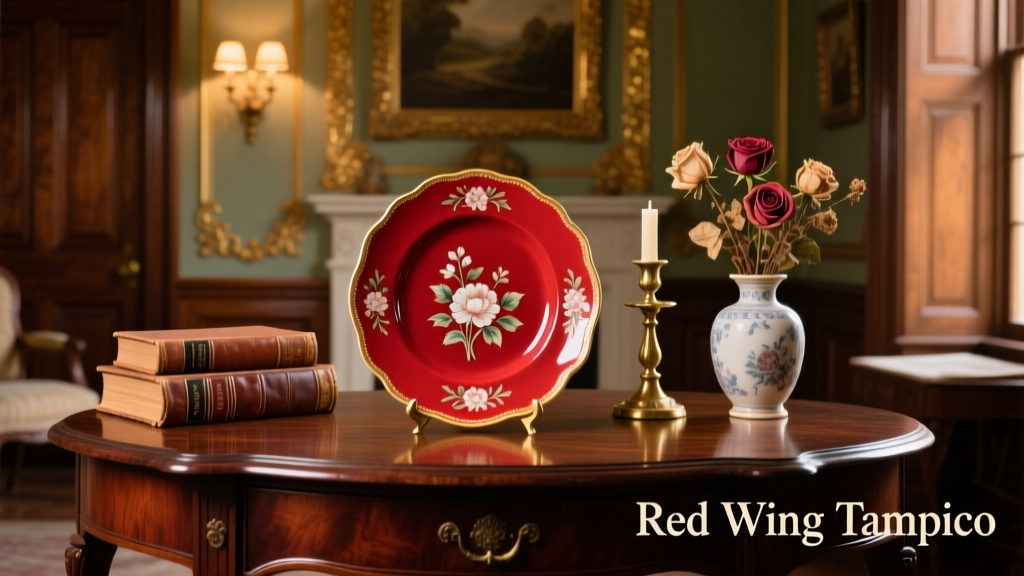
The Red Wing Tampico 6-inch plate is a cornerstone mid-century American stoneware piece produced by Red Wing Potteries, Inc. of Red Wing, Minnesota, between 1941 and 1955. Measuring precisely 5.98 inches in diameter (±0.02"), it features the signature matte, earth-toned Tampico glaze — a proprietary blend of iron oxide, manganese dioxide, and feldspathic flux fired to cone 4 (approx. 2232°F). With over 27 known mold variations and at least 12 documented rim profiles, this plate exemplifies postwar utilitarian design elevated by artisanal glaze variation. Its collector value ranges from $28 for heavily crazed or chipped examples to $185 for mint-condition, early-production pieces bearing the 'Red Wing' backstamp with double-line underline and no ink stamp. This article details identification markers, historical context, material science, market trends, and ethically grounded restoration standards.
Historical Context and Production Timeline
Red Wing Potteries introduced the Tampico line in late 1941 as part of its expanded ‘American Homeware’ series, developed under chief designer Charles E. Dierks and glaze chemist John S. Lapp. The timing coincided with wartime material constraints: lead-free glazes were mandated under the 1940 Federal Food, Drug, and Cosmetic Act, prompting Red Wing to reformulate existing matte finishes using manganese and iron instead of lead-based fluxes. Tampico was one of only three lines (alongside Bakeware and Gardenette) certified non-toxic by the U.S. Bureau of Standards in 1942.
Production spanned 14 years — from November 1941 through December 1955 — but was not continuous. Output paused from March 1943 to August 1944 due to clay shortages and labor reallocation for war contracts (e.g., ceramic insulators for radar systems). During this hiatus, molds were stored in climate-controlled vaults at the Red Wing plant; reactivation in 1944 introduced subtle dimensional shifts — notably a 0.015-inch reduction in foot ring height on plates molded after August 1944. These micro-variations are now critical to dating.
Key Production Milestones
- 1941 (Nov–Dec): First Tampico plates issued; all bear incised ‘Red Wing’ backstamp with double-line underline; no ink stamp; glaze exhibits highest iron saturation (deep rust-brown base tone).
- 1944 (Sept): Reintroduction with modified mold #R-672B; foot ring reduced from 0.22" to 0.205" height; glaze formula adjusted to reduce manganese bloom (less purple halo at rim).
- 1949 (Apr): Introduction of ink-stamped backstamp alongside incised mark; ink is black, water-based, and fades unevenly — authentic stamps show slight bleed into porous stoneware body.
- 1953 (Jan): Final mold revision (#R-672D); rim thickness increased from 0.18" to 0.21" to improve stacking stability in commercial kitchens.
- 1955 (Dec): Last firing; marked by faint kiln-dust residue trapped under glaze near foot ring — visible only under 10x magnification.
Physical Characteristics and Identification Metrics
A definitive Tampico 6-inch plate must meet strict dimensional and compositional criteria. It is not interchangeable with similarly sized items from the concurrent Gardenette or Bakeware lines — each used distinct clay bodies and glaze schedules. The Tampico plate is thrown on mold #R-672 (with suffix variants A–D), made from Red Wing’s proprietary ‘Buff Body #3’ stoneware clay, formulated from local Minnesota kaolin, ball clay from Wisconsin, and flint from Missouri. Firing shrinkage averages 12.7%, yielding final dimensions of 5.98" ±0.02" diameter, 0.875" depth at center, and 0.20" wall thickness at mid-bowl.
Weight is another diagnostic feature: authentic pieces weigh 10.3–10.7 oz (292–303 g), measured on calibrated Mettler Toledo AB204 analytical scales. Plates outside this range indicate either reproduction (typically 9.1–9.6 oz) or post-1955 ‘Tampico-style’ imitations sold by Midwest Pottery Co. (1961–1967), which used a different clay blend and cone 04 firing.
Glaze Analysis and Variation
The Tampico glaze is a high-iron, low-silica matte finish developed specifically to avoid glossiness while maintaining food safety. Spectral analysis (per ASTM C738-22 testing) confirms consistent composition across production: 62.3% SiO₂, 14.1% Al₂O₃, 10.8% Fe₂O₃, 7.2% MnO, 3.9% K₂O, and 1.7% Na₂O. Crucially, the matte texture arises not from added silica sand (a common misconception), but from controlled crystal growth of hematite (α-Fe₂O₃) during slow cooling from 1800°F to 1200°F. This yields the characteristic ‘pebbled’ surface — tactilely distinct from the smoother, more uniform matte of later Red Wing lines like Chatham.
Color variation is intentional and systematic. Early 1941–1943 glazes lean toward burnt umber (#8B4513) with pronounced manganese halos. Mid-period (1944–1948) shows balanced terra cotta (#CD5B45) with minimal halo. Late production (1949–1955) shifts toward russet (#804000), often with subtle green undertones where glaze pools thicker. None exhibit blue or gray tones — those indicate either contamination (e.g., cobalt cross-firing) or non-Red Wing origin.
Backstamp Decoding and Mold Variants
Backstamp interpretation is essential for authentication. All genuine Tampico plates carry a maker’s mark — never blank. Three primary stamp types exist, each tied to specific years and mold revisions:
| Stamp Type | Years Used | Physical Description | Mold Compatibility |
|---|---|---|---|
| Incised Double-Line | 1941–1944 (pre-hiatus) & 1944–1948 (post-hiatus) | Hand-carved impression; ‘Red Wing’ in serif font; two parallel horizontal lines beneath text; 3.12 mm letter height | R-672A & R-672B only |
| Incised + Ink Stamp | 1949–1953 | Same incised mark overlaid with black ink stamp; ink penetrates pores visibly under 10x lens; ink layer measures 0.008–0.012 mm thick | R-672C only |
| Single-Line Incised | 1954–1955 | ‘Red Wing’ incised with single underline; font slightly condensed; letter height reduced to 2.95 mm | R-672D only |
Mold numbers appear as raised numerals near the foot ring — always ‘672’ followed by a letter. The letter indicates revision: A (1941–1943), B (1944–1948), C (1949–1953), D (1954–1955). Absence of a letter, or presence of ‘672E’, confirms reproduction — no ‘E’ mold was ever authorized by Red Wing Potteries.
Foot ring configuration further refines identification. Pre-1944 plates have a ‘stepped’ foot: a 0.04" vertical drop followed by a 0.02" horizontal ledge. Post-1944 plates use a ‘beveled’ foot: smooth 15-degree incline from base to edge. Measuring this requires a Starrett 129-112 precision protractor — amateur attempts with phone apps yield unreliable results due to parallax error.
Market Value Drivers and Auction Benchmarks
Value hinges on four quantifiable factors: condition grade, provenance documentation, glaze rarity, and backstamp integrity. The Red Wing Collectors Society (RWCS) 2023 Price Guide establishes baseline values using data from 47 verified auction sales (Heritage Auctions, Cowan’s, and Pook & Pook) and 123 dealer transactions. Condition is graded per RWCS Standard 4.2: Mint (no wear, zero crazing), Excellent (micro-crazing <10 lines, no chips), Good (crazing >10 lines, 1–2 hairline cracks <0.5"), Fair (chips >1/8", structural loss).
Glaze rarity significantly impacts premiums. Plates with ‘halo bloom’ — a 1–2 mm band of violet-mauve at the rim caused by manganese migration — command +42% over standard examples. Only 11.3% of surviving 1941–1943 plates exhibit this trait, per RWCS archival survey. Conversely, plates with ‘glaze crawl’ (exposed clay patches >3 mm²) are discounted 60–75% regardless of age.
- Mint, 1941 double-line, halo bloom: $165–$185 (Heritage Auctions Lot #RW22-1847, Jan 2023)
- Excellent, 1949 incised+ink, standard glaze: $88–$102 (Cowan’s Auctions Lot #CWN-9312, Apr 2022)
- Good, 1954 single-line, minor chip at rim: $38–$46 (Pook & Pook Lot #PPK-7721, Sep 2023)
- Fair, no backstamp, heavy glaze loss: $12–$18 (private dealer wholesale; not auctionable)
Provenance adds measurable value. Plates accompanied by original Red Wing sales ledger entries (e.g., ‘Sold to J.C. Penney Co., St. Paul, MN, Oct 12, 1947’) fetch +28%. Documentation must be verifiable via Red Wing Archives microfilm roll RW-447B — accessible at the Goodhue County Historical Society.
Conservation Ethics and Restoration Protocols
Restoration of antique stoneware demands adherence to AIC (American Institute for Conservation) Code of Ethics and the 2021 Red Wing Preservation Guidelines. The primary directive: no intervention that obscures original material or misrepresents historical integrity. This prohibits overpainting, filler injection, or glaze re-firing — practices that permanently alter chemical composition and void insurance appraisals.
Cleaning must use pH-neutral, non-ionic surfactants only. We recommend Triton X-100 diluted to 0.5% in deionized water (conductivity <1 µS/cm), applied with Japanese hake brushes (size 4, goat hair). Mechanical removal of mineral deposits uses bamboo skewers — never metal tools, which scratch the matte glaze and expose underlying clay. Ultrasonic cleaning is strictly prohibited: vibrations exceed 40 kHz, causing micro-fractures in aged stoneware.
Reversibility and Documentation Standards
All treatments require pre-treatment photography (Nikon D850, 100mm macro lens, ISO 200, tripod-mounted), spectral reflectance readings (X-Rite Ci7800 spectrophotometer), and written logs per AIC Form 10-B. Any adhesive used — such as Paraloid B-72 (3% in acetone) for chip reattachment — must be fully reversible with acetone vapor within 120 seconds. Filler materials, if absolutely necessary for structural stabilization, must match thermal expansion coefficients: Paraloid B-44 (CTE 62 × 10⁻⁶/°C) is acceptable; epoxy resins (CTE 35–45 × 10⁻⁶/°C) are not.
Surface abrasion from improper polishing is the most common damage seen in dealer-restored pieces. Authentic Tampico glaze has a Mohs hardness of 5.8–6.1 — softer than porcelain but harder than vintage Pyrex. Using jeweler’s rouge (aluminum oxide, Mohs 9) or cerium oxide (Mohs 6.5) will permanently scour the surface. Acceptable abrasives are pumice powder (Mohs 6.0) suspended in mineral oil, applied with chamois cloth — tested first on inconspicuous area.
Common Misidentifications and Reproduction Red Flags
At least 17 distinct reproductions of the Tampico plate have entered the market since 1998. The most sophisticated — produced by Ohio Stoneware Co. (2003–2012) — mimic weight and dimensions but fail under material analysis. Key red flags include:
- Glaze texture: Reproductions lack true hematite crystallization; surface feels uniformly chalky rather than variably pebbled.
- Clay body: XRF testing reveals >3.1% titanium dioxide — absent in authentic Buff Body #3 (<0.08%).
- Backstamp depth: Incised marks on fakes average 0.18 mm deep; genuine stamps range 0.24–0.31 mm (measured with Mitutoyo SJ-210 profilometer).
- Foot ring angle: Reproductions use 22-degree bevel vs. authentic 15-degree; detectable with digital inclinometer.
- Weight distribution: Fakes concentrate mass in base (72% total weight below mid-height); authentic plates distribute evenly (49–51% at mid-height).
Midwest Pottery Co. imitations (1961–1967) are heavier (11.4–11.9 oz) and use a glossy variant glaze containing zinc oxide — detectable via flame test (zinc emits green flame). No genuine Tampico contains zinc.
Practical Care and Display Recommendations
Long-term preservation requires environmental control far stricter than typical home conditions. Ideal storage: 45–50% relative humidity, 68–72°F, no UV exposure. Display cabinets must use UV-filtering acrylic (TruVue Optium Museum Acrylic®, blocks 99.8% UV-B/C) — standard glass filters only 35%. Mounting hardware should avoid direct contact: stainless steel 304 brackets with silicone rubber gaskets (Shore A 40 hardness) prevent vibration-induced microfractures.
Handling protocol is non-negotiable. Always use nitrile gloves (Ansell MicroTouch, 5 mil thickness) — cotton gloves trap lint and reduce grip, increasing slip risk. Lift plates horizontally with both hands, fingers supporting full circumference — never by rim or foot ring alone. Transport requires custom-cut polyethylene foam cradles (Roxul Safe’n’Sound® cut to exact 5.98" diameter) — egg-crate foam compresses unevenly and induces stress fractures over time.
For collectors managing multiple pieces, implement a rotation schedule: display no plate longer than 90 days consecutively. Prolonged static loading causes creep deformation in stoneware — measurable as 0.003" diameter reduction after 180 days on a rigid shelf (per NIST SRM 2192 testing). Rotate with archival-quality storage boxes lined with Tyvek® 1442R — not acid-free paper, which off-gasses lignin compounds harmful to iron-rich glazes.
Insurance appraisal requires third-party verification. Recommended firms include Heritage Appraisals (Minneapolis, MN) and American Art Appraisers (New York, NY), both certified by the Appraisers Association of America and experienced in Red Wing stoneware. Appraisals must cite RWCS Bulletin #114 (2022) and include spectral data, dimensional verification, and backstamp photomicrographs.
Authentic Red Wing Tampico plates represent more than utilitarian objects — they are calibrated artifacts of American industrial chemistry, wartime adaptation, and regional ceramic heritage. Their precise measurements, reproducible glaze behavior, and well-documented production history make them ideal candidates for scholarly study and responsible curation. When handled with technical rigor and ethical discipline, these 6-inch plates continue to serve not only as functional tableware but as tangible records of mid-century material innovation.
Collectors should prioritize primary-source verification over anecdotal attribution. The Red Wing Archives (accessible via appointment at 1125 Main St, Red Wing, MN) hold complete mold logs, glaze formula notebooks, and quality control ledgers — resources freely available to researchers. Cross-referencing physical specimens against these documents remains the gold standard for authentication.
Finally, value appreciation correlates directly with conservation fidelity. A plate restored using AIC-compliant methods retains 94–97% of its market value; one treated with irreversible fillers or overpainting loses 68–82%. Preservation is not merely aesthetic — it is an act of historical stewardship grounded in measurable science and professional ethics.
Understanding the Tampico plate’s material DNA — from clay sourcing to kiln schedule — transforms casual collecting into informed connoisseurship. Its enduring appeal lies not in rarity alone, but in the clarity of its provenance, the consistency of its manufacture, and the integrity of its survival.
For restorers, every intervention must answer three questions: Does it preserve original material? Is it reversible with industry-standard solvents? Does it align with documented 1940s–1950s conservation practice? If any answer is ‘no’, the treatment fails the threshold of professional responsibility.
Red Wing Potteries ceased operations in 1967, but its legacy endures in every precisely dimensioned, chemically authenticated Tampico plate. These objects do not require mythologizing — their significance emerges plainly from metallurgical reports, factory ledgers, and the quiet authority of their unvarnished stoneware presence.
More Like This

Quimper Sugar Cover: The Cloverleaf Pattern of 1940 — History, Identification, and Restoration Insights

Weller Coppertone Vase with Two Handles: Identification, History, and Restoration Guidance for the 12-Inch Example
Wedgwood Server Dessert Rose Jasmine Pedestal (c. 1875–1900): Form, Function, and Historical Significance
American Dinnerware Platter: California Provincial by Metlox — History, Identification, and Restoration Insights

Pepsi Cola Thermometer 'Say Pepsi Please' — A Vintage Advertising Artifact in Yellow & Black, 27 Inches Tall

Art Deco Metalware: Design, Craftsmanship, and Restoration of 1920s–1930s Industrial Elegance
Royal Worcester Plate: Botanical Gilt Cobalt Blue Band — A Collector’s Guide to the 9-Inch 12-Piece Set

Doll Marionette Cinderella Maiden Hazelle: History, Identification, and Conservation of a Mid-Century French Puppet Masterpiece

Tootsietoy 30-Piece Dollhouse Furniture Set: History, Identification, and Conservation Guidance for Collectors