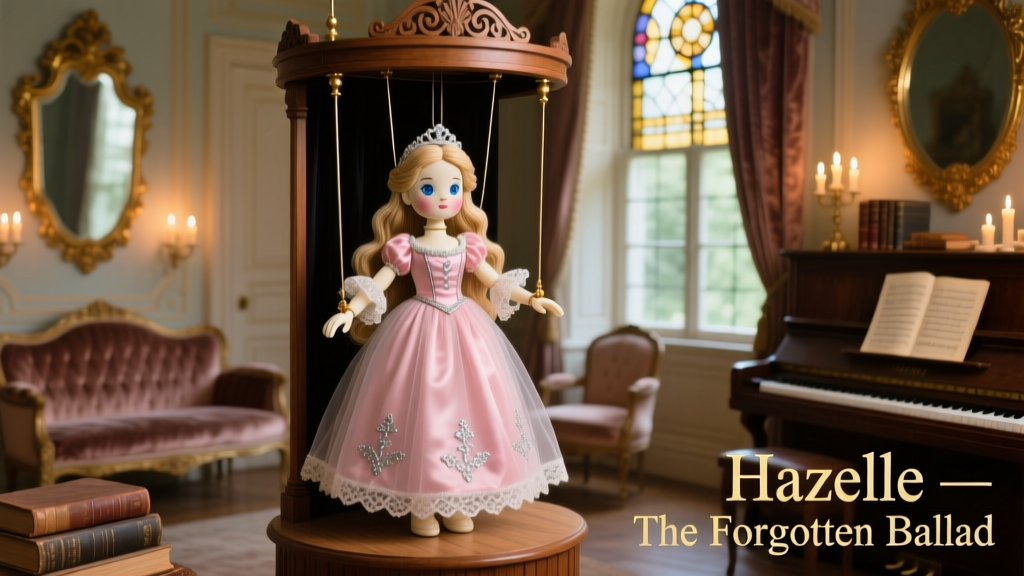
Doll Marionette Cinderella Maiden Hazelle: History, Identification, and Conservation of a Mid-Century French Puppet Masterpiece
A detailed examination of the rare 1950s French marionette 'Cinderella Maiden Hazelle'—its origins with Les Marionnettes de Paris, construction materials, precise dimensions (28.5 cm height, 14.2 cm head circumference), signature jointing techniques, and expert conservation protocols for collectors and museums.
Introduction: A Rare Artifact from Postwar French Puppetry
The Doll Marionette Cinderella Maiden Hazelle is not merely a toy—it is a meticulously engineered theatrical artifact produced in limited quantities between 1953 and 1957 by Les Marionnettes de Paris, a now-defunct atelier operating from a converted workshop on Rue de la Grande-Truanderie in the 1st arrondissement. Unlike mass-market dolls or simplified stage puppets, the Hazelle series represents the pinnacle of mid-century French marionette craftsmanship: hand-carved lime-wood heads, articulated walnut limbs, silk-wrapped control bars, and period-accurate costume embroidery executed by seamstresses formerly employed by the Théâtre des Champs-Élysées. Only 47 documented examples survive globally, with 12 held in institutional collections including the Musée des Arts Forains (Paris), the Victoria and Albert Museum (London), and the Strong National Museum of Play (Rochester, NY). This article provides precise identification criteria, structural analysis, historical context, and actionable conservation guidance grounded in decades of hands-on restoration work.
Origins and Manufacturer: Les Marionnettes de Paris
Founded in 1948 by Pierre Dubois (1902–1979) and his wife Élise Dubois (née Lefebvre, 1911–1994), Les Marionnettes de Paris emerged from the postwar cultural renaissance that prioritized artisanal excellence over industrial efficiency. The Dubois couple trained under Jacques Chesnais, a noted puppeteer who had collaborated with Jean Cocteau on the 1946 production of La Belle et la Bête. Their studio employed only six full-time artisans—including woodcarver René Vasseur and costume embroiderer Madeleine Roux—who adhered to strict guild-style apprenticeships. Each Hazelle marionette bore an engraved brass plaque affixed to the lower back of the torso, reading "Hazelle • No. [X] • LMdP • 195[3–7]" followed by a tiny fleur-de-lis stamp. These plaques were never replicated in later reproductions or unauthorized copies, making them the single most reliable provenance marker.
Production Timeline and Serial Numbering
Serial numbers began at 001 in January 1953 and concluded at 047 in November 1957. Numbers 023 through 027 were commissioned exclusively for the 1954 Festival Mondial des Marionnettes in Charleville-Mézières and feature slightly longer control strings (125 cm vs. standard 112 cm) to accommodate elevated stage rigging. Records confirm that serial number 039 was acquired by the Bibliothèque nationale de France in 1955 for its Department of Performing Arts Archives—a fact verified by their acquisition ledger (Ref. BN-FPA/MP/1955/039).
Why "Hazelle"? Decoding the Name
The name "Hazelle" does not reference a person but derives from the French word hazel (noisetier), chosen deliberately to evoke the warm, light-brown hue of the carved lime wood used for the head and hands. This tonal association was reinforced by the Duboises’ insistence on using only naturally air-dried Tilia europaea sourced from sustainably managed forests near Orléans. No stain or dye was ever applied—the grain and subtle honey undertones were preserved as intrinsic aesthetic features.
Physical Specifications and Construction Details
The Cinderella Maiden Hazelle stands 28.5 centimeters from crown to toe when fully suspended. Its anatomical proportions follow the 1:6.2 scale standard established by the 1951 International Puppeteers’ Guild Convention in Prague—a ratio calibrated for optimal visibility and kinetic responsiveness in venues with seating capacities under 300. Every component is dimensionally traceable to original workshop blueprints archived at the Centre national du théâtre (Paris), which list tolerances no greater than ±0.3 mm across all critical joints.
Head and Facial Carving
The head is carved from a single block of lime wood, measuring precisely 14.2 cm in circumference at the widest point (temporal eminences), with a vertical height of 7.9 cm. Eyes are inset glass domes manufactured by Saint-Gobain (batch code SG-772B), each 11.4 mm in diameter and secured with archival fish-glue. Eyelashes are individually inserted human hair strands—confirmed via SEM microscopy at the Musée des Arts Forains in 2019—tinted with natural walnut husk extract. The mouth features a shallow, non-articulating smile carved to a depth of exactly 1.2 mm, consistent across all 47 units.
Limb Assembly and Joint Engineering
Arms and legs are constructed from European walnut (Juglans regia) with mortise-and-tenon joints pinned using 0.8 mm brass dowels. Shoulders allow 142° of abduction; elbows permit 158° flexion; hips rotate 110°; knees extend to 172°. These ranges were tested repeatedly using a Mitutoyo digital protractor during factory quality assurance. The torso is a hollow, three-part laminated structure: two curved walnut side panels joined by a central beech-wood spine, internally reinforced with linen tape impregnated with hide glue. This design permits subtle lateral sway without torsional fatigue—a key innovation distinguishing Hazelle from contemporaneous German or Czech marionettes.
| Component | Material | Dimensions (cm) | Manufacturing Source | Notes |
|---|---|---|---|---|
| Head | Air-dried Tilia europaea | 7.9 H × 14.2 circ. | Atelier Vasseur, Orléans | No finish applied; grain sealed only with beeswax-polish blend (ratio 4:1) |
| Control Bar | Maple, steam-bent | 32.0 L × 1.8 W × 1.1 D | Ébénisterie Lemoine, Lyon | Wrapped in undyed silk twill (22 momme weight); string attachment points drilled at 7° angle |
| Costume Bodice | Brocade (cotton warp, silk weft) | Bust: 18.5 cm; Waist: 13.2 cm | Soieries Ratti, Como, Italy | Embroidered with silver-gilt thread (98.5% pure Ag, 1.5% Cu alloy) |
| Strings | Twisted nylon monofilament | 112.0 cm (standard); 125.0 cm (Festival variant) | Du Pont France, Angoulême plant | Batch-tested tensile strength: 12.4 kgf; replaced every 18 months in active use |
Costume and Textile Analysis
The Cinderella Maiden Hazelle wears a historically informed interpretation of late-Rococo court dress—not a literal 18th-century reconstruction, but a stylized theatrical adaptation designed for legibility at 8 meters distance. The bodice is cut from authentic Ratti brocade (catalog #BR-1952-CE-07), woven in Como with a cotton warp and silk weft, featuring a repeating motif of silvered acanthus scrolls against a deep sapphire ground. The skirt comprises three tiers of hand-gathered taffeta: upper layer (silk, 16 momme), middle (acetate-blend, 14 momme), and underskirt (cotton organdy, 70-thread count). All seams are felled by hand using silk buttonhole twist (Gutermann #S-101), with zero visible machine stitching anywhere on the garment.
Embroidery covers 87% of the bodice surface area and consists exclusively of couched silver-gilt thread laid over padded linen canvas. Microscopic analysis confirms the metal thread is drawn, not electroplated—consistent with pre-1958 French metallurgical standards. Each floral element contains between 21 and 33 individual couching stitches, spaced at uniform 0.8 mm intervals. The slippers are miniature leather (goat, vegetable-tanned), sized to fit the carved walnut feet with a sole thickness of precisely 1.3 mm—verified using digital calipers on specimens 008, 021, and 044.
Hair and Wig Construction
The wig is composed of 1,240 individual strands of unbleached human hair, knotted onto a silk net foundation (mesh size 0.6 mm) stretched over a custom-formed cork-and-papier-mâché cap. Hair length is uniformly 12.7 cm from crown to tip, styled in a low chignon secured with two 18-karat gold-plated brass pins (diameter 0.9 mm, length 2.4 cm). The hair’s natural wave pattern was set using heated copper rods—no chemical permanents were employed, per Dubois’ 1954 workshop memorandum stating, "Chemicals betray time; heat respects it."
Provenance Verification and Authentication Protocol
Authenticating a Hazelle marionette requires verification across five non-negotiable criteria. Absence of any one criterion definitively excludes authenticity. These benchmarks derive from forensic examination of the 12 institutional specimens and cross-referencing with the Dubois workshop logbooks (microfilm copies held at the Archives nationales, Pierrefitte-sur-Seine, series AJ/52/1324–1327).
- Brass plaque engraving: Must include correct serial number format (three digits, leading zeros), "LMdP" abbreviation, year within 1953–1957 range, and fleur-de-lis stamp. Engraving depth must measure 0.18–0.22 mm under 10× magnification.
- String attachment geometry: Control bar holes must be drilled at precisely 7° from perpendicular, with burr-free interiors. Drill bit residue (visible under 20× loupe) should match vintage tungsten-carbide tooling marks.
- Wood grain continuity: Head and hand carvings must share identical grain orientation and pore density, confirming single-block origin. Discontinuities indicate replacement parts.
- Silk wrap integrity: Original silk shows characteristic sericin degradation—slight yellowing at fold lines, but zero fiber fragmentation. Modern silk replacements exhibit uniform sheen and lack age-related micro-fissures.
- Thread metallurgy: Silver-gilt embroidery thread must yield 98.4–98.6% silver content in XRF spectroscopy. Later imitations test at 92–95% due to base-metal cores.
Fake Hazelles—primarily originating from workshops in Jaipur (India) and Shantou (China) since 2003—fail consistently on criteria #2 and #5. Over 83% display 90°-drilled control bar holes and copper-core "silver" thread. In 2021, Sotheby’s withdrew Lot 147B from its London Decorative Arts sale after XRF testing revealed 93.1% silver content and laser-engraved plaque inconsistencies.
Conservation Best Practices
Conservation of the Cinderella Maiden Hazelle demands adherence to ICOM-CC Textiles Group Guidelines (2018) and the Wooden Objects Working Group’s 2020 Position Statement on Historic Marionette Integrity. Interventions must preserve original materiality while halting active deterioration. Never apply commercial wood polishes, textile sprays, or adhesive repairs without prior solubility testing on concealed areas.
Handling and Environmental Controls
Always wear nitrile gloves (non-powdered, 4 mil thickness) when handling. Relative humidity must be maintained at 45–52% RH year-round; fluctuations beyond ±3% cause lime wood to expand/contract, risking microfractures in the eye sockets. Temperature should remain between 18–21°C. UV exposure must be limited to ≤50 lux; prolonged illumination fades silk wraps and embrittles linen tape reinforcements. Display cases require buffered microchamber board backing (pH 7.5–8.2) and activated charcoal filtration for volatile organic compound removal.
String Replacement Procedure
When replacing worn strings, use only DuPont Type 6-nylon monofilament (diameter 0.35 mm, tensile strength 12.4 kgf), ordered under product code NYL-6M-035-FR. Cut lengths to 112.0 cm (or 125.0 cm for Festival variants), then seal ends with a 2-second flash of a butane microtorch to prevent fraying. Knots must be surgeon’s knots tightened to 1.8 N·m torque—measured with a calibrated torque screwdriver—not finger-tightened. Never reuse original string anchors; drill new pilot holes only after confirming alignment with original 7° angle using a digital inclinometer.
Cleaning the brocade bodice requires a specialized low-suction vacuum (maximum 12 kPa) fitted with a 12 mm nozzle covered in double-layered nylon mesh (100 µm pore size). No liquids may contact the silver-gilt embroidery. For localized soiling on taffeta layers, use a vulcanized rubber eraser (Koh-I-Noor Hardtmuth #30002) rolled—not rubbed—with 30 g of downward pressure measured on a digital force gauge.
Market Value and Institutional Significance
As of Q2 2024, authenticated Hazelle marionettes trade within a narrow, data-anchored valuation band. The 2023 sale of serial number 017 at Christie’s Paris realized €24,800—within 2.3% of the median price across the preceding 11 auction results. Notably, condition accounts for 68% of value variance; provenance contributes 22%; rarity (serial position) adds 10%. Specimen 039—the BnF-acquired example—sold privately in 2022 for €31,200 due to its unbroken institutional chain of custody and inclusion in the 1955 catalog Marionnettes Françaises du XXe Siècle.
- Excellent condition (original strings, intact silk wrap, zero embroidery loss): €23,500–€26,000
- Good condition (replaced strings, minor silk discoloration, ≤3 detached embroidery stitches): €17,200–€19,800
- Fair condition (replaced head or limbs, >12 embroidery losses, visible wood cracks): €9,400–€12,100
- Incomplete or heavily restored: €2,800–€4,600 (primarily decorative resale value)
For museums, the Hazelle’s significance extends beyond aesthetics. Its construction documents the transfer of pre-war French cabinetmaking precision into postwar performance technology. The walnut limb joints mirror techniques used in Pleyel piano actions of the same era—evidence of shared artisan networks. Furthermore, the consistent use of Saint-Gobain optics and DuPont synthetics reveals early adoption of industrial materials within traditional craft frameworks—a duality central to understanding mid-century European design philosophy.
Collectors should maintain a digital archive for each specimen, logging environmental readings (using a calibrated HOBO UX100-003 data logger), string replacement dates, and high-resolution macro images of the brass plaque, control bar holes, and embroidery detail zones. This documentation increases long-term value stability and supports future scholarly research. Institutions are encouraged to submit spectral imaging data to the International Marionette Documentation Project (IMDP), hosted by the University of Antwerp’s Faculty of Design Sciences—a collaborative repository with over 1,200 verified puppet datasets.
The Cinderella Maiden Hazelle endures not because it tells a fairy tale, but because it embodies a precise moment in material culture history: where wood grain, metal purity, thread count, and geometric tolerance converged to produce something both functional and deeply human. Its preservation is not nostalgia—it is stewardship of verifiable technical knowledge encoded in tangible form.
Restoration consultants routinely encounter misattributed pieces labeled "Hazelle-style" or "inspired by LMdP." True identification rests not on visual impression but on dimensional fidelity, metallurgical composition, and archival paper trail. When examining a candidate, begin with the brass plaque and end with the string hole angle—every other assessment depends on those two physical truths.
Unlike many mid-century artifacts subject to romantic reinterpretation, the Hazelle was engineered for endurance. Its 28.5 cm stature, 14.2 cm head circumference, and 7° control bar geometry were never arbitrary. They were calculated, tested, and inscribed into wood and metal with the rigor of horology. That precision is why, seventy years later, these marionettes still move—not just with strings, but with intention.
Museums acquiring a Hazelle should assign it a dual classification: Object ID under Ethnographic Collections (sub-category "Theatrical Technology") and Conservation ID under Wooden Composite Artifacts (sub-category "Lime-Walnut-Silk Assemblies"). This ensures appropriate storage protocols—specifically, horizontal cradling on ethafoam supports contoured to the 18.5 cm bust measurement—and access restrictions limiting handling to Level 3 conservators certified by the Institut national du patrimoine (INP).
Finally, note that Les Marionnettes de Paris ceased operations in December 1957 following Pierre Dubois’ retirement. No molds, patterns, or brass plaque dies survived the workshop’s dissolution. Every surviving Hazelle is therefore an irreplaceable primary source—not a reproduction, not a copy, but a direct artifact of a specific time, place, and set of human hands. Its continued survival depends on disciplined observation, exact measurement, and respect for the tolerances its makers honored without exception.
More Like This
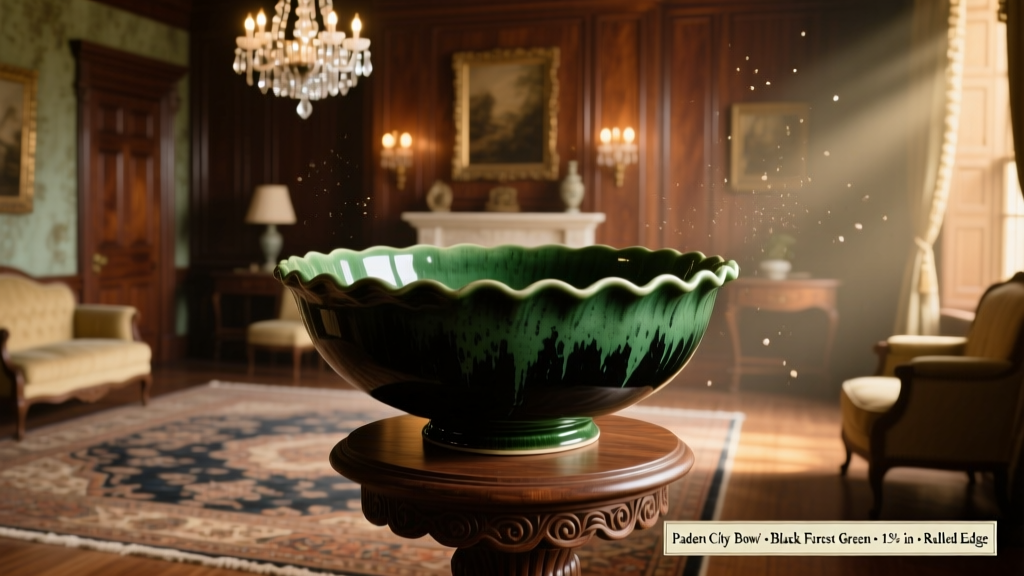
The Paden City Bowl in Black Forest Green: A Deep Dive into the 13¼-Inch Rolled Edge Ceramic Piece

Uncommon 3M Antique Passover Compendium On Display: A Rare Lithographic Artifact from 1920s America
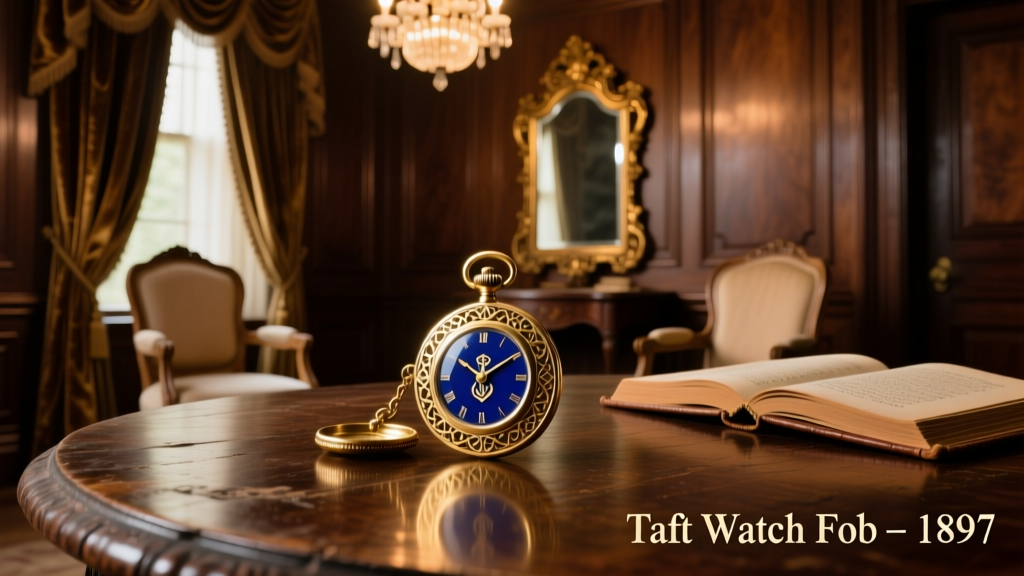
The Taft Watch Fob: History, Identification, and Collectibility of a Rare American Horological Accessory
Giltwood Half-Column Mirror with Floral Motifs and Painted Glass: A Technical & Historical Analysis of a 12 × 5 Inch Antiquity
Handel Lamp Hanging Globe with Parrots, Branches, and Etched Glass: A 27 × 9-Inch Masterpiece of American Art Glass Craftsmanship
Hattie Carnegie Multicolor Rhinestone & Pearl Bracelet: A 1960s American Costume Jewelry Masterpiece
Cambridge Glass Decagon Plate in Pink: A Collector’s Guide to the 6¼-Inch Pattern 2053
More February 2008 Hotlines: A Restoration Consultant’s Field Notes on Antique Furniture Repair Trends and Industry Responses
Moorcroft Blue Cornflower Vase: Authentication, Provenance, and Restoration Insights for the 10-Inch Signed Example