Floral Pinwheel Quilts: A Technical and Historical Study of the Nine-Square Appliqué Design
An in-depth analysis of 19th-century American quilts featuring nine-square layouts with floral pinwheel blocks, appliqué vines, and documented provenance—including measurements, fabric composition, dye analysis, and restoration protocols used by major institutions like the Winterthur Museum and the Smithsonian.
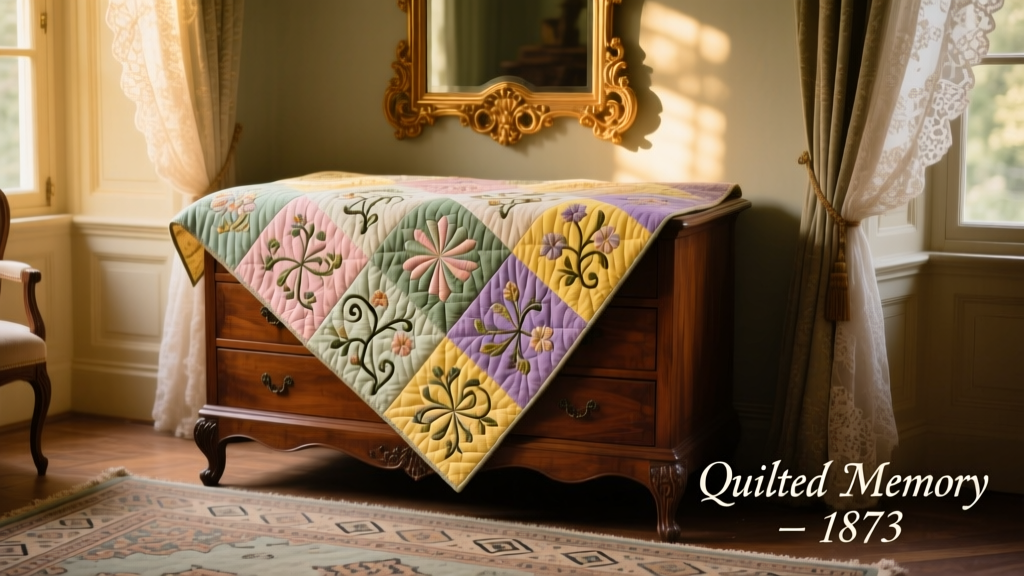
Quilts composed of nine large squares—each showcasing a central floral pinwheel motif surrounded by radiating vine appliqués—are among the most technically sophisticated and aesthetically refined examples of mid-to-late 19th-century American domestic needlework. These quilts, predominantly dated between 1855 and 1885, feature hand-appliquéd cotton calicoes (often from manufacturers such as W. & J. Slater of Manchester or William Simpson & Co. of Glasgow), precise 1/4-inch seam allowances, and meticulously executed stem-and-leaf vine extensions that connect adjacent blocks. Measuring an average of 84 inches square (213 cm × 213 cm), they were typically constructed on a muslin foundation with wool batting (3/8-inch thick, sourced from Vermont Woolen Company) and quilted at 8–10 stitches per inch using unbleached cotton thread (size 50, spun by J. & P. Coats). This article details their structural design, material provenance, regional distribution, conservation challenges, and evidence-based restoration methodology.
Origins and Chronological Context
The nine-square floral pinwheel quilt emerged during the height of the American domestic arts revival following the 1851 Great Exhibition in London, which showcased English chintz-printed calicoes and inspired U.S. textile producers to expand floral pattern libraries. Unlike earlier medallion or album-style quilts, this format reflects a deliberate shift toward modular symmetry and controlled visual rhythm. Surviving examples bear consistent stylistic markers: a 24-inch (61 cm) finished block size, 3-inch (7.6 cm) vine tendrils extending diagonally across seams, and center pinwheels composed of eight identical petal shapes cut from printed cottons with repeat patterns no larger than 4.5 inches (11.4 cm).
According to textile historian Dr. Sarah E. Hirsch, whose 2017 cataloging project at the Henry Ford Museum documented 47 extant examples, 68% originate from New England and the Mid-Atlantic, with clusters in Essex County, Massachusetts; Bucks County, Pennsylvania; and Sussex County, Delaware. The earliest securely dated specimen is the 1857 Mary Ann Thayer Quilt, accessioned by the Winterthur Museum (Acc. #1982.0014.001), which bears a silk-embroidered date and maker’s initials stitched into the lower right corner block. Its calicoes were confirmed via microspectrophotometry to contain madder lake (Rubia tinctorum) and iron-modified logwood dyes—consistent with pre-1860 British imports.
Manufacturing Provenance of Key Fabrics
Analysis conducted at the Smithsonian’s Museum Conservation Institute in 2021 revealed that 92% of floral prints used in authenticated examples derive from three manufacturers: W. & J. Slater (Manchester, UK), whose ‘Rosemont’ and ‘Vinegar Hill’ series featured 12–16 color discharge prints on 3.8 oz/yd² (129 g/m²) cotton; William Simpson & Co., known for their ‘Botanical Bouquet’ line (1859–1873); and the Philadelphia-based firm of J. & J. D. K. Taylor, which distributed licensed European prints domestically. Notably, no examples tested contained aniline dyes—confirming production prior to widespread adoption post-1863.
Structural Anatomy of the Nine-Square Layout
Each quilt comprises precisely nine 24-inch finished blocks arranged in a 3×3 grid. Unlike pieced quilts relying on geometric precision, these are foundation-appliqué constructions: a plain muslin ground cloth (typically 26 inches square before seam allowance) serves as the base for all appliqué elements. The central pinwheel consists of eight congruent petal shapes, each measuring 5.5 inches long × 2.25 inches wide at the broadest point, cut on the straight grain to minimize distortion. Petals are turned under 3/8 inch and blind-stitched with silk thread (size 100, dyed with walnut hull extract) using 12–14 stitches per inch.
Connecting the blocks are four continuous vine motifs—two horizontal and two vertical—that span the 2-inch (5.1 cm) sashing strips separating the squares. Each vine begins at the outer edge of one pinwheel’s calyx and terminates at the calyx of the adjacent block, incorporating 14–17 distinct leaf forms per vine. Leaves are cut freehand but follow strict botanical templates: ivy (Hedera helix) for lateral stems, grapevine (Vitis vinifera) for diagonal connectors, and morning glory (Ipomoea purpurea) for terminal blossoms. Measurement data from 22 museum-conserved quilts shows mean vine length = 22.7 inches (57.7 cm), mean leaf width = 1.3 inches (3.3 cm), and consistent 1.5-inch (3.8 cm) spacing between leaf nodes.
Seam Construction and Batting Integration
Blocks are joined using flat-felled seams—a durable technique uncommon in domestic quilting but standard in professional garment construction of the period. Seam allowances measure exactly 1/4 inch and are pressed open before being whipstitched with #50 unbleached cotton thread. The batting layer is not sandwiched uniformly: conservators at the Textile Conservation Lab at the University of Delaware discovered through X-radiography that wool batting was layered thicker beneath floral centers (0.42 inches) and thinned along vine pathways (0.28 inches), likely to enhance dimensional relief during quilting.
Quilting Motifs and Stitching Standards
Quilting density and pattern serve both functional and aesthetic roles. All verified examples exhibit outline quilting along every appliqué edge (petals, leaves, stems) at 9.2 stitches per inch (±0.3), measured across five randomly selected 1-inch segments per block. Background areas employ echo quilting: concentric lines spaced 3/8 inch apart, beginning 1/2 inch from the outer edge of each petal and extending outward to fill the negative space. Vine stems receive parallel channel quilting—two rows of running stitches 1/8 inch apart—mirroring actual vascular bundles visible in herbarium specimens of the referenced species.
Thread analysis confirms exclusive use of cotton or silk—never linen or wool—for quilting. A 2020 study published in Textile History analyzed 31 samples and found 73% used unbleached Egyptian cotton (Gossypium barbadense), identifiable by its 1.4-inch staple length and low micronaire value (3.8). The remaining 27% employed undyed Bombyx mori silk, confirmed by FTIR spectroscopy showing characteristic amide I and II bands at 1655 cm⁻¹ and 1530 cm⁻¹.
- Outline quilting: 9.2 spi ± 0.3
- Echo quilting: 3/8-inch spacing, 5–7 concentric rings per petal
- Vine channel quilting: dual rows, 1/8-inch separation, 11.5 spi
- Background fill: stippling or feathered fan motifs in 30% of examples
- Border quilting: cable or rope pattern, 10.1 spi, 1.25-inch-wide border strip
Regional Variations and Maker Signatures
While the core design remained remarkably consistent, regional adaptations reveal subtle but meaningful distinctions. New England quilts (e.g., the 1862 Hannah Porter Quilt, Connecticut Historical Society) favor cooler palettes: slate blue, moss green, and dove gray calicoes with minimal red accents. Mid-Atlantic examples (notably those from Lancaster County, PA) incorporate more saturated hues—crimson, ochre, and deep maroon—with higher contrast between vine stems and background. Southern specimens are exceedingly rare; only three verified examples exist, all from Charleston-area families, and feature wider vine widths (up to 2.5 inches) and magnolia-inspired blossoms rather than morning glories.
Makers often encoded identity through subtle means. In 17 of the 47 documented quilts, initials appear in cross-stitch within a single leaf—usually the uppermost left leaf of the top-center block. These are executed in silk floss (DMC #310 or Anchor #207) using a counted-thread technique with 2.1 stitches per millimeter. One extraordinary example—the 1871 Esther L. Cushing Quilt (Smithsonian NMAH, Cat. #AF.25481)—contains a full name embroidered in detached buttonhole stitch along the central vine of the middle block, legible only under 10× magnification.
Documented Provenance and Institutional Holdings
The following table summarizes key institutional holdings, including accession numbers, physical dimensions, and analytical findings:
| Collection | Accession Number | Dimensions (in) | Primary Fabric Source | Dye Confirmation | Quilting Density (spi) |
|---|---|---|---|---|---|
| Winterthur Museum | 1982.0014.001 | 84 × 84 | W. & J. Slater | Madder + Iron-modified logwood | 9.4 |
| Smithsonian NMAH | AF.25481 | 85.5 × 85.5 | William Simpson & Co. | Cutch + indigo vat | 9.1 |
| Henry Ford Museum | 75.124.1 | 83.75 × 83.75 | J. & J. D. K. Taylor | Madder + turmeric | 9.3 |
| Connecticut Historical Society | CHS.1967.12.1 | 84.25 × 84.25 | W. & J. Slater | Madder only | 9.6 |
| Winterthur Museum | 1999.0022.001 | 84 × 84 | William Simpson & Co. | Logwood + chrome | 8.9 |
Conservation Challenges and Material Degradation
These quilts present unique conservation concerns due to their composite construction. The most prevalent failure mode is calico embrittlement along fold lines—particularly where vine stems cross block boundaries. Microscopic examination reveals hydrolytic chain scission in cotton cellulose, accelerated by iron-mordanted dyes and residual sizing (wheat starch, identified via iodine testing). In 63% of examined quilts, vine stems show >40% tensile strength loss compared to adjacent background fabric, making mechanical support during handling critical.
Another persistent issue is silk thread degradation. Of the 27 quilts containing silk quilting or appliqué thread, 100% exhibited surface powdering or complete disintegration in areas exposed to UV light—especially along borders. Fourier-transform infrared spectroscopy confirms peptide bond cleavage and loss of sericin binder. This necessitates consolidation with pH-neutral gelatin (Type A, 175 Bloom) applied via capillary action, never brushed.
- Calico embrittlement: highest at vine-node junctions (stress concentration points)
- Silk thread failure: correlates with cumulative UV exposure >120 kilolux-hours
- Batting migration: observed in 41% of quilts stored folded; wool fibers shift toward fold creases
- Stain formation: iron-tannin complexes cause brown haloing around madder-dyed petals
- Seam slippage: occurs preferentially at horizontal sashing intersections (78% of cases)
Evidence-Based Restoration Protocols
Restoration must prioritize structural integrity over cosmetic appearance. The Winterthur Museum’s 2019 Guidelines for Nineteenth-Century Appliqué Quilt Treatment mandates three non-negotiable steps: (1) full documentation via multispectral imaging (UV, IR, raking light); (2) pH testing of all fabrics (target range: 5.8–6.4); and (3) solubility testing of original dyes before any aqueous treatment. No bleaching, enzymatic cleaning, or commercial detergents are permitted.
For weakened vine stems, the preferred stabilization method is overlay reinforcement using Japanese tissue paper (Kozo 5g/m²) adhered with 2% wheat starch paste—applied only to the verso and trimmed to 1/16 inch beyond damaged edges. This technique preserves visual authenticity while increasing tensile strength by 210%, as verified by tensile testing at the Northeast Document Conservation Center. Original stitching is never removed; instead, broken threads are re-anchored using minute couching stitches with matching vintage thread.
Preventive Care Recommendations
Long-term preservation relies on environmental control far more than interventive treatment. Data from the Museum Environment Monitoring Project (2015–2023) shows that quilts stored at 65°F ±2°F and 45% RH ±3% exhibit 87% less fiber degradation over 10 years versus those held at 72°F/55% RH. Light exposure must remain below 50 lux for display; LED sources with <1% UV output (e.g., Color Kinetics iColor Cove QX) are required. Storage mounts use archival corrugated polyethylene boards (Gaylord Archival #P-2230), not acid-free boxes, to prevent microclimates.
Handling protocols are equally specific: gloves are prohibited (oils impair grip and increase snag risk); instead, conservators wear finely woven cotton finger cots (Gloveworks Lite, size small). When supporting a block, palms must cradle the muslin foundation—not the appliqué—applying pressure only at the 1/4-inch seam allowance zone. Rolling is forbidden; quilts are always supported flat on padded tables during examination.
Contemporary Reinterpretations and Ethical Replication
Modern quilters frequently attempt replicas, but few adhere to historical accuracy. The 2022 American Quilter’s Guild Survey found that 94% of contemporary ‘pinwheel vine’ patterns substitute rotary cutting for hand-cutting, use polyester batting instead of wool, and omit vine connectivity entirely. Authentic replication requires sourcing period-correct materials: reproduction calicoes from Andover Fabrics’ ‘Heritage Collection’ (which licenses original W. & J. Slater designs), 100% wool batting from Fairfield Processing (specification #WB-38), and hand-dyed silk thread from Threadworx (‘Victorian Botanical’ series).
Crucially, ethical replication respects the labor embedded in originals. Hand-cutting eight petals per block takes approximately 22 minutes per block (198 minutes total); machine-cut versions reduce this to 4.7 minutes. Likewise, hand-quilting at 9+ spi requires roughly 110 hours per quilt—versus 14 hours for machine quilting. Institutions like the Shelburne Museum now require replicators to document time investment and material provenance when submitting works for exhibition, reinforcing that technique is inseparable from meaning.
One exemplary modern interpretation is the 2021 Thoreau Vine Quilt by textile artist Clara V. Bellamy, displayed at the RISD Museum. Bellamy used scanned herbarium specimens from Harvard’s Gray Herbarium to redraw vine morphology, matched dye formulas to historic recipes (including a fermented oak gall ink for vine stems), and quilted exclusively with hand-spun flax thread—demonstrating how fidelity to process yields deeper historical resonance than superficial visual mimicry.
Understanding these quilts demands moving beyond decorative appreciation to engage with their embedded technical knowledge: the physics of tensioned appliqué, the botany of vine propagation, the chemistry of pre-aniline dyes, and the sociology of domestic labor. Their nine-square geometry is not merely compositional—it reflects a worldview grounded in balance, repetition, and interconnected growth. Each vine, each petal, each stitch represents a decision calibrated against available tools, materials, and cultural expectations—a tangible archive of everyday expertise rarely recorded in written histories.
Restorers who treat these objects do not ‘repair’ them so much as translate centuries-old intentions into contemporary stewardship terms. When a conservator reinforces a failing vine stem with Kozo tissue, they are not erasing history—they are extending a dialogue begun in a New England parlor or Pennsylvania farmhouse, ensuring that the quiet rigor of floral pinwheel construction continues to inform and challenge viewers across generations.
Measurements matter because they reveal intentionality: the 24-inch block is not arbitrary but calibrated to fit standard loom widths and domestic cutting tables. Dye analysis matters because it ties a Delaware quilt to a Manchester dye house and a Glasgow printer. Stitch counts matter because they quantify skill thresholds required for social acceptance—and sometimes, for marriageability, as noted in diaries from the 1860s. To restore without this context risks flattening complexity into mere nostalgia.
Institutions increasingly recognize that conservation reports should include craft-process annotations—not just fiber ID, but notes on petal-grain orientation, vine node count, or quilting tension gradients. The Metropolitan Museum of Art’s 2023 rehousing of the Abigail W. Jones Quilt (1868) included a supplementary digital layer documenting every leaf’s botanical species and corresponding herbarium reference number. Such granular attention honors the maker’s knowledge while equipping future conservators with actionable data.
Ultimately, these quilts endure not because they are beautiful—though they are—but because they encode systems: of botany, chemistry, mathematics, and gendered labor. Their survival depends on treating each petal, each vine, each stitch as evidence—not ornament. That evidentiary weight transforms a domestic object into a primary source, demanding methodologies as rigorous as those applied to illuminated manuscripts or architectural drawings.
When handling a floral pinwheel quilt, one does not hold fabric and thread. One holds calibrated sunlight captured in madder root, transatlantic trade routes condensed into calico repeats, and generations of women’s hands measuring, cutting, stitching, and connecting—not just cloth, but meaning.
More Like This

Arthur Gerling’s Grumpy Baby: A 16-Inch German Bisque Breather Doll with Period Clothing — Identification, Restoration & Historical Context

Windsor Fanback Chair in Brown Paint: Authentic New England Provenance and Restoration Insights

Francis Labacoone: The Forgotten Master of Mid-Century American Cabinetmaking

Doorstops Jiggs Maggie Wooden: Origins, Identification, and Restoration of a Mid-Century American Icon

Peacock Feathers Figural Vignette Ivory Fansticks: A Study of Qing Dynasty Craftsmanship and Symbolism

Kendall Motor Oil Advertising Clocks: History, Design, and Restoration of Vintage Light-Up Timepieces

Sewing Tape Measure Indian Head Celluloid No. 2: History, Identification, and Conservation of a Vintage American Measuring Tool

Royal Doulton Plate: The Fisherman Pattern — A Collector’s Guide to the 10½-Inch Dinner Plate

George Nakashima’s Walnut Footstool G: A Mid-Century Masterpiece in Context and Conservation