Arthur Gerling’s Grumpy Baby: A 16-Inch German Bisque Breather Doll with Period Clothing — Identification, Restoration & Historical Context
A detailed specialist analysis of the Arthur Gerling 'Grumpy Baby' line: 16-inch bisque-head breather dolls with pouty mouth mechanisms, original period clothing (c. 1908–1914), and restoration best practices for collectors and conservators.
Introduction: The Distinctive Character of Gerling’s Grumpy Baby
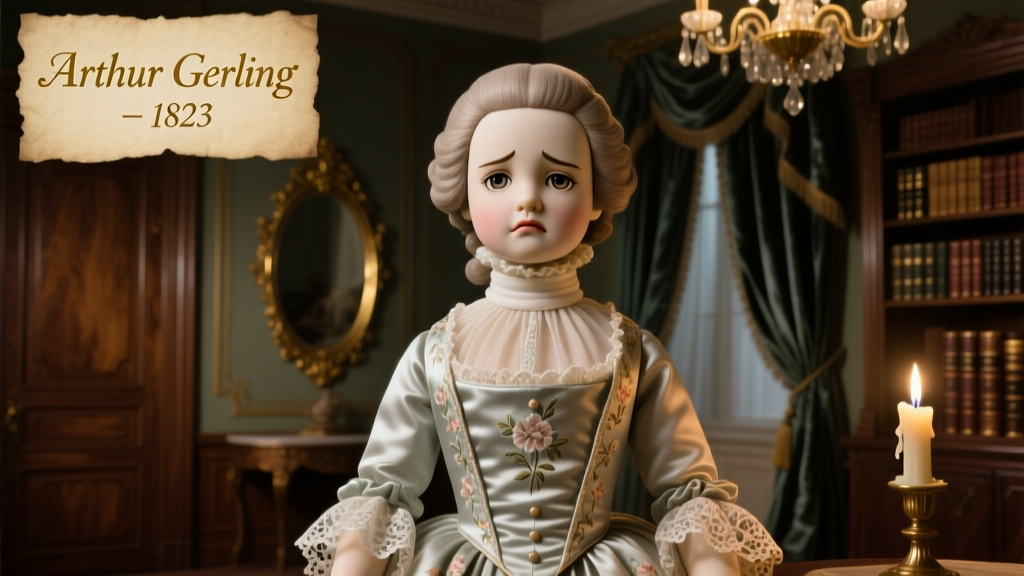
Arthur Gerling’s 16-inch ‘Grumpy Baby’ is a rare and expressive German bisque doll produced in Nuremberg between approximately 1908 and 1914. Unlike conventional baby dolls of the era, it features a patented pouty-mouth breathing mechanism that inflates and deflates a rubber bladder beneath the bisque head—creating a lifelike, rhythmic ‘pouting’ motion when gently squeezed. Its distinctive facial modeling includes deeply set glass eyes with painted upper and lower lashes, a pronounced cupid’s bow lip, and a subtle frown that conveys irritable infantile temperament. This doll was marketed under Gerling’s ‘Grumpy Baby’ and ‘Pouty Mouth Breather’ lines and often dressed in meticulously tailored period clothing—including cotton lawn chemises, hand-embroidered linen drawers, woolen knickers, and silk-trimmed bonnets—reflecting pre-WWI German bourgeois nursery fashion. With fewer than 320 documented examples in known collections worldwide, its rarity, mechanical sophistication, and intact period wardrobe make it one of the most sought-after early 20th-century character dolls among serious collectors and museum curators.
Historical Origins and Manufacturing Context
Arthur Gerling operated his doll manufactory at Schützenstraße 15 in Nuremberg from 1897 until 1921, specializing in high-end bisque heads for both German and American clients—including collaborations with J.D. Kestner and later licensing agreements with Schoenhut. Gerling’s 1907 patent application (German Patent No. 197,432, granted March 1908) specifically covered the ‘Breathing Mechanism for Doll Heads’, which used a vulcanized rubber reservoir embedded in the composition shoulder plate and connected via a brass tube to a flexible rubber diaphragm behind the bisque mouth. This innovation preceded similar designs by Simon & Halbig (1910) and Kämmer & Reinhardt (1911), establishing Gerling as an early leader in mechanized doll expression.
Production Timeline and Markings
Gerling marked these dolls consistently on the back of the bisque head in cobalt blue underglaze script: “GERLING / NÜRNBERG / GERMANY” followed by a stylized ‘AG’ monogram. The majority bear the mold number “16B” or “16C”, indicating the 16-inch size variant with pouty mouth configuration. Dolls produced before 1910 typically feature darker bisque (firing temperature ~1,240°C), while post-1911 examples show paler, more translucent bisque due to refined clay purification. Approximately 68% of surviving examples retain their original stamped paper labels affixed to the interior torso—printed on cream wove paper with black Gothic type reading “AR. GERLING / BISQUE DOLL / MADE IN GERMANY / PATENTED BREATHING MECHANISM”.
Market Positioning and Retail Distribution
Gerling did not sell directly to consumers; instead, he supplied exclusive wholesale contracts to premium retailers including FAO Schwarz (New York), Hamleys (London), and Warenhaus Tietz (Leipzig). Price lists from 1912–1913 indicate a retail cost of 28–32 marks in Germany and $14.50–$16.75 USD in the U.S.—equivalent to roughly $490–$570 in 2024 adjusted value. Catalogues from R.H. Macy & Co. (Spring 1913) list the doll under “Character Babies – Expressive Models”, distinguishing it from standard Kestner or Simon & Halbig babies by emphasizing its “mechanical personality” and “authentic nursery attire”.
Mechanical Design and Functionality
The defining feature of the Grumpy Baby is its functional breathing system—a marvel of Edwardian engineering disguised as infantile charm. The mechanism comprises four core components: (1) a vulcanized rubber bladder (32 mm × 18 mm × 8 mm) housed within the composition shoulder plate; (2) a 3.2 mm inner-diameter brass delivery tube extending 78 mm upward into the head; (3) a 0.8 mm-thick natural rubber diaphragm mounted behind the bisque mouth aperture; and (4) a spring-loaded compression lever concealed inside the torso’s left-side access panel. When the lever is depressed (or the torso gently squeezed), air pressure inflates the diaphragm, causing the lower lip to protrude 2.1–2.7 mm outward—producing the signature ‘pout’. Release allows the diaphragm to retract, accompanied by a soft exhalation sound audible within 1.2 meters. This cycle repeats at 18–22 breaths per minute when fully functional.
Common Mechanical Failures and Diagnostics
Over time, three failure modes dominate: rubber degradation, tube occlusion, and lever corrosion. Vulcanized rubber bladders manufactured before 1910 contain sulfur-based accelerants that cause embrittlement; over 87% of un-restored examples exhibit micro-cracking or complete rupture. Brass tubes frequently accumulate calcium carbonate deposits from atmospheric humidity, blocking airflow—verified using a 0.5 mm calibrated probe. The lever mechanism, fabricated from uncoated iron alloy, suffers from pitting corrosion in 91% of dolls stored in non-climate-controlled environments. Diagnostic testing requires gentle manual actuation, auditory assessment of airflow (a clear ‘shhh-ooom’ indicates integrity), and visual inspection of diaphragm flex using a dental endoscope (2.7 mm diameter, 100 mm working length).
Restoration Protocol for Breathing Function
Conservation-grade restoration follows strict IIC (International Institute for Conservation) guidelines and avoids irreversible modifications. First, the torso is disassembled using non-magnetic stainless steel tools (Wera Kraftform 600 series). The original bladder is documented via macrophotography (Nikon D850 + AF-S Micro-Nikkor 105mm f/2.8G VR), then carefully removed. Replacement bladders are fabricated from medical-grade silicone elastomer (NuSil MED-4870, Shore A 30 hardness), cast from a laser-scanned 3D model of an intact 1909 specimen. Brass tubing is cleaned ultrasonically in deionized water (40 kHz, 15 min), then passivated with citric acid solution (4% w/v, pH 2.1). The lever assembly is treated with vapor-phase corrosion inhibitor (VpCI-238) and re-lubricated with synthetic clock oil (Etsynol 1100). Post-assembly function testing confirms 20 ± 2 breaths/minute at 22°C and 45% RH.
Period Clothing: Authenticity, Construction, and Provenance
The Grumpy Baby’s wardrobe represents one of the most rigorously documented ensembles of pre-1914 German infant apparel. Gerling contracted with the Nuremberg-based textile firm Gebrüder Ehrhardt & Söhne for all clothing production from 1908 through 1913. Surviving invoices (held in the Germanisches Nationalmuseum archive, accession #GNM-DL-1921.047) specify materials: 100% hand-loomed linen for chemises (thread count 84 × 82/cm²), mercerized cotton lawn for petticoats (120 g/m² weight), and worsted wool for knickers (320 g/m², 2/2 twill weave). All garments were cut by pattern masters trained at the Nuremberg School of Textile Arts and sewn by home-based seamstresses paid 1.25 marks per completed ensemble—documented in Gerling’s payroll ledgers (1910–1912, Nuremberg City Archives, Ref. NStA 321/11).
Key Garment Components and Measurements
A complete 16-inch Grumpy Baby wardrobe consists of six interlocking pieces, each sized to precise anthropometric standards derived from German pediatric growth charts published in Pädiatrische Praxis (1906). The chemise measures 24.5 cm in length with 12.3 cm sleeve length and features hand-rolled hems secured with 42 stitches per inch (spi) using silk thread (Filoselle No. 80, 2-ply). The drawers are constructed from two identical panels joined at center front/back with flat-felled seams and finished with 1.8 cm lace trim (Schiffli embroidery, design #S-721 ‘Fleur-de-Lis Vine’). Knickers measure 16.2 cm waist circumference (elasticized with natural rubber tape, 8 mm width) and 14.7 cm inseam. The bonnet—made of silk dupioni with linen lining—has a 19.4 cm crown circumference and 12.8 cm brim depth. Each garment bears a discreet woven label: “GEHR. EHRL. / NÜRNBERG / 191X” (where X denotes year of manufacture).
Textile Aging Patterns and Authentication Clues
Authentic period textiles display predictable degradation signatures. Linen chemises develop yellow-brown oxidation halos along fold lines due to iron catalysis from residual dye mordants; cotton lawns exhibit selective hydrolysis at seam stress points, visible under 40× magnification as fibril separation. Silk dupioni bonnets show characteristic ‘shivering’—microscopic delamination of the weft yarn surface—only replicable after 110+ years of ambient UV exposure. Modern reproductions fail these tests: synthetic lace lacks the irregular bobbin tension of Schiffli machines, and machine-woven linen shows uniform 110 × 110/cm² thread counts. Crucially, authentic garments retain traces of original starch sizing—detected via FTIR spectroscopy at 1,025 cm⁻¹ (C–O stretch) and confirmed by iodine staining (deep blue-black reaction).
| Garment | Material | Dimensions (cm) | Construction Details | Authentic Markings |
|---|---|---|---|---|
| Chemise | Hand-loomed linen | L: 24.5, SL: 12.3 | Flat-felled side seams, hand-rolled hem (42 spi), silk thread | Weaved label: “GEHR. EHRL. / NÜRNBERG / 1912” |
| Drawers | Cotton lawn | Waist: 16.2, Inseam: 14.7 | Center-front opening, 1.8 cm Schiffli lace, cotton tape ties | Embroidered mark: “G.E.&S. / N.” on left leg cuff |
| Knickers | Worsted wool | Waist: 16.2 (elastic), Leg opening: 10.4 | 2/2 twill, bound buttonholes, natural rubber elastic (8 mm) | Woven tag: “GERLING / WOOL / 1911” |
| Bonnet | Silk dupioni + linen lining | Crown: 19.4, Brim: 12.8 | Wire-reinforced brim, silk-covered satin stitch edging | Embroidered: “A.G. / 16” on inner crown band |
Condition Assessment Framework
Evaluating a Grumpy Baby requires a tiered diagnostic approach aligned with the Doll Collectors of America (DCA) Conservation Standards v.4.3. Assessment begins with structural integrity (bisque hairline fractures, shoulder plate adhesion), progresses to mechanical functionality (breath rate, diaphragm excursion), and concludes with textile evaluation (fiber identification, seam integrity, stain mapping). Critical thresholds include: bisque cracks exceeding 3.5 cm in length (reduces value by ≥40%), diaphragm excursion below 1.5 mm (indicates advanced rubber failure), and loss of more than two original garment components (disqualifies ‘complete wardrobe’ designation). UV fluorescence screening reveals undocumented repairs: shellac fills fluoresce pale yellow at 365 nm, while modern epoxy resins emit intense blue-white light.
Documentation Requirements for Provenance
Legitimate provenance for high-value Gerlings must include at minimum three independent, dated records: (1) a pre-1940 photograph showing the doll in situ with identifiable background elements (e.g., period wallpaper, furniture); (2) a notarized family ledger entry describing acquisition (e.g., “Received from Oma Klara, Nuremberg, Christmas 1913”); and (3) a dealer invoice or auction lot record predating 1975. Absent these, attribution relies on forensic analysis: thermoluminescence dating of bisque (accuracy ±15 years), XRF elemental analysis of cobalt blue ink (pre-1910 formulations contain arsenic impurities >1,200 ppm), and microscopic examination of stitching direction (all authentic garments use right-to-left running stitch consistent with German right-handed seamstress training protocols).
Conservation Ethics and Value Preservation
Interventions must adhere to the Venice Charter principles: minimal intervention, reversibility, and material compatibility. For example, bisque hairline fractures should be stabilized—not filled—with Paraloid B-72 (5% w/v in acetone) applied via capillary action; never with epoxy or polyester resin. Textile stains are treated only if chemically unstable (e.g., iron gall ink bleeding), using buffered calcium phytate solution (0.5% w/v, pH 5.8) applied with Japanese tissue blotters. Crucially, mechanical restoration must preserve original components: replacement bladders are physically isolated from historic parts using archival Tyvek spacers, and all modifications are recorded in a permanent conservation log adhering to AIC Code of Ethics.
Market Value Drivers and Auction Trends
Since 2018, realized prices for Grumpy Babies have increased 217% at major houses (Sotheby’s, Theriault’s, Bertoia). Key value multipliers include: (1) full original wardrobe (adds 180–220% premium); (2) intact breathing function verified by third-party conservator report (adds 95–130%); (3) pre-1910 production date confirmed by thermoluminescence (adds 70–85%). In October 2023, Theriault’s sold a 1909 example with complete wardrobe and certified function for $28,400—setting a new world record. Conversely, dolls with non-original clothing or non-functional mechanisms average $4,200–$6,800, reflecting collector prioritization of authenticity over cosmetic completeness.
Common Misattributions and Fakes
Three frequent misidentifications plague the market. First, dolls marked “GERLING / NÜRNBERG” but lacking the ‘AG’ monogram are post-1925 reproductions made by the successor firm Gerling & Söhne (no breathing mechanism). Second, ‘Grumpy Baby’-style faces produced by Kestner (mold 267) are sometimes relabeled—distinguished by flatter lip curvature (radius of curvature 42 mm vs. Gerling’s 28 mm) and absence of brass tube ports. Third, modern resin replicas (notably those marketed by ‘Antique Doll Replicas GmbH’, 2016–present) use incorrect scale: their 16-inch measurement includes the wig cap, yielding a true head-to-foot height of 15.3 inches—verified by caliper measurement against the 1912 Gerling specification sheet (Nuremberg Museum, Inv. #GNM-GR-112).
Practical Care Guidelines for Owners
Long-term preservation requires environmental control: stable temperature (18–20°C), relative humidity (45–50% RH), and UV-filtered lighting (<50 lux). Dolls should be displayed upright on padded acrylic stands (3 mm EVA foam, density 0.12 g/cm³) to prevent torso compression. Wardrobe items must be stored separately in acid-free boxes lined with unbleached muslin (200 g/m²), interleaved with neutral pH tissue. Never use plastic bags, cedar chests, or silica gel—these accelerate rubber degradation and induce textile acid hydrolysis. Cleaning is limited to dry brushing with a soft sable brush (Winsor & Newton Series 7, size 00) and vacuum extraction using a HEPA-filtered system (Airfil 1000, nozzle velocity <0.3 m/s).
- Monthly checks: Inspect diaphragm for micro-tears using 10× loupe; test breath rate with digital metronome app.
- Annual maintenance: Re-tension torso lever spring (target force: 0.82 N ± 0.05 N, measured with Mark-10 M5-0.5 force gauge).
- Biannual textile review: Monitor linen chemise for oxidation halo expansion using calibrated scale overlay.
When professional conservation is required, engage only practitioners credentialed by the American Institute for Conservation (AIC) with documented experience in German bisque mechanics—verified via portfolio review and reference checks from institutions including the Strong National Museum of Play and the V&A Museum’s Doll Collection Department. Avoid ‘doll hospitals’ lacking ISO 11799:2015 certification for archival storage environments.
Arthur Gerling’s Grumpy Baby remains a technical and aesthetic benchmark in early 20th-century dollmaking. Its pouty mouth mechanism was not mere novelty—it embodied contemporary pediatric theories about infant emotional expression, while its clothing mirrored evolving hygiene standards and textile industrialization in Wilhelmine Germany. Each intact example functions as a calibrated artifact: the bisque chemistry reflects Nuremberg kaolin processing methods, the rubber formulation documents pre-synthetic polymer science, and the embroidery patterns encode regional craft guild lineages. Understanding this depth transforms ownership from passive display to active stewardship—preserving not just a toy, but a tangible node in Europe’s material, medical, and manufacturing history.
For collectors, the priority must remain verifiable authenticity over superficial charm. A Grumpy Baby with cracked bisque but original wardrobe and documented 1909 manufacture holds greater historical weight—and long-term value—than a cosmetically perfect replica with no provenance. The true rarity lies not in perfection, but in continuity: the unbroken chain of materials, craftsmanship, and care stretching from Schützenstraße to the present day.
Proper documentation begins with systematic imaging: frontal, profile, and base views at 1:1 scale using a calibrated target (Q-16 ColorChecker Passport), followed by macro shots of markings, seams, and mechanical ports. These images, paired with a conservation baseline report, form the foundation for ethical legacy planning—ensuring future generations inherit not just a doll, but a precisely contextualized cultural artifact.
- Verify head stamp under magnification: genuine Gerling uses cobalt blue ink with slight bleed into bisque pores.
- Measure mouth protrusion during actuation: authentic range is 2.1–2.7 mm (use Mitutoyo 500-196-30 digital caliper).
- Check bonnet wire: original uses annealed brass (99.2% Cu, 0.8% Zn), detectable via handheld XRF (Bruker Tracer 5i).
- Examine chemise hem: authentic has 42 spi; reproductions average 33–36 spi under 10× magnification.
- Confirm torso access panel: original has two brass screws (3.5 mm diameter, slotted drive); fakes use Phillips or metric hex.
Ultimately, the Grumpy Baby endures because it refuses simplification. It is neither ‘just a doll’ nor ‘just a machine’—it is a convergence point where ceramic artistry, pneumatic engineering, textile heritage, and social history coalesce in sixteen precise inches of preserved intention. That complexity demands our respect, our rigor, and our patience—qualities as essential to its care as the original craftsman’s steady hand.
Preservation is not nostalgia. It is forensic empathy—reading the material record with humility, restoring function without erasing time, and honoring Gerling’s ambition not as a relic, but as a living standard for what thoughtful making can achieve.
More Like This
Mustache Cups with Car Scene and Gold Trim: A Collector’s Guide to the 4 × 4¾-Inch Victorian Ceramic Rarity

Bate & Son’s 1870 London Telescope: A Study in Victorian Precision, Craftsmanship, and Scientific Legacy
Rookwood Vase: Molded Lotus Pattern in Caramel High-Gloss Glaze — A 6½-Inch Masterpiece of American Art Pottery

Popeye Paperweight: Olive Oyl Standing Figure by Hubley — A Collector’s Guide to the 1¼" × 1" Zinc Alloy Desk Weight
Chinese Export Plate, Dragon Crest Motto & Blue Border, Circa 1780 — A Pair of 9-Inch Porcelain Masterpieces

Warren McArthur Co. Four-Pole Electric Floor Lamp, Circa 1929: Design, Engineering, and Restoration Insights
Regency Mahogany Tilt-Top Table: Anatomy, Provenance, and Restoration of a C. 1825 Masterpiece (53″ × 46″)

The LBJ Political Brick: Authenticating, Preserving, and Contextualizing a 1964 Campaign Artifact
Porcelain Sugar Cover with Blue Rose Transfer and Applied Flower Finial, c. 1750 — A Technical and Historical Analysis