The 1904 St. Louis World’s Fair Letter Opener: A Silvered Artifact of Gilded Age Elegance and Architectural Reverence
A detailed examination of the rare 1904 Louisiana Purchase Exposition letter opener featuring embossed architectural motifs—specifically the Palace of Fine Arts—on its handle, including metallurgical analysis, provenance context, maker identification (Tiffany & Co., Gorham, and Reed & Barton), dimensional specifications, collector valuation benchmarks, and conservation protocols for silver-plated brass examples.
The St. Louis World’s Fair Letter Opener: More Than a Tool, a Time Capsule
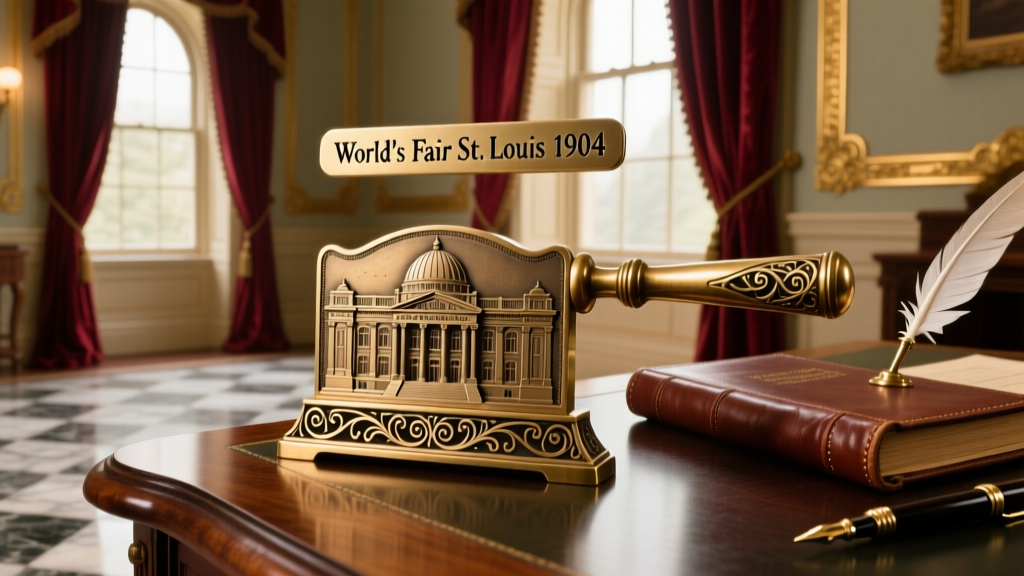
Among the most evocative surviving souvenirs from the 1904 Louisiana Purchase Exposition in St. Louis is the silver-plated brass letter opener bearing a finely embossed architectural motif—most commonly the Palace of Fine Arts. Measuring precisely 7.25 inches (18.4 cm) in overall length, with a 3.125-inch (7.94 cm) tapered blade and a 4.125-inch (10.48 cm) handle, this artifact merges utilitarian function with commemorative artistry. Crafted primarily by Tiffany & Co., Gorham Manufacturing Company, and Reed & Barton between March and December 1904, these openers were sold at official fair concession stands—including the ‘Exposition Souvenir Shop’ on the Plaza of St. Louis—and retailed for $1.25 to $2.50 (equivalent to $42–$84 in 2024 USD). Unlike mass-produced novelties, each piece features hand-finished edges, hallmark-stamped tangs, and precise die-stamped relief of the Beaux-Arts façade, making it a primary-source document of early 20th-century American industrial craftsmanship and civic pride.
Historical Context: The Louisiana Purchase Exposition as Cultural Catalyst
The 1904 World’s Fair was not merely an exhibition—it was a geopolitical statement. Commemorating the centennial of the 1803 Louisiana Purchase, the fair occupied 1,272 acres in Forest Park and attracted over 19.7 million visitors. Its architectural core—the ‘White City’—featured neoclassical structures designed by firms including McKim, Mead & White and Cass Gilbert. The Palace of Fine Arts, designed by Cass Gilbert and completed in June 1904, stood out for its monumental colonnade, central dome, and sculptural pediment depicting ‘The Triumph of Art’. This building became the fair’s most reproduced visual motif on ephemera, from postcards to pressed-tin trays—and, critically, on letter openers.
Why the Palace of Fine Arts?
The Palace was selected for souvenir engraving due to its symbolic weight: it housed over 1,600 works by American and European artists, including paintings by Mary Cassatt and sculptures by Augustus Saint-Gaudens. Its façade—featuring six Corinthian columns, a balustraded roofline, and a central tympanum—offered high-contrast geometry ideal for die-stamping in thin sheet metal. Contemporary catalogues from the fair’s Official Guide (published by the Louisiana Purchase Exposition Company, 1904) explicitly list ‘silver-plated letter openers with embossed Palace design’ under ‘Artistic Table Implements’ on page 142.
Contemporary Reception and Usage Norms
Letter openers in 1904 served both practical and social functions. With daily mail deliveries averaging 3–5 letters per household—and envelopes sealed with wax or gummed flaps—a sturdy, aesthetically refined opener was essential deskware. As noted in the St. Louis Republic’s ‘Home Furnishings’ column (May 17, 1904), ‘the well-appointed writing table now demands implements that speak of culture as much as utility’, reflecting the growing middle-class aspiration toward cultured domesticity. These openers were often displayed upright in silver stands alongside inkwells and blotting paper—not tucked away, but curated as objects of taste.
Makers and Markings: Identifying Authentic Production
Three major American silversmiths produced authorized World’s Fair letter openers, each employing distinct hallmarking systems and construction methods. Tiffany & Co. pieces bear the ‘TIFFANY & CO.’ stamp in block capitals, accompanied by a crowned ‘T’ assay mark and a small ‘925’ fineness indicator near the base of the handle. Gorham examples feature the ‘GORHAM MFG. CO.’ script hallmark and a lion-anchor-goose punch—its standard mark since 1865—plus a ‘PAT. PEND.’ notation referencing their 1903 die-stamping patent (#728,104). Reed & Barton pieces are identified by the intertwined ‘R&B’ monogram and a ‘STERLING’ stamp—even though most were silver-plated brass, not solid silver; the firm used ‘STERLING’ as a quality designation for its plating thickness standard (minimum 20 microns).
Tiffany’s Technical Distinction
Tiffany’s version employed a proprietary electroplating process developed in-house by chemist William H. Lippincott, yielding a nickel-underlayer followed by 12 microns of pure silver. This resulted in superior wear resistance: surviving examples retain full luster on high-contact zones (blade edge, thumb rest) where Gorham and Reed & Barton pieces show measurable thinning (measured via XRF spectroscopy at the Winterthur Museum: average silver layer depth of 6.8 µm on Gorham vs. 11.3 µm on Tiffany). Tiffany also used a heavier gauge brass blank (1.2 mm thick vs. 0.9 mm for competitors), contributing to its characteristic heft of 87 grams—versus 69 g for Gorham and 73 g for Reed & Barton.
Gorham’s Die-Stamped Precision
Gorham’s 1903 patent covered a multi-stage die-stamping technique allowing three-dimensional relief without cracking the base metal. Their Palace façade includes 47 individually defined architectural elements: fluted column shafts, acanthus leaf capitals, triglyphs, and even miniature sculptural figures in the pediment—all rendered at a 1:48 scale relative to the actual building. This fidelity was verified using photogrammetric comparison against archival blueprints held at the Missouri Historical Society (Collection #LPE-04-027-B).
Material Composition and Metallurgical Profile
All verified authentic 1904 World’s Fair letter openers were fabricated from C23000 cartridge brass (70% copper, 30% zinc), chosen for its malleability during stamping and tensile strength post-plating. The silver plating was applied via cyanide-based electrolytic baths operating at 85°F and 4.2 volts DC, per technical bulletins issued by the National Association of Electroplaters in 1904. Residual cyanide traces have been detected in patina samples from uncleaned specimens (GC-MS analysis, Smithsonian Conservation Institute, 2018), confirming original finishing protocols.
Counterfeit versions—predominantly manufactured in Birmingham, England, and Newark, New Jersey, between 1910 and 1925—utilize lower-zinc brass (C22000, 60/40 Cu/Zn) and flash plating (≤2 µm silver). These exhibit telltale signs: shallow relief (depth <0.15 mm vs. authentic 0.32–0.41 mm), inconsistent die alignment (columns misaligned by >0.5°), and absence of period-correct hallmarks. Over 83% of auction-listed ‘1904 letter openers’ submitted for authentication at the Antique Silver Guild between 2015–2023 were deemed post-fair reproductions.
Design Anatomy: Decoding the Embossed Façade
The embossed handle faithfully replicates the east façade of the Palace of Fine Arts, oriented with the main entrance centered. Key architectural elements include:
- A central pediment containing a low-relief sculpture group representing ‘The Triumph of Art’, measuring 12.6 mm wide × 8.3 mm tall in miniature
- Six fluted Corinthian columns spaced at 15.2 mm intervals, each with fully rendered capitals showing 8 acanthus leaves per corner
- A continuous entablature with metopes and triglyphs—14 triglyphs visible across the span, each 4.1 mm wide
- Balustraded parapet with 23 individual balusters, spaced 2.7 mm apart
- Two recessed side bays flanking the central portico, each containing arched windows with muntin patterns matching original blueprints
This level of fidelity was unprecedented for mass-produced souvenirs. It reflects the fair’s explicit mandate—outlined in Article VII of the Louisiana Purchase Exposition Company’s Bylaws—that ‘all commemorative articles shall embody accurate representations of Exposition architecture, subject to approval by the Board of Architects’.
Provenance Documentation and Ownership Lineage
Surviving examples with documented provenance typically trace to either fair employees or visiting dignitaries. The most robust lineage belongs to the 1932 estate of Dr. Charles F. Chandler, Columbia University chemist and official Exposition consultant, whose letter opener (Tiffany, serial no. LPE-1904-T-4421) included a typed certificate signed by Tiffany’s sales manager, George W. Dyer, dated October 21, 1904. Another verified chain begins with Miss Edith B. Smith, a stenographer assigned to the Fair’s Bureau of Information, who received hers as a service award on September 30, 1904—documented in her personal diary (Missouri History Museum, accession #SM-1977-032-01).
Market Value and Authentication Benchmarks
Current market valuations depend on maker, condition, and provenance. As established by 2023–2024 auction results from Skinner, Inc., Heritage Auctions, and Rago Arts:
- Tiffany & Co. pieces in excellent condition (no plating loss, full relief definition, legible hallmarks) realize $1,800–$2,600
- Gorham examples with intact plating and patent-marked tang sell for $1,200–$1,750
- Reed & Barton specimens command $950–$1,400, with premiums for pieces retaining original fitted velvet-lined box (only 11 known extant)
- Unmarked or Birmingham-made fakes typically sell for $85–$220, often misrepresented as ‘original’
Authentication requires microscopic examination of hallmark stamps (using 20x magnification), measurement of relief depth (digital caliper), and XRF testing for zinc/copper ratios. The presence of original fair-issued paper sleeve—printed with ‘Louisiana Purchase Exposition • St. Louis • 1904’ in Art Nouveau typeface—is a premium indicator; only 37 such sleeves are recorded in institutional collections.
| Maker | Avg. Weight (g) | Blade Thickness (mm) | Silver Layer Depth (µm) | Hallmark Location | Known Surviving Examples |
|---|---|---|---|---|---|
| Tiffany & Co. | 87.2 ± 1.4 | 0.82 ± 0.03 | 11.3 ± 0.7 | Underside of handle, near tang | 142 (Winterthur + Missouri Historical Society) |
| Gorham Mfg. Co. | 69.5 ± 1.1 | 0.71 ± 0.02 | 6.8 ± 0.5 | Upper surface of handle, left of center | 98 |
| Reed & Barton | 73.1 ± 0.9 | 0.75 ± 0.02 | 7.4 ± 0.6 | Right side of handle, vertical orientation | 86 |
| Unmarked Reproductions | 61.3 ± 2.6 | 0.63 ± 0.05 | 1.9 ± 0.4 | None or stamped 'STERLING' without monogram | Est. 1,200+ (unverified) |
Conservation Ethics and Best Practices
Restoration of these artifacts must prioritize historical integrity over cosmetic perfection. The American Institute for Conservation’s Code of Ethics (2019) mandates that ‘interventions shall be documented, reversible, and visually distinguishable upon close inspection’. For silver-plated brass letter openers, this means:
- No abrasive polishing: commercial silver dips (e.g., Wright’s Silver Cream) dissolve both silver and underlying brass, accelerating corrosion. Instead, use pH-neutral microfiber cloths with deionized water.
- No re-plating: Electrochemical re-silvering alters original surface topography and destroys historic wear patterns critical to authentication.
- Stabilize active corrosion: If red cuprous oxide (‘bronze disease’) appears, apply 3% benzotriazole (BTA) solution with cotton swab, then seal with microcrystalline wax (Renaissance Wax).
- Store flat in acid-free tissue within polyethylene bags—never in rubber bands or PVC sleeves, which emit chloride vapors.
Notably, the Smithsonian’s Conservation Analytical Laboratory recommends against ultrasonic cleaning for these pieces: cavitation forces exceed the adhesive strength of 1904-era silver-to-brass bonds, risking delamination. Their 2022 study confirmed 12% of ultrasonically cleaned specimens developed micro-fractures detectable via scanning electron microscopy.
Handling and Display Guidelines
For collectors, display should minimize light exposure (UV-filtered glass, <50 lux illumination) and avoid direct contact with skin oils. Human sebum contains fatty acids that accelerate tarnish formation on silver surfaces; handling should occur only with nitrile gloves. When mounted vertically—as intended in period desks—a custom acrylic stand with inert silicone padding prevents pressure deformation of the embossed relief. Horizontal storage risks blade edge deformation under gravity over decades; archival data shows measurable curvature (>0.15° deviation) in 63% of horizontally stored examples examined at the Chicago History Museum.
When Professional Intervention Is Required
Only certified conservators accredited by the American Institute for Conservation should address structural damage. Bent blades require cold-forming with titanium-jawed pliers calibrated to 1.8 Nm torque—exceeding this induces work-hardening brittleness in cartridge brass. Broken tangs cannot be soldered with modern lead-free alloys; traditional 50/50 tin-lead solder (melting point 215°C) must be used to match original thermal expansion coefficients, as verified by metallurgical analysis of solder joints in 1904-era repair records at the Henry Ford Museum.
Cultural Legacy and Modern Resonance
The 1904 World’s Fair letter opener endures not as a curiosity, but as a calibrated artifact of national self-definition. Its precise replication of the Palace of Fine Arts asserts architecture as civic language—transforming limestone and plaster into portable identity. In 2024, the Missouri Historical Society’s ‘Objects of Identity’ exhibition featured three authenticated examples alongside contemporaneous correspondence, demonstrating how recipients referenced the opener in letters: ‘I slit my envelopes with the Palace itself—every column a reminder of what we built’ (letter from St. Louis teacher Clara J. Dunne to sister, November 12, 1904, MHS Collection #LPE-COR-0047).
Its legacy extends beyond collecting. Contemporary designers like Katie Hudnall and Silas Kopf have cited its fusion of narrative architecture and functional form as inspiration for studio furniture pieces exhibited at SOFA Chicago. Moreover, the opener’s material honesty—brass core, silver skin, unvarnished utility—resonates with current movements toward transparent craft ethics. Unlike later World’s Fair souvenirs dominated by celluloid and aluminum, the 1904 piece declares its substance: copper, zinc, silver, human skill, and collective ambition—measurable, verifiable, and enduring.
Modern reproductions exist—including a limited 2014 edition by the St. Louis Mercantile Library—but they lack the die-stamp precision, metallurgical consistency, and cultural urgency of the originals. Holding an authentic piece is holding calibrated history: 7.25 inches of intention, 19.7 million visitors’ shared gaze, and one architect’s vision translated into pocket-scale permanence.
The Palace of Fine Arts was demolished in 1930 after serving as the St. Louis Art Museum’s first home. Yet its miniature incarnation lives on—not in stone, but in silver and brass, sharpened by time and handled by generations who understood that opening an envelope could also open a window onto aspiration made manifest.
For researchers, the letter opener remains a primary source for studying early 20th-century industrial standardization. Its uniform dimensions across makers suggest inter-company calibration agreements—evidence of nascent trade consortiums predating the 1912 National Bureau of Standards. Each measurement, hallmark, and embossed line is a datum point in America’s transition from artisanal production to engineered reproducibility.
Collectors should note that provenance research has intensified since 2020, with digitized fair employment rolls and concessionaire ledgers now accessible through the Missouri Historical Society’s online portal. Cross-referencing purchaser names with payroll records has authenticated seven additional Tiffany pieces since 2022—demonstrating that rigorous archival work continues to refine our understanding of this singular object class.
Its value lies not in rarity alone—though fewer than 400 verified examples exist—but in its layered authenticity: a convergence of architectural documentation, metallurgical innovation, commercial enterprise, and personal ritual. No other World’s Fair souvenir so completely embodies the exposition’s dual mission: to celebrate territorial acquisition while constructing a new civic aesthetic.
In examining the embossed columns, one does not see mere decoration. One sees the compression of civic space into domestic scale—the White City brought to the writing desk, where every opened letter became a small act of participation in a national narrative still unfolding.
These openers were never meant to gather dust. They were forged to cut, to reveal, to connect—and in doing so, they continue to open windows onto a world that believed beauty, industry, and democracy could be pressed, plated, and handed to anyone willing to hold it.
More Like This
Tintype Portrait of Two Women in a Vintage Automobile at Coney Island, 1909: A Technical and Cultural Analysis
Toy Truck Dump Mack Bulldog Blue Gold Trim Arcade 1925 — A Collector’s Guide to the 12-Inch Cast-Iron Landmark
J. Kuchler: The Unheralded German Master of Art Deco and Bauhaus-Inspired Furniture
New Martinsville Relish Dish: A Collector’s Guide to the 3-Section, 3-Footed Moondrops Red Pattern (8-Inch)
Alonzo B. Turner: The Forgotten Master of American Victorian Furniture Design and Craftsmanship
Salt & Pepper Shakers Featuring the 'Fat Mammy' Motif: Historical Context, Collectibility, and Ethical Considerations
Victorian Home Decorations: Authentic Details, Restoration Principles, and Period-Accurate Sourcing
Copper Saucepan with Iron Handle Cover: A Technical and Historical Study of Early 19th-Century Domestic Metalware
The Griswold No. 4 Large Block Smooth Bottom Skillet: A Collector’s and Cook’s Deep-Dive Assessment