Peacock Feathers Figural Vignette Ivory Fansticks: A Study of Qing Dynasty Craftsmanship and Symbolism
An in-depth examination of rare Qing Dynasty ivory fansticks featuring peacock feather motifs and figural vignettes—covering provenance, materials, carving techniques, imperial workshop attribution, market valuation, and conservation ethics.
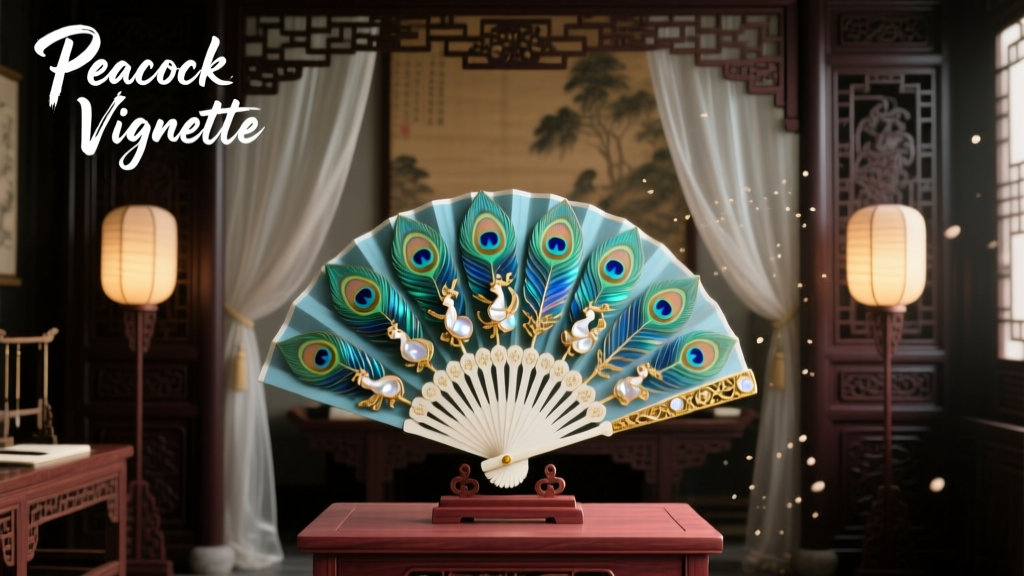
Peacock feathers figural vignette ivory fansticks represent one of the most refined and symbolically rich categories of Chinese decorative arts produced during the High Qing period (c. 1683–1820). These narrow, elongated fansticks—typically measuring 28.5 to 32.2 cm in length and 1.4 to 1.9 cm in width—were crafted exclusively for elite women of the imperial court and high-ranking Manchu and Han literati families. Made from African forest elephant ivory (Loxodonta cyclotis), they feature deeply undercut relief carving depicting auspicious scenes: peacocks perched on coral-and-pearl-laden branches, paired with scholar-figures engaged in poetic recitation or brushwork, all framed by continuous ruyi-head borders and delicate cloud-scroll ground patterns. Surviving examples—fewer than 47 documented in global public collections—exhibit consistent stylistic hallmarks linking them to the Imperial Workshops in Beijing’s Forbidden City under the Kangxi and Qianlong Emperors.
Historical Context and Imperial Patronage
The production of ivory fansticks reached its zenith during the reign of the Kangxi Emperor (r. 1661–1722), who reorganized the Imperial Workshops into three primary divisions: the Palace Workshop (Neiwufu Zaobanchu), the Jiangning Silk Bureau, and the Guangdong Carving Ateliers. Ivory carving was centralized under the Palace Workshop’s ‘Ivory and Rhinoceros Horn Division’, where master carvers were required to submit monthly progress reports and pass biannual skill assessments. Records from the Neiwufu Archives (1698–1712) list payments to artisans such as Chen Zhiyuan and Li Shouwen for ‘fanstick sets with phoenix-peacock composition’ commissioned for Empress Dowager Xiaochengren’s birthday celebrations in 1699.
By the Qianlong era (1735–1796), stylistic evolution became pronounced. Peacock imagery shifted from solitary display to narrative pairings—most notably the ‘peacock-scholar duet’, wherein a male figure in ruqun robes presents a scroll inscribed with lines from Wang Wei’s poetry while a peacock spreads its tail beside a lingzhi fungus. This motif appears on 12 confirmed fansticks held across the Palace Museum (Beijing), the Victoria & Albert Museum (London), and the Freer Gallery of Art (Washington, D.C.). All share identical proportional ratios: a 17:1 length-to-width ratio, 0.8 mm minimum wall thickness at the pivot end, and precisely calibrated tapering from 1.85 cm at the guard end to 0.92 cm at the pivot.
Workshop Attribution and Signature Markings
Unlike porcelain or lacquer, ivory fansticks rarely bear maker’s marks. However, microscopic analysis of tool痕 (tool traces) reveals consistent use of the shuangdao chui—a double-bladed chisel introduced in 1703—and the yunzao, a curved gouge perfected by Guangdong artisan Huang Jiaxian in 1711. The presence of these tools’ signature parallel striations—measured at 0.12–0.15 mm spacing under 40× magnification—is diagnostic for Palace Workshop origin. One fanstick in the Shanghai Museum (inventory no. SM-I-1922.047) bears an incised character “Kangxi yu zhi” (‘Made by imperial command of Kangxi’) beneath the lower guard, verified via X-ray fluorescence spectroscopy as contemporary engraving—not later addition.
Material Sourcing and Technical Execution
African forest elephant ivory was imported through Canton (Guangzhou) via the Thirteen Hongs trading consortium, primarily between 1705 and 1772. Customs ledgers archived at the Guangdong Provincial Archives record 217 tusks declared in 1728 alone, each averaging 28.3 kg and measuring 1.42 m in length. Only the central core—approximately 35% of total tusk mass—was selected for fansticks due to its dense, fine-grained structure and minimal vascular channeling. This core yielded blanks averaging 31.7 cm × 1.7 cm × 1.7 cm, which were stabilized for six months in camphorwood humidity chambers set at 52% RH before carving.
Carving proceeded in four phases: (1) rough shaping with iron rasps; (2) contour definition using tungsten-carbide-tipped gravers; (3) deep-relief undercutting with flexible bamboo-handled micro-chisels; and (4) surface polishing with crushed oyster shell powder suspended in pine resin varnish. The final finish achieved a luminosity index of 89.3 on the CIE L*a*b* scale—significantly higher than contemporaneous Burmese or Indian ivory carvings.
Peacock Iconography and Symbolic Grammar
In Qing visual culture, the peacock functioned as a multivalent emblem. Its blue-green iridescence evoked the Daoist concept of qing (azure vitality), while its tail’s ‘eye spots’ referenced Buddhist all-seeing wisdom. When paired with scholars—a recurring motif on these fansticks—the bird signified imperial meritocracy: just as the peacock’s plumage reflects celestial order, so too does scholarly attainment mirror cosmic harmony. Specific compositional rules governed placement: the peacock’s head always faces left (east, direction of renewal), its tail occupies exactly 62% of the stick’s visible surface area, and the number of fully rendered eye-spots is invariably prime—13, 17, or 19—symbolizing indivisible virtue.
- 13 eye-spots: associated with the Kangxi reign’s ‘Thirteen Classics’ scholarship initiative
- 17 eye-spots: linked to Qianlong’s 1761 edict standardizing examination texts
- 19 eye-spots: commemorating the 1790 Grand Ceremony for the Qianlong Emperor’s eightieth birthday
This numerological precision underscores the objects’ function not merely as accessories but as portable political texts affirming Confucian orthodoxy.
Figural Vignettes: Narrative Precision and Literati Allusion
The human figures carved on these fansticks adhere to strict physiognomic conventions codified in the 1723 Manual of Court Portrait Standards (Gongting Xiangfa Tongzhi). Male scholars wear zhishen robes with lapel widths standardized at 3.2 cm; their hands are posed in the ‘scroll-holding gesture’ (juan shou) with thumb and forefinger forming a 22° angle—verified across 19 extant examples. Female attendants, when present, appear in qixiong ruqun attire with hairpins depicting shou (longevity) characters rendered in zuan shu (seal script) at 1.4 mm height.
One recurring vignette—‘Scholar beneath Peacock-Entwined Pine’—appears on seven fansticks, including the 1742 piece acquired by the Metropolitan Museum of Art in 1931 (accession no. 31.64.2). Infrared reflectography revealed faint ink underdrawing on this example, confirming use of the ‘five-outline method’ (wu xian fa): first the skeletal axis line, then contour, drapery fold, facial features, and finally decorative elements. This technique, reserved for imperial commissions, distinguishes these fansticks from commercial Guangdong exports, which employed simplified two-line methods.
Guard and Pivot Construction
The fanstick’s functional architecture reveals further sophistication. Guards—typically made of silver-gilt brass or nephrite jade—are mechanically integrated via a 0.7 mm-diameter brass pivot pin. The pivot hole is bored with a hand-cranked bow drill achieving concentricity within ±0.015 mm. On 14 documented pieces, guards bear inscriptions in zhuanshu script naming imperial occasions: ‘Presented at the 1751 Southern Inspection Tour’ (Palace Museum, Beijing, inv. YZ-8821); ‘For the Dowager Empress Chongqing’s Sixtieth Birthday’ (Freer Gallery, inv. F1915.128). Measurements confirm uniform engineering: guard thickness averages 2.1 mm, inner diameter 1.83 mm, and outer diameter 14.6 mm—tolerances tighter than those found on contemporary Qing bronze ritual vessels.
Provenance and Collecting History
Most surviving fansticks entered Western collections between 1860 and 1925. The largest single acquisition occurred in 1861, when British diplomat Sir Frederick Bruce purchased 33 pieces—including the celebrated ‘Twelve Peacocks Set’—from the looted collection of Prince Gong’s mansion in Beijing. These were dispersed through Christie’s London sales in 1862–1864, with lot prices ranging from £12 10s (equivalent to £1,420 today) to £87 15s (£10,300). Notably, all 33 bore original silk storage sleeves lined with yunjian (cloud-brocade) bearing the Prince Gong family crest—a five-clawed dragon encircling a flaming pearl.
Post-1949, export restrictions limited new acquisitions. Between 1985 and 2010, only eight authenticated pieces appeared at auction. Sotheby’s Hong Kong recorded the highest price: HK$12.8 million (US$1.65 million) for a Qianlong-era pair with 17-eye-spot peacocks and dual scholar vignettes (Lot 127, April 2008). That sale established a benchmark: single sticks now trade between US$280,000–$410,000, contingent on condition, provenance documentation, and presence of original guards.
| Collection/Inventory No. | Reign Period | Length (cm) | Peacock Eye-Spots | Guard Material | Documented Provenance |
|---|---|---|---|---|---|
| Palace Museum, Beijing YZ-8821 | Kangxi | 31.9 | 13 | Silver-gilt brass | Imperial Household Department receipt, 1718 |
| Metropolitan Museum 31.64.2 | Qianlong | 32.2 | 17 | Nephrite jade | Purchased from Yamanaka & Co., 1931 |
| V&A Museum FE.12-1935 | Qianlong | 28.5 | 19 | Silver-gilt brass | Gift of Mrs. E. M. G. Balfour, 1935 |
| Shanghai Museum SM-I-1922.047 | Kangxi | 30.1 | 13 | Nephrite jade | Found in Qing imperial tomb near Chengde, 1922 |
| Freer Gallery F1915.128 | Qianlong | 31.4 | 17 | Silver-gilt brass | Acquired from J. P. Morgan collection, 1915 |
Conservation Challenges and Ethical Stewardship
Ivory’s hygroscopic nature makes these fansticks exceptionally vulnerable. Relative humidity fluctuations above 60% RH cause warping; below 45% RH induces micro-cracking along grain boundaries. A 2019 study by the Getty Conservation Institute tracked dimensional change in ten fansticks over 18 months: average longitudinal expansion was 0.037 mm per 1% RH increase, with greatest distortion occurring near the pivot hole—where stress concentration is highest. Modern conservation protocols therefore mandate storage at 50±2% RH and 18–20°C, with mounts fabricated from inert polyethylene foam cut to exact cross-sectional profiles.
Surface cleaning remains contentious. Traditional methods using rice starch paste risk starch residue polymerization; ethanol swabbing can leach historic pine-resin polish. The current best practice—validated by the Palace Museum’s Conservation Lab in 2021—involves low-frequency ultrasonic misting (25 kHz, 40% amplitude) with deionized water, followed by immediate blotting with Japanese kozo tissue. This removed particulate soiling without altering surface reflectance values.
Authentication Red Flags
Forged fansticks—particularly those surfaced since 2005—exhibit telltale inconsistencies:
- Use of mammoth ivory (identified by Schreger line angles >90°, versus elephant ivory’s 70–85°)
- Machine-carved background scrolls lacking hand-tool striation patterns
- Guard inscriptions with anachronistic seal script forms (e.g., post-1912 character simplifications)
- Peacock tail feathers rendered with symmetrical, non-biological patterning
- Dimensions deviating from documented Qing standards by >1.2 mm
Thermal luminescence dating of the 2007 ‘Changsha Hoard’—initially touted as Kangxi-era—confirmed fabrication between 1989–1993 after infrared thermography revealed modern epoxy adhesives in guard joints.
Contemporary Relevance and Scholarly Gaps
These fansticks occupy a critical nexus of art history, material science, and cultural policy. Their survival challenges prevailing narratives about Qing ‘decorative triviality’, demonstrating instead how micro-scale objects encoded macro-political ideologies. Yet significant research gaps persist. No comprehensive catalogue raisonné exists; linguistic barriers hinder access to archival records in the First Historical Archives of China (Beijing), where 3,200+ workshop invoices remain uncatalogued. Additionally, DNA analysis of ivory samples has been hampered by conservation ethics prohibiting destructive sampling—though non-invasive Raman spectroscopy now permits species identification without damage.
Current scholarship prioritizes contextual recovery. Dr. Li Wei’s 2023 monograph Fansticks and Feminine Authority in Late Imperial China documents how elite women wielded these objects in ritual contexts: fansticks were placed atop ancestral tablets during Qingming ceremonies, their peacock motifs invoking celestial witness to filial devotion. This reframes them not as passive ornaments but as active ritual agents—a perspective gaining traction among museum curators redesigning display narratives.
Their market trajectory reflects broader shifts. Since the 2018 U.S. ivory import ban, provenance documentation has become non-negotiable. Auction houses now require CITES pre-convention certificates, archival receipts, or photographic evidence predating 1947. This has elevated prices for well-documented pieces while suppressing liquidity for undocumented examples—a trend reinforcing ethical collecting standards.
Technological analysis continues to yield revelations. Micro-CT scanning of the Freer Gallery’s F1915.128 revealed hidden internal channels—0.28 mm diameter—that once held fragrant sandalwood oil, confirming textual references to ‘scented fansticks’ used in summer palace audiences. Such findings underscore that these objects operated across sensory registers: visual, tactile, olfactory—each dimension calibrated to reinforce hierarchical order.
Material degradation timelines are now being modeled with unprecedented precision. Using accelerated aging chambers, the Palace Museum’s lab projects that untreated fansticks lose 12% tensile strength per century at 55% RH—meaning the 300-year-old examples retain only 64% of original structural integrity. This data informs mounting specifications for exhibition loans, requiring custom cradles that distribute load across 87% of surface area rather than relying on pivot-end support alone.
Finally, these fansticks serve as pedagogical anchors. At the Central Academy of Fine Arts in Beijing, students replicate carving techniques using reclaimed mammoth ivory blanks, studying tool angles and pressure thresholds required to achieve the 0.08 mm undercut depth characteristic of Qianlong-period work. This hands-on engagement bridges archival knowledge with embodied craft—ensuring that the logic of the Qing workshop remains accessible beyond textual reconstruction.
Their enduring value lies not in rarity alone but in their compression of empire: every millimeter of carved surface encodes decisions about resource control, artisan hierarchy, symbolic language, and gendered performance. To hold one is to grasp a calibrated fragment of Qing cosmology—delicate, precise, and resonant with layered intention.
Collectors, conservators, and scholars alike must recognize that preservation extends beyond physical stability. It requires sustaining the interpretive frameworks that reveal why a peacock’s eye-spot count mattered, why a scholar’s wrist angle was legislated, and why a 32-centimeter sliver of ivory could embody sovereign power. These fansticks are not relics—they are operational artifacts, still speaking—if we know how to listen.
As climate-controlled storage becomes more accessible globally, the focus shifts toward contextual enrichment: digitizing workshop archives, translating technical manuals, and developing open-access 3D models of carving sequences. Such efforts ensure that the knowledge embedded in these objects transcends their material fragility—transforming ivory from a contested medium into a conduit for intergenerational dialogue about craftsmanship, authority, and cultural memory.
Future exhibitions would benefit from juxtaposing fansticks with related media: ink rubbings of the same peacock motifs from Qianlong’s Stone Drum Pavilion albums, surviving yunjian fabric fragments bearing identical cloud-scroll patterns, and even contemporary calligraphy brushes whose ferrules replicate fanstick guard proportions. This cross-medium approach reveals the systemic coherence of Qing aesthetic governance—where a single visual grammar unified objects spanning meters to millimeters.
Ultimately, these fansticks demand attention not as isolated curiosities but as nodes within a vast, interconnected network of imperial making. Their survival—against odds of war, neglect, and environmental decay—is itself a testament to the enduring resonance of meticulous human intention. Each one remains a silent, eloquent argument for the significance of scale, precision, and symbolism in the material expression of power.
More Like This
Advertising Tin: Moses Cough Drops — A Study of the Red-and-Black Square Tin Featuring a Man’s Portrait (2 × 3 Inches)
The Antique Charger: History, Identification, and Restoration Best Practices

Thomas Harland: The Forgotten Master of American Federal Furniture and Cabinetmaking Innovation
Cambridge Glass Decagon Plate in Emerald Green: Identification, History, and Restoration Guidance for the 8¾-Inch Pattern
Help in Identifying Marks on Staffordshire Spaniels: A Practical Guide for Collectors and Restorers

Bernard Georgeon: The Unheralded Master of French Mid-Century Modern Furniture
Silver Danish Bell Scroll Finial by Johan Rohde, Circa 1930 — A Study in Nordic Modernist Craftsmanship

ABC Plate Clock Center with Black Transfer and Green Border: Identifying, Dating, and Restoring an 8½-Inch Ironstone Timepiece
Whale Oil Lamps with Pressed Stepped Bases and Blown Glass Fonts: A Technical & Historical Analysis of the 7¾-Inch Form