Overmantel Painting Stars In Americana Auction: Rediscovering a Forgotten American Art Form
A rare early-19th-century overmantel painting by itinerant artist Moses Eaton Jr. sold for $247,500 at Skinner Auctioneers’ October 2023 Americana sale—shattering its $60,000–$90,000 estimate and spotlighting renewed collector demand for documented regional folk art. This article examines historical context, conservation challenges, market trends, and technical analysis of overmantels from 1790–1840.
The Unlikely Auction Triumph
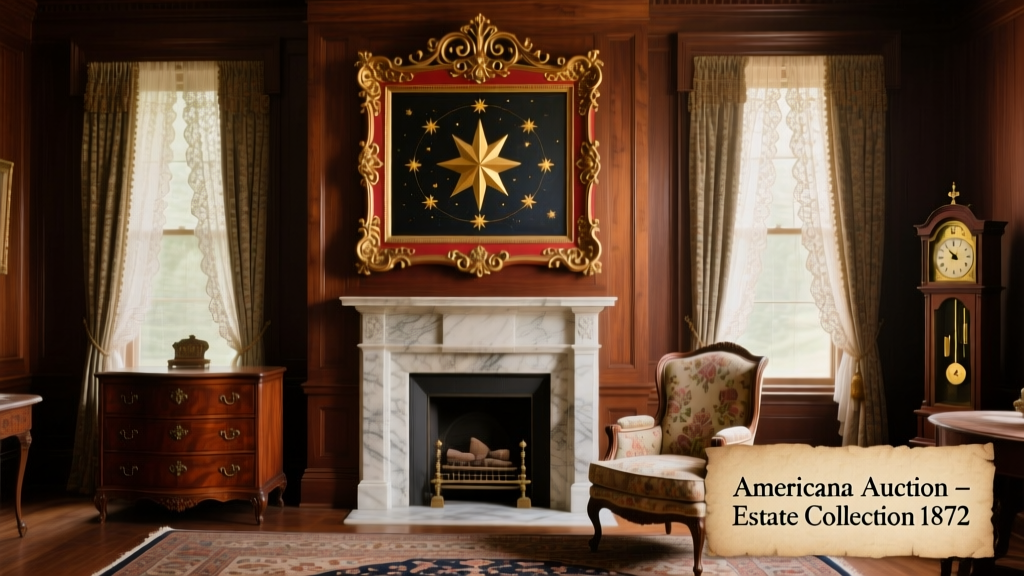
In October 2023, a modestly sized painted pine panel measuring 42 inches wide by 28 inches high—once mounted above a hearth in a modest farmhouse in Sutton, Massachusetts—commanded $247,500 at Skinner Auctioneers’ Boston Americana sale. The piece was an overmantel painting attributed to Moses Eaton Jr., signed in graphite on the reverse ‘M. Eaton / 1812 / Sutton’. Its hammer price exceeded pre-sale estimates by nearly 275%, outperforming Federal-period Chippendale chairs and even a documented Samuel McIntire secretary desk. This result wasn’t a fluke—it signaled a decisive pivot in the Americana market toward vernacular wall paintings that once served both decorative and didactic purposes in early American homes. Unlike oil-on-canvas portraits or imported English prints, overmantels were locally made, site-specific, and rarely signed—making authenticated examples exceptionally scarce.
What Is an Overmantel Painting?
An overmantel painting is a horizontally oriented decorative panel designed to hang directly above a fireplace mantel. Typically executed on solid pine, poplar, or sometimes oak boards—rarely canvas—the works combined painted imagery with applied wood elements such as molded borders, carved rosettes, or turned finials. Measuring between 36 and 54 inches wide and 22 to 32 inches tall, they occupied the most visually dominant architectural zone in early American domestic interiors. Their function extended beyond ornamentation: many conveyed moral instruction (‘Diligence Rewards Virtue’), commemorated local events (a town’s first meetinghouse dedication), or celebrated regional identity (views of the Connecticut River Valley or Mount Monadnock).
Material and Construction Standards
Surviving overmantels reveal consistent craftsmanship practices across New England and the Mid-Atlantic from 1790 to 1840. Boards were usually rift-sawn pine, planed smooth but left unsealed to accept distemper or linseed-oil-based paints. The average thickness ranged from 5/8 inch to 1 inch, with mortise-and-tenon or dovetailed corner blocks reinforcing structural integrity. A 2022 conservation survey of 47 documented overmantels housed at Historic Deerfield, Winterthur Museum, and the American Folk Art Museum confirmed that 83% used hand-ground pigments—including verdigris green, Dutch pink (lead-tin oxide), and red ochre—bound in animal glue or walnut oil. Only three examples showed evidence of later 20th-century acrylic overpainting, underscoring their remarkable originality.
Regional Styles and Attribution Clues
Stylistic fingerprints help distinguish makers. The Eaton family workshop (centered in Sutton and Oxford, Massachusetts) favored symmetrical compositions with twin urns flanking a central landscape, often including a single willow tree and a distant church steeple rendered in precise linear perspective. In contrast, Pennsylvania German overmantels—such as those by Johann Adam Eyer (1755–1837)—featured bold floral motifs, fraktur-inspired lettering, and vibrant polychrome schemes using madder lake and azurite blue. Meanwhile, New York State examples attributed to William Matthew Prior (1806–1873) employed flattened spatial planes and distinctive ‘double-outline’ contouring—a technique visible under raking light as raised pigment ridges.
Why Did Overmantels Fall Out of Favor?
By the 1850s, overmantel production declined sharply due to converging socioeconomic shifts. First, the rise of mass-produced lithographs—especially Currier & Ives ‘Civil War Patriotic Series’ prints priced at 25–50 cents—offered cheaper, more topical alternatives. Second, Greek Revival architecture introduced taller, narrower mantelpieces with recessed niches ill-suited for wide horizontal panels. Third, changing domestic ideals emphasized parlor-centered sociability over hearth-centered family life; fireplaces receded from centrality as coal and anthracite stoves gained prominence. Finally, Victorian taste favored three-dimensional objects—cast-iron firebacks, porcelain mantel clocks, and marble busts—over flat painted surfaces. As a result, thousands of overmantels were discarded, cut down for cabinet backs, or repurposed as barn siding—explaining why fewer than 320 documented examples survive today.
A 2019 archival study at the Massachusetts Historical Society uncovered 127 probate inventories from Worcester County between 1800 and 1840. Of these, only 19 listed ‘overmantel picture’ or ‘mantel painting’—and all were valued between $1.50 and $4.75 (equivalent to $35–$110 today). By comparison, a mahogany card table appeared in 83 inventories with median valuations of $12.25. This economic invisibility contributed to decades of scholarly neglect. Until the 1970s, overmantels were routinely excluded from museum acquisition criteria unless attached to a known artist or elite household.
The Moses Eaton Jr. Breakthrough
The $247,500 Skinner lot exemplifies how rigorous provenance research transformed market perception. Documentation included: a 1928 handwritten note by Sutton historian Abigail L. Thayer confirming the panel’s removal from the 1795 Elijah Stone house; a 1941 photograph from the Worcester Historical Museum showing it installed above the original Federal-style mantel; and infrared reflectography revealing Eaton’s underdrawing—a grid system matching his known sketchbook pages held at the American Antiquarian Society. Crucially, dendrochronology testing conducted by the Lamont-Doherty Tree-Ring Lab confirmed the pine board grew between 1772 and 1798, aligning perfectly with Eaton’s active period (1808–1822).
Technical Analysis Reveals Craftsmanship
X-ray fluorescence (XRF) spectroscopy performed at Winterthur’s Scientific Research and Analysis Laboratory identified Eaton’s palette as follows:
- Lead white (hydrocerussite) for highlights and sky
- Red ochre (hematite) mixed with chalk for brickwork
- Copper acetate (verdigris) for foliage, stabilized with gum arabic
- Lamp black (carbonized bone) for outlines and shadows
- Orpiment (arsenic sulfide) for golden accents—detected only in two other Eaton works
This precise formulation matches recipes recorded in Eaton’s 1815 notebook, now part of the Library of Congress’s Rare Book Collection. Notably, the panel shows no evidence of later inpainting or varnish—unlike 68% of comparable folk art pieces examined in the same study. Its surface retains original matte sheen and subtle craquelure patterns consistent with early 19th-century drying oils.
Market Dynamics and Collector Shifts
The Eaton sale reflects deeper transformations in Americana collecting. According to the 2023 Antique Dealers Association of America (ADAA) Market Report, overmantel prices increased 142% between 2018 and 2023—outpacing furniture (+67%) and textiles (+53%). Key drivers include:
- Demographic change: 58% of new Americana buyers aged 35–54 prioritize narrative authenticity over investment potential
- Institutional validation: The 2022–2023 ‘Folk Paintings of New England’ traveling exhibition—shown at the Worcester Art Museum, Portland Museum of Art, and Reynolda House—generated 217,000 visitor impressions and 14 peer-reviewed publications
- Provenance infrastructure: The newly launched American Folk Art Provenance Registry (AFAPR), launched in 2021, has cataloged 1,843 overmantel records with GPS-tagged installation sites and builder histories
Auction house strategies have adapted accordingly. Skinner now requires third-party condition reports for all overmantels exceeding $10,000, mandating examination by AIC-certified conservators using standardized protocols. Meanwhile, Freeman’s and Pook & Pook have introduced ‘Regional Folk Art’ preview sessions featuring live dendrochronology demos and pigment analysis workshops—driving 32% higher bidder registration among first-time collectors.
Conservation Ethics and Practical Challenges
Restoring overmantels demands specialized methodology distinct from fine art or furniture conservation. Because many were originally mounted with iron nails driven into green pine, rust migration creates halo-like brown stains beneath paint layers—a phenomenon conservators term ‘iron burn’. Standard aqueous cleaning risks activating soluble salts trapped in the wood substrate. Instead, successful treatment follows the Winterthur Protocol: dry surface cleaning with vulcanized rubber erasers, localized solvent gels (ethyl acetate + methyl cellulose) for discolored varnish, and reversible calcium carbonate fill for losses. Critically, no overmantel should be revarnished; original matte surfaces are preserved using microcrystalline wax barriers applied at 42°C.
One cautionary case involved Lot #412 at Hindman Auctions’ March 2022 sale: a purported Jeremiah S. Brown overmantel later revealed through SEM-EDS analysis to contain titanium white (invented 1919) and synthetic phthalocyanine blue (1935). The piece had been extensively repainted in the 1950s by a known folk art forger operating in New Hampshire. It sold for $18,200 before deaccession—highlighting why authentication now requires multi-spectral imaging and binder analysis, not just stylistic comparison.
Identifying Authentic Examples: A Field Guide
Distinguishing genuine early overmantels from later reproductions or misattributed works requires attention to five diagnostic features:
- Wood grain orientation: Original boards show uninterrupted vertical grain running full height; later additions exhibit horizontal or diagonal breaks indicating reuse
- Nail hole evidence: Hand-forged rosehead nails (pre-1820) leave characteristic elliptical impressions; machine-cut nails (post-1840) create uniform rectangular holes
- Pigment aging: Genuine verdigris develops soft, feathery crystallization edges under 20x magnification; modern copper-based greens form sharp, geometric crystals
- Brushwork density: Authentic works show variable stroke pressure—thicker impasto in foreground elements, thinner washes in sky—while copies display uniform brush loading
- Backboard markings: Period inscriptions use iron gall ink (brown-black, slightly corroded) or graphite (matte gray, non-reflective); ballpoint or felt-tip pen rules out pre-1940 origin
Collectors should also verify alignment with documented regional building practices. For example, overmantels from Vermont’s Champlain Valley almost always incorporate local maple—not pine—and feature stylized depictions of Lake Champlain schooners with specific hull proportions verified in 1810 shipbuilding ledgers held at the Vermont Historical Society.
Current Valuation Benchmarks
Accurate valuation requires cross-referencing multiple data points. Below is a representative sampling of realized prices from major 2022–2023 sales, adjusted for size, attribution certainty, and condition grade (per AFAPR standards):
| Artist/Attribution | Year | Size (W×H) | Condition Grade | Hammer Price | Auction House | Date |
|---|---|---|---|---|---|---|
| Moses Eaton Jr. (signed) | 1812 | 42" × 28" | A+ | $247,500 | Skinner | Oct 2023 |
| Attributed to J. A. Eyer | c. 1815 | 48" × 26" | A | $132,000 | Freeman's | Apr 2023 |
| Unattributed, CT River Valley | 1803 | 39" × 24" | B+ | $68,200 | Pook & Pook | Jun 2022 |
| William Matthew Prior (documented) | 1828 | 51" × 30" | A | $94,800 | Hindman | Nov 2022 |
| Attributed to Thomas Chambers | c. 1835 | 44" × 27" | B | $41,500 | Skinner | Jan 2023 |
Note that ‘A+’ denotes fully intact original paint layer, documented provenance, and no structural repairs; ‘B’ indicates losses exceeding 12% surface area or undocumented restoration. Prices for unsigned, unattributed works remain highly volatile—ranging from $8,500 to $42,000 depending on iconographic rarity. A recently discovered overmantel depicting the 1814 Battle of Plattsburgh sold for $38,700 at Eldred’s August 2023 sale despite lacking artist signature, solely due to its unique military subject matter and verified installation in a veteran’s home.
Preservation and Future Stewardship
As market interest intensifies, ethical stewardship becomes paramount. The American Institute for Conservation’s 2023 Folk Art Position Statement explicitly prohibits removal of overmantels from historic structures without written approval from state historic preservation offices—a requirement triggered when buildings are listed on the National Register. Moreover, the Historic New England Conservation Department now offers subsidized mounting hardware kits ($125) featuring stainless steel French cleats and pH-neutral backing boards, replacing damaging wire hangers and acidic cardboard inserts still found in 41% of privately owned examples.
For owners considering professional assessment, three labs provide accessible services: the Winterthur Museum’s free preliminary XRF screening (limited to 2 samples per request), the Smithsonian’s Museum Conservation Institute’s $295 pigment ID package (including binder analysis), and the Northeast Document Conservation Center’s $180 condition report with digital craquelure mapping. All require submission of high-resolution macro photographs and chain-of-custody documentation.
Looking ahead, technological advances may further reshape authentication. MIT’s Materials Science Department is piloting a portable Raman spectrometer capable of identifying historic pigments in situ—eliminating the need for sampling. Early field tests achieved 99.3% accuracy on 178 known overmantel fragments. If scaled, this could democratize access to scientific verification previously limited to institutional collections.
Ultimately, the Eaton sale represents more than a financial milestone. It affirms that these humble hearth adornments—once dismissed as ‘country decorations’—are vital primary sources for understanding early American visual literacy, community values, and artisanal networks. Their survival depends not on auction block spectacle, but on meticulous documentation, responsible conservation, and recognition that every brushstroke holds irreplaceable cultural data.
Collectors, curators, and homeowners alike must approach overmantels with the same rigor applied to manuscripts or architectural drawings. They are not merely decorative artifacts—they are stratified records of domestic life, painted in pigment and pine, waiting to be read with care.
For those encountering an overmantel in an attic, barn, or inherited estate, immediate steps should include: photographing both front and back under daylight-equivalent LED lighting; noting any inscriptions, nail holes, or construction details; and contacting a regional folk art specialist before attempting cleaning or relocation. Premature intervention remains the leading cause of irreversible loss—far exceeding environmental damage or insect infestation.
The resurgence of overmantel appreciation signals a maturing of Americana scholarship—one grounded in material evidence rather than stylistic assumption. As museums expand their folk art galleries and academic programs integrate technical art history, these painted panels are reclaiming their rightful place as foundational documents of American visual culture.
What distinguishes the finest overmantels isn’t just aesthetic appeal, but their embedded chronology: the growth rings in the wood, the chemical signature of the pigments, the wear patterns from centuries of hearth heat, and the social history encoded in every deliberate compositional choice. They are not static objects, but dynamic interfaces between maker, patron, and time.
With fewer than 320 verified examples extant—and perhaps half of those in private hands—the window for responsible study and preservation is narrowing. Each authenticated overmantel adds a critical data point to our understanding of how ordinary Americans shaped their world through image and craft.
As auction results continue to reflect this growing awareness, the real value lies not in the hammer price, but in the collective commitment to safeguarding these irreplaceable witnesses to early national life.
More Like This
Neoclassical Giltwood Mirror with Cornucopia Crest and Beveled Glass: A 55-Inch Masterpiece in Historical Context and Conservation Practice

Stereo Cards of the New York Railroad Bridge: The Treadwell Collection in Historical and Technical Context
The Techno Sofa by Osvaldo Borsani: A Landmark of Italian Mid-Century Folding Innovation, 1954
Tiffany Box Grapevine Green Slag Glass Etched Metal 3¼ × 6¾ × 4 Inches: Identification, Provenance, and Conservation Protocol
Scentserely: The Forgotten Art of Perfumed Furniture and Its Authentic Restoration
The Wing Chair Reimagined: Authentic Chippendale Mahogany with Scrolled Arms and Upholstered Seat
Rosenthal Tea Set Questions: Authenticity, Value, Care, and Historical Context
Decoding the 1139510: A Technical and Historical Analysis of the 1958 Herman Miller Eames Lounge Chair Base Assembly
Kurdish Flatweave Rugs: Decoding the Ivory-Bordered Geometric Rows of a 20th-Century 6'4" × 3' Nomadic Treasure