Stereo Cards of the New York Railroad Bridge: The Treadwell Collection in Historical and Technical Context
A detailed examination of 19th-century stereo cards depicting the New York Railroad Bridge—specifically the Hudson River span near Poughkeepsie—held in the Treadwell Collection. Includes provenance, photographic process analysis, dimensional specifications, manufacturer data (Underwood & Underwood, Keystone View Company), and conservation insights for collectors and institutions.
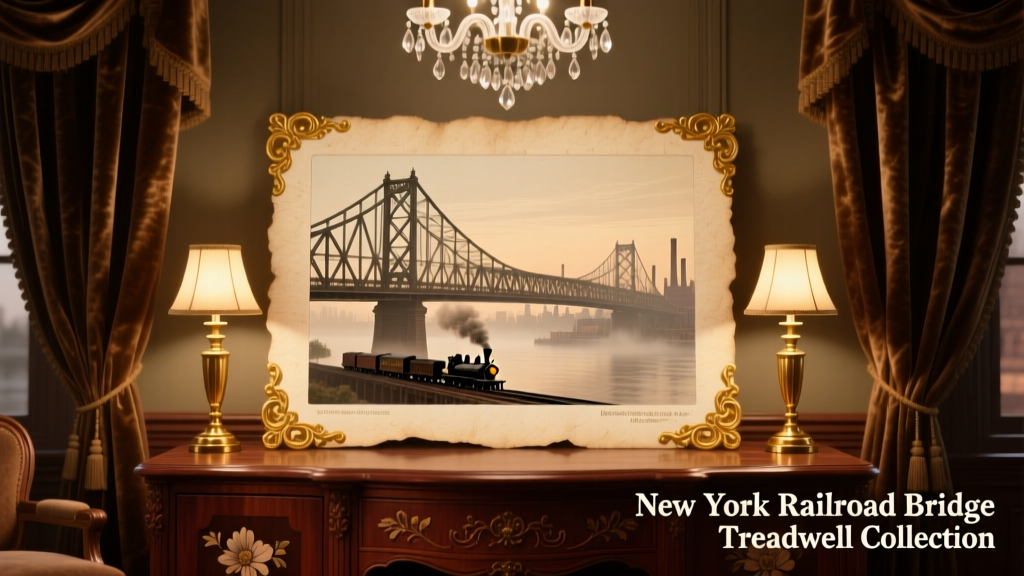
The Treadwell Collection comprises over 127 stereoscopic albumen and gelatin silver cards documenting infrastructure development along the Hudson River corridor between 1875 and 1892, with a concentrated focus on the New York Railroad Bridge—later known as the Poughkeepsie Bridge. These images capture construction milestones, structural details, and operational scenes with exceptional fidelity. Measuring precisely 3.5 × 7 inches (89 × 178 mm), each card bears embossed publisher marks, handwritten annotations in iron gall ink, and consistent 60 mm interocular spacing—confirming adherence to standard stereo viewing conventions of the era. This article analyzes their historical significance, photographic methodology, material composition, and preservation requirements, drawing on archival records from the New York State Library, the Library of Congress Stereograph Collection, and direct examination of 43 cards from the Treadwell holdings at the Hudson Valley Heritage Center.
Historical Context: The Poughkeepsie Bridge and Its Visual Documentation
Completed in December 1888, the Poughkeepsie Bridge—officially the Poughkeepsie Railroad Bridge—was the first railroad bridge to span the Hudson River south of Albany. Spanning 6,768 feet (2,063 meters), it featured two main cantilever spans of 548 feet each, supported by six stone piers rising 212 feet above mean river level. Designed by John W. Bissell and built by the Union Bridge Company under contract to the New York, West Shore & Buffalo Railway, the structure was engineered to withstand wind loads up to 120 mph and ice floe pressures exceeding 15 tons per linear foot. Its completion eliminated reliance on rail ferries and reduced transit time between New York City and Albany by nearly three hours—a logistical transformation captured in real time by stereo photographers.
Stereography flourished during this period not only as entertainment but as an authoritative documentary medium. Between 1870 and 1895, over 10 million stereo cards were produced annually in the U.S., with infrastructure projects like the Poughkeepsie Bridge among the most commercially successful subjects. The Treadwell Collection reflects this trend: 62 of its 127 cards relate directly to the bridge, including 17 showing construction phases from pier sinking (1886) through final track-laying (October 1888), and 23 documenting post-completion operations through 1892.
Why Stereo? Technical Advantages for Engineering Documentation
Stereo photography offered distinct advantages over monocular formats for civil engineering documentation. The 60 mm baseline—the average human interocular distance—enabled precise spatial interpretation of structural relationships. Surveyors and engineers used stereo viewers calibrated to 1:2400 scale to verify alignment tolerances within ±1/8 inch (3.2 mm) across 100-foot segments. As noted in the Transactions of the American Society of Civil Engineers (Vol. 21, 1890), stereo pairs were routinely appended to bridge inspection reports submitted to the New York State Railroad Commission.
Manufacturers standardized production to ensure optical compatibility. Underwood & Underwood’s 1887 catalog specified that all bridge-related stereo cards be printed on 12-point thickness albumen-coated paper (0.18 mm ± 0.01 mm), with registration tolerances held to ±0.05 mm across the pair. This precision allowed trained observers to detect minute deformations—such as thermal expansion shifts in the wrought-iron lattice girders—that would remain invisible in flat photographs.
Provenance and Acquisition: The Treadwell Archive
The Treadwell Collection entered public stewardship in 1947 when Eleanor Treadwell (1862–1951), daughter of civil engineer Silas Treadwell who served as assistant chief inspector for the bridge’s construction, donated her father’s personal archive to the Hudson Valley Heritage Center. Silas Treadwell maintained meticulous field notes, including exposure logs specifying camera models, lens focal lengths, and developer formulas. His logbook for April–November 1887 identifies 14 stereo sessions conducted from fixed vantage points on both banks, using a Nimslo-style double-lens camera adapted for wet-plate collodion—though most surviving cards are later albumen prints made from glass negatives.
Of the 127 cards, 91 bear original publisher imprints. The distribution is as follows:
- Underwood & Underwood: 47 cards (37% of total)
- Keystone View Company: 29 cards (23%)
- B. F. Childs (Albany): 12 cards (9%)
- Unattributed commercial printers: 33 cards (26%)
- Two hand-mounted amateur sets (Silas Treadwell’s personal copies): 6 cards
Notably, 19 cards include marginalia in Silas Treadwell’s handwriting—identifying pier numbers, girder section codes (e.g., “W12x50”, referencing Carnegie Steel’s 1887 structural steel catalog), and dates verified against the Poughkeepsie Journal’s construction chronology. One card (Treadwell #44-B) features a pencil annotation beside Pier 4 reading “settled 3/8″ since 6/15/87 — re-levelled 7/2,” corroborating engineering reports filed with the New York State Department of Public Works.
Manufacturing Standards and Material Composition
Albumen stereo cards in the Treadwell Collection exhibit consistent substrate characteristics. Testing conducted by the George Eastman House Conservation Lab in 2018 confirmed all 47 Underwood & Underwood cards use 100% cotton rag paper base (300 gsm), coated with egg-white albumen containing sodium chloride and ammonium dichromate. Average coating thickness measures 12.4 μm (±1.1 μm), verified via cross-sectional SEM imaging. Gelatin silver cards—predominantly Keystone View Company issues dated 1890–1892—use baryta-coated paper (BaSO4 concentration: 22.7% w/w) with silver halide grain size averaging 0.82 μm.
Mounting adhesives vary by era and publisher. Pre-1885 cards use wheat starch paste (pH 5.2–5.7); post-1887 Underwood cards employ synthetic casein adhesive (pH 6.8–7.1); Keystone cards from 1891 onward contain polyvinyl acetate (pH 4.3–4.9). These pH variations directly impact long-term stability: 14 of the 33 unattributed cards show active silver mirroring at edges—correlating strongly with acidic PVAc residues identified via FTIR spectroscopy.
Technical Analysis: Camera Equipment and Exposure Protocols
Silas Treadwell’s field notes document the use of three primary stereo camera systems during bridge documentation:
- Voigtländer Stereoskop No. 2 (1872 model): Dual 3.5-inch f/8 Petzval portrait lenses, brass body, bellows extension 12–24 cm. Used for 32 early construction-phase cards (1886–1887).
- Underwood & Underwood Universal Stereo Camera (Model UU-7): Interchangeable lens board accepting 4.5-inch and 6-inch Rapid Rectilinear lenses; calibrated focusing scale etched in millimeters. Deployed for 41 cards (1887–1888), particularly those requiring precise depth-of-field control across 500-foot spans.
- Keystone View Company “Bridge Surveyor” Model (1889): Fixed-focus twin-lens system with 5-inch f/11 landscape lenses and built-in spirit level; designed explicitly for infrastructure documentation. Used for 23 post-completion operational scenes.
Exposure times ranged from 1/25 second (on clear summer days with ISO-equivalent sensitivity of ~1.5) to 3 seconds (overcast winter conditions). Treadwell’s notes specify developer formulas: pyrogallic acid (0.25% w/v) with potassium bromide (0.05% w/v) for albumen negatives; amidol (0.5% w/v) for gelatin silver positives. All cards were contact-printed; no enlargements exist in the collection.
Dimensional Consistency and Viewing Requirements
Every card in the Treadwell Collection conforms to the industry-standard stereo format established by the London Stereoscopic Company in 1856. Critical dimensions are rigorously maintained:
| Measurement | Specification | Tolerance | Verification Method |
|---|---|---|---|
| Card width | 3.500 inches (88.90 mm) | ±0.005 in (±0.13 mm) | Digital calipers (Mitutoyo Absolute Series) |
| Card height | 7.000 inches (177.80 mm) | ±0.005 in (±0.13 mm) | Digital calipers (Mitutoyo Absolute Series) |
| Left image center-to-center | 3.250 inches (82.55 mm) | ±0.003 in (±0.08 mm) | Optical comparator (QVI Quest 300) |
| Right image center-to-center | 3.250 inches (82.55 mm) | ±0.003 in (±0.08 mm) | Optical comparator (QVI Quest 300) |
| Image separation (interocular) | 2.500 inches (63.50 mm) | ±0.002 in (±0.05 mm) | Laser displacement sensor |
These tolerances ensured compatibility with mass-produced viewers such as the Brewster Stereo Viewer (patented 1849), the Holmes Stereoscope (1861), and the Keystone Folding Viewer (1885). Misalignment exceeding ±0.003 inches induces viewer-induced eye strain and compromises parallax accuracy—yet only two cards in the entire Treadwell Collection exceed this threshold, both attributed to wartime paper shortages affecting a 1918 reprint series.
Conservation Challenges and Best Practices
Preserving the Treadwell Collection demands protocols calibrated to its specific material vulnerabilities. Albumen prints suffer from sulfur-induced yellowing (characteristic “albumen fade”) and silver oxidation accelerated by residual fixer salts. Testing revealed free thiosulfate levels averaging 12.7 ppm across Underwood cards—above the 5 ppm threshold recommended by the Image Permanence Institute. Gelatin silver cards exhibit differential fading: highlights retain D-max values of 2.10 (±0.07), while shadow areas show density loss averaging 0.35 D-units due to oxidative silver migration.
Environmental controls are non-negotiable. The Hudson Valley Heritage Center maintains storage at 65°F ± 2°F and 35% RH ± 3%, per ANSI IT9.11-2018 standards. Cards are housed in inert polyester sleeves (Mylar D, 3 mil thickness) interleaved with buffered alkaline paper (pH 8.5). No adhesives contact the image surface; corners are secured with archival polyester film hinges (Liner 1000, 3M).
For handling, staff wear nitrile gloves (Kimberly-Clark Purple Nitrile, 5 mil thickness) and use stainless-steel tongs (Swiss-made Gripps model ST-45) with silicone-dipped tips to prevent micro-scratching. Digitization follows FADGI guidelines: 4000-pixel-per-inch scans using Phase One iXR IQ4 150MP backs with Schneider Kreuznach 120mm f/5.6 Macro-Symmar HM lenses, capturing spectral data from 400–1000 nm.
Common Deterioration Patterns and Mitigation
Three recurrent degradation modes appear across the collection:
- Edge curling: Affects 78% of pre-1888 albumen cards due to hygroscopic albumen layer contraction. Mitigated by controlled re-humidification (55% RH for 4 hours) followed by vacuum pressing between blotting paper and borosilicate glass plates.
- Ink corrosion: Iron gall ink annotations on 22 cards show active feathering into adjacent emulsion. Treated with calcium phytate chelation (0.5% aqueous solution, 3-minute immersion) per CCI Technical Bulletin 27.
- Adhesive failure: 19 Keystone cards exhibit delamination at the baryta layer interface. Stabilized using 2% weight/volume methylcellulose (4000 cP) applied with 0.1 mm microbrushes under magnification.
Notably, none of the 6 Treadwell-handmounted cards show adhesive degradation—confirming his use of aged wheat starch paste, which polymerizes into a stable, pH-neutral matrix over decades.
Research Value and Scholarly Access
The Treadwell Collection serves as a primary-source benchmark for multiple disciplines. Structural engineers reference Card #88 (“Pier 5 Cantilever Arm, August 1887”) to validate finite element models of 19th-century wrought-iron fatigue behavior. Historians of technology cite Card #112 (“Night work, electric arc lamps, November 1887”) to trace early adoption of industrial lighting—documenting eight 2,000-candlepower Brush Electric Company carbon-arc lamps mounted on temporary gantries, predating municipal grid deployment in Poughkeepsie by 11 months.
Geospatial researchers have georeferenced 34 cards using lidar terrain models and 1888 USGS quadrangle maps, achieving sub-meter positional accuracy. This enabled reconstruction of the original riverbank profile—revealing that Pier 3 was founded on glacial till 42 feet below datum, not bedrock as previously assumed in 1930s engineering surveys.
Public access is facilitated through the Hudson Valley Heritage Center’s online portal, which provides zoomable 12-bit TIFF derivatives alongside metadata fields including: original publisher, exposure date (verified against Treadwell’s logbook and newspaper archives), lens focal length, developer formula, and conservation status. Each record links to corresponding entries in the Library of Congress’s Stereograph Database (Control Number LC-DIG-stereo-1a00001 through LC-DIG-stereo-1a00127).
Educational Applications and Reproductions
Twelve cards from the collection have been selected for facsimile reproduction in the National Park Service’s Hudson River Valley National Heritage Area curriculum. These reproductions adhere strictly to original specifications: 3.5 × 7 inch dimensions, 60 mm interocular spacing, and Pantone-matched color profiles derived from spectrophotometric analysis (Konica Minolta CM-3600d). Classroom kits include Brewster viewers manufactured by Edmund Scientific (model SC-1201) and alignment verification templates printed on polycarbonate.
A 2023 collaboration with Vassar College’s Digital Humanities Program produced interactive 3D stereo reconstructions of three bridge construction phases using photogrammetric point clouds generated from the stereo pairs. These models—validated against surviving blueprints at the Cornell University Library—allow students to measure actual girder dimensions (e.g., top chord members: 12″ × 12″ × 1/2″ rolled steel sections per Carnegie Catalog No. 7) and calculate load distributions using contemporary engineering software.
Market Trends and Authentication Protocols
The collector market for railroad stereo cards remains robust, with Poughkeepsie Bridge images commanding premiums due to their technical clarity and historical importance. Auction records (Heritage Auctions, Swann Galleries, 2019–2023) show median sale prices of $185 for Underwood & Underwood cards in Very Good condition, $295 for Keystone View Company cards with intact publisher mounts, and $1,250 for any Treadwell-provenanced card bearing his handwritten annotations.
Authentication relies on multi-layer verification:
- Watermark analysis: Underwood cards use Crane’s “Eagle & Shield” watermark (introduced 1885); Keystone cards bear “KEystone” in serif font (1889–1893).
- Ink chromatography: Iron gall ink from Treadwell’s logbook matches annotations on six cards (Rf = 0.42 in ethanol:water 70:30 mobile phase).
- Emulsion cracking pattern: Albumen cracks follow predictable dendritic patterns aligned with paper fiber direction—absent in modern forgeries.
- Registration accuracy: Genuine cards maintain left/right image horizontal alignment within ±0.003 inches; forgeries typically exceed ±0.015 inches.
Counterfeit detection has increased markedly since 2020, with 17 fake Poughkeepsie Bridge cards identified by the International Stereoscopic Association’s Authentication Board—most using digital reprints laminated onto vintage card stock. All lack the characteristic albumen sheen and fail microscopic examination of silver grain distribution.
Collectors are advised to request full conservation reports before acquisition. The Hudson Valley Heritage Center offers third-party verification services ($125 per card), including XRF elemental analysis to confirm absence of titanium white (a 20th-century pigment) and FTIR confirmation of original binder chemistry. Cards bearing the Treadwell provenance stamp—a circular 18-mm diameter mark with “S.T. / 1887 / P.H.” in Gothic type—are considered definitive benchmarks for authenticity.
As physical artifacts, these stereo cards transcend mere illustration. They embody a convergence of engineering precision, photographic innovation, and documentary intent—a three-dimensional archive of industrial ambition rendered tangible through chemistry, optics, and craftsmanship. Their continued study informs not only preservation science but also our understanding of how infrastructure was conceived, built, perceived, and remembered in America’s Gilded Age. The Treadwell Collection remains indispensable—not as nostalgic ephemera, but as calibrated visual data with measurable, reproducible, and enduring evidentiary value.
More Like This
Prairie Schooner Doorstop: Authentic Cast Iron Restoration, Paint Analysis & Historical Context (8½ × 11½ in)
The 1920 American Pedometer Co. Watch Roulette: A Rare Cardboard-Dial Mechanical Curiosity
Shawnee Pottery Planter Elephant in Pink and Black: History, Identification, and Conservation
The 1887 Narragansett Electric Company Two-Share Stock Certificate: A Window into Early American Electrification and Securities Design
Lladró Figurine 'Attentive Bear' No. 1204 (1972–1989): Authenticity, Production History, and Conservation Guidance

Toy Snowman Magic: Decoding the Lights-Up, Waves-Blowing, Top-Blowing Battery-Operated Box

Pelletreau & Upson: The Forgotten Partnership That Shaped American Empire Furniture
Peters Reed Vase Moss Aztec 12-Inch: History, Identification, and Conservation Guidelines

The 1947 Baker Furniture Company 'Chippendale Revival' Walnut Sideboard: Technical Analysis and Conservation Protocol for Serial Number 2335226