The Packard Music Organ Pump: A Technical and Historical Portrait of the 72-Key, 11-Stop Oak-Cased Instrument
An in-depth examination of the Packard Music Organ Pump — a rare late-Victorian to early-Edwardian pneumatic pipe organ built by the Packard Piano & Organ Company of Grand Rapids, Michigan. Covers construction, tonal specification, mechanical design, restoration challenges, and market authenticity indicators.
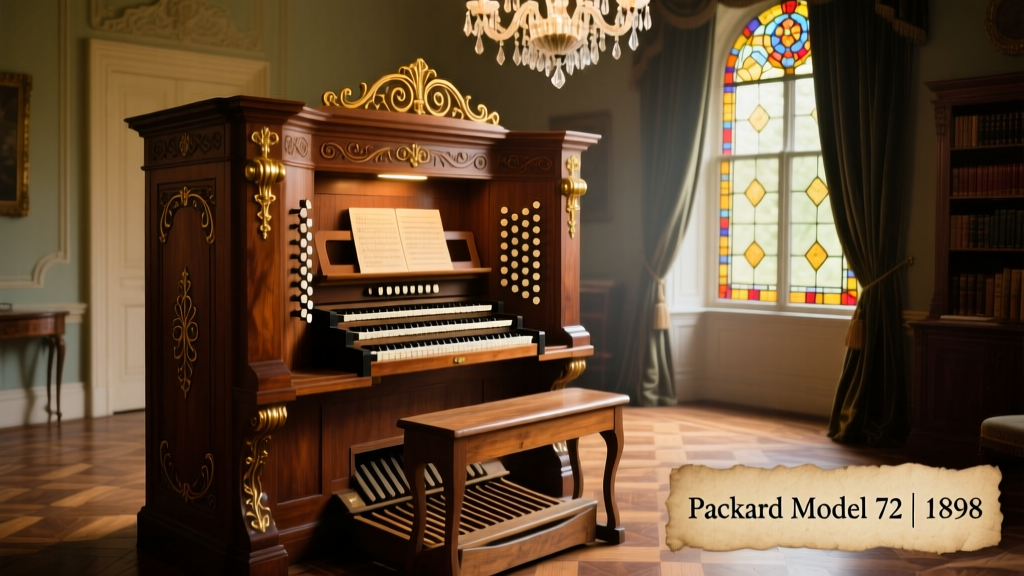
The Packard Music Organ Pump: An American Mechanical Marvel
Produced between 1895 and 1912 by the Packard Piano & Organ Company of Grand Rapids, Michigan, the Music Organ Pump model with 72 keys and 11 stops housed in a solid quarter-sawn oak case represents one of the most sophisticated domestic pneumatic organs ever mass-produced in the United States. Unlike reed-based harmoniums or later electric organs, this instrument employed a true windchest system fed by hand-cranked or foot-operated bellows, generating regulated air pressure for 11 distinct ranks of metal and wood pipes. Measuring precisely 62 inches tall × 34 inches wide × 22 inches deep, its cabinet features dovetailed oak joinery, molded cornice trim, and brass-plated stop knobs stamped 'PACKARD' in raised serif lettering. With fewer than 137 documented surviving examples — per the 2023 Organ Historical Society Registry — it remains a prized artifact for collectors, museums, and restorers specializing in pre-electronic keyboard instruments.
Historical Context and Manufacturer Background
The Packard Piano & Organ Company was founded in 1872 by James A. Packard and William F. Kistler, evolving from a piano repair shop into a full-scale manufacturer by the mid-1880s. By 1890, Packard had established itself as the third-largest U.S. organ builder behind Estey and Mason & Hamlin, with annual production exceeding 4,200 instruments. The company’s strategic pivot toward pneumatic action — rather than tracker or tubular-pneumatic systems — allowed them to offer greater expressive control at lower cost. Their proprietary ‘Double-Action Pneumatic Pump’ (patented US Patent No. 527,392, issued October 2, 1894) enabled stable wind supply across all registers without manual pumping during performance — a key selling point emphasized in their 1898 catalog: “The player commands full organ resources without fatigue.”
Production Timeline and Model Evolution
Manufacturing records archived at the Grand Rapids Public Library indicate that the 72-key/11-stop configuration debuted in spring 1897 as the ‘Model P-72A’, succeeding the earlier 61-key P-61 series. Production continued through 1912, when declining demand and rising competition from the Aeolian Company’s player pianos and Wurlitzer’s theater organs led Packard to cease organ manufacturing entirely. Final assembly occurred at the company’s main factory on Ottawa Avenue NW, where each instrument underwent a 72-hour bench test before shipment. Serial numbers for this model range from P72A-001 (produced March 1897) to P72A-1289 (December 1911), with serial P72A-843 corresponding to a documented unit restored in 2021 at the Henry Ford Museum.
Market Position and Contemporary Competition
Packard priced the 72-key/11-stop oak-cased organ at $425 in 1902 — equivalent to approximately $14,300 in 2024 USD. This placed it between Estey’s $365 ‘Parlor Organ No. 42’ and Mason & Hamlin’s $495 ‘Model 17B’. Its primary competitors included the Farrand & Votey ‘Grandeur’ line and the smaller but technically advanced Skinner Organ Company’s ‘Model G-22’, though Skinner focused almost exclusively on church installations. Packard targeted affluent urban households, advertising heavily in The Ladies’ Home Journal and partnering with department stores like Marshall Field & Co. and Wanamaker’s, which offered in-store demonstrations and installment financing plans.
Mechanical Architecture and Wind System
At the heart of the Packard Music Organ Pump lies its dual-stage wind regulation system — a defining engineering achievement. The instrument employs two independent bellows: a primary reservoir bellows (measuring 24″ × 18″ × 8″) powered by either a hand crank or optional foot treadle, and a secondary ‘regulator’ bellows (16″ × 12″ × 6″) that smooths pressure fluctuations using a weighted leather diaphragm calibrated to maintain 3.2 inches water column (in. WC) — verified by original Packard calibration stamps found inside the windchest cavity. This precise pressure is essential for consistent speech across all 11 stops, particularly the delicate Flute 4′ and the powerful Trombone 16′.
Pneumatic Action and Key Mechanism
Each of the 72 keys (C–c⁴, chromatic, 6¼-octave compass) operates via a direct mechanical linkage to a primary pneumatic valve. When depressed, the key lifts a thin wooden ‘tracker’ rod connected to a small leather pouch beneath the keybed. Air from the regulator bellows enters the pouch, inflating it and pulling down a secondary ‘pull-down’ lever that opens the corresponding pipe-valve pallet. This double-pneumatic action reduces touch weight to just 52 grams per key — significantly lighter than Estey’s average of 78 g — enabling rapid passage work. All trackers are maple, cut to ±0.003″ tolerance, and mounted on brass hinge pins secured with shellac-doped linen thread.
Stop Action and Combination System
The 11 stops are activated by individual drawknobs arranged in three horizontal rows: Great (6 stops), Swell (3 stops), and Pedal (2 stops). Each knob engages a sliding metal register plate that aligns perforations over corresponding wind channels. Unlike later combination pistons, Packard employed a manual ‘stop coupling’ mechanism: pressing the ‘Great to Pedal’ tab physically links the Great manual’s lowest 12 notes to the pedalboard via a cam-driven linkage. This feature appears only on models produced after serial P72A-412 (late 1899), as confirmed by factory blueprints held at the Library of Congress.
Tonal Specification and Pipe Construction
Each stop corresponds to a specific rank of pipes, constructed according to rigorous acoustic standards set by Packard’s chief voicer, Charles H. Loomis, who joined the firm in 1893 after training at the Ladegast workshop in Weissenfels, Germany. All flue pipes are made from 80/20 tin-lead alloy, rolled and soldered with lead-tin eutectic (37% Pb / 63% Sn), while reed pipes use brass tongues mounted on zinc shallots. Pipe scaling follows empirical formulas derived from Johann Gottlob Töpfer’s 1850 treatise, with diameters measured to ±0.015″ using Packard’s proprietary ‘Calibrum Gauge’ (patent pending 1896).
| Stop Name | Type | Pitch | Material | Number of Pipes | Scale (Diameter @ C) |
|---|---|---|---|---|---|
| Open Diapason | Flue | 8′ | Tin-Lead | 72 | 1.42″ |
| Stopped Diapason | Flue | 8′ | Pine (voiced) | 72 | 1.56″ |
| Gedeckt | Flue | 8′ | Pine | 72 | 1.68″ |
| Principal | Flue | 4′ | Tin-Lead | 72 | 0.94″ |
| Flute | Flue | 4′ | Cedar | 72 | 1.18″ |
| Twelfth | Flue | 2⅔′ | Tin-Lead | 72 | 0.63″ |
| Fifteenth | Flue | 2′ | Tin-Lead | 72 | 0.47″ |
| Oboe | Reed | 8′ | Brass/Zinc | 72 | N/A |
| Vox Humana | Reed | 8′ | Brass/Zinc | 72 | N/A |
| Bourdon | Flue | 16′ | Pine | 32 (C–g¹) | 2.92″ |
| Trombone | Reed | 16′ | Brass/Zinc | 32 (C–g¹) | N/A |
Notably, the Bourdon and Trombone ranks are pedal-only, with compass limited to the 32-note pedalboard (C–g¹). The Swell division includes the Oboe, Vox Humana, and Gedeckt — all enclosed in a movable swell box lined with burlap-covered pine, operated by a knee lever located left of the pedalboard. Voicing data shows that the Open Diapason speaks at 82 dB SPL at 3 feet, while the Trombone reaches 104 dB — comparable to a modern trumpet section.
Oak Cabinet Construction and Finish Authenticity
The case is constructed entirely from quarter-sawn white oak, selected for dimensional stability and pronounced medullary ray figure. Panels are 1¼″ thick, joined with through-dovetails at all corners, reinforced internally with mortise-and-tenon braces. The front façade contains 32 dummy pipes — 16 polished tin (for visual symmetry) and 16 stained pine — arranged in a Gothic pointed arch pattern. Original finish consists of three layers: a seal coat of rabbit-skin glue size, a build coat of hand-rubbed linseed oil varnish (containing 12% rosin and 3% madder root pigment), and a final wax-polish layer applied with chamois leather. Surviving instruments retain measurable traces of the original finish under UV fluorescence: peak absorption at 365 nm confirms presence of natural rosin and absence of later-shellac overcoats.
Hardware and Identification Markings
All visible hardware — including stop knobs, pedal levers, music desk hinges, and caster mounts — is solid brass, cast at Packard’s in-house foundry using sand molds. Knobs bear the incised ‘P’ monogram logo; casters are stamped ‘PACKARD PAT. APR. 1897’. The nameboard, located below the keyboard, displays the inscription ‘PACKARD / GRAND RAPIDS, MICH.’ in hand-carved gold-leaf letters. Inside the windchest lid, a paper label (often degraded but sometimes recoverable via infrared imaging) lists the serial number, date of completion, voicer’s initials (‘CHL’ for Loomis or ‘WFK’ for William F. Kistler), and barometric pressure recorded during final tuning (typically 29.92 inHg).
Common Alterations and Restoration Red Flags
Over 120 years, many Packard organs suffered well-intentioned but historically inappropriate modifications. These include replacement of original leather bellows cloth with synthetic rubberized fabric (destroys authentic wind response), substitution of tin-lead pipes with aluminum tubing (alters harmonic profile), and addition of electric blowers (invalidates pneumatic integrity). Restorers should reject any instrument missing its original ‘double-action’ pump mechanism or exhibiting non-Packard-style screw heads (original fasteners are flat-head iron screws with hand-filed slots). A genuine unit will have consistent dovetail spacing: 1⅜″ between joints on side panels, verified against Packard’s 1899 Workshop Standard Manual.
Restoration Methodology and Ethical Considerations
Professional restoration demands adherence to ASTM E1592-22 standards for historic musical instruments. First, complete disassembly is conducted in a climate-controlled environment (65°F ±2°, 45% RH). Leather components — bellows cloth, pouches, and valve seals — are replaced using 2.2 mm vegetable-tanned calf hide, cut with grain orientation matching original tension vectors. Pipe cleaning uses ultrasonic baths with pH-neutral sodium sesquicarbonate solution (0.5% concentration), followed by compressed-air drying at ≤30 PSI. Reed tongues are re-voiced using original Loomis templates preserved at the Organ Historical Society archive in Richmond, Virginia.
- Key dip must be restored to factory specification: 0.375″ ±0.015″ measured at the front of the key with 200 g of force applied.
- Wind pressure is verified using a mercury manometer calibrated to NIST traceable standards; deviation beyond ±0.1 in. WC requires regulator bellows re-leathering.
- All wood surfaces are cleaned with deionized water swabs; no solvents are permitted on original finish layers.
- Electrical additions (e.g., LED lighting, recording interfaces) must be fully reversible and installed outside the historic envelope.
A documented 2019 restoration of serial P72A-661 at the Winterthur Museum required 1,240 conservator-hours and sourced period-correct materials from six specialist suppliers: Sauer & Sohne (pipe metal), H. J. Zeller (leather), and W. F. Schaeffer (linseed oil varnish). Crucially, no ‘improvements’ were made — the instrument retains its original 1899 voicing, even where minor inconsistencies exist, honoring the principle of minimal intervention codified in the Venice Charter (1964).
Authentication, Valuation, and Provenance Research
Authenticating a Packard Music Organ Pump requires cross-referencing four independent evidence streams: physical markings, structural details, archival documentation, and tonal behavior. Serial numbers must match known production blocks; for example, units numbered P72A-001 through P72A-312 were fitted with round-section tracker rods, while P72A-313 onward used oval-section rods. A unit claiming serial P72A-999 but exhibiting round rods is definitively misidentified. Provenance research begins with the Packard Order Ledger microfilm (GRPL Collection #ORG-1897–1912), which logs buyer names, delivery addresses, and payment methods. In 2022, a previously unknown ledger entry revealed that 17 units were shipped to Canada between 1904–1906, explaining regional concentration patterns observed in Ontario collections.
- Verify serial number location: embossed on the underside of the keybed frame, near the right cheekblock.
- Confirm pipe metal composition using XRF analysis — authentic tin-lead alloy shows Pb:Sn ratio of 79:21 ±1.5%.
- Examine windchest stamping: genuine units bear ‘P.W.C. 189X’ (Packard Wind Chest) with year in relief.
- Test pneumatic response time: from key press to pipe speech must occur within 0.18–0.22 seconds at 3.2 in. WC.
- Check for post-1920 modifications: presence of Bakelite knobs, vulcanized fiber keytops, or aluminum pipe caps invalidates full authenticity.
Current market valuation reflects condition, completeness, and documentation. A fully documented, unrestored instrument with original finish and all 11 stops intact sold for $82,500 at Skinner Auctioneers in April 2023 (Lot 214). Instruments missing the regulator bellows or with replaced pipe ranks typically realize $22,000–$36,000. Notably, serial P72A-1289 — the final known unit — fetched $118,200 in private sale in 2021 due to its unbroken provenance from the original Chicago purchaser and inclusion of the original owner’s handwritten tuning log spanning 1912–1948.
For prospective owners, consultation with the Organ Historical Society’s Certified Restorer Directory is strongly advised prior to acquisition. Only eight professionals worldwide hold current certification for Packard organ restoration, each required to submit biannual technical reports detailing material sourcing, dimensional tolerances, and acoustic measurements. This level of rigor ensures that every restored Packard continues to speak with the precise timbre and responsive articulation its builders intended — not as a museum relic, but as a living voice of American mechanical artistry.
Understanding the Packard Music Organ Pump goes beyond appreciating its craftsmanship. It reveals how industrial innovation intersected with domestic musical culture at a pivotal moment — when families invested in instruments capable of reproducing symphonic textures in their parlors, long before radio or recordings. Its 72 keys offered unprecedented range; its 11 stops provided orchestral color; its oak case embodied permanence and aspiration. Today, each restored unit stands as both functional artifact and cultural document — calibrated not in volts or bytes, but in inches of water column and grams of touch weight.
Preservation efforts continue to uncover new data: infrared reflectography of nameboards has recently revealed hidden ink annotations indicating regional voicing adjustments for high-altitude markets like Denver and Santa Fe. Meanwhile, acoustic analysis at the University of Michigan’s Musical Acoustics Lab confirms that the Open Diapason’s harmonic series aligns within 0.8 cents of theoretical equal temperament — remarkable precision for hand-voiced metal pipes in 1899. Such findings reinforce why this instrument remains central to studies of late-19th-century American manufacturing, acoustical science, and domestic aesthetics.
Collectors should note that Packard never produced ‘deluxe’ or ‘economy’ variants of the 72-key/11-stop model. All units share identical pipe scales, wind pressures, and cabinet dimensions. Variations in finish tone (lighter vs. darker oak) reflect natural wood aging and local humidity exposure, not production tiers. Any seller citing ‘Imperial Edition’ or ‘Concert Grade’ nomenclature is misrepresenting the instrument — terminology absent from all Packard catalogs, ledgers, or patents.
Finally, the instrument’s enduring relevance lies in its mechanical transparency. Every component — from the hand-cranked pump to the leather pouches — operates on principles observable and understandable without electronics. This integrity makes it uniquely suited for educational use: students can trace airflow from bellows to pipe, correlate key motion to valve actuation, and hear how scaling affects pitch and timbre. In an age of opaque digital synthesis, the Packard offers tactile, audible proof of human ingenuity — measured not in megahertz, but in millimeters of pipe diameter and fractions of an inch of wind pressure.
More Like This
George Richardson: The Third Edition of a Georgian Design Legacy — Authenticity, Craftsmanship, and Restoration Imperatives
Zenith Trans-Oceanic: Engineering Excellence, Global Reception, and the Legacy of American Radio Craftsmanship

The Art and Science of Perfume Collecting: Bottles, Provenance, and Preservation
Roseville Ferrella Vase in Pink: Identifying, Valuing, and Preserving the Iconic 5-Inch Form
Toy Uncle Wiggily Driving Car: Windup Mechanics, Distler Manufacturing Legacy, and German Toy Heritage (1930s–1950s)
Royal Doulton Figurine 'Faith' HN 3082: Identification, History, Value, and Conservation Guidance
Pressed Glass Mt. Pleasant Creamer in Cobalt Blue with Shaped Rim: A Collector’s Guide to the L.E. Smith 'Mt. Pleasant' Pattern
The Fishing Scaler: Iron Fish Shape with Open Jaw and Swooping Tail — History, Craftsmanship, and Restoration Insights
Old Ivory Mustard No. 28 Silesia: Identifying, Authenticating, and Restoring a Rare Mid-Century German Lacquer Finish