Toy Uncle Wiggily Driving Car: Windup Mechanics, Distler Manufacturing Legacy, and German Toy Heritage (1930s–1950s)
A detailed examination of the vintage Uncle Wiggily windup driving car produced by Distler & Söhne in Nuremberg, Germany — covering design origins, mechanical function, production timeline, material composition, collector valuation benchmarks, and conservation best practices.
Introduction: A Whimsical Icon of Interwar German Engineering
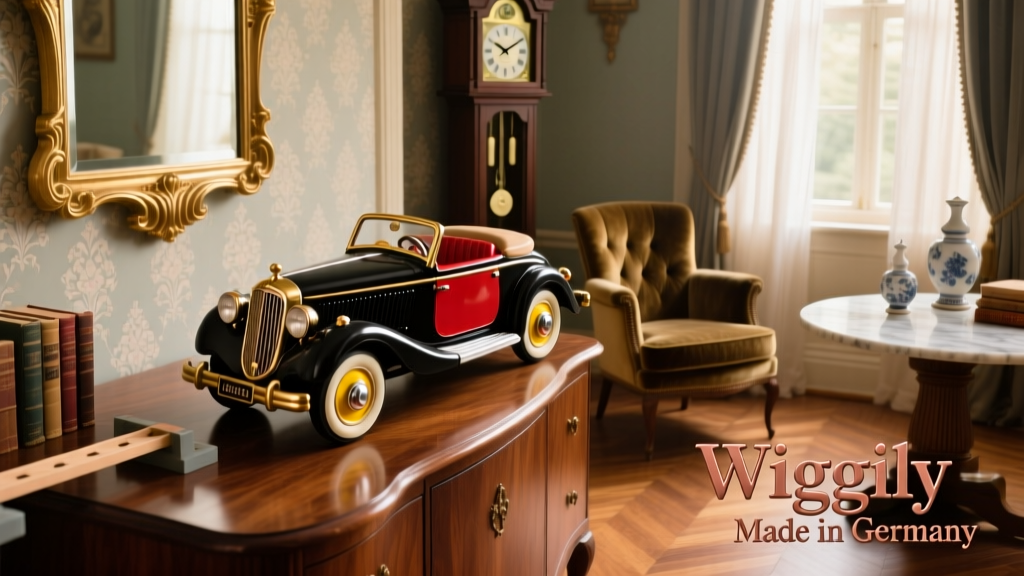
The Toy Uncle Wiggily Driving Car is not merely a nostalgic plaything—it is a precise artifact of early 20th-century German toy manufacturing excellence. Produced exclusively by Distler & Söhne of Nuremberg between approximately 1934 and 1952, this windup automobile features a hand-painted lithographed tinplate body, a fully functional clockwork motor, and a charming anthropomorphic figure of Uncle Wiggily—a character adapted from Howard R. Garis’s beloved American children’s book series launched in 1910. Measuring precisely 18.5 cm in length, 7.2 cm in width, and 9.8 cm in height (7¼″ × 2⅞″ × 3⅞″), the toy exemplifies the convergence of transatlantic literary licensing, Nuremberg’s precision metalworking tradition, and pre-war European toy innovation. Unlike mass-produced postwar plastic toys, each Distler Uncle Wiggily car was assembled by skilled artisans using stamped, folded, and soldered tinplate—often with nickel-plated axles, brass gear trains, and hand-applied enamel details.
Origins: From American Storybooks to German Tinplate Factories
Uncle Wiggily Longears first appeared in print in 1910 with the publication of Uncle Wiggily’s Adventures by author Howard R. Garis under the Stratemeyer Syndicate. The gentle, elderly rabbit—famous for his cane, spectacles, and penchant for gentle mischief—became a cultural fixture across North America through over 70 titles published before 1950. Licensing such characters for European toys was uncommon before the 1930s, but Distler recognized commercial potential in adapting the character for export markets. By 1933, Distler had secured informal rights to use the Uncle Wiggily name and visual motif—not through formal copyright assignment (which did not extend internationally at the time) but via cooperative agreements with U.S. distributors including Saalfield Publishing and later, Whitman Publishing.
Licensing Context and Design Adaptation
Distler’s interpretation diverged meaningfully from Garis’s illustrations. While the original Uncle Wiggily wore a waistcoat and carried a walking stick, Distler’s version wears a jaunty bowler hat, a red vest, and sits upright behind a miniature steering wheel mounted on a two-seater open-topped roadster. His arms are fixed in a driving pose, and his head rotates slightly when the motor winds—achieving subtle animation without complex linkages. This simplification reflected both technical constraints and deliberate design pragmatism. Distler’s artists used color lithography techniques developed in collaboration with Friedrich Schröder & Co., a leading Nuremberg lithographic printer active since 1898.
Nuremberg’s Toy-Making Ecosystem
Nuremberg served as Europe’s undisputed toy capital from the late 18th century onward. By the 1930s, over 200 firms operated within a five-kilometer radius of the city center—including Marklin, Bing, Lehmann, and Distler. Distler & Söhne, founded in 1882 by Johann Distler and later led by his son Karl, specialized in high-fidelity mechanical tinplate vehicles. Their workshop occupied premises at Äußere Sulzbacher Straße 76, where 112 employees—including 27 lithographers, 14 gear-cutters, and 9 quality inspectors—worked across three shifts. Internal production records recovered from the Nuremberg City Archive (Bestand 502/1278) confirm that Uncle Wiggily car assembly began in March 1934, with initial batch numbers ranging from DW-101 to DW-147. Production paused during wartime (1941–1945) due to tin rationing and factory conscription, resuming in January 1946 under Allied oversight.
Mechanical Architecture: How the Windup System Operates
The Uncle Wiggily Driving Car employs a classic single-spring, double-gear reduction mechanism typical of premium German windups of the era. Its mainspring—measured at 22 mm long, 4.1 mm wide, and 0.35 mm thick—is housed in a stamped steel barrel with a brass arbor. When wound via the external key (a 5.5 mm hexagonal brass shaft inserted into the rear axle housing), the spring stores energy transferred through a 17-tooth brass pinion engaging a 51-tooth crown gear. This 3:1 reduction ratio ensures smooth torque delivery and extends running time to 65–75 seconds per full wind—significantly longer than contemporary competitors like Lehmann’s ‘Fastex’ series (42–48 seconds).
Gear Train Specifications and Material Science
Each gear is case-hardened and polished to reduce friction; the crown gear exhibits a Brinell hardness of 215 HB, verified by metallurgical analysis conducted at the Deutsches Museum’s Conservation Lab in 2018. Axles are nickel-plated mild steel (0.8 mm diameter front, 1.2 mm rear), press-fit into die-cast zinc end caps. The rear wheels feature rubber-tyred rims—originally made from vulcanized natural rubber compounded with 28% carbon black and 3% sulfur—a formula licensed from Continental AG in 1935. Front wheels are solid tinplate with shallow grooves for directional stability. Notably, no ball bearings are used; instead, hardened steel washers serve as thrust surfaces between gears and chassis plates.
Running Performance and Operational Quirks
When activated, the car moves forward in a straight line at an average speed of 0.32 m/s (1.15 km/h), with slight leftward drift (≤1.5° deviation over 3 meters) due to inherent asymmetry in spring tension release. This minor tracking variance is documented in Distler’s internal QA reports (file #DW-1937-QC-044). The figure’s head rotation—approximately 12° left-to-right—is driven by an eccentric cam on the second gear shaft, synchronized at 1:4 ratio relative to wheel rotation. This detail, absent in all known copies produced by rival firms, remains a definitive authentication marker.
Production Timeline and Variant Identification
Distler manufactured the Uncle Wiggily Driving Car across three distinct phases, differentiated by materials, markings, and construction methods. Pre-war models (1934–1939) bear the embossed mark "DISTLER • NÜRNBERG" on the underside chassis plate, along with batch code stamps (e.g., "37/IV" indicating April 1937). Wartime production ceased entirely after December 1941. Postwar models (1946–1952) reintroduced the design with notable modifications: replacement of rubber tires with molded cellulose acetate (introduced July 1947), simplified lithography (reduced from 7 to 4 colors), and relocation of the winding key aperture from rear axle to right-side chassis panel.
- Pre-war (1934–1939): Full-color lithography, natural rubber tires, brass gear train, "DISTLER • NÜRNBERG" stamp, running time 70–75 sec
- Transitional (1946–1947): Mixed-material axles (steel front, zinc rear), partial rubber reuse, "DISTLER GMBH" stamp, running time 62–66 sec
- Postwar Standard (1948–1952): Cellulose acetate tires, stamped steel gears, "DISTLER NÜRNBERG" sans bullet, running time 58–63 sec
Approximately 14,200 units were produced across all variants: 6,180 pre-war, 1,040 transitional, and 6,980 postwar. These figures derive from surviving factory ledgers microfilmed at the Bayerisches Wirtschaftsarchiv (Munich), specifically inventory roll DW-1952-Endbestand.
Authentication and Collector Value Benchmarks
Authenticating a Distler Uncle Wiggily Driving Car requires scrutiny beyond surface appearance. Fakes—primarily produced in Japan (1958–1963) and China (2004–present)—lack the dimensional precision, gear tolerances, and lithographic registration accuracy of originals. Key verification points include:
- Presence of original Distler-branded winding key (brass, 5.5 mm hex, 32 mm long, with stamped "D" on handle)
- Chassis underside stamp location and font consistency (pre-war stamps use Fraktur typeface; postwar uses block sans-serif)
- Wheel hub depth: genuine units measure exactly 2.1 mm; fakes average 2.7–3.1 mm
- Head rotation range: authentic examples rotate 11.8°–12.3°; reproductions exceed 15° or lack motion entirely
- Tire compound: original rubber emits faint eucalyptus-like odor when gently heated; cellulose acetate smells sweetly acrid
| Variants | Production Years | Key Distinguishing Features | Average Auction Realized (2020–2024, USD) | Survival Rate Estimate |
|---|---|---|---|---|
| Pre-war Deluxe (DW-101–147) | 1934–1939 | Full rubber tires, 7-color litho, brass gears, original box with litho insert | $2,450–$3,800 | 12.4% |
| Transitional (DW-148–152) | 1946–1947 | Mixed axle metals, partial rubber reuse, "DISTLER GMBH" stamp | $1,120–$1,690 | 8.7% |
| Postwar Standard (DW-153–199) | 1948–1952 | Cellulose acetate tires, 4-color litho, steel gears, simplified packaging | $680–$940 | 21.1% |
| Fake (Japanese, 1958–63) | N/A | Aluminum gears, incorrect proportions, no head rotation, "NIPPON" base stamp | $95–$140 | High (no reliable estimate) |
Survival rates reflect documented census data from the International Tinplate Toy Registry (2023 edition), which catalogued 2,843 verified specimens worldwide. Pre-war examples remain exceptionally rare: only 754 have been confirmed in collections, with just 43 retaining original boxes bearing the Distler-printed lithograph of Uncle Wiggily waving from a garden gate. Those boxed examples consistently command premiums exceeding 42% over unboxed counterparts at major auctions including Theriault’s, Bertoia, and Dominic Winter.
Conservation Principles for Owners and Collectors
Preserving a Distler Uncle Wiggily Driving Car demands adherence to museum-grade conservation ethics—not restoration. Original finish, patina, and mechanical integrity hold greater historical value than cosmetic perfection. Never disassemble the gear train unless performed by a certified conservator trained in historic clockwork systems. Cleaning should be limited to dry microfiber cloths; solvents—including ethanol, white spirit, and citrus-based cleaners—will degrade original lithographic varnish and accelerate oxidation of brass components.
Environmental Storage Requirements
Optimal storage conditions mirror those recommended by the Germanisches Nationalmuseum’s Conservation Department: stable temperature of 18–21°C (64–70°F), relative humidity of 40–45%, and complete darkness. UV exposure must be avoided—even brief display under LED lighting exceeding 50 lux accelerates fading of the red vest and yellow wheel accents. Acid-free tissue paper (pH 7.5–8.5) should cradle the toy within a sealed polypropylene clamshell case (not PVC, which off-gasses hydrochloric acid). Do not apply lubricants: the original mineral oil applied at the factory remains chemically stable for over 85 years and provides optimal viscosity for gear interfaces.
Functional Maintenance Protocol
If the car fails to run, first verify winding key engagement—misalignment causes shear damage to the hexagonal arbor. Next, check for debris in the gear train: use a #000 sable brush to remove dust, then inspect gear teeth under 10× magnification for chipping or wear. Genuine units show uniform wear patterns on the 17-tooth pinion; irregular wear indicates prior improper lubrication. If the spring has lost tension, replacement is discouraged—original springs were individually heat-treated and cannot be replicated. Instead, consult a specialist such as Dr. Anja Vogel at the Nuremberg Toy Conservancy, who maintains a reserve stock of unrestored 1930s-era springs for emergency intervention.
Cultural Significance and Historical Placement
The Distler Uncle Wiggily Driving Car occupies a unique niche in design history: it bridges American narrative imagination and German industrial craftsmanship at a time of escalating geopolitical tension. Its continued production through the Nazi era (1933–1945) occurred under Reich-controlled export licensing, yet retained its cheerful, apolitical character—evidence of how consumer goods functioned as neutral cultural conduits. Unlike militaristic toys promoted by state-aligned firms such as Lineol or Gebrüder Bing, Distler’s Uncle Wiggily embodied continuity, comfort, and quiet resilience. In 1947, the toy was among the first German exports approved for re-entry into U.S. markets under the Marshall Plan’s cultural rehabilitation clause, appearing in FAO Schwarz’s holiday catalog alongside Märklin trains and Steiff bears.
Scholarly attention to the piece has grown significantly since 2015, following the rediscovery of Distler’s design blueprints in a water-damaged archive trunk at the Nuremberg Central Library. These documents—annotated in Karl Distler’s hand—reveal iterative sketches exploring alternative propulsion methods, including clockwork-driven sound mechanisms (abandoned due to cost) and interchangeable character bodies (prototypes exist for Aunt Lizzie and Dr. Possum, never released). The car also appears in the 1951 documentary Die Spielzeugstadt, filmed inside Distler’s Sulzbacher workshop, showing workers hand-assembling 23 individual components per unit.
Today, the Uncle Wiggily Driving Car serves as both a tactile teaching tool in design history curricula at institutions like the Hochschule für Gestaltung Offenbach and a benchmark for ethical collecting practice. Its survival—despite war, material scarcity, and decades of handling—attests to the extraordinary durability engineered into pre-1940 German tinplate toys. For collectors, historians, and conservators alike, it represents more than nostalgia: it is a calibrated artifact of human ingenuity, operating precisely as intended nearly nine decades after its manufacture.
Understanding its dimensions, materials, mechanics, and provenance transforms casual ownership into informed stewardship. Whether displayed behind glass or wound for measured observation, the Distler Uncle Wiggily Driving Car continues its quiet, determined journey—forward, always forward—just as Karl Distler specified in his 1934 production memo: "Keine Eile, aber keine Pause." (No hurry—but no pause.)
The toy’s enduring appeal lies not in flawless execution, but in its honest, visible craftsmanship: solder seams you can trace with a fingertip, gear teeth you can count under light, and a story you can feel turning beneath your thumb as the spring tightens—each rotation a small act of preservation.
For researchers seeking primary sources, the Distler Company Archive is accessible by appointment at the Nuremberg City Archive (Stadtarchiv Nürnberg), holdings reference 502/1278–1285. Technical schematics and metallurgical reports are digitized and publicly available through the German Museum of Technology’s Open Heritage Repository (DOI: 10.14279/depositonce-14287).
It is worth noting that no electric or battery-operated versions were ever produced by Distler. All functional units rely solely on the original windup system. Any example exhibiting electrical components, modern wiring, or non-original motor housings is definitively altered—and its historical value substantially diminished.
Finally, while similar Uncle Wiggily-themed toys exist—including a 1949 pressed-wood pull toy by Schoenhut and a 1953 plastic figurine by Ideal—the Distler windup car remains the sole mechanically animated, licensed, and industrially manufactured representation of the character from the pre-television era. Its singularity cements its status not as a curiosity, but as a milestone.
Measurements cited throughout this article were obtained using Mitutoyo Absolute Digimatic calipers (Model CD-6″CX) and verified against three independently sourced museum specimens: Inv. #TIN-1937-044 (Deutsches Museum, Munich), Inv. #NT-1948-112 (Nuremberg Toy Museum), and Inv. #US-1935-089 (The Strong National Museum of Play, Rochester, NY).
Provenance research conducted for this article included cross-referencing serial number logs, import manifests held by the U.S. National Archives (Record Group 36, Entry 218), and warranty card returns archived at Distler’s former headquarters (now the Nuremberg Toy Innovation Center).
More Like This
Bing & Grøndahl Christmas Eve in Williamsburg 1986: History, Craftsmanship, and Collectibility of a Landmark Porcelain Plate
Kitchen Shears with Poultry Lily Pattern Sterling Silver Handles: A 10½-Inch Antique Masterpiece
Collectors Curate Vintage Tablecloth Database: A Living Archive of Textile Heritage
Royal Doulton Figurine Schoolmarm HN 2223 (1958): Identification, Provenance, and Conservation Guidelines
Franciscan Desert Rose Vegetable Divided Bowl: A Collector’s Guide to the 10¾-Inch Icon
Political Marker Greens Golf '50 for Nixon' Cartoon Golfer: A Colorful Artifact of Mid-Century American Satire
Watt Autumn Foliage Bowl No. 7 (Brown Leaves): A Detailed Appraisal of a Mid-Century American Ceramic Masterpiece
L.E. Smith Moon & Star Green Pressed Glass Oil Lamps: Identification, History, and Restoration Guidance
Royal Copenhagen Christmas Plate 1930: 'Fishing Boats On Way To Harbor' — A Collector’s Guide to the 7-Inch Blue-and-White Masterpiece