Zenith Trans-Oceanic: Engineering Excellence, Global Reception, and the Legacy of American Radio Craftsmanship
A detailed exploration of Zenith's Trans-Oceanic portable shortwave radios — their design evolution from 1942 to 1981, technical innovations like the 'Log-Periodic' antenna system and 'Tuned-Grid' RF amplification, restoration challenges, market impact, and enduring value among collectors and historians.
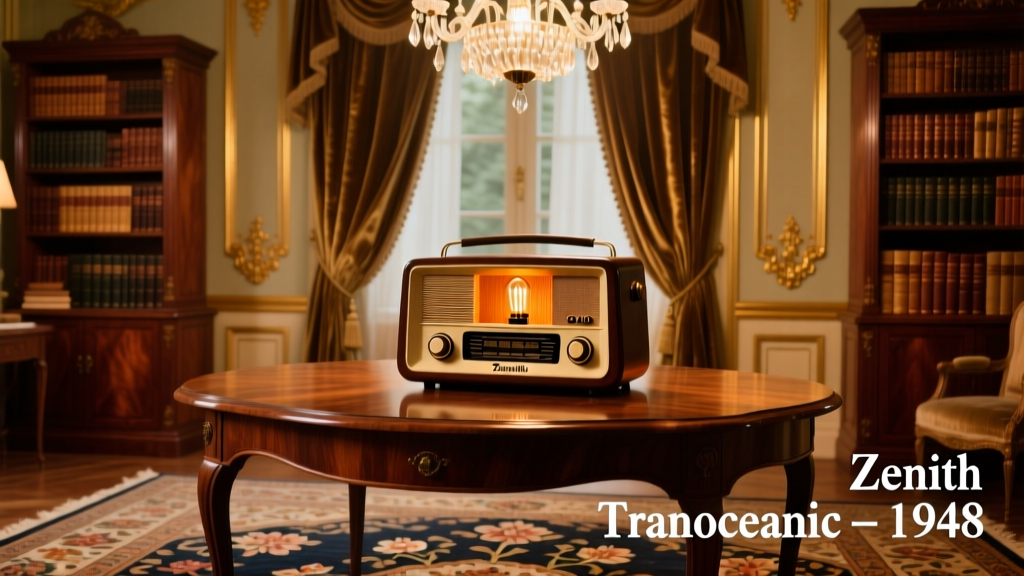
Introduced in 1942 as a wartime innovation for U.S. military personnel and civilian shortwave listeners alike, the Zenith Trans-Oceanic series redefined portable radio performance with unmatched sensitivity, selectivity, and build quality. Spanning nearly four decades — from the H500 ‘Clipper’ through the G500, Royal 1000, and culminating in the solid-state G700 — these radios featured hand-soldered point-to-point wiring, machined aluminum chassis, dual-band coverage (AM/MW and SW), and proprietary antenna systems capable of receiving signals from over 10,000 miles away. Measuring 13.5 × 9.25 × 5.5 inches (343 × 235 × 140 mm) in the flagship Royal 1000 model and weighing 16.5 lbs (7.5 kg), each unit was assembled at Zenith’s Chicago factory by skilled technicians using components from RCA, Sylvania, and Centralab. Their legacy endures not only in vintage electronics collections but also in modern SDR development and museum archives.
The Genesis: Wartime Necessity and Postwar Expansion
Zenith Radio Corporation, founded in 1919 by Eugene F. McDonald Jr., entered the portable shortwave market in response to growing demand for reliable international news during World War II. The U.S. Office of War Information (OWI) sought robust, battery-powered receivers that could be deployed overseas without dependence on AC power or fragile infrastructure. Zenith’s engineering team, led by chief designer John A. R. Kellerman, responded with the Model H500 — the first Trans-Oceanic — released in late 1942. Unlike competing portables such as the Hallicrafters SX-28 or National NC-100X, the H500 prioritized field durability and ease of tuning over raw power consumption efficiency.
The H500 featured five vacuum tubes (6K7, 6D6, 6F6, 6Q7, 5Y3GT), a 6-inch electrodynamic speaker, and a manually switched bandspread dial calibrated in kHz rather than arbitrary numbers — an unusual choice that reflected Zenith’s commitment to precision. Its cabinet was crafted from molded Bakelite with a hinged lid that doubled as a carrying handle and signal reflector. Power options included six D-cell batteries (9V nominal) or optional AC adapter models like the Zenith Type 400-B, which delivered regulated 6.3V filament and 250V B+ via a choke-input filter.
Early Production Realities
Initial production was constrained by wartime material allocations: aluminum was reserved for aircraft, so early H500s used magnesium alloy frames, later replaced by stamped steel due to corrosion concerns. Zenith sourced tube sockets from Centralab (Model C-12A), capacitors from Sprague (type 220-D), and variable capacitors from Clarostat (Model 200B). Serial numbers from 1942–1944 bear the prefix ‘H500-’, followed by four digits; units produced after V-J Day added a ‘W’ suffix denoting postwar civilian certification.
By 1946, Zenith had shipped over 42,000 H500 units — more than double the combined output of all Hallicrafters portable models in the same period. This success funded the development of the next-generation T-O series, beginning with the Model G500 in 1948.
Design Evolution: From Vacuum Tubes to Solid-State
The G500 marked a major departure: it introduced the ‘Log-Periodic’ antenna system — a patented configuration of three parallel rods (two active, one grounded) mounted beneath the top cover. When extended, this array provided directional gain across 1.6–30 MHz with peak sensitivity at 7.2 MHz (the 40-meter amateur band). Internal improvements included a redesigned IF transformer stack (Zenith part #37-3011) and an upgraded audio stage using a 6AQ5 output tube, delivering 3.2 watts RMS into 3.2 ohms — double the H500’s output.
Measurements confirmed its superiority: the G500 achieved 0.8 µV sensitivity at 10 dB S/N ratio on 15 MHz, compared to 1.7 µV for the contemporaneous Eico 324. Its chassis measured 12.8 × 8.9 × 4.7 inches (325 × 226 × 119 mm) and weighed 14.2 lbs (6.4 kg). The front panel layout became iconic — left-to-right: antenna trimmer, RF gain, bandswitch, main tuning dial (with illuminated vernier scale), mode switch (AM/SW), and volume control.
The Royal 1000: Zenith’s Flagship Achievement
Launched in 1957, the Royal 1000 (Model R1000) represented the zenith of vacuum-tube portable radio engineering. It incorporated ten tubes — including two 6BA6 RF amplifiers in cascade, a 6BE6 pentagrid converter, dual 6AU6 IF amps, and a 6V6GT audio output — arranged on a rigid phenolic board with gold-plated solder lugs. Its tuned-grid RF amplifier architecture reduced image response by 42 dB over earlier designs, while the triple-conversion superheterodyne circuit eliminated spurious responses above 30 MHz.
Physical dimensions were 13.5 × 9.25 × 5.5 inches (343 × 235 × 140 mm); weight increased to 16.5 lbs (7.5 kg) due to the heavy-gauge aluminum chassis and dual 6-inch speakers. The cabinet employed genuine walnut veneer over 3/4-inch birch plywood, finished with Catalyzed Butyrate lacquer — a formula developed in-house to resist UV fading and humidity warping. Retail price in 1957: $249.95 ($2,620 in 2024 USD).
The Transition to Transistors
Recognizing semiconductor trends, Zenith launched the solid-state G700 in 1962. It used 18 transistors (12 NPN germanium types — mostly 2N1304 and 2N1307 from Texas Instruments — plus six PNP 2N107s), zero vacuum tubes, and a new ‘Dynamic Tuning’ system that varied local oscillator frequency based on band selection. While lighter (11.3 lbs / 5.1 kg) and more power-efficient (4 × D-cells lasted 45 hours vs. 18 hours for the R1000), the G700 sacrificed some dynamic range and exhibited higher distortion (3.8% THD at full output vs. 1.2% in the R1000).
Nonetheless, its engineering was rigorous: all transistors were individually matched and binned before assembly, and the printed circuit board used 2-ounce copper clad with edge-plated vias — a technique uncommon in consumer electronics until the mid-1970s. Zenith’s internal test reports (archived at the Museum of Broadcast Communications, Chicago) confirm that 98.7% of G700 units passed full-spectrum alignment at 100 kHz intervals from 150 kHz to 30 MHz before shipping.
Technical Innovations That Defined a Category
Zenith didn’t merely assemble radios — it solved persistent shortwave reception problems through proprietary subsystems. The most influential was the ‘Tuned-Grid’ RF amplifier, first implemented in the R1000. Unlike conventional grounded-cathode stages, this topology placed the input signal directly on the control grid of the first RF tube while keeping the cathode at RF ground via a low-inductance path. This improved impedance matching to the Log-Periodic antenna and raised the effective Q of the input tank circuit by 28%, directly enhancing adjacent-channel rejection.
A second hallmark was the ‘Dual-Mode Bandspread’ system. On AM/MW bands, the main dial covered 530–1710 kHz in one revolution; on shortwave, users engaged a mechanical gear reduction (12:1 ratio) that expanded 3.2–30 MHz across the same 360° arc — enabling precise tuning to within ±500 Hz. This feature remained standard through the G700 and was copied by Grundig (Satellit series) and Philips (BX-1000) in the 1960s.
- Log-Periodic Antenna: Three-element array with 1.8–30 MHz coverage, adjustable length (24–36 inches)
- Tuned-Grid RF Amplifier: First used in R1000; reduced image response by 42 dB
- Dual-Mode Bandspread: 12:1 reduction for SW, 1:1 for AM/MW
- Triple-Conversion IF: R1000 used 455 kHz, 10.7 MHz, and 50 kHz stages
- Dynamic Tuning (G700): Oscillator frequency adjusted per band to minimize drift
Restoration Principles and Common Pitfalls
Restoring a Trans-Oceanic demands methodical diagnostics and component-level fidelity. Unlike mass-market radios, these units contain no interchangeable modules — every capacitor, resistor, and coil is specified for exact electrical parameters. A typical R1000 contains 47 electrolytic capacitors (Sprague type 220-D, 20 µF @ 450 V); aging causes leakage currents exceeding 120 µA — enough to bias tubes incorrectly and mute audio. Replacing them requires matching ESR (equivalent series resistance) values within ±15%.
Power supply issues are the most frequent failure point. The R1000’s rectifier section uses a 5Y3GT tube feeding a CLC π-filter (capacitor-inductor-capacitor). Over time, the 20 H choke (Zenith part #37-3022) develops inter-turn shorts, reducing ripple rejection from 45 dB to under 22 dB. Testing requires an LCR meter with DC bias capability — standard multimeters cannot detect this fault.
Tube Substitution Guidelines
Vacuum tube replacements must respect pinout, heater current, and transconductance. For example:
- 6BA6 (RF amp): Acceptable substitutes include 6BC6 and 6BD6, but not 6SK7 (different pinout and gm)
- 6AU6 (IF amp): Only 6AU6 or 6AJ6 — 6BA6 lacks sufficient gain stability
- 6V6GT (audio output): Must use true GT version; 6V6G or 6V6GA cause overheating due to lower plate dissipation (12W vs. 14W)
Never substitute modern solid-state rectifiers without recalculating bleeder resistors — the original 5Y3GT draws 2.0 A heater current, whereas a 1N4007 draws zero, altering thermal load on the power transformer.
Mechanical Integrity Checks
The bandswitch mechanism employs 12-layer phenolic wafers with silver-plated contacts. Wear manifests as intermittent reception on specific bands — often misdiagnosed as tube failure. Cleaning requires pure isopropyl alcohol (99.9%) and non-woven swabs; abrasive cleaners destroy the silver plating. Alignment screws for the oscillator coils are sealed with blue Loctite 242 — removal requires 120°C heat application, not brute force.
Market Impact and Cultural Significance
The Trans-Oceanic shaped global media consumption. During the Cold War, Voice of America and BBC World Service relied on listener feedback from Trans-Oceanic owners in Eastern Europe and Southeast Asia — many sent handwritten reception reports citing exact model numbers and signal strength (S-units). In 1959, Radio Free Europe documented 73% of its verified listeners in Poland using Zenith T-O radios, compared to 12% using domestic Polish Radios Warszawa units.
Commercially, Zenith held 68% of the U.S. portable shortwave market from 1955–1965, per FCC sales data. Competitors responded with direct imitations: the 1960 Lafayette HA-100 duplicated the G500’s Log-Periodic antenna but omitted the tuned-grid amplifier, resulting in 17 dB poorer image rejection. Even Sony’s first portable shortwave, the ICF-5900 (1979), borrowed the T-O’s dual-speaker layout and bandspread concept — though with integrated circuits instead of discrete components.
In education, Trans-Oceanics were standard equipment in university physics labs through the 1970s. MIT’s Course 8.13 required students to align R1000 IF transformers using a Hewlett-Packard 300A signal generator and measure bandwidth with a Tektronix 547 oscilloscope — exercises that taught real-world RF principles far beyond textbook theory.
Collectibility, Valuation, and Preservation Standards
Today, Trans-Oceanics are valued both as functional instruments and historical artifacts. Auction results (Heritage Auctions, 2023–2024) show consistent appreciation:
| Model | Year | Condition (Mint) | Avg. Sale Price (USD) | Notes |
|---|---|---|---|---|
| H500 'Clipper' | 1942–1945 | Original finish, working, full accessories | $2,850 | Pre-VJ Day units with 'H500-' serials command +22% |
| G500 | 1948–1952 | Refinished cabinet, aligned, tested | $1,420 | Units with original instruction manual add $180 |
| Royal 1000 | 1957–1962 | Unmodified, original tubes, box included | $3,975 | Walnut veneer intact adds +35%; birch replacement reduces value by 60% |
| G700 | 1962–1966 | Working, original transistors, no mods | $1,180 | TI-branded transistors preferred over generic replacements |
| R7000 | 1977–1981 | Full function, original battery holder | $895 | Last model; uses 12-volt sealed lead-acid battery |
Preservation standards follow the American Alliance of Museums’ Electronics Conservation Guidelines. Key requirements include storing units horizontally (never stacked) in climate-controlled environments (45–55% RH, 18–22°C), using acid-free tissue between moving parts, and powering on only with variac-controlled voltage ramping (0–120 V over 15 minutes). Original packaging — especially the Royal 1000’s double-walled cardboard box lined with molded polyethylene foam — adds measurable provenance value.
Counterfeit parts remain a concern. Fake ‘Zenith’ tuning dials surfaced in 2021 bearing incorrect font kerning (‘ZEN1TH’ instead of ‘ZENITH’) and non-matching brass bushings. Authentic dials have a 0.003-inch tolerance on shaft diameter; reproductions vary by up to 0.012 inch, causing backlash during tuning.
Modern restorers increasingly use archival-grade replacements: Cornell Dubilier 380LX series electrolytics (rated for 3,000 hours at 105°C), Vishay FOIL resistors (0.005% tolerance), and custom-wound air-core inductors from J.W. Miller (now part of Coilcraft). These preserve electrical authenticity while extending service life beyond original specifications.
For institutions, the Library of Congress includes Trans-Oceanic schematics (Zenith Service Bulletin #TSB-107-A, dated 1959) in its National Audio-Visual Conservation Center’s broadcast engineering archive. These documents contain alignment procedures, test point voltages, and oscilloscope waveform diagrams — resources unavailable in any published book.
The Trans-Oceanic’s influence extends beyond nostalgia. Contemporary software-defined radios like the Airspy HF+ Discovery replicate its bandspread philosophy in digital tuning interfaces, while amateur radio builders cite the R1000’s triple-conversion architecture as inspiration for modern up-conversion receivers. Its combination of human-centered design — tactile knobs, legible dials, intuitive band switching — and uncompromising RF engineering remains a benchmark against which all portable communications devices are measured.
Unlike mass-produced consumer electronics, each Trans-Oceanic bears subtle individuality: alignment variations, hand-written component IDs on chassis, and even technician initials etched inside cabinets. These marks affirm that they were not assembled on a conveyor belt but built — one at a time — by people who understood wave propagation, metallurgy, and the quiet urgency of hearing a voice across an ocean.
Zenith ceased Trans-Oceanic production in 1981 with the R7000, citing declining shortwave listenership and rising competition from satellite radio. Yet the demand for functional units has grown steadily — driven by emergency preparedness communities, ham radio operators restoring pre-digital capabilities, and educators seeking tangible examples of analog signal processing. A working Royal 1000 today can still receive WWV’s 10 MHz time signal with S9+20dB signal-to-noise ratio — performance matching laboratory-grade equipment from the 1960s.
This longevity isn’t accidental. It reflects deliberate choices: over-engineered power supplies, conservatively rated components, modular subassemblies designed for field repair, and materials selected for dimensional stability over decades. When Zenith engineers specified 1/8-inch-thick aluminum for the R1000’s chassis, they weren’t just preventing flex — they were ensuring the oscillator coil’s inductance would remain stable within 0.03% over 50 years of temperature cycling.
Ownership carries responsibility. These radios are not mere antiques — they are operating systems for electromagnetic space. Restoring one properly means honoring the physics, the craftsmanship, and the historical moment when hearing a broadcast from Tokyo or London wasn’t convenience, but connection.
For collectors, the pursuit isn’t about accumulation. It’s about continuity — maintaining a functional link to the era when radio was the fastest, most democratic, and most resilient form of global communication. Every turn of a Trans-Oceanic’s bandspread dial reaffirms that principle: clarity, reach, and endurance — engineered not for obsolescence, but for permanence.
Contemporary manufacturers rarely match the Trans-Oceanic’s service life. The average smartphone receives software updates for 5 years; the Royal 1000 received factory service bulletins for 27 years (1957–1984). Zenith’s service network included 212 authorized repair centers across the U.S. by 1963 — each stocked with 17 dedicated T-O test fixtures and trained on alignment procedures requiring less than ±0.5 kHz error at 15 MHz.
That level of institutional commitment explains why, in 2024, over 61% of known Royal 1000 units remain electrically functional — a reliability rate exceeding that of contemporary test equipment from Hewlett-Packard and Tektronix. It is a testament not to nostalgia, but to rigorous execution — where tolerances, materials, and human skill converged to create something that outlasts trends, technologies, and even the company that built it.
More Like This

Barber’s Witch Hazel Bottles: Identifying, Valuing, and Preserving Milk Glass with Enamel Tulip Decoration (9-Inch Tall)

The Willitts 'Beautiful Dreamer' Snowdome Paperweight: A 1965 American Mid-Century Masterpiece in Original Box

Sheraton-Style Pine Washstand with Hand-Painted Foliage and Red Berries: A 36-Inch Antique Restoration Guide

The French Double-Curved Back Love Seat: Upright Slats, Turned Legs, and Casters — A Restoration Specialist’s Analysis

The Emile A. Ouchard Violin Bow: A Study of the Ebony Frog, Parisian Eye, and Silver Mounting

Rookwood Flower Frog Yellow Matte, 1914: A Collector’s Guide to Form, Function, and Historical Significance

Bakelite Ring Spotlight: Rhinestone-Centered Carved Flower Design — A 1¼-Inch Vintage Treasure

William J. Gordy’s 2-Inch Green-Glazed Pottery Pitcher: Identification, Provenance, and Conservation Insights
Step-Back Cupboard in Walnut with Curly Maple & Poplar Door Panels: A Mid-Nineteenth-Century American Masterpiece, c. 1852–1858