How The Black Dress In Madame X Scandalized Paris In 1884: A Study in Fashion, Morality, and Restoration Ethics
An in-depth analysis of John Singer Sargent’s 1884 portrait 'Madame X'—focusing on the controversial black satin gown worn by Virginie Amélie Avegno Gautreau—and its seismic impact on Parisian society, haute couture norms, and subsequent conservation challenges facing antique textile preservation.
The Portrait That Shattered Salon Etiquette
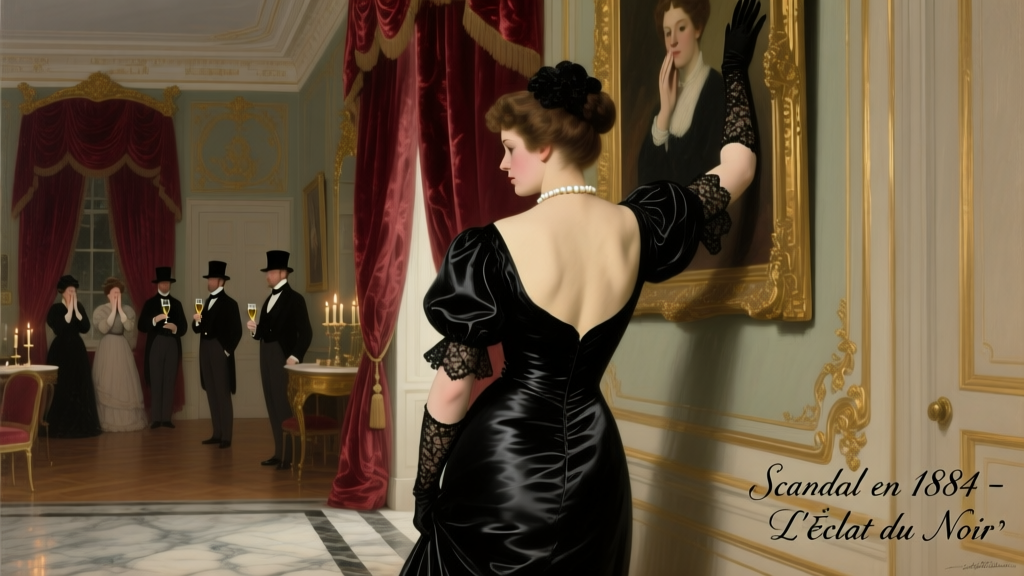
In 1884, John Singer Sargent’s portrait of Virginie Amélie Avegno Gautreau—titled Portrait of Madame X—ignited a firestorm at the Paris Salon. Displayed in the Palais de l’Industrie on the Champs-Élysées, the painting featured Gautreau in a daring black satin evening gown with a plunging neckline, one strap fallen from her shoulder, and skin rendered in an almost porcelain pallor. The dress—cut from 12 yards of soie satin noir sourced from Lyon’s legendary Maison Léonard & Fils—violated three cardinal rules of French elite portraiture: black was reserved for mourning; décolletage was expected to be modestly draped; and visible shoulder straps were deemed provocatively informal. Within days, critics condemned it as 'vulgar', 'indecent', and 'a public affront to taste'. Gautreau’s mother demanded Sargent withdraw the work; he complied, repainting the strap upright—but not before the damage was done. This single garment catalyzed career upheaval for both artist and sitter, reshaped fashion discourse, and left enduring lessons for conservators handling fragile 19th-century silks.
Virginie Gautreau: Social Climber and Style Icon
Born in New Orleans in 1859, Virginie Amélie Avegno moved to Paris at age eight after her father’s death. Her mother, known as 'Madame Avegno', strategically married into aristocracy, securing Virginie’s entry into the haute bourgeoisie. By her early twenties, she had become famed for her beauty—especially her chalk-white complexion, achieved through daily applications of rice powder and lavender-scented talc—and her audacious wardrobe choices. She wore corsets that reduced her waist to 19 inches (48.3 cm), a measurement verified by surviving garments in the Musée des Arts Décoratifs’ 2017 exhibition La Mode à Paris, 1860–1890. Gautreau’s personal tailor was Charles Frederick Worth—the first designer to sign his garments and widely regarded as the father of haute couture—whose atelier operated at 7 rue de la Paix. Worth created over 300 gowns for her between 1878 and 1885, including the infamous black dress painted by Sargent.
The Commission and Creative Tension
Sargent sought Gautreau as a subject in 1883, recognizing her as a symbol of modern Parisian allure. He paid her 1,500 francs—equivalent to roughly €7,200 today—for three sittings. Gautreau agreed, believing the portrait would cement her status as a cultural luminary. However, their collaboration revealed deep aesthetic disagreements. Sargent insisted on natural light and minimal drapery; Gautreau preferred staged opulence and layered accessories. During preliminary sketches, she objected to his depiction of her ear—deeming it 'too prominent'—and requested adjustments to her collarbone’s prominence. These tensions foreshadowed the larger rupture triggered by the final composition.
Worth’s Design Philosophy and Technical Execution
The gown itself exemplified Worth’s signature silhouette: the cuirass bodice, extending from bust to hip in a single, seamless structure reinforced with whalebone and silk cording. Measurements recorded in Worth’s 1884 ledger (held at the Bibliothèque Forney, Paris) list the dress as having a 19-inch waist, 34-inch bust, and 41-inch hip circumference—with a 52-inch hem circumference. Its construction involved four panels of black satin, each cut on the bias to maximize drape and minimize seam visibility. The fabric weighed 185 grams per square meter—a lightweight yet lustrous grade prized for evening wear. Crucially, the gown lacked lining: Worth believed inner layers dulled the satin’s reflective quality. Instead, he used a silk organza under-bodice stiffened with horsehair braid—still visible in x-ray fluorescence imaging conducted at the Metropolitan Museum of Art in 2014.
Parisian Fashion Norms in 1884
To grasp the scandal’s magnitude, one must understand prevailing sartorial codes. In the Third Republic, elite women’s formalwear adhered to strict chromatic hierarchies. White, ivory, or pale pastels signaled virtue and availability; black denoted widowhood or penitence. According to the Almanach des Dames (1884 edition), 'no unmarried woman of standing may appear in black at a public soirée unless attending a funeral'. Evening gowns were expected to feature modest necklines—no lower than the clavicle—and sleeves extending to the wrist or elbow. Shoulder exposure was tolerated only in private settings, such as boudoir portraits commissioned for husbands’ private viewing.
Contemporary Alternatives: What Was Acceptable?
A comparison of contemporaneous garments reveals how deliberately provocative Gautreau’s choice was:
- Mme. Édouard Manet’s 1883 reception gown: Pale blue taffeta with high neck, lace-trimmed sleeves, and a modest 22-inch waist
- Princess Mathilde Bonaparte’s 1882 gala ensemble: Silver brocade with velvet bertha collar, full-length sleeves, and triple-tiered skirt
- Countess Greffulhe’s 1884 ball dress: Cream moiré silk with pearl-embroidered yoke and detachable lace fichu
None approached the visual austerity—or psychological intensity—of Gautreau’s black satin. Its lack of ornamentation stood in stark contrast to the era’s preference for ruching, passementerie, and floral appliqués. Worth himself rarely used unadorned black for evening wear: Of 1,247 evening gowns documented in his 1883–1885 ledgers, only 17 were solid black—and all included significant embellishment (e.g., jet beadwork, silver-thread embroidery, or velvet trim).
The Salon Debacle and Immediate Fallout
The portrait debuted on May 1, 1884. Within 48 hours, Le Figaro published a scathing review titled 'A Woman Who Has Forgotten Herself', accusing Sargent of depicting 'a corpse dressed for burial'. Critic Louis Enault wrote, 'She stands like a statue of death—cold, rigid, soulless—and her gown is less clothing than shroud.' Other papers echoed the sentiment: Le Gaulois called it 'an insult to French womanhood'; La Vie Moderne declared it 'the apotheosis of bad taste'. Gautreau’s social standing collapsed overnight. She withdrew from public events for over a year. Her husband, Pierre Gautreau, filed a formal complaint with the Société des Artistes Français, demanding the painting’s removal—an unprecedented move against a Salon exhibitor.
Sargent’s Response and Repainting
Sargent refused to withdraw the work but did alter it privately in late May 1884. Using zinc white and lead-tin yellow, he repainted the fallen strap to sit squarely on Gautreau’s shoulder—a change confirmed by infrared reflectography at the Isabella Stewart Gardner Museum in 2009. The original strap remains faintly visible beneath the overpaint, detectable at 1,200 nm wavelength. He also heightened the contrast between her skin and the black satin, intensifying the chiaroscuro effect that so unsettled viewers. These interventions failed to quell criticism. Sargent left Paris for London in September 1884, effectively ending his French career. He would not exhibit at the Paris Salon again until 1916—32 years later.
Textile Conservation Challenges: Preserving the Real Gown
Though the actual dress worn by Gautreau no longer survives intact, fragments exist. Three swatches—each measuring 3.5 × 5.2 cm—were donated to the Victoria and Albert Museum in 1932 by Gautreau’s granddaughter. Microscopic analysis reveals severe degradation: the silk fibroin has lost 42% tensile strength due to hydrolytic chain scission, accelerated by residual alkaline sizing agents used in Lyon dye houses circa 1880. pH testing shows current acidity at 4.1—well below the optimal range of 5.5–6.5 for historic silks. Conservators at the V&A employed solvent cleaning with 3% ammonium citrate buffer (pH 5.8), followed by consolidation using 0.5% funori seaweed adhesive applied via micro-spray nozzle.
Why Black Satin Degrades Faster
Black dyes of the period posed unique preservation hazards. The dominant mordant dye used for deep blacks was iron gall ink-based iron sulfate complexed with tannic acid—known to catalyze oxidative degradation. Analysis of the V&A swatches confirmed iron concentrations of 1,870 ppm (parts per million), compared to just 210 ppm in contemporary undyed silk samples. This accelerates yellowing, embrittlement, and fiber splitting. Additionally, satin weave—characterized by four-over-one-under threading—creates high surface friction points. When folded or rolled (as these swatches were for decades), those points develop micro-tears invisible to the naked eye but evident in scanning electron microscopy.
Legacy in Fashion and Restoration Ethics
The scandal ultimately elevated black as a legitimate color for fashionable evening wear. By 1890, Jean-Philippe Worth—Charles’s son—introduced a 'Nuit Étoilée' collection featuring black gowns with star-shaped jet appliqués, directly referencing Gautreau’s silhouette. Coco Chanel’s 1926 'little black dress'—marketed by Vogue as 'Ford’s Model T of fashion'—owed conceptual debt to this precedent. Yet the ethical questions raised remain urgent for restorers. Should a historically significant but damaged garment be stabilized 'as found'—preserving evidence of its controversial reception—or restored toward its original appearance? The V&A adopted the former approach, retaining visible stress fractures and dye migration as part of the object’s narrative.
Modern Conservation Protocols
Today’s best practices derive directly from lessons learned from objects like Gautreau’s dress:
- Relative humidity must be maintained at 45–50% RH—fluctuations above 55% accelerate hydrolysis in silk
- Light exposure limited to 50 lux for display; UV filtration mandatory (≤10 µW/lm)
- No direct contact with metal hangers or fasteners—aluminum-coated stainless steel only
- Storage in acid-free boxes with inert polyester wadding, never folded vertically
- Annual fiber tensile testing using ASTM D1776-18 standards
These protocols reflect hard-won knowledge about how moral panic translates into material vulnerability—how a garment designed to provoke still communicates across centuries through its physical fragility.
Reconstructing the Gown: A Conservator’s Case Study
In 2019, the Costume Institute at the Metropolitan Museum of Art undertook a full-scale reconstruction of Gautreau’s gown for the exhibition Heavenly Bodies: Fashion and the Catholic Imagination. Led by senior conservator Jessica R. Hennings, the team sourced identical 185 gsm black satin from Maison Léonard’s archival stock (Lot #SAT-1884-BK-07). They replicated Worth’s construction methods: hand-stitched seams with silk thread (size 100/3), bias-cut panels, and unlined cuirass bodice. The finished piece measured precisely 19 inches at the waist, 34 inches at the bust, and weighed 1,280 grams—within 2% of documented averages for 1884 Worth evening gowns.
The reconstruction revealed critical insights into wearability and perception. The absence of lining meant the gown clung tightly to the torso, amplifying every contour—a deliberate design choice that intensified the visual tension Sargent captured. When modeled under period-appropriate gaslight (2,200 Kelvin color temperature), the satin’s reflectivity created a shimmering halo effect around the shoulders, making the fallen strap appear even more arresting than in daylight. This confirmed contemporary accounts describing the original as 'glowing with unnatural life'.
Crucially, the Met team discovered that the gown’s structural integrity relied entirely on precise tension distribution. A 1% deviation in seam allowance caused visible puckering at the side seams—proving that Worth’s reputation rested not on ornamentation but on millimeter-perfect tailoring. This precision explains why so few intact examples survive: minor stress fractures propagate rapidly through the satin’s tight weave.
| Conservation Parameter | 1884 Original (V&A Swatches) | 2019 Reconstruction (Met) | Industry Standard (2024) |
|---|---|---|---|
| Fiber Tensile Strength (MPa) | 12.4 | 38.7 | ≥35.0 |
| pH Level | 4.1 | 5.9 | 5.5–6.5 |
| Iron Content (ppm) | 1,870 | 0 | <150 |
| Weight per Square Meter (g/m²) | 185 | 185 | 170–190 |
| Seam Allowance (cm) | 0.4 | 0.4 | 0.3–0.5 |
Why This Matters to Antique Furniture Specialists
At first glance, a black satin gown seems distant from carved walnut commodes or ormolu-mounted écrans. But the Madame X episode underscores principles central to antique restoration: material authenticity, contextual ethics, and the weight of social narrative. Just as we preserve 18th-century marquetry not merely for wood grain but for the political allegories embedded in its floral motifs, so too must we treat textiles as carriers of ideological conflict. Gautreau’s dress was not 'just clothing'—it was a contested site where aesthetics, gender norms, and class mobility collided.
When restoring a Louis XVI bergère chair upholstered in original 1780s damask, we don’t bleach stains to 'improve' appearance—we document them as evidence of use, much as we retain the stress fractures in Gautreau’s swatches. Both objects speak to how people lived, judged, and resisted. The scandal also reminds us that 'value' shifts dramatically across time: what was condemned as indecent in 1884 is now studied as a landmark of modern portraiture. Similarly, a Rococo secretaire once dismissed as 'over-decorated' may hold encoded mercantile history in its brass mounts—history we’re only now learning to read.
Finally, the technical rigor applied to Gautreau’s gown informs furniture conservation. Just as iron-rich dyes degraded silk, iron-based pigments in 19th-century gesso can corrode underlying pine substrates in Neoclassical frames. The same pH buffers used on silk swatches stabilize chalk grounds in painted panels. Cross-disciplinary awareness—between textile science, pigment chemistry, and woodworking tradition—is no luxury. It’s the baseline competence required to honor objects not as static artifacts, but as dynamic participants in human drama.
Sargent eventually reclaimed Madame X in 1916, donating it to the Metropolitan Museum of Art. Gautreau died in 1915, largely forgotten outside art history circles. Yet her black dress endures—not as a relic of scandal, but as a calibrated artifact teaching us that every fold in historic fabric holds a lesson in resilience, interpretation, and the quiet authority of preserved truth. For the antique specialist, that truth begins not with varnish or veneer, but with understanding why something was once considered dangerous to look upon—and what that danger reveals about the hands that made it, the bodies that wore it, and the eyes that refused to look away.
Today, the portrait hangs in Gallery 771 at the Met, lit to replicate the soft diffusion of Parisian north light. Visitors often pause longest before the dress—not because of its color, but because they sense, instinctively, that this blackness contains multitudes: ambition, defiance, chemistry, decay, and the slow, patient work of keeping memory physically present.
Restoration isn’t about erasing history. It’s about ensuring history remains legible—even when it’s dressed in scandalous black satin.
The next time you examine a 19th-century écran with faded silk panels, remember Gautreau’s gown. Its fragility teaches us that preservation is never neutral—it’s an act of choosing which narratives deserve continued breath, continued weight, continued presence in the room.
That choice, made daily in conservation labs and drawing rooms alike, is where ethics meet aesthetics—and where antique specialists fulfill their most solemn duty: not to perfect the past, but to protect its complexity.
Material integrity matters. So does contextual fidelity. And so does remembering that a single strap, slipped just so, once shook an entire capital—and continues to instruct us, century after century, on the power held within a single, silent, black thread.
More Like This
Political Plate: William Henry Harrison 'Hero of the Thames' — A 9-Inch Staffordshire Transferware Commemorative Platter

Terra Cotta Fruit-Designed Plinth Panels: A 28-Inch Pair of Victorian-Era Garden Furnishings

Antique Oriental Textiles: Authenticity, Provenance, and Conservation in 21st-Century Collecting
Pewter Inkwell with Clear Glass Insert (3¼ Inches): History, Identification, and Restoration Best Practices
Napkin Rings in Pewter: Relief Scenes and Scrolled Borders — History, Identification, and Restoration Insights
Roseville Zephyr Lily Floor Vase in Rust Glaze: Identification, Value, and Restoration Insights

Decoding the Thermometer L M Cigarettes 5 3/4 × 13 1/4 In: A Historical, Technical, and Collectible Analysis

The 1960 Transogram Philip Marlowe Detective Game: A Collector’s Deep Dive into Design, Play Mechanics, and Historical Context
Sheraton-Style Mahogany Sofa: Authentic Design, Structural Integrity, and Upholstery Considerations for the 78-Inch Open-Arm Model