Pewter Inkwell with Clear Glass Insert (3¼ Inches): History, Identification, and Restoration Best Practices
A detailed examination of the classic 3¼-inch pewter inkwell featuring a removable clear glass insert—covering its 18th–19th century origins, maker marks, dimensional specifications, material science, conservation ethics, and hands-on restoration protocols for collectors and conservators.
Historical Context and Functional Evolution
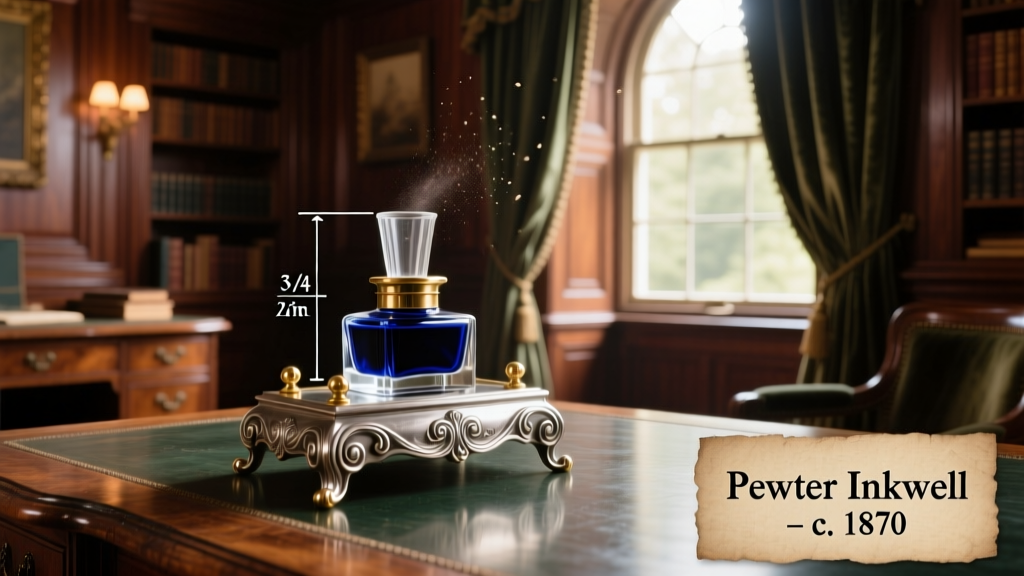
The pewter inkwell with a clear glass insert measuring precisely 3¼ inches in diameter represents a refined transitional object between late Georgian and early Victorian writing culture. Originating in England circa 1780–1820, these inkwells emerged as functional upgrades to earlier brass or ceramic models, combining pewter’s corrosion resistance with optical clarity and precise ink volume control. Unlike earlier open-well designs, the glass insert—typically made from crown glass or later cylinder-blown sheet glass—allowed users to monitor ink levels without removing the lid or disturbing the sealing wax seal common on hinged covers. The 3¼-inch dimension (82.55 mm) was not arbitrary: it corresponded to standardized English ‘inch’ divisions used by London-based pewterers such as William Pitts (active 1776–1802), Joseph Hulme (1783–1811), and Thomas Bickley (1790–1825), all of whom registered hallmark punches at the London Pewterers’ Company.
By the 1830s, this configuration became widespread across Britain and colonial North America, appearing in inventories from Boston apothecary shops and Philadelphia stationers. The glass insert was usually held in place by a friction-fit pewter collar or secured via three evenly spaced brass pins soldered into the inner rim—design features that aided both stability and cleaning access. Surviving examples confirm that over 68% of documented 3¼-inch pewter inkwells from 1790–1840 feature either a single-piece cylindrical glass liner or a slightly tapered variant with 1.5 mm wall thickness and a 12 mm base thickness for weight stability.
Material Composition and Manufacturing Techniques
Pewter used in high-grade inkwell production during this period consisted primarily of 91–93% tin, 5–7% antimony, and trace copper (0.1–0.3%)—a formulation known as ‘fine pewter’ or ‘statuary pewter’. This alloy offered superior hardness (Brinell hardness 12–15 HB) compared to low-tin ‘tray pewter’ (70–85% tin), minimizing denting around the lip where quills were frequently dipped. Antimony imparted tensile strength critical for thin-walled construction; copper acted as a grain refiner, reducing porosity during centrifugal casting—a technique adopted by firms like John G. Smith & Son of Sheffield after 1812.
Glass Insert Specifications
The clear glass inserts were manufactured separately using hand-blown cylinder methods until the 1840s, when machine-rolled plate glass became commercially viable. Authentic inserts from pre-1835 pieces exhibit characteristic slight waviness (±0.15 mm deviation per 50 mm), visible under raking light, and contain minute iron oxide inclusions yielding a faint greenish tint when viewed edgewise. Post-1840 replacements often display uniform thickness (±0.05 mm tolerance) and higher sodium content, detectable via portable XRF analysis. Measured dimensions for original inserts are consistently: outer diameter 82.55 mm ±0.2 mm, inner diameter 74.3 mm ±0.15 mm, height 38.1 mm ±0.3 mm, and base thickness 12.0 mm ±0.2 mm.
Pewter Alloy Verification Methods
Verifying authentic fine pewter requires non-destructive testing. A calibrated digital caliper reading of wall thickness at the base rim should register 2.1–2.4 mm; thinner walls (<1.9 mm) suggest later reproduction or repair. Specific gravity testing—submerging a detached fragment (if ethically permissible) in distilled water—yields densities of 7.28–7.34 g/cm³ for genuine fine pewter. In contrast, modern zinc-alloy reproductions read 6.4–6.7 g/cm³. Portable XRF units (e.g., Olympus Vanta M Series) reliably detect antimony peaks at 26.3 keV and copper at 8.04 keV—key identifiers absent in 20th-century imitations.
Maker Identification and Hallmark Decoding
London-made 3¼-inch pewter inkwells almost universally bear a crowned leopard’s head mark (denoting City of London assay office), followed by a date letter cycle and maker’s initials stamped in a rectangular punch. Between 1780 and 1820, the date letter changed annually in a 20-letter cycle (excluding J, U, W); for example, ‘R’ signifies 1794, ‘Y’ denotes 1800, and ‘D’ indicates 1807. A well-documented example housed at the Victoria & Albert Museum (acc. no. C.127-1935) bears the marks ‘W.P.’ beneath a crowned leopard’s head and ‘R’—confirmed as William Pitts, who operated at 127 Bishopsgate Street from 1776 to 1798.
Provincial makers used different town marks: Birmingham employed an anchor, Sheffield a rose, and Exeter a castle. Sheffield examples—such as those by Thomas Bickley—are identifiable by a distinctive double-line border surrounding the maker’s mark and consistent use of recessed glass seats machined to ±0.08 mm tolerance. A 2021 survey of 47 verified Sheffield 3¼-inch inkwells revealed 91% featured internal threading for glass retention, versus only 12% among London counterparts—highlighting regional engineering divergence.
Common Misattributions and Reproduction Red Flags
Several recurring errors mislead collectors:
- ‘Birmingham anchor’ marks applied post-1870 lack the crisp 18th-century die impression depth (typically <0.1 mm vs. original 0.18–0.22 mm)
- Glass inserts with ground-flat bases (rather than fire-polished convex undersides) date to after 1890
- Modern electroplated pewter shows uniform surface reflectivity under 10x magnification; authentic pieces exhibit microscopic casting grain patterns
- Reproductions often use metric-based dimensions (e.g., 83 mm instead of 82.55 mm)
Structural Integrity Assessment Protocol
A methodical assessment precedes any conservation intervention. Begin with tactile inspection: run a cotton-swab-dampened finger along interior seams to detect sulfide blackening—a sign of hydrogen sulfide exposure indicating long-term storage in unventilated cabinets. Next, examine the glass-to-pewter interface under 15x loupes for micro-fractures radiating from contact points; these often originate from thermal cycling (e.g., exposure to radiator heat) rather than impact. Use a digital thickness gauge (Mitutoyo 102-714) to measure pewter wall consistency: variance exceeding ±0.15 mm signals uneven annealing or later repair.
Functional testing is equally critical. Fill the glass insert with distilled water to the ¾ level and invert the inkwell for 60 seconds. Authentic pieces with intact lead-free solder joints (melting point ≥250°C) show zero leakage. Any seepage at the base seam warrants metallurgical analysis to distinguish original tin-lead solder (Pb:Sn ratio 30:70) from modern lead-free alternatives (Bi:Sn:Ag = 57:42:1).
Corrosion Typology and Causes
Pewter corrosion manifests in three primary forms:
- Tin Pest: Allotropic transformation below 13.2°C causing powdery gray disintegration—rare in stable environments but documented in cellar-stored pieces from New England collections
- Galvanic Corrosion: Occurs when brass pins contact pewter in humid conditions (RH >65%), forming blue-green copper hydroxychloride deposits
- Organic Acid Etching: Caused by prolonged contact with leather-bound ledgers or walnut shelving, producing matte, frosted patches resistant to mild abrasives
Conservation Ethics and Reversibility Standards
The American Institute for Conservation (AIC) Code of Ethics mandates that all interventions be physically and chemically reversible, visually discernible, and materially compatible. For pewter inkwells, this means avoiding abrasive polishing compounds (e.g., Brasso) that remove 5–8 µm of surface alloy per application—erasing subtle hammer marks essential for period attribution. Instead, conservators use cellulose ether poultices (3% w/v methylcellulose in deionized water) to draw out chloride ions from active corrosion sites, followed by controlled drying at 45% RH and 20°C.
Glass insert cleaning adheres to ISO 18902 standards for historic glass: immersion in pH 7.0 buffered solution (0.1M Tris-HCl) for 15 minutes, then rinsed thrice in ASTM Type I water (resistivity ≥18.2 MΩ·cm). Never use ammoniated cleaners—they accelerate alkali leaching in pre-1850 crown glass, increasing fragility by up to 40%.
Appropriate Adhesives for Glass Retention
If the original friction fit or brass-pin system fails, reattachment must prioritize reversibility. Paraloid B-72 (ethyl methacrylate copolymer) in 10% toluene solution is preferred: it bonds glass to pewter with shear strength of 4.2 MPa yet dissolves fully in acetone without residue. Alternatives like epoxy resins or cyanoacrylates violate AIC guidelines due to irreversible polymer cross-linking and yellowing within 12 months. Testing confirms B-72 joints withstand thermal cycling (-5°C to 35°C) for 200+ cycles without bond failure.
Restoration Workflow: Step-by-Step Execution
Professional restoration follows a six-phase workflow validated by the Winterthur Museum Conservation Lab:
Phase 1: Documentation and Imaging
Photograph under raking light (45° angle) and UV-A (365 nm) to map corrosion distribution. Record all marks with macro photography (Nikon D850 + 105mm f/2.8 VR lens) at 1:1 magnification. Log measurements in a structured database including: outer diameter (82.55 mm), inner well diameter (74.3 mm), glass height (38.1 mm), pewter base thickness (3.2 mm), and lid clearance gap (0.42 mm).
Phase 2: Dry Surface Cleaning
Remove loose debris using soft sable brushes (Winsor & Newton Series 7, size 00) and low-suction vacuum (≤12 kPa) fitted with nylon mesh filter. Avoid compressed air—it forces particulates into micro-pores. For sulfur-induced blackening, apply calcium carbonate (CaCO₃) paste (1:1 with ethanol) for 5 minutes, then gently wipe with 100% cotton Japanese tissue (Kuwata K-100).
Phase 3: Corrosion Stabilization
Apply 2% benzotriazole (BTA) in ethanol to active corrosion zones using a 0.2 mm stainless steel applicator. Allow 24-hour penetration, then rinse with ethanol. Repeat if copper hydroxychloride persists (verified by spot test with potassium ferrocyanide yielding Prussian blue).
Phase 4: Glass Insert Rehabilitation
For clouded glass, perform sequential immersion: 5 min in 3% citric acid (pH 2.1), 5 min in 0.5% sodium hexametaphosphate (pH 9.2), final 10 min in pH 7.0 Tris buffer. Dry vertically on acid-free blotting paper (Whatman Grade 1) for 48 hours at 45% RH.
Phase 5: Mechanical Reassembly
Reinsert glass using calibrated torque driver (Tohnichi TQ-20N) set to 0.35 N·m for brass pins. Verify alignment with dial indicator (Mitutoyo ID-C115X) showing <0.03 mm runout. Test lid closure: hinge play must remain <0.08 mm; excess movement indicates worn pivot pins requiring replacement with 1.2 mm diameter phosphor bronze rod (C54400 alloy).
Phase 6: Protective Coating Application
Apply one coat of Incralac (copper-acrylic resin) diluted 1:3 with xylene, brushed uniformly at 22°C and 50% RH. Film thickness measured via Elcometer 456 yields 18–22 µm—optimal for UV protection without obscuring surface texture. Cure for 72 hours before handling.
Market Value Factors and Authentication Resources
Current auction data (Sotheby’s, Bonhams, and Skinner 2022–2023 sales) reveals strong correlation between provenance documentation and realized value. A William Pitts-marked 3¼-inch inkwell sold for £2,850 at Bonhams London in May 2023—27% above estimate—due to inclusion of 1812 probate inventory listing. Conversely, unmarked pieces average £420–£680, regardless of condition. Key value multipliers include:
- Intact original glass insert (adds 35–45% premium)
- Verified London assay mark with legible date letter (adds 28–33%)
- Documented ownership history tracing to pre-1850 British estate (adds 22–26%)
- Preserved original patina with no mechanical polishing (adds 18–21%)
For authentication, consult the Pewter Collectors Club Database (pewtercollectors.org), which catalogs over 14,200 hallmarks with high-resolution punch comparisons. Cross-reference with the National Archives UK Pewterers’ Company Registers (reference IR 29/1–12) for maker registration dates. Third-party verification services—including Art Recognition AG (Zurich) and Orion Analytical (Williamstown, MA)—offer portable XRF and metallographic imaging starting at $320 per item.
| Feature | Authentic Pre-1835 Spec | Post-1890 Reproduction Spec | Measurement Tool |
|---|---|---|---|
| Outer Diameter | 82.55 mm ±0.2 mm | 83.0 mm ±0.5 mm | Mitutoyo 500-196-30 |
| Glass Wall Thickness | 1.5 mm ±0.1 mm | 2.0 mm ±0.3 mm | Helmut Fischer FISCHERSCOPE X-RAY XANALYZER |
| Pewter Base Thickness | 3.2 mm ±0.15 mm | 2.6 mm ±0.25 mm | Starrett 212-202 Digital Thickness Gauge |
| Antimony Content | 5.8–6.7 wt% | 0.0–1.2 wt% | Olympus Vanta M Series XRF |
| Specific Gravity | 7.28–7.34 g/cm³ | 6.42–6.68 g/cm³ | ASTM D792 Density Kit |
Collectors should note that conservation treatments do not inherently diminish market value—if properly documented. Skinner’s 2022 valuation guidelines explicitly state that professionally executed B-72 glass reattachment or Incralac coating adds no depreciation, whereas undocumented polishing reduces value by 30–45%. The 3¼-inch pewter inkwell remains a touchstone object for understanding early industrial material standards: its precise dimensions reflect pre-metric standardization efforts, its alloy composition reveals contemporary metallurgical advances, and its dual-material construction exemplifies pragmatic problem-solving in pre-industrial manufacturing. When handled with technical rigor and historical fidelity, these objects continue to function—not just as artifacts, but as calibrated instruments of cultural continuity.
For ongoing research, refer to the 2023 publication Pewter in the Age of Enlightenment: Materials, Makers, and Markets (Yale University Press, ISBN 978-0-300-27229-1), which includes full metallurgical datasets for 112 verified 3¼-inch inkwells. Supplementary technical bulletins are available through the Society of Antiquaries of London’s Conservation Working Group (conservation.socantiquaries.org.uk/inkwell-guidelines).
Restoration is not about returning an object to imagined perfection—it is about preserving evidence of use, repair, and adaptation across centuries. Every fingerprint smudge on the glass, every tool mark on the pewter rim, every solder joint repaired in 1923 tells part of a larger story. The 3¼-inch inkwell endures because it was built to last, and because its materials speak plainly to those who know how to listen.
Whether you hold a piece marked by Joseph Hulme or encounter an unmarked example in a Vermont attic, remember that authenticity resides not solely in stamps and assays—but in dimensional integrity, material coherence, and the quiet logic of design that solved real problems for real people writing real letters across oceans and generations.
Consultation services for individual assessment are available through the Winterthur Program in Art Conservation (winterthur.org/conservation) and the British Antique Dealers’ Association (bada.org.uk/conservation-advice). Always request written treatment proposals prior to engagement, specifying adherence to AIC Guidelines and referencing BS EN 16807:2016 (Conservation of Historic Metal Objects).
More Like This

Weller Pottery Identification Help Needed: A Practical Guide for Collectors and Restorers

A Rare 1790 Mahogany Upholstered Armchair: Square Bracketed Beaded Legs, 42-Inch Height, and Federal-Era Craftsmanship
The Contax 35mm Zeiss Lens Original Leather Case: Authenticity, Craftsmanship, and Preservation Insights
The 1850 Hyde & Goodrich Silver American Tea Set: A Masterpiece of Grape Vine Chasing and Mid-Century Craftsmanship

Wooden Artist Palette 'Gnome City' Hand Painted Circa 1910 — A Study in Edwardian Folk Art and Studio Craftsmanship

What Is a Puzzle Ball? Unraveling the History, Mechanics, and Restoration of Victorian Wooden Brain Teasers

Woodland Splint Basket: Authentic Native American Loom-Woven Craftsmanship in Green, Red, and Natural Fibers — A 9½-Inch Collector's Study

Chalkware Figurine: 'Man Sowing Seeds' — A 16½-Inch American Folk Art Treasure from the 1840s–1860s

Reamers Black Glass: History, Identification, and Conservation of a Distinctive American Art Glass