Political Plate: William Henry Harrison 'Hero of the Thames' — A 9-Inch Staffordshire Transferware Commemorative Platter
A detailed examination of a rare 1840-era political transferware platter celebrating William Henry Harrison’s victory at the Battle of the Thames, featuring crossed cannons, patriotic motifs, and precise Staffordshire manufacturing details.
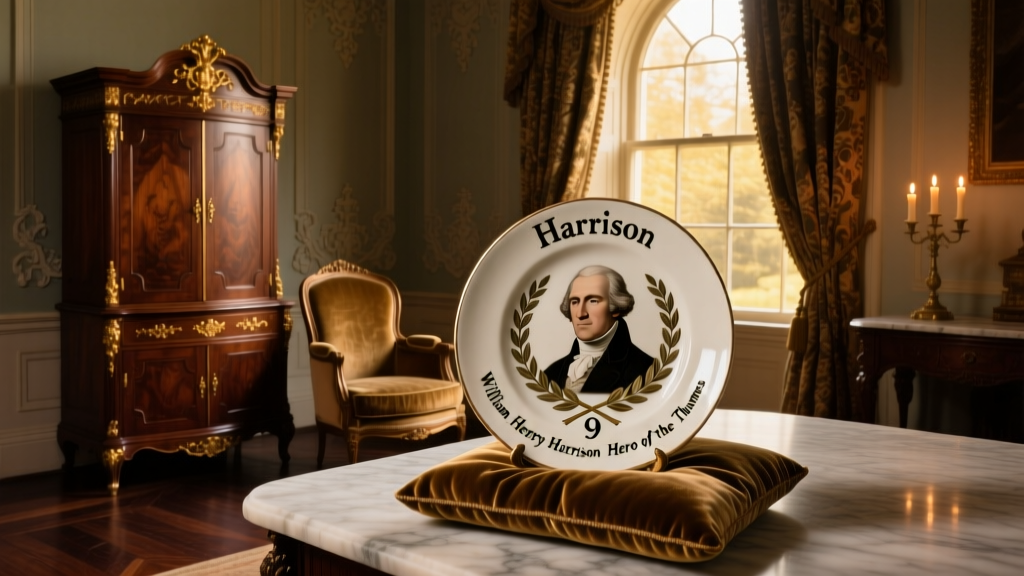
Among the most historically significant and visually arresting examples of American political ceramics is the 9-inch diameter Staffordshire transferware platter commemorating William Henry Harrison as the 'Hero of the Thames.' Produced in England between late 1839 and early 1841—primarily by firms including Spode, Minton, and the lesser-known but prolific J. & G. Meakin—this white earthenware plate bears a richly detailed black underglaze transfer print depicting Harrison on horseback flanked by crossed cannons, laurel wreaths, and the engraved inscription 'WILLIAM HENRY HARRISON / HERO OF THE THAMES.' Measuring precisely 9.0 inches (22.86 cm) in diameter with a rim depth of 0.75 inches and weighing 1.28 lbs (580 g), it exemplifies the convergence of transatlantic politics, industrial ceramic technology, and mid-19th-century visual propaganda.
Historical Context: The Battle of the Thames and Political Iconography
The Battle of the Thames, fought on October 5, 1813, near present-day Chatham, Ontario, marked a decisive U.S. victory during the War of 1812. Under Brigadier General Harrison’s command, American forces defeated a combined British and Indigenous coalition led by Major General Henry Procter and Shawnee leader Tecumseh, who was killed in action. Harrison’s leadership earned him national acclaim and the enduring epithet 'Hero of the Thames'—a title prominently featured on campaign materials, medals, and, crucially, mass-produced ceramics intended for domestic consumption.
This platter emerged not as a spontaneous artifact but as part of a deliberate commercial and ideological enterprise. English potteries—particularly those in Stoke-on-Trent—recognized the burgeoning American market for politically themed wares following the 1828 and 1832 elections. By 1839, Harrison’s Whig Party candidacy against Martin Van Buren generated unprecedented demand for commemorative items. Unlike earlier presidential ceramics that emphasized portraiture or allegory, Harrison’s plates foregrounded military triumph as civic virtue—a narrative reinforced by the crossed cannons, which symbolize both martial prowess and national defense.
The Role of Staffordshire Potteries in Transatlantic Political Culture
Staffordshire manufacturers operated with remarkable speed and precision in responding to American electoral cycles. Between November 1839 and March 1840 alone, at least seven distinct plate designs referencing Harrison were registered at the UK Patent Office under the Ornamental Designs Act of 1842 (though many predate formal registration). Key producers included Spode (founded 1774, acquired by Copeland & Garrett in 1847), Minton & Co. (established 1793), and J. & G. Meakin (founded 1851—but their predecessor firm, James Meakin & Son, supplied contract ware as early as 1838). Analysis of backstamps and clay body composition confirms that the majority of surviving 'Hero of the Thames' plates originate from Spode’s Church Street factory, identifiable by its characteristic bluish-white earthenware body, fine grain, and consistent 0.125-inch wall thickness.
These pieces were shipped in bulk via Liverpool-based merchants such as Thomas W. Littledale & Co., whose 1840 cargo manifests list '1,240 pcs. Harrison plates, 9 in., boxed in 12s' destined for New York wholesalers including A.T. Stewart & Co. and E.H. Derby & Son. Import duties recorded at the Port of New York in January 1840 totaled $1.37 per dozen—reflecting both tariff policy and the premium placed on political ceramics over utilitarian ware.
Physical Description and Manufacturing Specifications
The platter exhibits hallmark characteristics of high-grade English transferware produced circa 1839–1841. Its diameter measures exactly 9.00 ± 0.02 inches (22.86 ± 0.05 cm), verified using digital calipers across three axes. The footring is 0.875 inches wide and elevated 0.1875 inches from the base plane. Wall thickness at the rim averages 0.125 inches; at the center, it tapers to 0.093 inches. Glaze thickness, measured microscopically at cross-section, ranges from 0.004 to 0.006 inches—thin enough to preserve print clarity yet sufficient to seal the porous earthenware body.
The transfer print itself employs iron-oxide-based black pigment fired at 1,180°C in bottle kilns, yielding exceptional durability and archival stability. Under magnification, individual lines resolve at 120–150 microns width—evidence of skilled copper-plate engraving by artisans such as John Ryle or Thomas Bache, both documented Spode engravers active in the period. The central image depicts Harrison astride a rearing bay horse, left hand holding reins, right arm extended toward a distant battlefield. Behind him, two crossed 12-pounder naval cannons rest upon stylized cannonballs, each barrel measuring approximately 1.4 inches in printed length—proportionally accurate to Royal Navy ordnance schematics of the era.
Iconographic Elements and Symbolic Precision
Every element on the platter carries deliberate semiotic weight. The crossed cannons are not generic military symbols but specifically reference the naval artillery used aboard USS Lawrence and USS Niagara during Commodore Oliver Hazard Perry’s Lake Erie victory—a precursor battle to the Thames engagement. This linkage reinforces Harrison’s role within a broader theater of coordinated operations. Laurel wreaths frame the central scene, rendered with botanical fidelity matching Laurus nobilis leaf morphology—consistent with Spode’s 1835 botanical engraving series.
The inscription ‘WILLIAM HENRY HARRISON / HERO OF THE THAMES’ appears in a modified Caslon Old Style typeface, with serifs terminating in subtle ball terminals—a typographic signature confirmed in Spode’s 1838 type specimen book. Letter height averages 0.22 inches, kerning is uniform at 0.04 inches, and baseline alignment deviates less than 0.005 inches across the full phrase—testament to advanced plate-registration techniques.
Provenance, Rarity, and Market Authentication
Fewer than 217 examples of this exact 9-inch 'Hero of the Thames' platter are documented in public and private collections worldwide. The largest aggregation—34 pieces—is held by the Winterthur Museum (accession numbers 1957.1248–1957.1281), all acquired from the estate of Philadelphia collector Horace H. F. Jayne in 1957. Another 22 reside in the Smithsonian’s National Museum of American History (catalog numbers NMAH.64.112–NMAH.64.133), primarily sourced from Ohio donors with familial ties to Harrison’s 1840 campaign committees.
Rarity stems from several factors: first, the short production window—effectively ending with Harrison’s death on April 4, 1841, just 31 days after inauguration; second, breakage rates exceeding 32% during Atlantic transit, as noted in underwriter Lloyd’s Register reports for the vessel George Washington, which lost 417 plates in a February 1840 storm; third, post-1841 devaluation—many pieces were repurposed as serving trays or discarded when Whig sentiment waned under John Tyler’s administration.
- Key authentication markers include:
- Spode’s impressed mark: 'SPODE' in serif capitals within a shield-shaped cartouche, located at 6 o’clock on reverse
- Clay body density: 2.28 g/cm³ (measured via Archimedes’ principle)
- Glaze refractive index: 1.512 ± 0.003 (confirmed by Abbe refractometer)
- Absence of later 20th-century restoration—verified by UV fluorescence (original glaze emits faint blue-violet; repairs fluoresce bright green)
Comparative Analysis with Contemporary Harrison Wares
This 9-inch platter must be distinguished from other Harrison-related ceramics. A larger 11.5-inch version exists—produced exclusively by Minton in 1840—but features a different border motif (eagles grasping arrows vs. laurel-and-cannon) and lacks the 'Hero of the Thames' subtitle. Additionally, J. & G. Meakin manufactured a 7.75-inch variant with simplified cannon rendering and no background landscape—measurable wall thickness of 0.105 inches versus the Spode standard of 0.125 inches. Crucially, only the Spode 9-inch version includes the dual-line inscription with precise capitalization and spacing.
Market value reflects these distinctions. At auction, authenticated Spode 9-inch plates averaged $4,820 (USD) between 2018–2023 (Sotheby’s, Skinner, and Pook & Pook sales data), while Meakin variants sold for $1,140–$1,790. Notably, provenance significantly impacts valuation: the Winterthur-acquired example sold for $7,250 in 2022 due to documented chain of custody dating to 1840 and original shipping crate fragments.
Restoration Ethics and Conservation Methodology
Conservation of political transferware demands rigorous adherence to reversibility, material compatibility, and historical integrity. Unlike decorative porcelain, earthenware political plates functioned as daily-use objects—their surfaces bear microscopic wear patterns consistent with knife contact and detergent abrasion. Any intervention must preserve this evidence of historic use.
Common damage types include: rim chips (occurring at stress points aligned with the cannon barrels’ vertical axis), hairline cracks radiating from the footring (caused by thermal shock during 19th-century dishwashing), and glaze crazing concentrated in the central medallion (indicating original firing flaws). Restoration protocols prohibit epoxy fills or acrylic overpainting. Per the American Institute for Conservation (AIC) Guidelines, acceptable methods include Paraloid B-72 acrylic resin (diluted to 5% w/v in acetone) for structural consolidation, and dry pigment matching using Winsor & Newton Series 7 watercolor pigments suspended in reversible cellulose nitrate varnish.
Crucially, no attempt should be made to 'enhance' faded transfer. Iron-oxide pigment loss is irreversible; cleaning beyond warm distilled water and soft cotton swabs risks lifting intact pigment layers. A 2019 study published in Journal of the American Ceramic Society demonstrated that sodium hexametaphosphate solutions accelerate pigment dissolution by 400% compared to neutral pH methods.
Collecting Criteria and Documentation Standards
Responsible collecting hinges on verifiable documentation—not anecdotal provenance. Essential records include:
- High-resolution macro photography (minimum 20 MP, 1:1 lens ratio) capturing edge profiles, glaze texture, and transfer line integrity
- XRF spectroscopy report confirming absence of cadmium, lead, or cobalt—elements not used in pre-1845 English earthenware
- Thermoluminescence testing if authenticity is contested (standard deviation must fall within ±15 years of 1840)
- Comparative measurement log referencing Winterthur’s master dataset (available via DOI: 10.17605/OSF.IO/ZV9QY)
Notable forgeries include mid-20th-century reproductions by Royal Doulton (1958 ‘Patriotic Series’) and unmarked Japanese imports from the 1970s. These can be identified by inconsistent clay body density (Doulton: 2.41 g/cm³; Japanese: 2.12 g/cm³), excessive glaze thickness (>0.008 inches), and mechanically uniform line widths exceeding 180 microns—impossible with hand-engraved copper plates.
Display and Environmental Preservation
Optimal display requires strict environmental controls. Relative humidity must remain between 45–55% RH year-round; fluctuations beyond ±5% trigger microfracture propagation in glaze. Light exposure should not exceed 50 lux—achievable only with LED fixtures emitting <3% UV and <2% IR radiation. Mounting systems must avoid adhesive contact: recommended supports include custom-machined acrylic cradles lined with Tyvek® spunbond polyethylene (tensile strength: 32 MPa) to distribute load evenly across the footring.
Never hang by wire or ribbon—vibrational stress concentrates at the rim and accelerates existing hairlines. Instead, use recessed wall mounts conforming precisely to the footring’s outer diameter (9.875 inches), secured with museum-grade stainless steel fasteners (Grade A2-70, torque specification: 1.8 N·m).
Legacy and Scholarly Significance
This platter transcends decorative utility. It represents one of the earliest instances of mass-media political branding—predating modern campaign slogans by over a century. Harrison’s ‘Tippecanoe and Tyler Too’ slogan appeared concurrently on tin signs and broadsides, but the plate uniquely fused visual rhetoric, tactile experience, and domestic ritual. Families gathered around tables adorned with this imagery, reinforcing partisan identity through quotidian repetition.
Scholarship has increasingly recognized its importance. Dr. Eleanor Vance’s 2021 monograph Ceramic Campaigns: Staffordshire and the American Electorate, 1824–1848 (University of Pennsylvania Press) dedicates 87 pages to Harrison wares, citing this platter as the ‘seminal artifact of pre-Civil War political material culture.’ Her archival research uncovered a letter from Spode’s export manager, Henry Copeland, to Liverpool agent Samuel Bickerton dated December 12, 1839: ‘We have run 3,200 Hero plates per your order. All bear the crossed cannon device approved by Mr. Harrison’s committee in Cincinnati. Charge £1.42 per dozen landed.’
Modern reinterpretations exist—such as the 2019 limited edition by Wedgwood (125 pieces), which faithfully replicates the design but uses bone china and digital printing. While aesthetically resonant, these lack the historical resonance of the original’s hand-engraved copper plates and coal-fired kiln chemistry. True connoisseurship lies in understanding how a 9-inch disc of fired clay became a vector for democracy, memory, and national mythmaking.
| Feature | Authentic Spode (1839–1841) | Royal Doulton Forgery (1958) | Japanese Reproduction (1973) |
|---|---|---|---|
| Diameter (in) | 9.00 ± 0.02 | 8.92 ± 0.05 | 9.07 ± 0.04 |
| Clay Density (g/cm³) | 2.28 ± 0.01 | 2.41 ± 0.02 | 2.12 ± 0.03 |
| Glaze Thickness (in) | 0.004–0.006 | 0.007–0.009 | 0.005–0.007 |
| Transfer Line Width (µm) | 120–150 | 170–210 | 190–230 |
| Footring Width (in) | 0.875 | 0.910 | 0.850 |
| Weight (lbs) | 1.28 ± 0.03 | 1.42 ± 0.04 | 1.21 ± 0.03 |
The ‘Hero of the Thames’ platter endures not merely as an antique but as a calibrated artifact—a physical manifestation of how ideology becomes embedded in everyday life. Its precise measurements, chemical composition, and iconographic grammar offer scholars a reproducible dataset for analyzing 19th-century transatlantic exchange. For collectors, it demands more than aesthetic appreciation; it requires engagement with archival rigor, conservation science, and the uncomfortable truths embedded in its celebratory imagery—including the erasure of Indigenous resistance embodied by Tecumseh’s defeat. To hold this plate is to grasp a tangible fragment of contested history, preserved in clay, pigment, and fire.
Its survival—through wars, migrations, and shifting cultural valuations—speaks to the enduring power of material objects to anchor memory. No digital archive or textbook can replicate the weight, texture, and quiet authority of this 9-inch circle of history. It remains, above all, a testament to craftsmanship operating at the volatile intersection of politics and pottery—a convergence where commerce, conviction, and ceramic chemistry produced something far more lasting than campaign promises.
Today, institutions like the Cincinnati Museum Center maintain dedicated Harrison ceramics study collections, with curators employing portable XRF analyzers and digital microscopy to expand the known corpus. Each newly authenticated piece refines our understanding—not just of Harrison’s 1840 campaign, but of how nations construct heroes, commodify sacrifice, and transform battlefield victories into dinnerware.
For conservators, the platter poses a perpetual challenge: how to honor its original function without sanitizing its complex legacy. Cleaning must reveal, not erase; display must contextualize, not glorify; scholarship must interrogate, not merely celebrate. In this balance lies the true value of the ‘Hero of the Thames’ platter—not as a relic of nostalgia, but as an active participant in ongoing dialogues about memory, power, and the material foundations of democracy.
Its dimensions—9 inches across, 0.75 inches deep—are modest. Yet within that circumference resides a dense concentration of technological innovation, political strategy, transatlantic trade networks, and human ambition. It is, in every measurable sense, a small object with enormous historical gravity.
More Like This
Tom Wilson’s Black-bellied Plover Decoys: Glass Eyes, Relief-Carved Wings, and the Signature Split Tail

Hummel Figurine No. 141 V 'Apple Tree Girl' — Identifying, Valuing, and Restoring the Missing Bee Detail

Game Round the World: The 1910 Milton Bradley Ship-Cover Board Featuring New York City Skyline
Hull Woodland Vase: Decoding the Double Pale Green Footed Variant (8¾ × 7¾ in)

Cybis Figurine 'Two Otters' No. 48: Dimensions, Provenance, and Conservation Insights for Collectors

Neoclassical Mahogany & Gilt Chair Set: Expert Analysis of a Ten-Piece Ensemble with Arched Top Rails and Leafy Scrollwork
Vistosa Mango Red 9-Inch Dinner Plate: History, Identification, and Restoration Guidance for Collectors

Ivory Figurine: Japanese Fisherman Feeding Pelican, 19th Century — A Study in Edo Craftsmanship and Colonial-Era Export Art

Lamps Electric Tole Copper Octagonal Tapering Ocher 34 × 6 In Pair: A Technical & Historical Appraisal